Psychological mistakes in trading are recurring decision-process distortions where emotional pressure, cognitive bias, or attachment changes the standard a trader uses to make decisions. They are not only emotions. They become trading problems when they alter selection, timing, sizing judgment, patience, review behavior, or respect for a predefined boundary.
In trading psychology, the practical issue is not whether fear, frustration, confidence, or excitement appears. Those states can appear during normal market participation. The risk begins when the trader treats a temporary pressure state as a reason to change the decision rule.
- Psychological mistakes are decision distortions, not just emotions.
- The recurring mechanism is pressure, rule drift, and inconsistent action.
- Common forms include overtrading, revenge trading, FOMO, fear, overconfidence, confirmation bias, emotional attachment, and ignored risk boundaries.
- Process boundaries can reduce drift, but they do not guarantee better market outcomes.
What Psychological Mistakes in Trading Mean
A psychological mistake in trading happens when a trader stops applying the original decision standard and starts reacting from pressure, bias, attachment, or recent outcome emotion.
The mistake is not simply feeling fear or confidence. The mistake is letting that state change the rule being used. A planned decision might require clear criteria, but pressure can make the trader accept weaker evidence, ignore a boundary, keep checking only confirming information, or change behavior after one recent loss or win.
That is why psychological mistakes are best understood as process errors. They sit between market information and trader action. The chart, setup, or market condition may be unchanged, but the trader’s interpretation standard becomes less stable.
Why Pressure Changes Trading Decisions
Pressure affects trading decisions because markets create incomplete information, uncertain outcomes, and fast feedback. When a trader wants relief, confirmation, recovery, or control, the decision process can shift from planned criteria to emotional justification.
A clear plan might define what evidence is required before action. Under pressure, the trader may lower that standard. A move that would normally be considered unclear can start to feel urgent. A loss can make immediate recovery feel more important than process consistency. A recent win can make weak conditions feel acceptable because confidence is temporarily high.
The recurring pattern is pressure -> rule drift -> inconsistent action. The specific emotion may change, but the process risk is the same: the trader stops using the same standard across similar decisions.
This creates a narrow but important distinction. Emotional control is not the whole topic here. The central issue is whether the trader’s decision standard remains stable when pressure appears.
Common Psychological Mistakes in Trading
The most common psychological mistakes in trading usually come from the same mechanism: a pressure state changes how evidence, risk, or uncertainty is treated.
| Mistake | How it distorts the decision | Safer process boundary |
|---|---|---|
| Overtrading | Activity starts to replace selectivity, especially when boredom, frustration, or urgency increases. | Separate valid conditions from the desire to be active. |
| Revenge trading | A recent loss creates pressure to recover quickly, so the next decision is judged by emotional relief rather than criteria. | Use a pause rule before reassessing any new decision after a loss. |
| FOMO and chasing | Fear of missing a move makes speed feel more important than evidence quality. | Require the same planned criteria even when price movement feels urgent. |
| Fear and hesitation | Uncertainty becomes a reason to avoid a decision even when the plan has already defined the conditions. | Check whether hesitation comes from missing criteria or from discomfort with uncertainty. |
| Overconfidence | A recent win or strong opinion makes weak evidence feel stronger than it is. | Review whether the current decision would still qualify without the recent outcome. |
| Confirmation bias | The trader gives more weight to evidence that supports the preferred view and filters out conflicting information. | Actively define what would weaken the idea before judging confirming evidence. |
| Emotional attachment | The trader protects a prior opinion instead of reassessing the current evidence. | Treat the idea as conditional, not as something that must be defended. |
| Ignored risk boundary | The trader recognizes a boundary before pressure appears, then negotiates with it once the decision becomes uncomfortable. | Make the boundary reviewable before the pressure state begins. |
Pressure State, Rule Drift, and Process Boundary
A clean diagnostic sequence starts with the pressure state, then the mistake, then the way the decision standard changed. That keeps the focus on process rather than self-blame.
| Pressure state | Common mistake | Decision distortion | Process boundary | Limitation |
|---|---|---|---|---|
| Recent loss | Revenge trading | The next decision becomes a recovery attempt. | Pause before evaluating any new opportunity. | A pause rule only works if it is respected before urgency takes control. |
| Fast movement | FOMO | Speed replaces evidence quality. | Check planned criteria before acting on urgency. | The market can keep moving without creating a valid decision. |
| Recent win | Overconfidence | Weak evidence feels acceptable because confidence is elevated. | Review the decision as if the previous result did not exist. | Confidence can still feel rational while it is lowering standards. |
| Unclear conditions | Confirmation bias | Conflicting information is ignored or minimized. | Define invalidating or weakening evidence in advance. | A checklist can become decorative if only confirming items are checked. |
| Attachment to an idea | Defending the position or view | The trader protects the idea instead of reassessing it. | Separate the original thesis from current evidence. | Attachment often appears as analysis, not as emotion. |
| Desire for certainty | Hesitation or forced confirmation | The trader either avoids action or searches for certainty that markets do not provide. | Distinguish missing criteria from normal uncertainty. | More analysis does not always reduce uncertainty. |
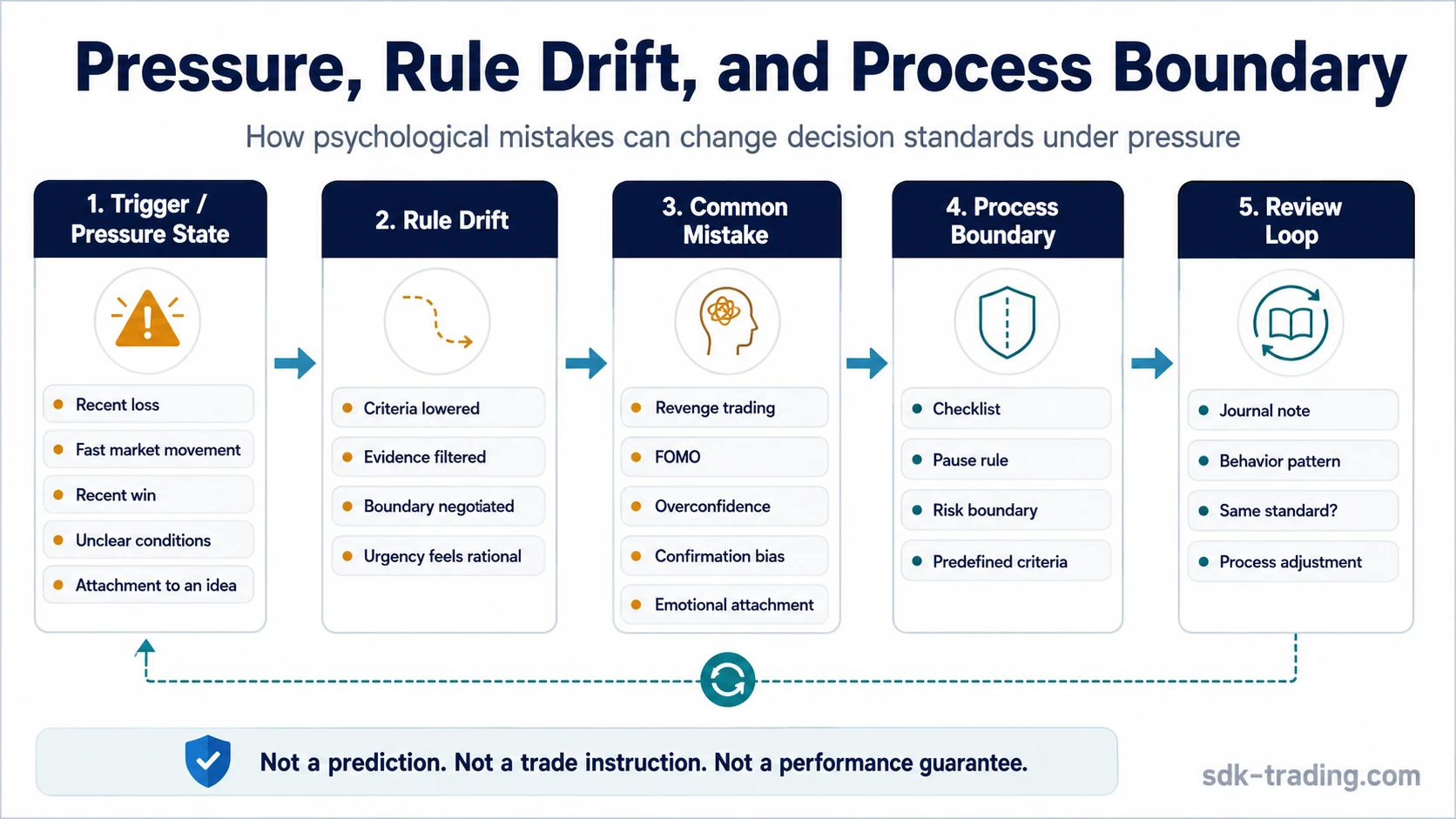
How Process Boundaries Reduce Rule Drift
A process boundary is a predefined rule, checklist, pause, journal prompt, or review condition that keeps a decision from being rewritten under pressure. It does not predict the market. It protects the decision standard from changing without being noticed.
Useful boundaries are usually simple. A trader can define what conditions must be present, what would weaken the decision, what pressure state requires a pause, and what must be recorded for later review. The value is not that the boundary creates certainty. The value is that it makes rule drift visible.
- Checklist boundary: verifies whether the planned criteria are actually present.
- Pause boundary: interrupts decisions made immediately after a strong emotional trigger.
- Journal boundary: records whether the decision followed the plan or changed under pressure.
- Review boundary: separates one emotional decision from a repeated behavioral pattern.
These tools are weaker when they are used only after the decision. They work best as decision boundaries before pressure turns into justification.
A Practical Scenario
A trader has a predefined standard for waiting until conditions are clear. After a loss, a new market move appears quickly. The move feels like a chance to recover, so the trader starts accepting evidence that would normally be considered incomplete. The psychological mistake is not the loss itself or the desire to recover. The mistake is that the recovery pressure changes the standard used to judge the next decision.
A safer review would ask: was the next decision based on the same criteria that existed before the loss, or did the recent outcome change the threshold? That question keeps the focus on process drift rather than on whether the next market move happened to work or fail.
Why Awareness Alone Is Not Enough
Recognizing a psychological mistake does not automatically stop it in real time. Awareness can identify the pattern after the fact, but pressure often appears before the trader has time to think clearly. That is why the process boundary matters.
A journal can show repeated overtrading. A checklist can show that criteria were missing. A pause rule can interrupt urgency. But none of those tools guarantees discipline, consistency, or better outcomes. They only make the behavior easier to observe and review.
Psychological mistakes in trading cannot be removed by naming them once. Fear, confidence, frustration, and attachment can return under pressure. The practical goal is not emotional perfection. The practical goal is a decision process that makes rule drift harder to miss.
The strongest review question is not “Was the outcome good?” A more useful question is “Did the decision follow the same standard that existed before pressure appeared?”
Psychological Mistakes in Trading FAQ
Are psychological mistakes in trading the same as emotions?
No. Emotions can be present without becoming mistakes. The mistake happens when emotion, bias, or attachment changes the decision standard.
Why do traders keep repeating the same psychological mistakes?
Repeated mistakes often come from pressure states that appear before the trader notices rule drift. Without a process boundary, the same emotional trigger can keep changing the decision standard.
Can a trading checklist prevent psychological mistakes?
A checklist can make some rule drift easier to catch, but it cannot guarantee discipline or outcomes. It is most useful when it is applied before pressure turns into justification.