Reading a candlestick chart starts with the candle’s open, high, low and close, but the candle is only the raw record. A safer reading asks five questions in order: what came before it, where the body closed, how the wick tested price, which timeframe created the candle, and whether the next response accepted or rejected the tested area.
The common mistake is reading the shape before the response. A long wick, small body, or strong close can show that pressure changed during one interval, but the safer reading waits to see whether the tested area is accepted, rejected, or quickly erased.
Candlestick Reading Framework
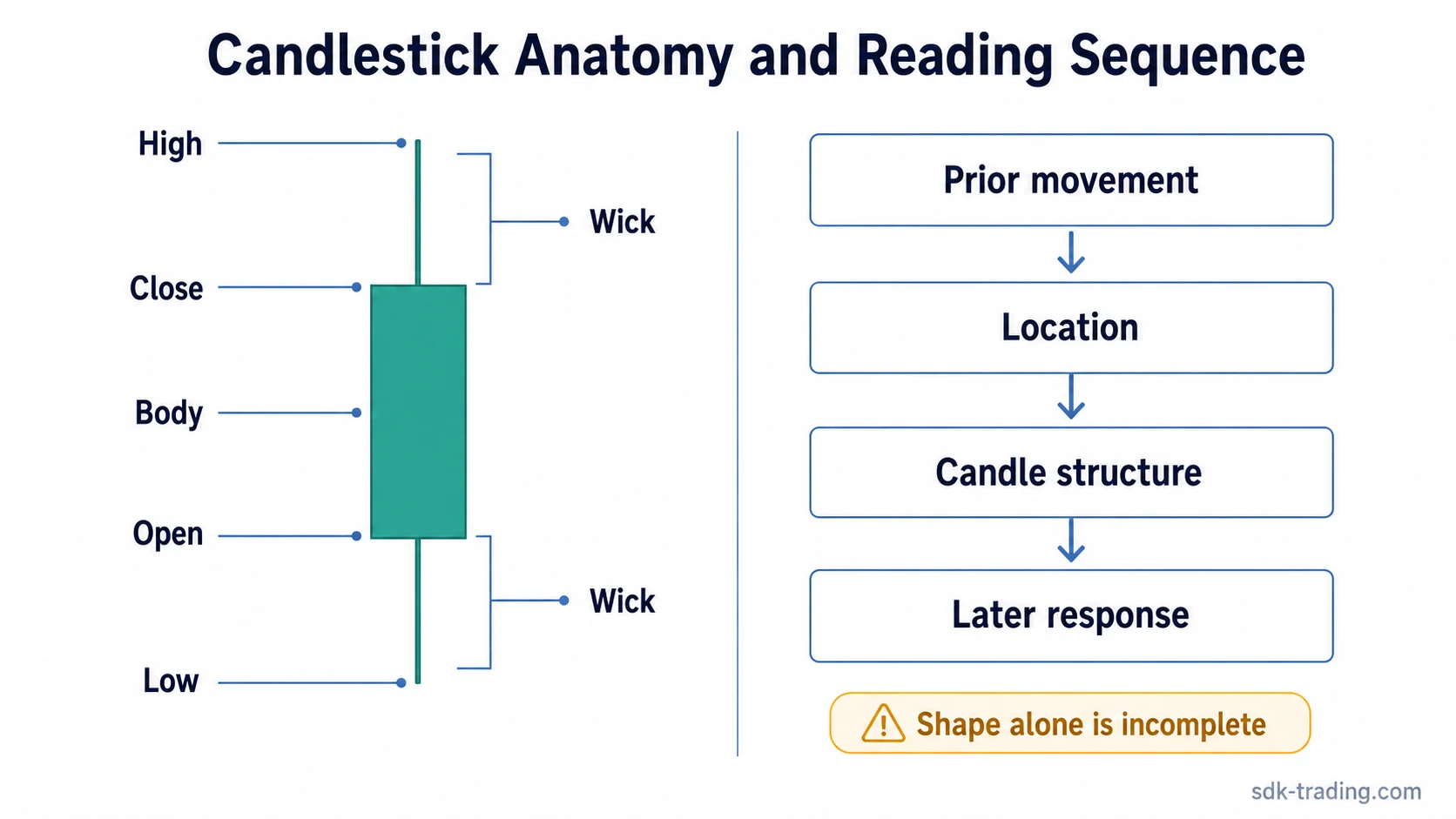
A candlestick chart is read by combining candle anatomy with sequence. Anatomy shows the open, high, low, close, body and wick. Sequence explains where that candle appeared, how it closed, and whether later price behavior respected or erased the initial reading.
| Reading step | Question to ask | What it prevents |
|---|---|---|
| Prior movement | Was price advancing, declining, ranging, compressing or testing an area? | Reading the same candle the same way in every location |
| Candle anatomy | Where are the open, high, low, close, body and wick? | Confusing a visual shape with a complete interpretation |
| Close location | Did the candle close near the high, near the low or near the middle? | Overweighting the wick while ignoring where the period ended |
| Timeframe | What amount of price behavior is compressed into this candle? | Treating a short-term pause like a higher-timeframe shift |
| Later response | Did price accept, reject, overlap or reclaim the tested area? | Calling a candle meaningful before the market has responded |
Candlestick Anatomy in Trading
Each candle compresses one trading period into four prices. The open marks where the period began. The close marks where it ended. The high marks the upper extreme reached during that period, and the low marks the lower extreme.
The body is the distance between the open and close. A large body shows that price travelled meaningfully from the open to the close. A small body shows that the period ended near where it started, which can reflect balance, hesitation, failed progress or simple noise depending on location.
Wicks, also called shadows, show price movement outside the body. A long upper wick means price traded higher but did not hold the upper area by the close. A long lower wick means price traded lower but did not hold the lower area by the close.
| Candle part | What it records | What it does not prove by itself |
|---|---|---|
| Open | The first traded price of the candle period | Who will control the next period |
| Close | The final traded price of the candle period | Whether the move will continue after the candle |
| High | The highest price reached during the period | Whether the upper test was accepted |
| Low | The lowest price reached during the period | Whether the lower test created lasting demand |
| Body | The distance between the open and close | Whether the candle is enough for a complete decision |
| Wick | The distance between the body and the high or low | Whether rejection remains valid after later trading |
How to Read the Candle Sequence
The candle being studied is not the starting point. The prior movement tells whether price is moving into a test, pulling away from a level, consolidating, accelerating or losing progress. A candle near a clear testing area carries a different reading from the same candle inside a random range.
After location, read the candle’s structure. Body size, wick length, full range and close location show how far price travelled and how much of that range was held by the close. A close near the high shows a different end-of-period result from a candle that merely wicked upward and closed back near the middle.
The response after the candle is the filter. If price moves away from the tested area and avoids reclaiming it, the original reading becomes more defensible. If price overlaps the candle, returns into the wick area or quickly reclaims the rejected zone, the first reading weakens or stays unresolved.
| Sequence clue | Cleaner reading | Weaker reading |
|---|---|---|
| Prior movement | The candle appears at a meaningful test after a visible move | The candle appears in the middle of overlapping price action |
| Body and wick | The body, wick and close location tell the same story | The wick suggests one thing but the close location is unclear |
| Close location | The candle closes away from the rejected area | The candle closes near the middle with no clear control |
| Later response | Price avoids deep acceptance back into the tested area | Price quickly overlaps or reclaims the area that was supposedly rejected |
Timeframe Changes the Reading
A candle always belongs to a timeframe. One daily candle may contain many intraday advances, failures, pullbacks and recoveries. A five-minute candle may only show a brief reaction inside a larger daily range.
This is why the same shape can look meaningful on one chart and insignificant on another. A long lower wick on a daily chart can compress a full session of selling and recovery. A similar wick on a short-term chart may only reflect a brief test inside ordinary noise.
The practical boundary is simple: read the candle at the timeframe where the decision is being made, then check whether the surrounding structure agrees. If the higher timeframe is still unresolved, a lower-timeframe candle should not be treated as the whole answer.
Misread vs Safer Interpretation
Candlestick mistakes usually come from treating one visual feature as a complete message. Color, wick length and pattern name can help describe a candle, but they do not replace location, sequence and response.
| Common misread | Safer interpretation | What to check next |
|---|---|---|
| A green candle means buyers control the chart | It only means the candle closed above its open | Whether the close broke structure, held above a tested area or only recovered inside a range |
| A red candle means sellers control the chart | It only means the candle closed below its open | Whether the candle actually changed sequence or stayed inside prior overlap |
| A long wick proves rejection | It shows a test that was not held by the close | Whether price later avoids accepting back into the wick area |
| A small body always means reversal risk | It shows limited progress from open to close | Whether the candle forms after extension, at a test, or inside ordinary consolidation |
| A named candle is enough | The name labels the structure, not the final meaning | Whether the next candles confirm, weaken or erase the label |
Clean, Weak and Invalid Candle Readings
A candle reading becomes cleaner when the shape, location and later response point in the same direction. It becomes weaker when one part of the evidence conflicts with the others. It becomes invalid when later price behavior removes the condition that made the first candle worth attention.
| Reading quality | What it looks like | How to treat the interpretation |
|---|---|---|
| Cleaner reading | The candle forms at a meaningful area, closes away from the tested extreme, and later price avoids deep acceptance back through that area. | The candle can be treated as useful evidence inside the broader structure. |
| Weak reading | The candle has mixed features: unclear location, overlapping follow-up, a middle close, or a wick that later price keeps revisiting. | The reading should stay provisional because the market has not separated from the tested area. |
| Invalid reading | Later candles reclaim the area that was supposedly rejected or accept back inside the range that gave the candle its meaning. | The original candle label should not keep driving the interpretation after the condition has failed. |
Named Candles Still Need Context
Pattern names are useful labels, but they are not final interpretations. A doji candle describes a candle where the open and close are very close. That label says little unless the candle’s location and follow-up explain whether the market is balancing, pausing, failing to continue or simply moving without direction.
A hammer candle describes a small body near the upper part of the range with a long lower shadow. The shape can show recovery from a lower test, but the reading is stronger only when the surrounding structure and next response support that recovery instead of immediately accepting lower again.
The same principle applies to other candlestick names. The label helps identify the structure. The reading comes from where it appears, how it closes and what the market does afterward.
Simple Candlestick Chart Reading Example
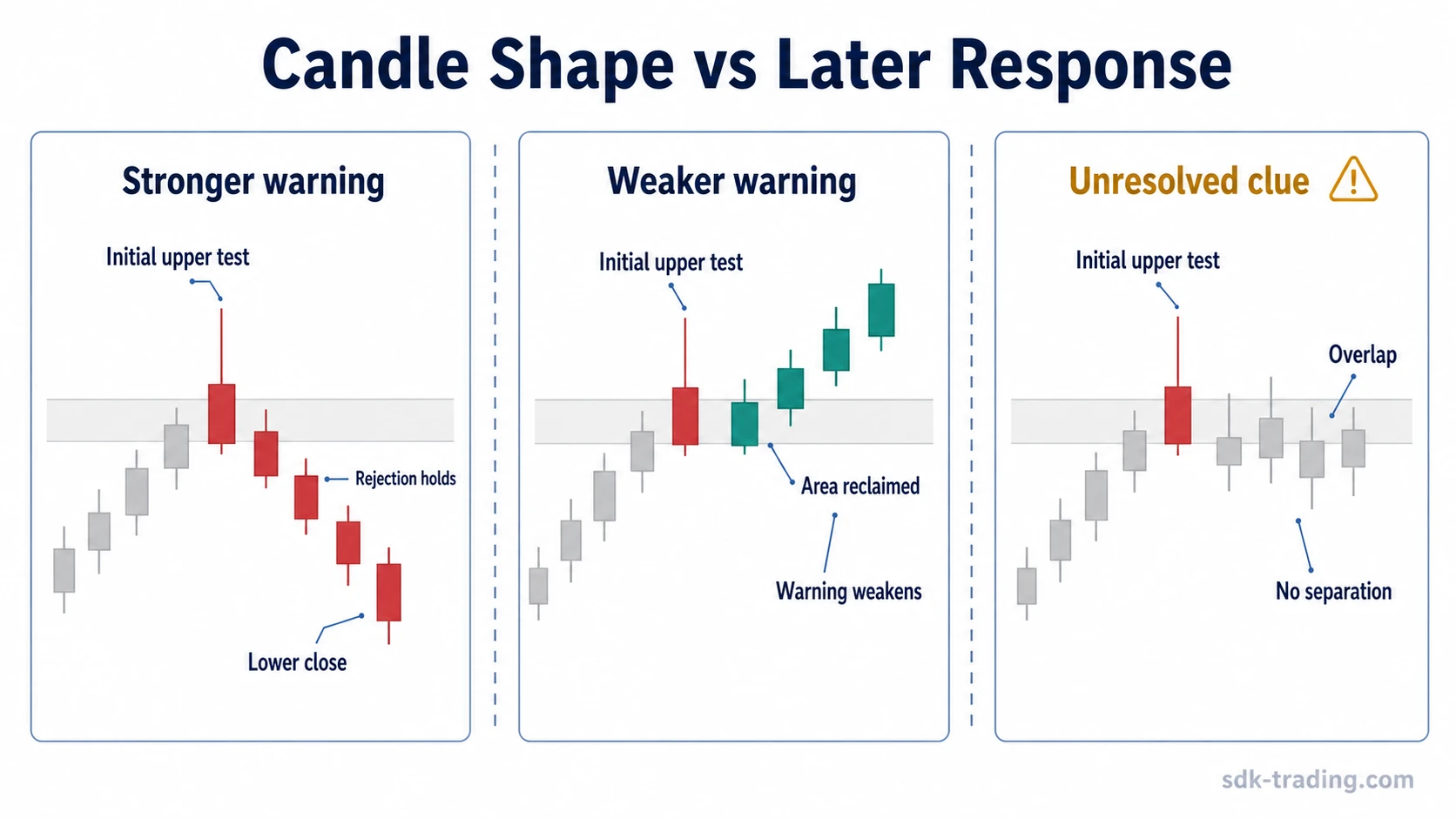
Suppose price has advanced into a prior resistance area and briefly trades above it. The candle closes back below the area with a long upper wick. The first observation is that price tested higher levels but did not hold them by the close.
That observation remains incomplete if the following candles only overlap the same area. The market has shown a failed hold at the upper extreme, but it has not yet shown enough separation to prove that the test changed the broader sequence.
The bearish reading becomes more defensible if the next recovery attempt stalls below the rejected area and price closes lower again. The reading weakens if price quickly reclaims the area and begins closing above it. The same initial candle can therefore become a stronger clue, a failed clue or an unresolved structure depending on acceptance and rejection.
Compact Reading Checklist
- Identify the candle’s open, high, low and close.
- Compare body size, wick length and total range.
- Check where the candle appears in the prior movement.
- Read the close location before relying on the wick.
- Match the reading to the timeframe being used.
- Watch whether price accepts, rejects, overlaps or reclaims the tested area.
- Do not let candle color, wick length or pattern name replace sequence.
FAQ
What is the first thing to read on a candlestick chart?
Start with the candle’s open, high, low and close. Those four prices define the body, wick and range. After that, check where the candle formed and how later price responded.
Are green and red candles enough to understand direction?
No. Color only shows whether the close was above or below the open. Directional interpretation also needs prior movement, location, range, close position and the response after the candle.
Why do wicks matter in candlestick analysis?
Wicks show price areas that were tested but not held by the close. A wick can suggest rejection or recovery, but later price behavior shows whether that test still matters.
Can one candle confirm a reversal?
One candle can show that pressure changed during one period, but a reversal reading normally needs a broader sequence, failed acceptance of the prior direction, or a clear shift in later candles.
Why can the same candle mean different things on different timeframes?
Each timeframe compresses a different amount of price behavior. A daily candle may contain several smaller intraday swings, while a short-term candle may only record a brief test or pause.