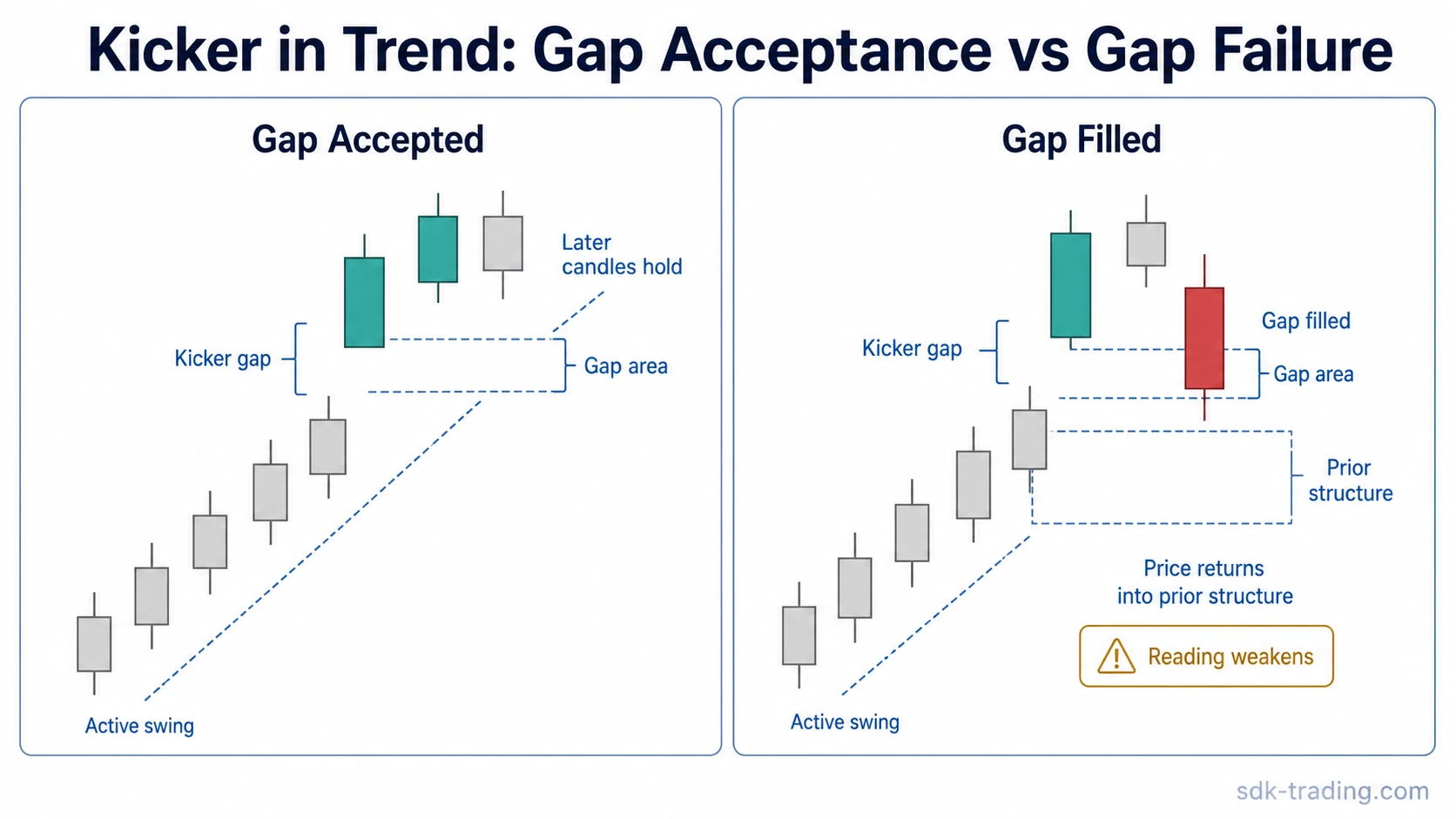
A kicker inside a trading trend is a trend-acceptance test, not a separate definition of the kicker candlestick. The question is whether the gap extends the active swing and then stays accepted, or whether price quickly fills the gap and turns the candle into failed displacement.
This keeps the trend version separate from the base kicker pattern. The candle can show sudden directional pressure, but the support-page issue is narrower: whether trend placement, gap acceptance, and later candles support continuation instead of exposing a late or unstable move.
Key Points
- A kicker inside a trend is a narrow trend-placement reading, not a replacement for the base kicker candlestick definition.
- The reading is stronger when the gap fits the active swing direction and holds outside nearby structure.
- Continuation is weaker when the gap is filled quickly, follow-through stalls, or the move appears late in an extended trend.
- The useful distinction is accepted displacement versus failed displacement, not the candle name by itself.
What a Kicker Means Inside an Active Trend
A kicker candlestick pattern uses a sharp gap or displacement to show that the market rejected the previous candle’s direction. Inside an existing trend, that displacement has to be judged against the current swing sequence rather than treated as a complete continuation reading.
In an uptrend, a bullish gap may support the trend only if price continues accepting higher levels after the displacement. In a downtrend, a bearish gap may support downside continuation only if sellers maintain pressure instead of allowing the gap area to be reclaimed quickly.
The trend context matters because the same candle can appear at different stages of movement. A mid-trend kicker after compression can show renewed directional effort. A late-stage kicker after several extended swings can also reflect emotional participation near exhaustion, especially if the gap fails quickly.
When Trend Alignment Strengthens the Reading
Trend alignment becomes more useful when the kicker appears in the direction of the active swing, breaks away from a recent pause, and is followed by candles that hold the new area. The gap is then part of a broader acceptance sequence, not only a one-candle event.
A cleaner continuation reading usually needs three conditions: the market was already directional, the kicker moved away from nearby balance or compression, and later candles did not immediately return into the gap. Without those conditions, the candle may still be notable, but its trend message is less reliable.
Higher-timeframe context can also change the reading. A kicker that looks strong on a lower timeframe may be less meaningful if it appears directly into a larger resistance area, a prior supply zone, or a mature move where new participation is arriving late.
When a Trend Kicker Becomes Weaker
A trend kicker weakens when the market cannot defend the gap. Quick gap fill, narrow follow-through, or repeated closes back inside the previous structure all reduce the continuation reading. The candle may have shown effort, but the result did not confirm acceptance.
Late-stage movement also deserves caution. A gap in the trend direction after a long advance or decline can attract attention, but it may appear after much of the move has already expanded. If later candles fail to extend and instead rotate back through the gap area, the kicker becomes more like failed displacement than clean continuation.
Trapped structure is another weak condition. If the kicker opens beyond a nearby range but closes back into it, or if the next candles remain boxed inside the same range, the market has not accepted the displacement. The gap direction alone is not enough.
Kicker in Trend Acceptance Test
| Trend-placement condition | What it tests | What weakens the support-page reading |
|---|---|---|
| Kicker gap opens away from the prior candle in the direction of the active swing | Whether the trend is receiving fresh directional displacement | The reading still needs later acceptance beyond the gap area |
| Kicker appears after compression or a small pause | Whether the market is leaving a short balance area | Acceptance matters more than the first gap itself |
| Later candles hold above the gap in an uptrend or below it in a downtrend | Whether the displacement remains accepted | Holding the area supports the reading but does not guarantee continuation |
| Price quickly fills the gap and closes back into prior structure | Whether the initial displacement has been absorbed | A gap fill does not automatically reverse the trend, but it weakens the kicker reading when acceptance fails |
| Kicker appears after an extended trend leg | Whether the move is becoming late-stage participation instead of clean continuation | Trend maturity can make follow-through less dependable |
Common Mistake: Treating the Gap as Confirmation
A common mistake is seeing an upside gap during an uptrend and immediately treating the candle as complete continuation evidence. The better diagnostic question is whether later candles keep accepting beyond the gap area or rotate back into the prior range.
The same issue appears in downtrends. A bearish kicker can look decisive at first, but if the next candles recover the gap area and hold inside the previous structure, the bearish continuation reading loses strength.
The gap shows a change in pressure. Confirmation depends on what the market does after that pressure appears.
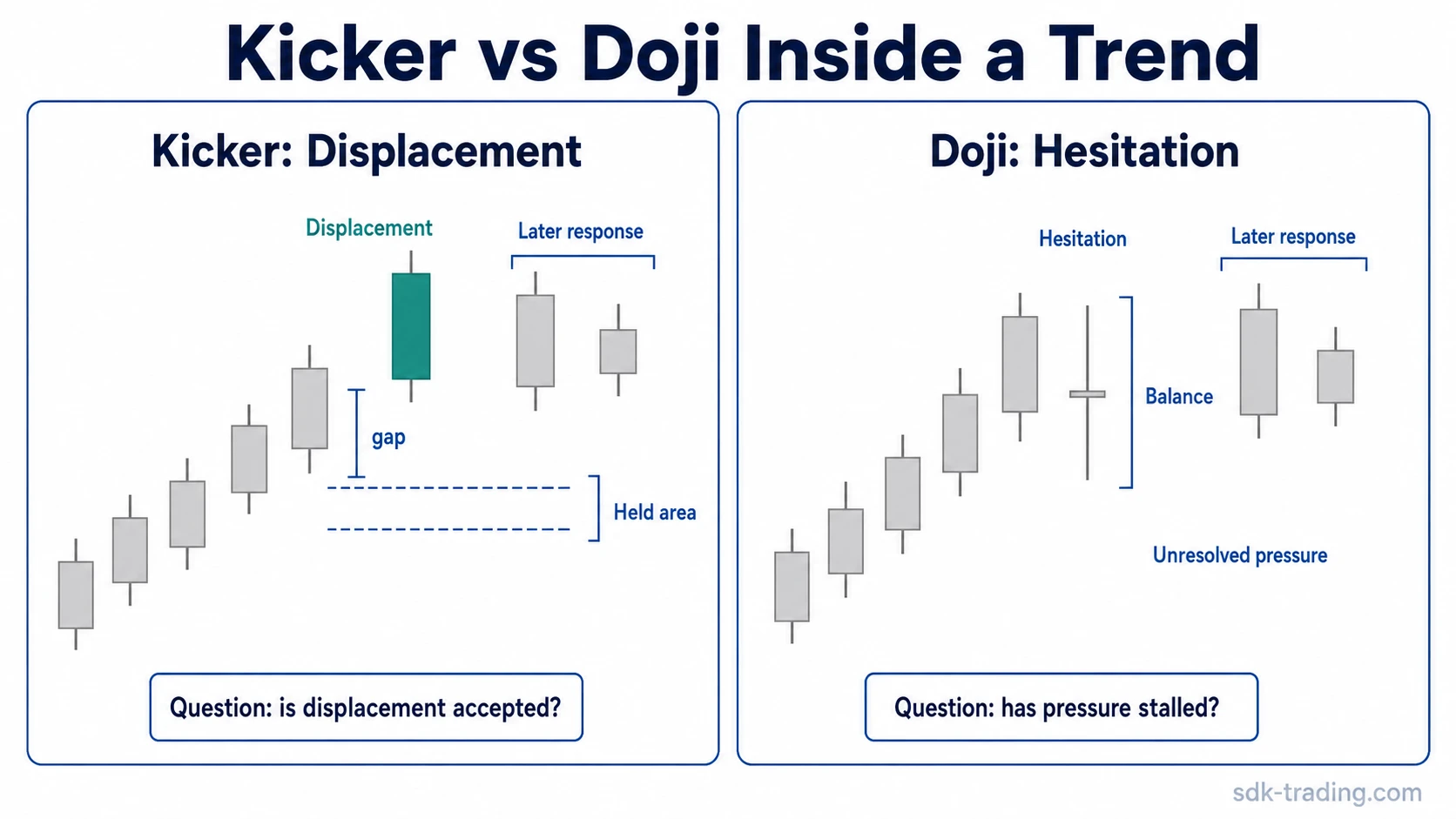
How Kicker and Doji Readings Differ in a Trend
A kicker inside a trend is mainly about displacement. It shows a sharp change in acceptance through a gap or strong directional separation from the previous candle.
A doji candle inside a trend has a different message because it usually reflects hesitation, balance, or unresolved pressure rather than sudden gap-driven displacement.
The distinction matters when reading continuation. A kicker asks whether displacement is accepted. A doji asks whether the trend has paused, stalled, or reached a temporary balance point. Neither candle should be read without the surrounding structure and the later response.