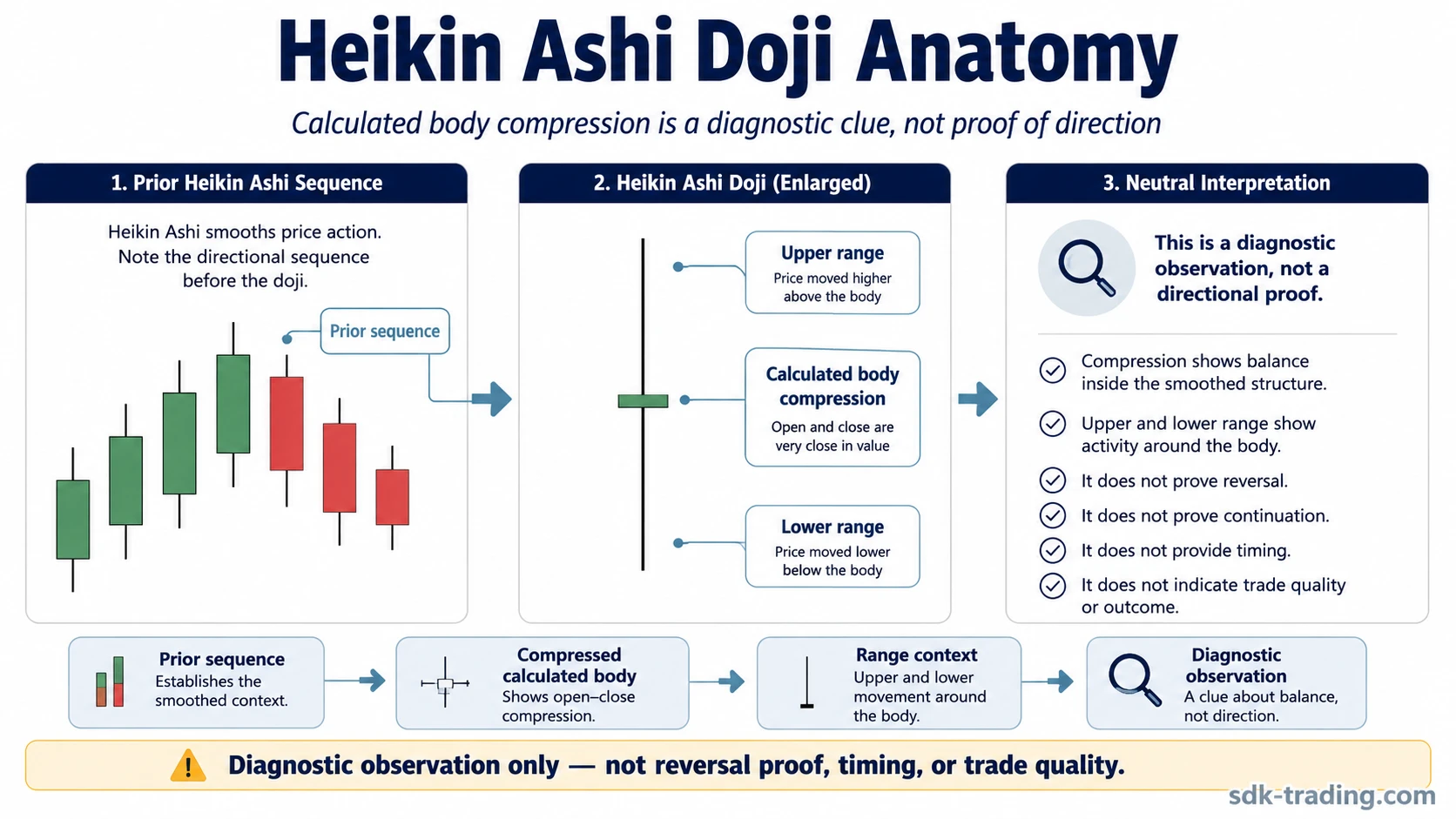
A Heikin Ashi doji is a small-body state inside a calculated Heikin Ashi sequence. The observable feature is compression between the calculated Heikin Ashi open and close, often with range movement above, below, or on both sides of the body.
Definition: A Heikin Ashi doji forms when the calculated Heikin Ashi open and close move close together, producing a small real body while the candle can still show meaningful upper and lower range movement.
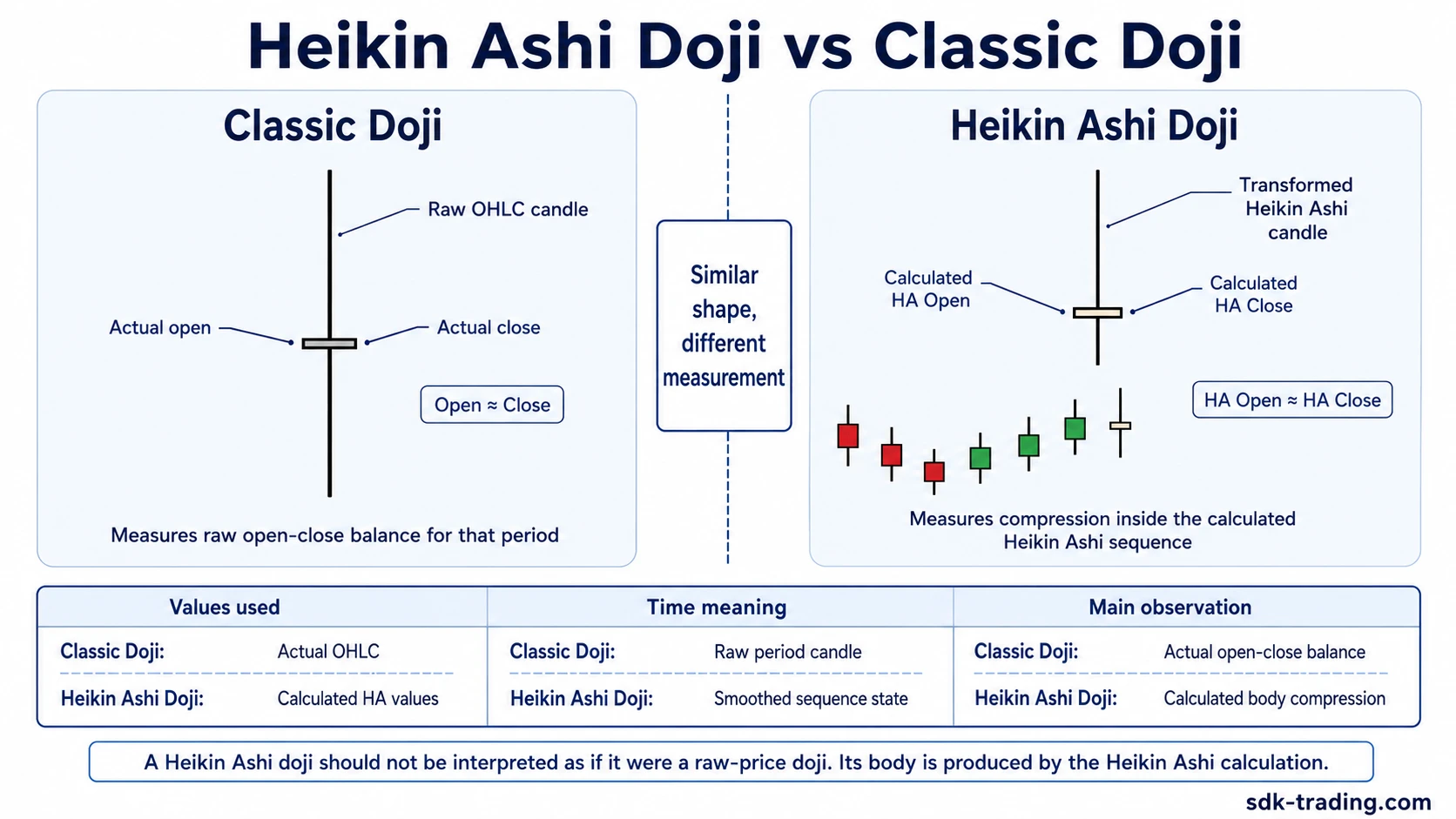
The important distinction is that this is not a raw-price doji. A standard doji compares the actual period open and close. A Heikin Ashi doji compares transformed values produced by the Heikin Ashi calculation, so it describes compression inside a smoothed sequence rather than exact raw open-close balance.
What You Can Observe in a Heikin Ashi Doji
A useful reading starts with what is visible rather than with a directional conclusion. The candle should first be examined as a calculated structure inside the Heikin Ashi sequence.
- Small calculated body: The Heikin Ashi open and close are close together, so directional separation inside the calculated body has narrowed.
- Upper and lower range movement: Wicks or range extension show that price still traveled beyond the body during the period.
- Prior sequence: Compression after several directional Heikin Ashi candles carries different information from another small body inside existing chop.
- Sequence change: The doji becomes more informative when it appears as a visible change from earlier body expansion or directional persistence.
Observation boundary: the doji identifies calculated body compression. The surrounding sequence determines whether that compression is unusual enough to add useful information.
Why the Calculated Body Matters
Heikin Ashi candles are not standard OHLC candles. Their displayed values are produced from current price inputs together with prior Heikin Ashi values. A small body therefore means that the transformed open and close have converged, not necessarily that the actual market-period open and close were almost equal.
This distinction matters because two charts built from the same underlying period can show different candle bodies. A raw candlestick may have a noticeable body while the corresponding Heikin Ashi candle appears compressed, or the reverse can occur depending on the calculated sequence.
The Heikin Ashi doji is therefore best treated as a state of the transformed sequence: directional expansion has narrowed for that calculated candle.
Heikin Ashi Doji vs Classic Doji
A classic doji and a Heikin Ashi doji can look similar, but they measure different relationships. The classic doji compares actual period values. The Heikin Ashi version compares calculated values inside a smoothed candle sequence.
| Feature | Classic doji | Heikin Ashi doji |
|---|---|---|
| Open-close basis | Actual period open and close | Calculated Heikin Ashi open and close |
| What the small body describes | Raw open-close balance for that candle | Compression inside the transformed Heikin Ashi sequence |
| Relationship to raw OHLC | Direct | Filtered through the Heikin Ashi calculation |
| Context that matters most | Location and surrounding raw candles | Prior Heikin Ashi sequence, body expansion or compression, and later sequence behavior |
When the Doji Adds More Information
A Heikin Ashi doji is more informative when it interrupts an established calculated sequence. For example, several directional candles with larger bodies may be followed by one sharply compressed body with range movement on both sides. The important observation is the change in sequence quality.
The reading is weaker when small bodies were already common before the doji appeared. In a choppy sequence with repeated compression, another small candle may add little new information because the chart was already showing weak directional separation.
| Sequence condition | What the doji adds |
|---|---|
| Clear directional candles before the doji | A visible interruption in calculated body expansion |
| Several mixed or small bodies before the doji | Less new information because compression was already present |
| Doji followed by renewed directional bodies | The compression was temporary inside the sequence |
| Doji followed by repeated compression or a changed sequence | The loss of directional separation has persisted beyond one candle |
Heikin Ashi Doji and Reversal
A compressed Heikin Ashi body can appear near a change in direction, but the candle itself only identifies compression inside the calculated sequence. The separate concept of Heikin Ashi reversal requires broader sequence evidence.
A later reversal reading becomes more defensible when the chart moves beyond one compressed candle and develops a clearer change in body direction, wick behavior, or sequence structure. If the next candles simply return to the prior directional pattern, the doji was a pause rather than a larger sequence transition.
Interpretation limit: a Heikin Ashi doji describes compression in calculated candle values. It does not determine the direction or size of the next market move.
Example: Compression After a Directional Sequence
Suppose a Heikin Ashi chart prints several consecutive directional candles with relatively large calculated bodies. The next candle has a much smaller body and visible range movement above and below it.
The first useful conclusion is narrow: the calculated sequence has stopped expanding as cleanly as before. If subsequent candles regain larger bodies in the same direction, the compression was temporary. If small bodies persist or the sequence changes direction, the original doji becomes part of a broader transition rather than an isolated candle.
Common Heikin Ashi Doji Misreads
| Misread | More precise reading |
|---|---|
| The raw open and close must be nearly equal. | The small body reflects calculated Heikin Ashi open and close, not necessarily the raw period values. |
| Every small Heikin Ashi body has special meaning. | A small body adds more information when it represents a change from the preceding calculated sequence. |
| One doji establishes a reversal. | The candle identifies compression; a broader sequence change is a separate observation. |
| A Heikin Ashi doji should be read exactly like a classic doji. | The visual resemblance does not remove the difference between raw and calculated candle values. |
Where the Doji Fits in Heikin Ashi Analysis
The Heikin Ashi doji is one candle state inside a broader transformed charting method. Broader construction and smoothing behavior belong to the main Heikin Ashi concept.
When the question expands from one compressed candle to recurring body shapes, wick behavior, and multi-candle sequences, Heikin Ashi pattern interpretation becomes the broader frame.