A Heikin Ashi reversal is a change in a calculated Heikin Ashi candle sequence that suggests the prior directional rhythm may be weakening and an opposite reading may be developing. It is a diagnostic chart observation, not proof that raw price has reversed and not a standalone trading signal.
Definition: A Heikin Ashi reversal is identified when a prior Heikin Ashi sequence loses directional strength, compresses or changes body structure, and then begins to show opposite-side acceptance through later calculated candles.
The important distinction is that Heikin Ashi candles are smoothed. Their open, high, low, and close values are calculated from raw OHLC inputs and prior Heikin Ashi values, so the reversal reading reflects a smoothed sequence rather than exact tradable candle prices.
- A Heikin Ashi reversal reading starts with sequence change, not with one candle changing color.
- The reading becomes more useful when body compression, shadow behavior, and follow-through point in the same direction.
- A doji-like Heikin Ashi candle can warn that momentum is compressing, but compression alone does not confirm a reversal.
- Because Heikin Ashi values are averaged, reversal evidence can appear later than the first raw-price turn.
- The reading weakens when opposite acceptance fails or the prior direction expands again.
What Is a Heikin Ashi Reversal?
A Heikin Ashi reversal is a shift from one smoothed candle rhythm into a possible opposite rhythm. In an upward sequence, that may mean larger bullish calculated bodies begin to compress, upper follow-through weakens, and bearish calculated candles start to appear. In a downward sequence, it may mean bearish calculated bodies lose range, lower follow-through weakens, and bullish calculated candles begin to appear.
The reversal label should be used carefully. The first opposite candle is only the beginning of the question. A stronger reading needs evidence that the prior sequence has stopped controlling the chart and that the opposite side is being accepted after the candle closes.
Boundary: A Heikin Ashi reversal does not prove direction, timing, continuation, trade quality, or outcome. It only marks a possible transition inside a calculated candle sequence.
Heikin Ashi Reversal Diagnostic Boundary
The diagnostic boundary separates a real reversal reading from a normal pause inside the same trend. The clearest readings combine prior-sequence weakness, body compression, shadow change, color or rhythm shift, and later acceptance in the opposite direction.
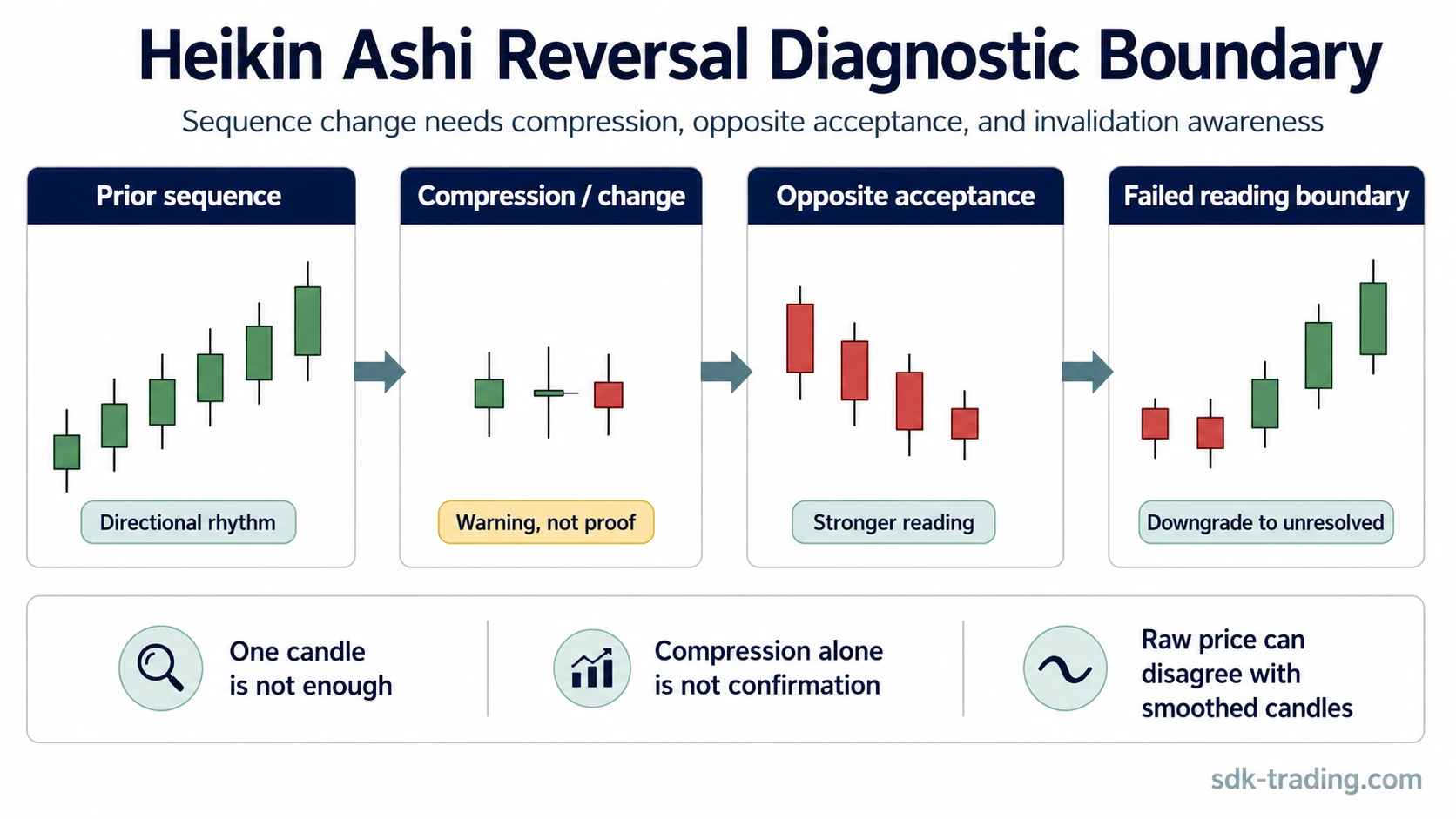
| Diagnostic field | What to look for | Safer interpretation |
|---|---|---|
| Observed clue | Prior Heikin Ashi move begins to lose body size, range quality, or directional smoothness. | The prior sequence may be weakening, but the chart has not yet confirmed an opposite sequence. |
| Compression | Calculated candle bodies become smaller or more balanced after a directional run. | Momentum may be pausing or transitioning; compression alone is not enough. |
| Shadow change | Opposite-side shadows appear, or the prior clean no-shadow rhythm starts breaking down. | The opposing side is becoming more visible, but acceptance still matters. |
| Color or rhythm shift | The calculated sequence changes color or alternates instead of continuing smoothly. | The chart is moving from trend rhythm into a transition zone. |
| Stronger reading | Opposite candles close and continue after the prior sequence weakens. | The reversal reading becomes more defensible when follow-through confirms the transition. |
| Not enough | One color change, one doji-like candle, or one small candle without follow-through. | The observation may only be a pause, not a reversal. |
| Invalidation | The prior direction expands again after the attempted shift, opposite acceptance fails, or raw price conflicts with the smoothed reading. | The reversal reading should be downgraded or treated as unresolved. |
Safety note: Heikin Ashi reversal analysis is a chart-reading filter. It can warn that a sequence is changing, but broader structure and confirmation decide whether the observation has useful context.
How to Identify a Heikin Ashi Reversal
Identification starts with the sequence before the possible turn. A reversal reading has more value after a visible directional run than inside random sideways candles. Without a prior rhythm, there is little to reverse.
- Check the prior sequence: Look for a run of Heikin Ashi candles with consistent color, body direction, and directional rhythm.
- Watch for body compression: Smaller calculated bodies after expansion can show that the prior side is losing pressure.
- Compare shadow behavior: A change in upper or lower shadows can show that the opposite side is beginning to respond.
- Wait for rhythm change: A color shift matters more when it appears after compression and not as a random candle inside noise.
- Check acceptance: Later candles should hold the opposite direction better than the first transition candle.
- Separate pause from reversal: If the prior direction quickly expands again, the reversal reading remains weak.
This is why a Heikin Ashi doji and a Heikin Ashi reversal are not the same thing. A doji-like candle highlights compression; a reversal reading needs the sequence to move beyond compression into opposite acceptance.
What Confirms or Weakens the Reading?
A Heikin Ashi reversal reading becomes stronger when several sequence clues align. It becomes weaker when the opposite clue is isolated, when the old direction quickly resumes, or when raw price does not support the smoothed candle reading.
| Area checked | Stronger reversal reading | Weaker reversal reading |
|---|---|---|
| Prior sequence | The prior Heikin Ashi rhythm visibly slows before the color or body shift. | The sequence is already choppy, so the opposite candle has less meaning. |
| Body behavior | Expansion in the old direction gives way to compression, then opposite body development. | Small candles appear but do not build into an opposite sequence. |
| Shadow behavior | Opposite-side shadows appear and the old clean trend rhythm breaks. | Shadows appear briefly, but the old direction quickly regains range. |
| Close and follow-through | Opposite candles close with enough continuity to show acceptance. | The first opposite candle is immediately absorbed or reversed. |
| Raw price relationship | Raw price action does not contradict the smoothed transition. | Raw price still shows acceptance in the old direction while Heikin Ashi appears to turn. |
Invalidation rule: The reading weakens when the old direction expands again, when opposite candles fail to hold, or when the calculated Heikin Ashi structure disagrees with raw price behavior.
Why Heikin Ashi Reversals Can Lag
Heikin Ashi candles smooth raw price movement by using calculated values. This smoothing can make trend rhythm easier to read, but it also means that a reversal reading may appear after raw price has already started changing direction.
The lag is not a flaw by itself. It is the trade-off of using a smoothed charting method. Heikin Ashi can reduce visual noise, but the same smoothing can delay the visible transition and hide the exact raw OHLC levels that matter for execution.
Calculated-price limitation: Heikin Ashi open, high, low, and close values should not be treated as exact raw market prices. A reversal candle on a Heikin Ashi chart may not match the raw candlestick that formed during the same period.
Common Heikin Ashi Reversal False Positives
Most false positives come from treating a single visual clue as a complete reversal. The calculated candle can warn that the prior move is changing, but one clue is not enough to define the transition.
| False-positive pattern | Why it misleads | Safer reading |
|---|---|---|
| Single color flip | One opposite candle can appear during a normal pause. | Check whether the next candles hold the opposite rhythm. |
| Doji-like compression | A small body can show hesitation without direction change. | Treat the candle as compression until follow-through appears. |
| Shadow change alone | New shadows can appear during volatility without sequence acceptance. | Compare shadows with body development and later closes. |
| Late smoothed turn | The Heikin Ashi sequence may turn after raw price has already moved. | Use raw candlesticks to understand the actual price structure. |
| Sideways chop | Alternating candles can look like repeated reversals. | Avoid treating every color change inside chop as a new directional transition. |
Heikin Ashi Reversal vs Normal Pause
The difference between a reversal and a pause is acceptance. A pause may compress, hesitate, or print a small opposite candle, then continue in the original direction. A reversal reading needs the opposite side to hold after the transition.
| Question | Normal pause | Possible reversal |
|---|---|---|
| What happens to the prior rhythm? | It briefly slows, then resumes. | It weakens and fails to regain control. |
| What does compression mean? | Temporary hesitation inside the same sequence. | A transition clue if followed by opposite acceptance. |
| What does the first opposite candle prove? | Very little by itself. | It starts the reversal question, but still needs follow-through. |
| What invalidates the reading? | The old sequence expands again. | The opposite side fails to hold and the old direction regains acceptance. |
How Heikin Ashi Reversal Relates to Patterns
A Heikin Ashi reversal is not the same as a fixed named candlestick pattern. It is a sequence reading inside a smoothed charting method. Some Heikin Ashi patterns may include reversal-like behavior, but the reversal reading still depends on context, compression, acceptance, and invalidation.
A raw candlestick reversal may focus on the shape of one or several raw OHLC candles. A Heikin Ashi reversal focuses on the smoothed rhythm created by calculated values. That difference matters because a Heikin Ashi candle may hide or delay the exact raw price behavior visible on a raw candlestick chart.
Example: After several strong bullish Heikin Ashi candles, the bodies may shrink and a small opposite candle may appear. That is not enough to call a reversal. The reading becomes stronger only if later calculated candles continue to accept the opposite direction instead of immediately returning to the prior bullish rhythm.
What a Heikin Ashi Reversal Does Not Tell You
A Heikin Ashi reversal does not tell you where to enter, where to exit, where to place risk, or whether the next move will continue. It also does not remove the need to understand raw price structure, volatility, liquidity, timeframe, or broader chart context.
- It does not prove that raw price has already reversed.
- It does not confirm trade direction by itself.
- It does not define risk or position quality.
- It does not remove false-start risk.
- It does not guarantee that the opposite sequence will continue.
Practical limit: A Heikin Ashi reversal is best treated as a diagnostic warning that the smoothed sequence may be changing. It should not be treated as a complete decision system.
Heikin Ashi Reversal FAQ
Is a Heikin Ashi reversal a buy or sell signal?
No. A Heikin Ashi reversal is a diagnostic candle-sequence reading. It can show that the prior smoothed rhythm may be weakening, but it does not provide an entry, exit, stop, target, or outcome by itself.
Can one Heikin Ashi candle confirm a reversal?
One candle is usually not enough. A stronger reading needs prior-sequence weakness, a meaningful shift in body or shadow behavior, and follow-through that shows opposite-side acceptance.
Why can a Heikin Ashi reversal appear late?
Heikin Ashi candles use calculated values rather than only raw OHLC candles. That smoothing can make the sequence easier to read, but it can also delay the visible reversal clue.
Is a Heikin Ashi doji the same as a reversal?
No. A doji-like Heikin Ashi candle shows compression or hesitation. A reversal reading needs the sequence to move beyond compression and show opposite acceptance.