Heikin Ashi is the more relevant lens when the question concerns a smoothed candle sequence across regular time periods. Renko is more relevant when the question concerns whether price has moved far enough to cross a selected movement threshold.
Both methods start from market price data, but they transform different parts of that information. Heikin Ashi changes the displayed candle values while preserving a regular time sequence. Renko rebuilds the chart around qualifying price movement, so elapsed time and smaller fluctuations become less visible in the main structure.
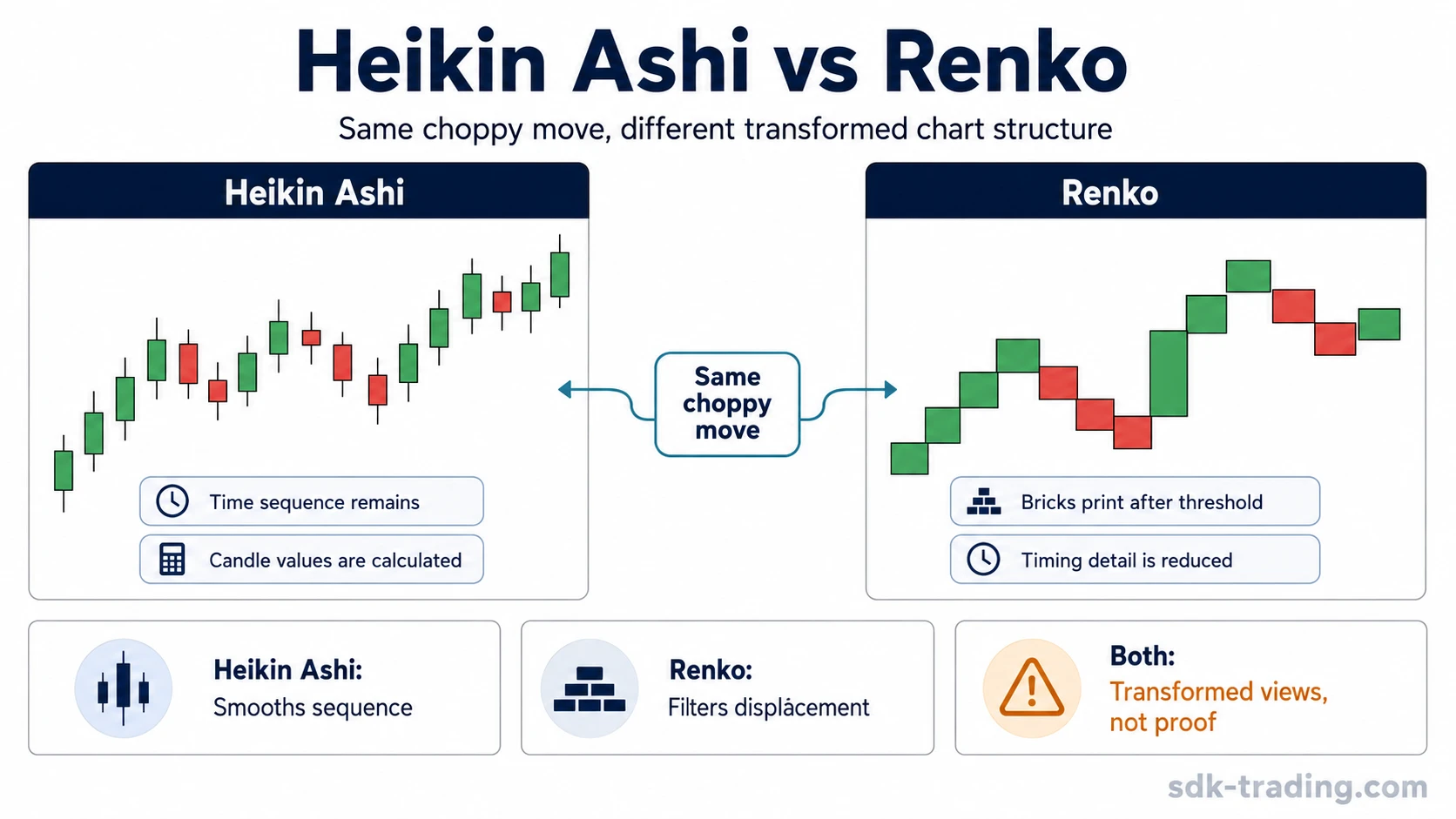
Core distinction: Heikin Ashi keeps one calculated candle for each chart interval. Renko prints a new brick only when price movement satisfies the selected brick rule. The first transforms candle values through time; the second reorganizes the chart around movement thresholds.
Heikin Ashi vs Renko: Which Lens Fits the Question?
The choice starts with the information you want the chart to retain. Heikin Ashi and Renko remove different kinds of detail, so a cleaner-looking chart can answer one question while making another harder to see.
| Chart question | Heikin Ashi | Renko |
|---|---|---|
| How has directional behavior developed across recent time periods? | Better suited because every regular chart interval still produces a calculated candle. | Less suited because periods with insufficient price movement may produce no new brick. |
| Has price moved far enough to exceed a defined movement threshold? | The candle sequence can show the move, but no fixed movement threshold controls whether a candle appears. | Better suited because brick formation is directly tied to qualifying price displacement. |
| Is normal elapsed time important? | Regular time intervals remain visible. | Elapsed time is reduced in the main visual structure. |
| Are exact raw period OHLC values required? | The displayed candles are calculated rather than standard raw OHLC candles. | The main structure does not preserve normal period-by-period OHLC candles. |
How Each Method Transforms Price
Heikin Ashi keeps the familiar candle format, but each candle is calculated from current price inputs and previous Heikin Ashi values. A candle still appears for every chart interval, although its displayed open and close are synthetic rather than the raw period open and close.
Renko charts use a different transformation. Price must move far enough under the selected brick construction rules before the chart adds another brick. Several time periods can therefore pass without changing the Renko structure, while a sufficiently large move can generate additional bricks.
| Information dimension | Heikin Ashi | Renko |
|---|---|---|
| Regular time sequence | Retained | Reduced in the main chart structure |
| Raw period OHLC | Transformed into calculated candle values | Not preserved as normal time-based candles |
| Small price fluctuations | Often softened by smoothing | May disappear from the brick structure when they remain below the required threshold |
| Movement threshold | Does not determine whether the next time-period candle appears | Directly controls brick formation |
| Response delay | Can arise from smoothing across calculated values | Can arise while price has not yet moved far enough to complete another brick |
Same Price Path, Different Output
Consider a market that advances through several time periods but repeatedly pulls back by small amounts. A standard price chart records every period and every raw candle.
On Heikin Ashi, each of those periods is still represented, but the calculated candle sequence can soften the visual effect of the small pullbacks. The advance may therefore appear more persistent than it does on the raw candle chart.
Renko handles the same movement differently. Pullbacks that remain below the applicable brick or reversal threshold may leave little or no trace in the main brick sequence. The chart can therefore show a cleaner directional structure while providing less information about when the smaller movements occurred.
Comparison boundary: visual disagreement between Heikin Ashi and Renko does not require different underlying market data. The disagreement can arise because each method discards or transforms a different dimension of the same price history.
What Heikin Ashi Can Hide
Heikin Ashi retains the time sequence but changes the candle values. That smoothing can make a directional run easier to follow, while also reducing the prominence of an abrupt change that is already visible in the raw candles.
The same issue applies to individual calculated candle shapes. A Heikin Ashi doji describes compression inside the transformed sequence. It should be interpreted as a feature of that calculated chart rather than as an exact raw OHLC candle.
What Renko Can Hide
Renko reduces the visibility of elapsed time and sub-threshold movement. A long quiet period can leave the brick structure unchanged, while a rapid price move can create several bricks without preserving the same period-by-period path that a time-based chart would show.
Brick size also changes the amount of retained detail. Larger thresholds remove more small movement from the main chart. Smaller thresholds preserve more transitions but also allow more of the short-term price variation back into the structure.
Exact behavior can vary with the platform and the selected Renko construction settings, so the brick rule is part of the chart definition rather than a cosmetic display choice.
Common Heikin Ashi vs Renko Misreadings
| Misreading | What the chart actually tells you |
|---|---|
| Renko is more accurate because the chart looks cleaner. | The chart is more selective. Its cleaner appearance comes partly from excluding movement that does not satisfy the brick rules. |
| Heikin Ashi preserves the same prices as ordinary candles. | The time intervals remain regular, but the displayed candle values are calculated. |
| If both charts look directional, they independently confirm the move. | Both views are transformations of the same underlying price history, so visual agreement is not independent evidence. |
Heikin Ashi or Renko?
Heikin Ashi fits a question about how a smoothed candle sequence evolves through regular time intervals. Renko fits a question about movement that is large enough to pass a selected price threshold.
Neither view preserves every property of the raw chart. Heikin Ashi sacrifices exact candle values for smoothing. Renko sacrifices regular timing and sub-threshold detail for movement filtering. The useful choice follows from which information can be reduced without removing the feature you are trying to study.