The TRIN indicator, also called the Arms Index, is a market breadth indicator that compares advancing and declining issues with advancing and declining volume. It shows whether price participation and volume participation are moving together or creating an imbalance beneath the headline index move.
Definition: TRIN measures the relationship between the advance-decline ratio and the advancing-volume-to-decline-volume ratio. A reading above or below 1 can describe pressure inside market breadth, but the value needs source, universe, and volume context before the interpretation is useful.
Key Points
- TRIN compares breadth counts with breadth volume.
- 1.0 is the neutral reference point, not a fixed market conclusion.
- Readings above 1 and below 1 depend on the exchange, index, or data universe being measured.
- Extreme readings can reflect stressed participation, but a single spike can be unstable.
- The raw ratio becomes weaker when count and volume inputs offset each other or come from inconsistent sources.
TRIN Indicator / Arms Index Definition
TRIN is a breadth-and-volume ratio. It does not measure price trend directly. It compares how many issues are advancing or declining with how much volume is flowing into advancing or declining issues.
The practical distinction is that TRIN can reveal a difference between participation by count and participation by volume. A market may have more advancing issues than declining issues, while declining volume remains heavy enough to keep the reading elevated. That conflict is a breadth-volume condition, not a complete market call.
TRIN Formula and Inputs
The standard TRIN formula is:
TRIN = (advancing issues / declining issues) / (advancing volume / declining volume)
The formula has two ratios. The numerator measures breadth by issue count. The denominator measures volume participation behind those advancing and declining issues. The denominator matters because volume can change the meaning of the same advance-decline count.
This is why TRIN can look different from a simple advance-decline reading: the volume ratio can strengthen, weaken, or offset the message from the issue-count ratio.
| Formula input | What it measures | Why it matters |
|---|---|---|
| Advancing issues | Number of stocks or issues trading higher in the selected universe | Shows how broad upside participation is by count |
| Declining issues | Number of stocks or issues trading lower in the selected universe | Shows how broad downside participation is by count |
| Advancing volume | Volume traded in advancing issues | Shows how much activity supports the advancing side |
| Declining volume | Volume traded in declining issues | Shows how much activity supports the declining side |
What TRIN Above 1 and Below 1 Mean
A TRIN value near 1 means the advance-decline ratio and the advancing-volume-to-declining-volume ratio are relatively balanced. Values below 1 usually show stronger volume participation in advancing issues relative to the count relationship. Values above 1 usually show heavier volume participation in declining issues relative to the count relationship.
Low or high TRIN values should be treated as ratio conditions, not fixed conclusions. Source data, market universe, intraday timing, and smoothing method can all change how much weight the value deserves.
| TRIN reading area | Basic interpretation | What to check before trusting it |
|---|---|---|
| Below 1 | Advancing volume is strong relative to the advance-decline count | Check whether the move is broad or concentrated in a narrow group |
| Near 1 | Breadth count and breadth volume are closer to balance | Check whether the market is quiet, mixed, or transitioning |
| Above 1 | Declining volume is heavy relative to the advance-decline count | Check whether weakness is broad, volume-led, or distorted by a few large components |
| Extreme low | Strong upside volume imbalance may be present | Check whether the value is a one-bar spike or part of a persistent condition |
| Extreme high | Strong downside volume imbalance may be present | Check whether the reading reflects broad stress or a temporary data distortion |
TRIN Reading Boundary Map
A safer TRIN interpretation starts with the raw value but does not stop there. The value becomes more useful only after the source universe, formula inputs, threshold area, smoothing, and broader breadth context are checked together.
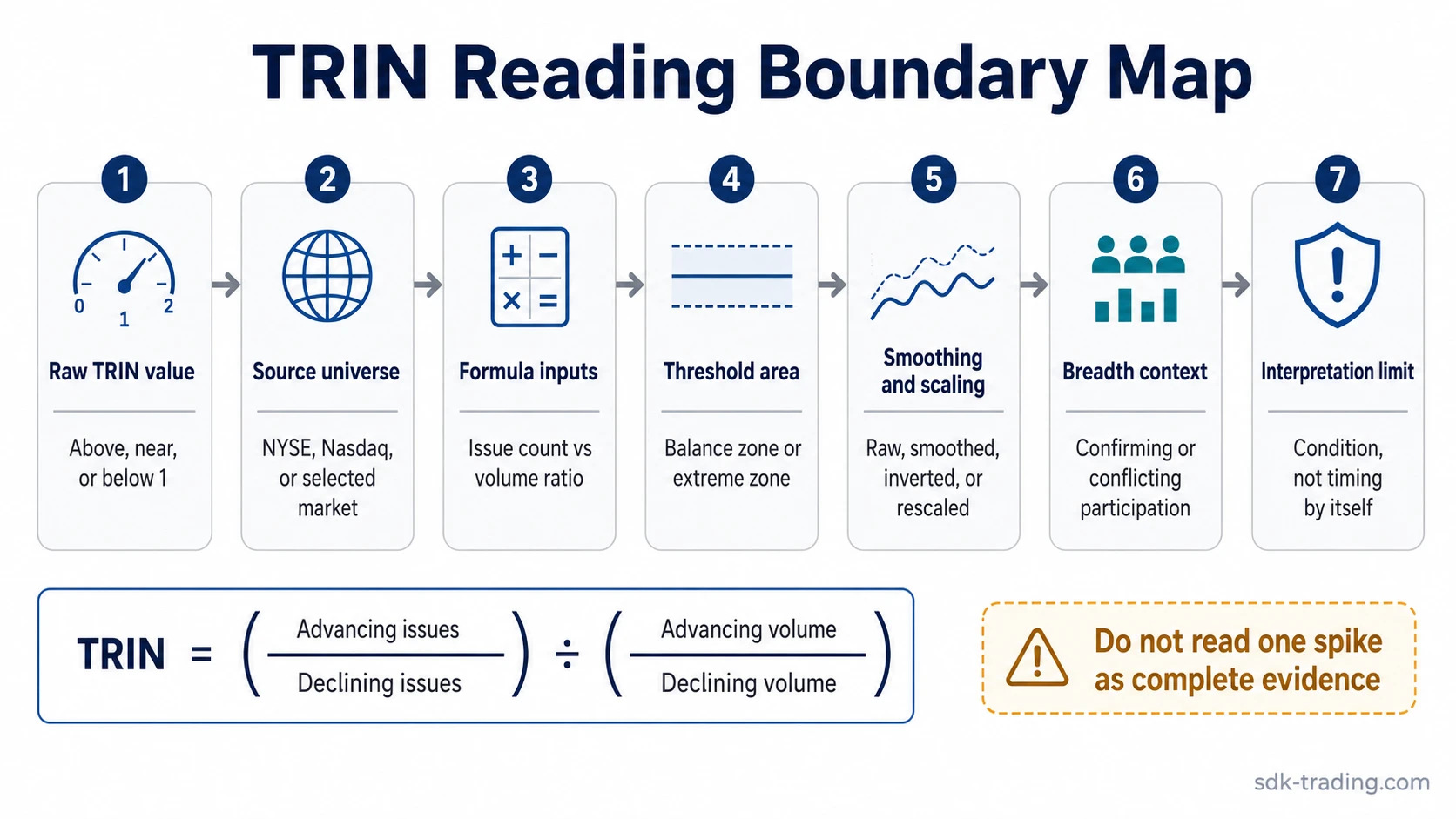
| Step | Question | Boundary |
|---|---|---|
| Raw value | Is TRIN above, below, or near 1? | The value gives the first clue, not the final interpretation. |
| Source universe | Is the reading based on NYSE, Nasdaq, or another universe? | Different universes can produce different readings on the same day. |
| Formula inputs | Are issue counts and volume telling the same story? | Offsetting inputs can make the ratio look cleaner than the underlying condition. |
| Threshold area | Is the reading near balance or near an extreme? | Thresholds should be treated as zones, not universal rules. |
| Smoothing and scaling | Is the chart raw, smoothed, inverted, or scaled differently? | Different platforms can make the same condition look more or less dramatic. |
| Breadth context | Does broader participation confirm or conflict with the TRIN reading? | Conflicting breadth data keeps the reading unresolved. |
| Interpretation limit | Does the reading describe a condition or imply timing? | TRIN can identify imbalance, but it does not define timing by itself. |
Clean, Weak, and Invalid TRIN Readings
A clean TRIN reading appears when the data source is stable, the formula inputs support the same imbalance, and broader breadth behavior does not contradict the value. A weak reading appears when one input dominates the calculation while the rest of the market picture stays mixed. An invalid reading appears when the source, universe, or chart setting makes comparison unreliable.
| Reading quality | Condition | Interpretation boundary |
|---|---|---|
| Clean | Issue counts, volume, and broader breadth context point toward the same imbalance | The reading can describe a clearer participation condition. |
| Weak | Counts and volume offset each other, or the reading depends on one unstable input | The value needs comparison with nearby breadth evidence. |
| Invalid or unusable | The data universe changes, the chart is scaled differently, or a single spike is treated as complete evidence | The reading should not be compared directly with prior values without adjustment. |
Example of a Basic TRIN Reading
A market session can show more advancing issues than declining issues while declining volume remains unusually heavy. The headline count looks constructive, but the volume side of the formula keeps TRIN elevated because downside activity is carrying more weight than the issue count alone suggests.
The stronger diagnostic case is not the elevated value by itself. The cleaner reading comes when the same universe is used consistently, the volume imbalance persists beyond a brief spike, and other breadth measures do not contradict the stress. The read stays unresolved if the next data points return quickly toward balance or if the imbalance came from a narrow concentration of large-volume decliners.
Why TRIN Can Mislead
TRIN can mislead when the ratio hides the behavior of its inputs. A similar final value can come from different combinations of advancing issues, declining issues, advancing volume, and declining volume. The same number can therefore represent different market conditions.
Common limitation: ratio cancellation can make TRIN look neutral even when one side of the formula is unstable. A balanced final value is less meaningful when both internal ratios are moving sharply in opposite directions.
Intraday readings can also spike and fade quickly. A short-lived extreme may reflect a temporary burst of volume rather than a durable breadth condition. Smoothed TRIN readings can reduce noise, but smoothing can also delay recognition of fast changes.
Data-source comparability matters. NYSE TRIN, Nasdaq TRIN, and index-specific variations may not describe the same universe. A reading from one source should not be compared mechanically with a reading from another source unless the construction is the same.
TRIN vs Other Breadth and Sentiment Indicators
TRIN belongs to the market breadth family because it compares participation across advancing and declining issues. Its distinctive feature is the volume layer inside the formula.
The high low index focuses on participation at new-high and new-low extremes. TRIN focuses on the relationship between advancing and declining issues and the volume behind those groups.
The put call ratio measures options activity and sentiment context. TRIN measures stock-market breadth and breadth volume, so the two indicators can describe different parts of market behavior.
New highs and new lows, McClellan indicators, and TICK readings can add surrounding context, but they should not be collapsed into TRIN. Each tool measures a different layer of participation, momentum, or short-term breadth pressure.
FAQ
What does the TRIN indicator measure?
The TRIN indicator measures the relationship between advancing and declining issues and the volume behind those advancing and declining issues. It combines breadth counts with breadth volume.
What is the TRIN formula?
The standard TRIN formula is advancing issues divided by declining issues, then divided by advancing volume divided by declining volume.
What do TRIN readings above or below 1 mean?
TRIN above 1 usually means declining volume is heavy relative to the advance-decline count, while TRIN below 1 usually means advancing volume is strong relative to that count. Both readings still need source, universe, and broader breadth context.
Why can TRIN readings be misleading?
TRIN can mislead when the formula inputs offset each other, when the data universe changes, or when a short intraday spike is treated as a complete market reading.