A support and resistance trading strategy is only useful when a visible area, a later test, and follow-through behavior create a readable condition. The level itself is not a signal, prediction, or proof that price must reverse.
The useful reading comes from sequence: a reference area forms, price returns to it, behavior around the area develops, and subsequent price action either supports, weakens, or invalidates the original reading.
Key Points
- Levels are reference areas, not fixed signals.
- The test matters more than the line.
- Acceptance and failed acceptance change the reading.
- A visible level can stop being useful if price later ignores it.
- The framework describes chart conditions, not trade instructions.
What a support and resistance trading strategy really means
In neutral price-action terms, a support and resistance trading strategy means using prior reaction areas as reference points for reading later behavior. The word “strategy” is safest when it means a structured observation process: identify the area, watch the test, read acceptance or rejection, and define what would make the reading fail.
A drawn level alone is not enough. A prior reaction can show where price once responded, but it does not prove that the same response must happen again. The area becomes useful only if current behavior still treats it as meaningful.
Why support and resistance are reference areas
A support area is a visible zone where downside movement previously slowed, paused, or changed behavior. It is better read as an area of prior response than as a precise price that must hold.
A resistance area is a visible zone where upside movement previously slowed, paused, or changed behavior. It is also a reference area, not a ceiling that guarantees rejection.
Reference areas can come from prior swing highs, prior swing lows, repeated reactions, range edges, failed probes, or areas where price previously shifted behavior. The cleaner the area is visually, the easier it is to monitor; that still does not make it automatic.
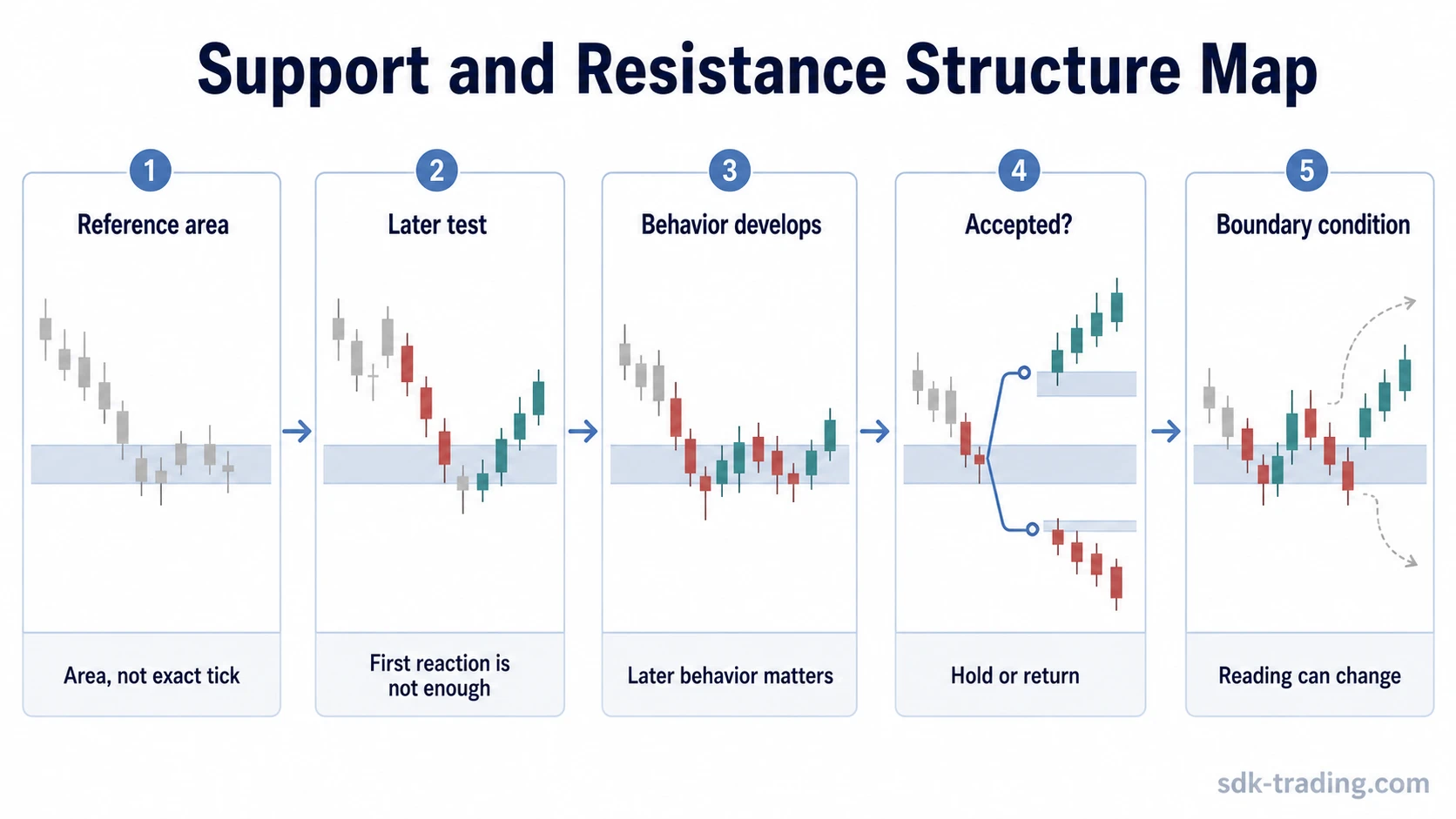
Level vs zone: A line marks the approximate reference. A zone leaves room for normal market movement around that reference. The reading depends on behavior around the area, not on whether price touches one exact tick.
How price tests a support or resistance area
A test begins when price returns to the reference area and starts interacting with it. The first reaction is only the beginning of the reading. A visible bounce, pause, or rejection can be useful, but behavior after the test decides whether the area remains meaningful.
Three questions keep the reading controlled:
- Does price respect the area without immediately ignoring it?
- Does the next sequence develop on the expected side of the area?
- What would show that the area is no longer being respected?
A test is not stronger simply because the line is older, cleaner, or touched more often. Repeated interaction can make an area easier to see, but it can also weaken the reading if price keeps cutting through it without a clear response.
Condition, implication, and limitation
The safest way to read support and resistance is to separate what is visible from what is only inferred.
| Reading element | What to observe | What it can imply | What it does not prove |
|---|---|---|---|
| Reference area | Prior visible reaction or repeated behavior | The market has responded there before | Hidden order identity or guaranteed future response |
| Test | Price behavior as it returns to the area | The area is still being checked by current price action | A completed reversal or continuation |
| Break | Movement through the area | The prior boundary is under pressure | Valid acceptance by itself |
| Acceptance | Price holds beyond the area and develops behavior there | The prior boundary may be changing role | Certain continuation |
| Failed acceptance | Price probes beyond the area, returns through it, and cannot continue beyond it | The break did not hold under later behavior | An automatic opposite outcome |
Clean, weak, and invalid level readings
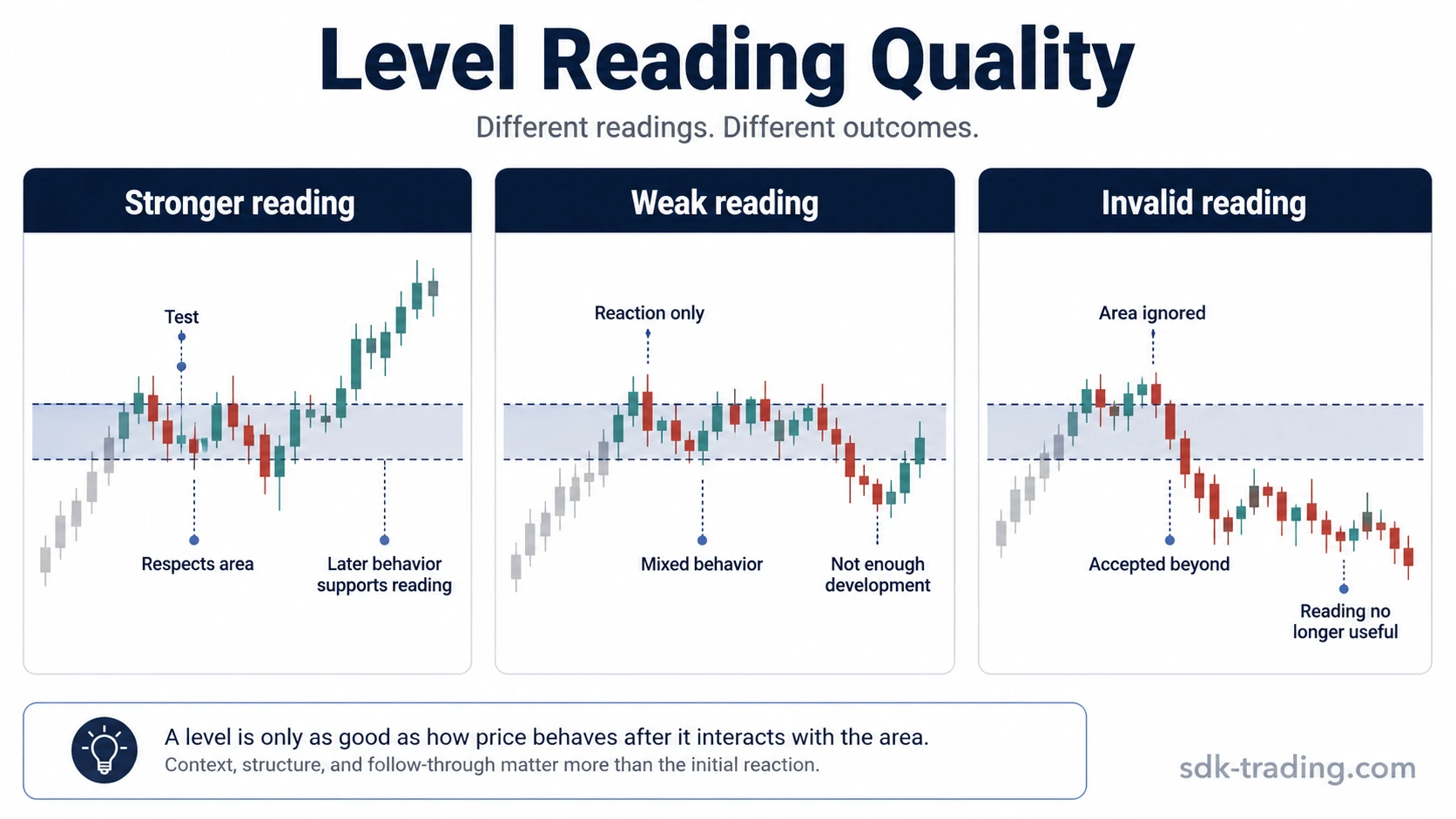
A level reading becomes more useful when it can be separated into clean, weak, and invalid conditions. This avoids treating every touch, wick, or reaction as equally meaningful.
| Reading type | Typical behavior | Interpretation | Main limitation |
|---|---|---|---|
| Clean reading | Price tests the area, respects the boundary, and later behavior supports the response | The reference area is still meaningful in the current sequence | Clean does not mean certain |
| Weak reading | Price reacts near the area, but follow-through is unclear or acceptance is mixed | The area is visible, but the reading is not yet strong | A reaction without development can fade quickly |
| Invalid reading | Price accepts beyond the area or repeatedly ignores it | The prior boundary no longer controls the current reading | The level may remain visible but lose practical meaning |
The edge-case is important: a level can still be obvious on the chart while no longer being useful. Visibility and usefulness are different. A boundary remains relevant only while later behavior continues to respect it.
Acceptance, failed acceptance, and role change
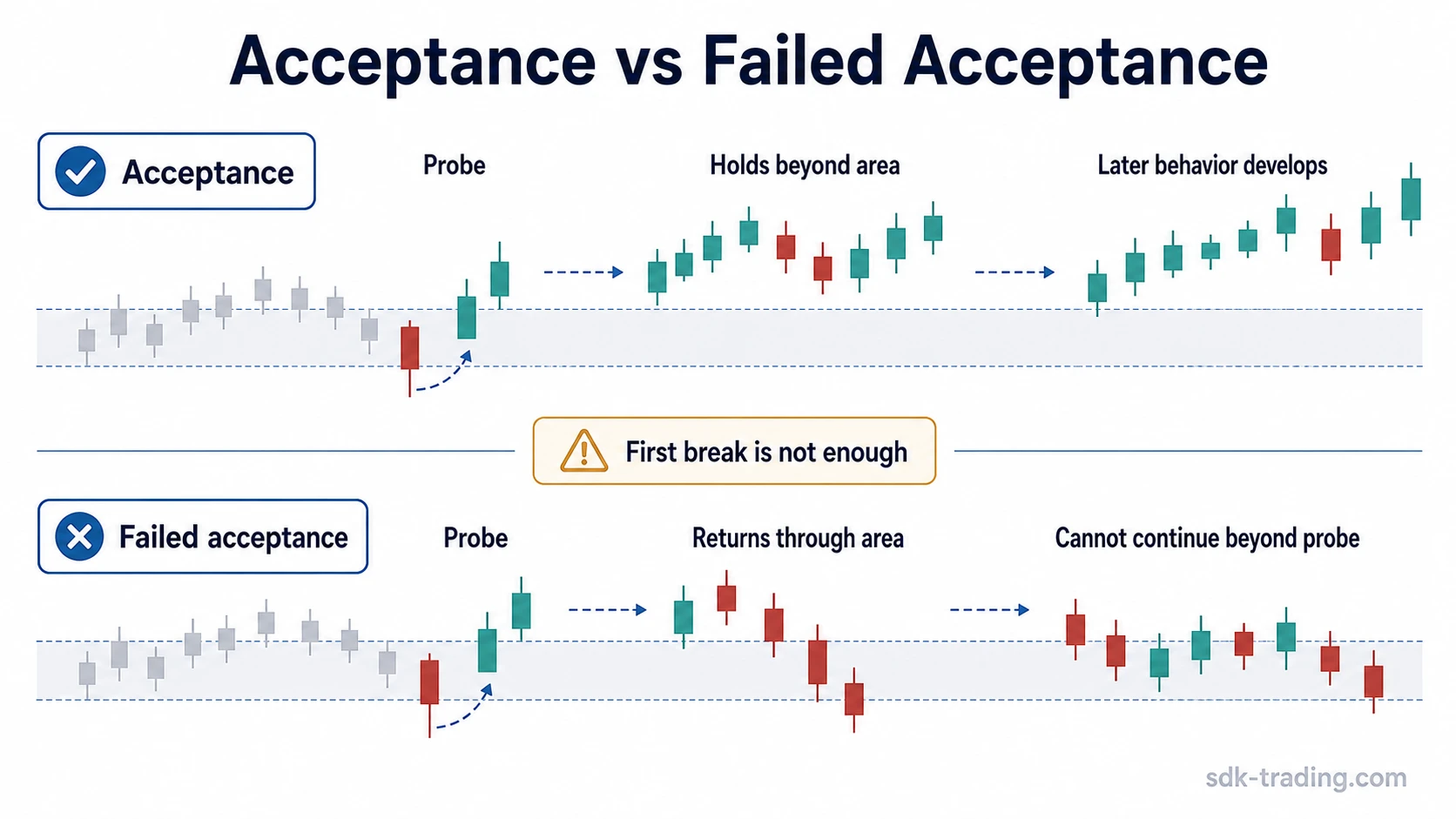
Acceptance means price moves beyond a reference area and then continues to develop behavior beyond that area. The important part is not the first break. The important part is whether price remains accepted beyond the prior boundary.
Failed acceptance appears when price probes beyond the area, returns through it, and cannot continue beyond the probe. In that case, the reading changes from “the boundary may be changing” to “the market has not yet accepted beyond the boundary.”
Role change is a later observation. A prior resistance area may begin acting like support only if price accepts above it and later behavior respects that area from the other side. A prior support area may begin acting like resistance only if price accepts below it and later behavior treats it as a boundary from underneath.
Returning back through a reference area after a probe can change the reading from acceptance to failed acceptance. The first break is not enough; reintegration through the area is often the more important clue.
A simplified chart-reading scenario
A market approaches a prior resistance area and briefly trades above it. At first, the move only shows that the prior boundary has been tested. If price then remains above the area and develops later behavior there, the reading may shift toward acceptance.
If price returns below the same area and cannot regain it, the reading changes. The useful observation is not that resistance “worked.” The useful observation is that acceptance above the reference area failed, so the boundary remains unresolved until later behavior confirms, weakens, or invalidates it.
The same logic applies in reverse around support. A brief move below support is only a probe until the next sequence shows whether price accepts below the area or returns back through it.
Common mistakes when using support and resistance
The most common mistake is treating a drawn level as if it already contains the answer. A level only marks where attention may be useful. It does not remove uncertainty.
- Drawing too many lines: When every small reaction becomes a level, the chart loses hierarchy.
- Reading the first touch too strongly: A visible reaction needs later behavior before it becomes a cleaner reading.
- Ignoring context: Trend, volatility, range position, and timeframe can change how the same area behaves.
- Confusing a probe with acceptance: Price moving through an area is different from price holding and developing beyond it.
- Assuming more touches always help: Repeated tests can clarify a boundary, but they can also show that the boundary is weakening.
When the reading becomes invalid
A support or resistance reading weakens when price no longer treats the area as a boundary. The failure condition is not emotional or fixed. It comes from later behavior.
The reading becomes less useful when price accepts beyond the area, returns to it without meaningful response, or cuts through it repeatedly. At that point, the area may remain visible historically, but the current sequence is no longer respecting it.
Invalidation is what keeps support and resistance from becoming a prediction model. The question is not whether the line is still on the chart. The question is whether current price behavior still gives the area practical meaning.
Useful summary
A support and resistance trading strategy is safest when it is treated as a conditional reading framework. The level gives a reference. The test gives current information. Acceptance, failed acceptance, and invalidation decide whether the reference area still matters.
The strongest version of the framework separates observation from conclusion. A visible area can matter, but a visible area alone is not a complete strategy.
FAQ
Is support and resistance a trading strategy?
Support and resistance can be part of a trading strategy, but a level alone is not a complete strategy. The useful framework depends on a visible reference area, a later test, acceptance or failed acceptance, and a clear condition that would weaken the reading.
Are support and resistance levels exact prices?
Support and resistance are usually better read as zones or reference areas. Exact lines can help mark the chart, but price often tests around an area rather than reacting perfectly at one fixed price.
What confirms support or resistance?
Confirmation is later observed behavior around the area. A cleaner reading appears when price tests the area and later behavior continues to respect the boundary. A single touch, wick, or reaction is not enough by itself.
What does failed acceptance mean?
Failed acceptance means price probes beyond a support or resistance area but cannot remain accepted there. Returning back through the reference area changes the reading because the break has not developed into sustained behavior beyond the boundary.