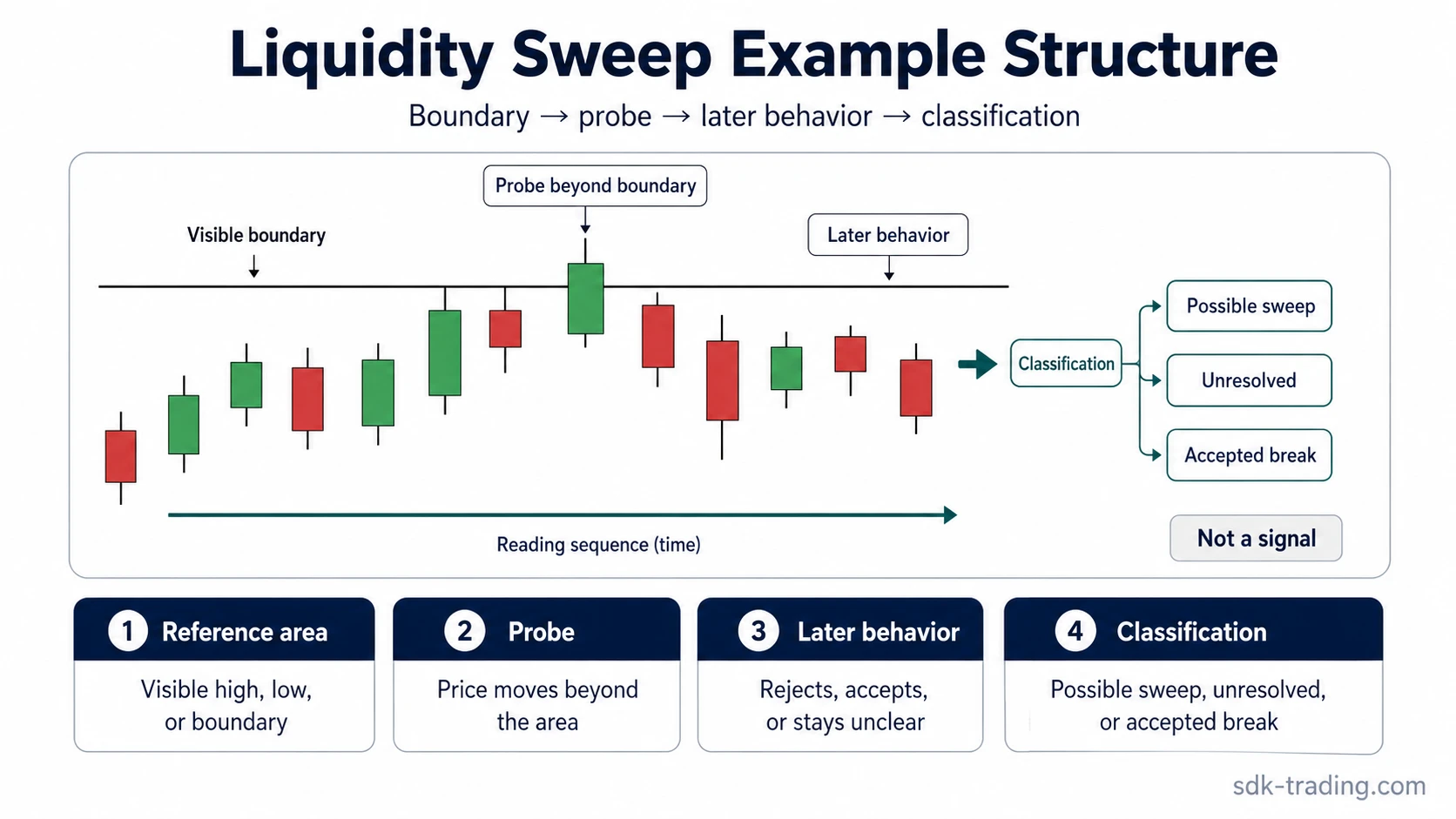
Liquidity sweep examples are easiest to misread when a visible high or low is broken, because the break alone does not confirm a sweep reading. A stronger reading needs a visible boundary, a probe beyond that boundary, and later behavior that shows whether price failed, accepted, or remained unresolved around the area.
In trading, a liquidity sweep reading is about structure and later acceptance, not about treating a wick beyond a level as a complete answer. The same initial move can become a stronger sweep example, a weak unresolved example, a simple break, or a grab-like probe depending on what price does after the boundary is tested.
Core idea: a liquidity sweep example begins with a visible reference area, but the classification comes from later behavior. The probe starts the question; acceptance, rejection, or unresolved movement shapes the answer.
What Makes a Liquidity Sweep Example Valid?
A cleaner liquidity sweep example usually has three observable parts: a visible high or low, a move beyond that area, and later behavior that fails to hold beyond the tested boundary. Without all three, the reading is weaker.
The visible reference area matters because the sweep reading depends on a level that market participants could reasonably notice. That area might be a prior swing high, prior swing low, equal high area, equal low area, or another clear boundary. If the level is not obvious, the later interpretation becomes less stable.
The probe matters because price must move beyond the reference area before the sweep idea can even be considered. A candle wick beyond the area may be part of the evidence, but it is not enough by itself.
Later behavior matters most. If price returns back through the boundary and cannot maintain acceptance beyond it, the sweep reading becomes more defensible. If price holds beyond the area and builds structure there, the example is better classified as acceptance or a simple break rather than a completed sweep.
- Reference area: a visible high, low, or boundary is already clear.
- Probe: price briefly moves beyond that area.
- Later behavior: price rejects, accepts, or remains unclear around the boundary.
- Classification: the example is stronger, weak, invalid, or unresolved.
Liquidity Sweep Example vs Simple Break
A simple break and a liquidity sweep example can begin the same way. Both may start with price moving beyond a visible high or low. The difference comes after the break.
A simple break is better classified when price holds beyond the level, builds acceptance, and continues to treat the old boundary as part of the new structure. In that case, the move beyond the level is not automatically a failed probe. It may be a new accepted area.
A liquidity sweep reading is more supported when price probes beyond the level but then fails to hold there. The old boundary remains important because follow-up structure shows that the move beyond it did not become accepted structure.
| Observed behavior | Safer interpretation | Why the distinction matters |
|---|---|---|
| Price moves beyond a visible high or low and holds there | Possible accepted break | The market may be building structure beyond the old boundary. |
| Price probes beyond the boundary and quickly returns inside it | Possible sweep reading | The move beyond the level failed to become accepted structure. |
| Price moves beyond the level but later behavior is mixed | Unresolved reading | The example is not complete enough to classify cleanly. |
Strong, Weak, and Invalid Liquidity Sweep Examples
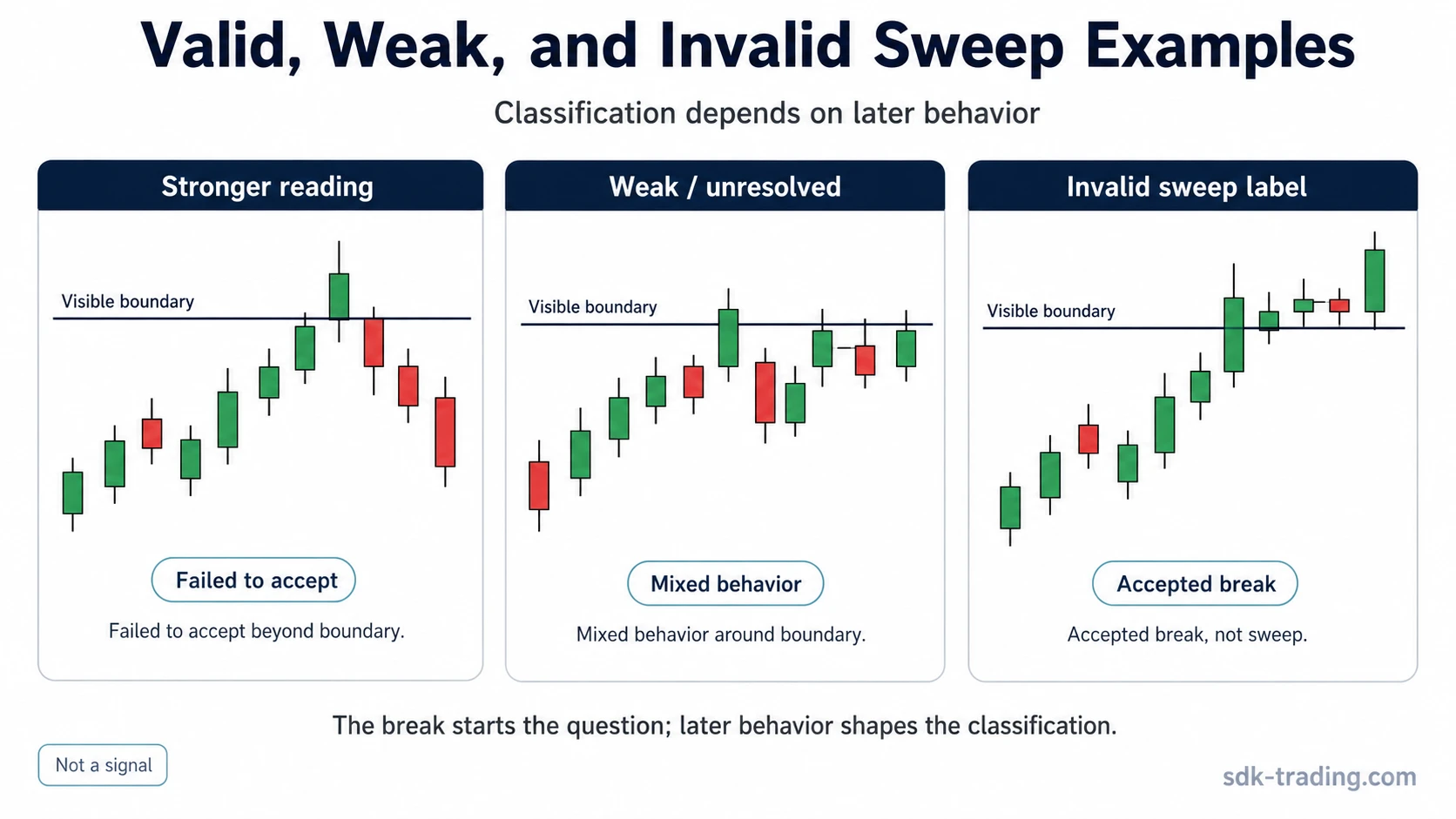
Liquidity sweep examples become clearer when they are classified by quality instead of labeled from the first candle that breaks a boundary. The useful distinction is not whether price crossed a line, but whether the later structure supports the sweep reading.
| Example type | What appears on the chart | Better reading | Main limitation |
|---|---|---|---|
| Stronger sweep example | A visible boundary is probed, price fails to hold beyond it, and later candles return back through the area. | The sweep reading is more supported because the move beyond the boundary did not become accepted structure. | It still does not predict the next move by itself. |
| Weak or unresolved example | Price trades beyond a level, but later candles do not clearly reject or accept the area. | The structure remains unfinished, so the sweep label is premature. | Unclear follow-through can make both reversal and continuation readings fragile. |
| Invalid or simple break example | Price breaks the boundary and then continues to hold beyond it. | The move is better treated as acceptance beyond the level, not a completed sweep. | Calling it a sweep can force a failed interpretation onto accepted price action. |
| Grab-like probe | Price briefly tags or pierces a nearby level, but the larger sweep sequence is not clean. | The example may sit closer to a liquidity grab reading than a full sweep reading. | The distinction depends on the boundary clarity and later behavior. |
Misread vs Safer Interpretation
The most common error is assigning the sweep label too early. A visible high or low can attract attention, but the first move beyond it only creates a possible reading. Acceptance or failure after the probe decides whether that reading improves or breaks down.
| Common misread | Safer interpretation |
|---|---|
| Every wick beyond a high or low is a liquidity sweep. | A wick is only one piece of structure. The later close, the next candles, and the ability or inability to reclaim the boundary all matter. |
| A sweep automatically means reversal. | A sweep reading only describes a failed or rejected probe around a boundary. Direction still depends on later structure. |
| A break beyond the level is enough to classify the example. | The break starts the classification process. It does not complete it. |
| An unresolved move can be treated as confirmed. | Mixed behavior around the boundary should remain unresolved until acceptance or failure becomes clearer. |
Example of a Cleaner Liquidity Sweep Reading
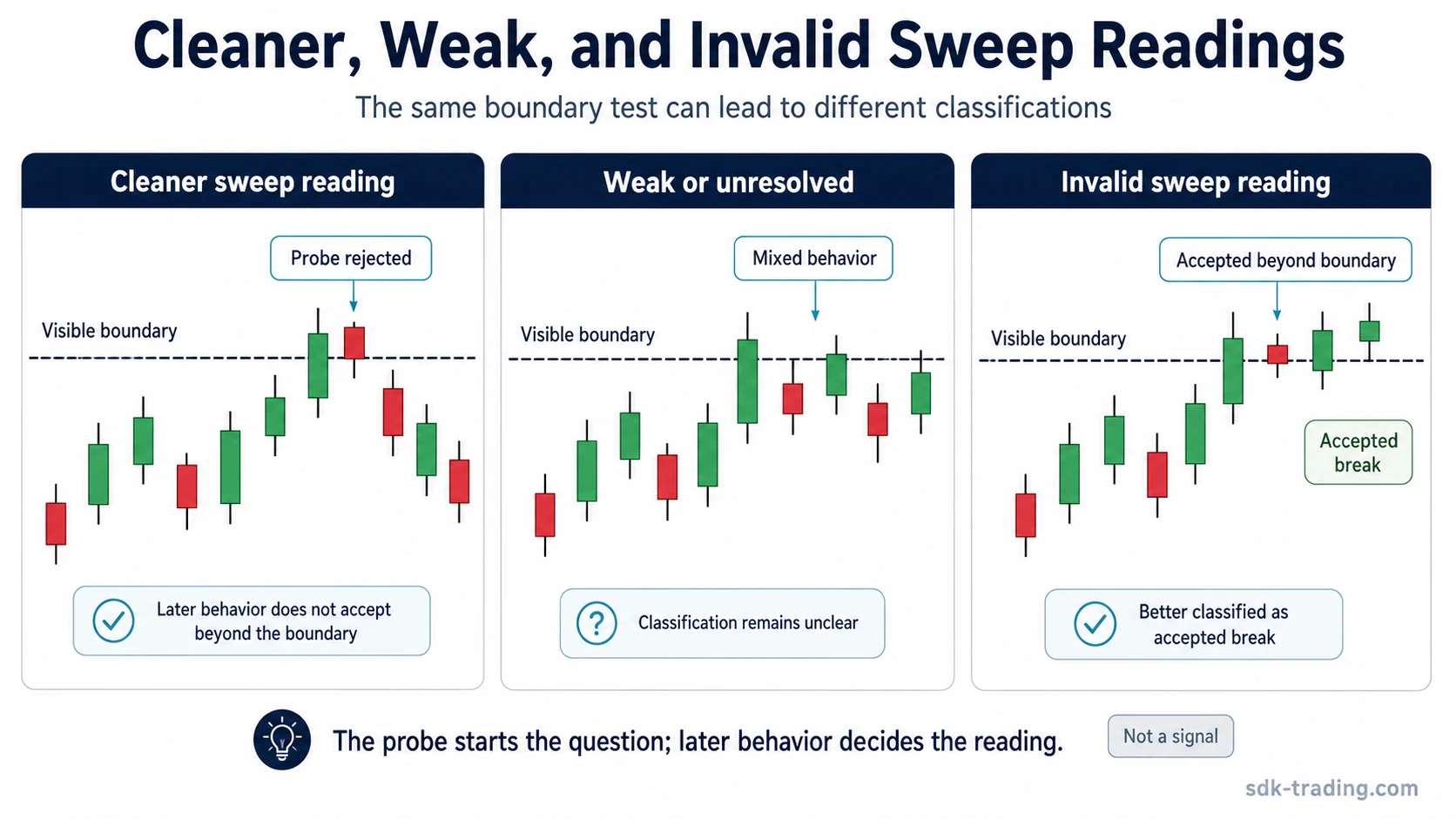
Price advances into a prior high that has already acted as a visible reference area. It trades briefly above that high, but the close cannot hold above the boundary. The next candles return below the level, and a later attempt to reclaim the same area stalls.
That sequence creates a cleaner sweep reading because the move beyond the high did not become accepted structure. The important evidence is not the first move above the level. The important evidence is the failure to hold above it and the later inability to reclaim the area cleanly.
The same logic can apply around a visible low. Price may trade below a known lower boundary, then return back above it. The reading becomes more defensible only if later behavior shows that the move below the boundary failed to gain acceptance.
Example of a Weak or Unresolved Sweep Reading
Price breaks above a prior high and then pauses around the boundary. Some candles trade back below the level, but later candles continue to test both sides of the same area. Neither acceptance above the level nor clean failure below it is obvious.
That structure is weaker because the follow-up structure does not give a clear answer. Calling it a completed sweep can overstate the evidence. Calling it a clean breakout can also overstate the evidence. The safer reading is that the boundary remains unresolved.
Unresolved examples prevent a mechanical sweep label because they keep the boundary classification open. A price move can be interesting, visible, and still incomplete.
Example of an Invalid Sweep Reading
Price moves above a visible high, closes above it, and then keeps treating the old high as accepted structure. Later candles hold above the boundary instead of rejecting it.
That is a weak place to force a sweep interpretation. The move beyond the level did not fail. It became accepted, at least for that part of the structure. A better classification is a break with acceptance, not a completed liquidity sweep example.
The same problem appears below visible lows. If price moves below a lower boundary and continues to hold below it, the example is not automatically a sell-side sweep. The market may be accepting lower structure rather than rejecting the probe.
Common Mistakes When Reading Liquidity Sweep Examples
| Mistake | Cleaner reading |
|---|---|
| Mistaking any wick for a sweep | A wick beyond a visible level can begin the question, but it does not finish the reading. The close, the next candles, and the ability or inability to reclaim the boundary all matter. |
| Assuming sweep means reversal | A sweep reading describes how price behaved around a boundary. It does not guarantee that price will reverse. Later structure may reject the area, accept the area, or remain mixed. |
| Ignoring acceptance | Acceptance is the main reason some supposed sweep examples fail. If price holds beyond the tested area, the example may belong in the simple break category instead. |
| Reading incomplete structure too early | The first break often looks more meaningful than it is. A better classification waits for enough later behavior to separate failure, acceptance, and unresolved movement. |
Liquidity Sweep vs Liquidity Grab in Examples
Liquidity sweep and liquidity grab readings are often confused because both can involve price moving beyond a visible high or low. The difference is usually about structure quality and the amount of later behavior available for classification.
A liquidity sweep example normally needs a clearer boundary, a probe beyond that boundary, and later evidence that the move failed to gain acceptance. A liquidity grab example can be a shorter, sharper probe where the broader sequence is less developed or less clean.
The distinction matters because a grab-like move should not be forced into a full sweep reading when the boundary, follow-through, or later behavior is not strong enough.
How Liquidity Sweep Examples Should Be Classified
Liquidity sweep examples are most useful as classification tools. They help separate a rejected probe from an accepted break, an unresolved move, or a grab-like test of a nearby level.
They are not entry instructions, exit instructions, stop placement rules, target frameworks, or performance claims. The example only describes what price has done around a visible boundary. Any further interpretation depends on separate market context and should not be inferred from the example alone.
Limitation: a liquidity sweep example can improve structure reading, but it does not turn a chart into a trade signal. The reading becomes safer when it stays conditional: boundary, probe, later behavior, classification.
Liquidity Sweep Examples FAQ
Is every break of a high or low a liquidity sweep?
No. A break becomes a possible sweep reading only when later behavior fails to accept beyond the tested boundary. If price holds beyond the level, a simple break or accepted structure may be the better classification.
Can a liquidity sweep example fail?
Yes. A possible sweep reading can fail if price accepts beyond the boundary instead of rejecting it. It can also remain unresolved if later behavior does not clearly support either acceptance or failure.
Is a liquidity sweep example a trade signal?
No. It is a way to classify price behavior around a visible boundary. It does not define direction, entry, stop placement, target, probability, or outcome.