Risk management in day trading is the process of limiting how much one trade, one session, or one emotional decision can damage a trading account. It is an intraday control layer, not a way to predict direction. The useful question is not only whether a setup looks attractive, but whether the loss limit, position size, session limit, and execution discipline are defined before the trade is active.
Definition: Risk management in day trading is the same-day process of controlling exposure across individual trades, total session loss, position size, overtrading, and emotional escalation.
Day trading compresses decisions into a short window. A trader may face several setups, changing volatility, fast losses, and the temptation to recover immediately. That makes the boundary more important than the forecast. A risk system can define how much damage is acceptable before the session begins, but it cannot prove that the next price move will follow the preferred direction.
Key Points
- Day-trading risk management controls same-day exposure rather than market direction.
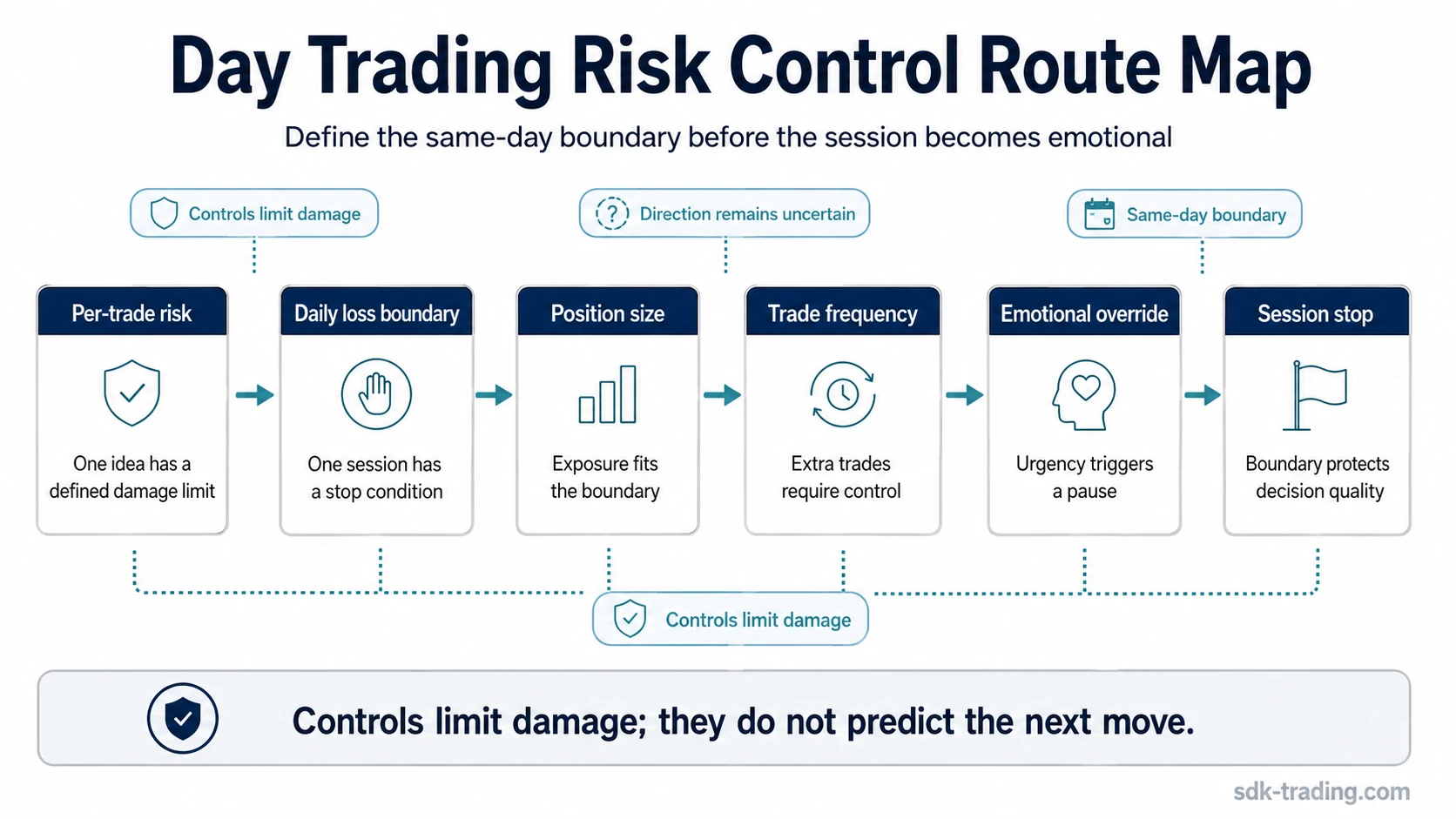
- The main limits are per-trade loss, daily loss, position size, trade frequency, and emotional override.
- Position sizing turns an idea into measured exposure; it should not be treated as a confidence score.
- Stop discipline means respecting a predefined loss limit, not finding a perfect stop location.
- Risk controls can limit damage and reduce escalation, but they do not guarantee profitability.
What Risk Management Means in Day Trading
Day-trading risk management is a narrower application of risk management in trading. The broader concept covers how traders define loss, exposure, position size, expectancy, and discipline across different trading styles. The intraday version applies those controls inside one session, where decisions and emotional pressure arrive faster.
The difference is the time constraint. A swing trader may have time to review a position after the close. A day trader often has to decide in real time whether a loss is still inside the plan, whether another trade is allowed, whether size should be reduced, or whether the session should stop. That is why day-trading risk management needs clear same-day limits before setups are evaluated.
Risk boundary versus prediction: A defined risk boundary says how much can be lost if the idea fails. It does not say that the idea will work. The limit protects the account from uncontrolled exposure; it does not remove uncertainty from the market.
The Same-Day Risk Boundary
The same-day boundary separates a planned loss from an uncontrolled session. It connects one trade, the total trading day, position exposure, and behavior after a loss. Without that control point, a small planned loss can become a larger decision problem: adding size, moving the limit, taking extra trades, or trying to recover immediately.
A clean intraday boundary usually answers four questions before the session becomes emotional:
- One trade: How much damage can one idea cause if it fails?
- One session: At what point does the day stop because the account or decision quality needs protection?
- One exposure decision: Is the position size aligned with the defined risk limit?
- One emotional trigger: What happens after frustration, revenge trading, or urgency begins to influence execution?
These questions keep risk management tied to behavior. A trader can have a reasonable market view and still create unacceptable risk if the position is too large, the daily loss limit is ignored, or extra trades are taken only to offset an earlier loss.
Core Controls Day Traders Use to Limit Risk
The core controls are not trade signals. They are filters that decide whether the account can absorb the risk of participating. The same setup can be acceptable at one size and unacceptable at another size because exposure changes the damage profile.
| Control | What it limits | Day-trading interpretation |
|---|---|---|
| Per-trade risk | Damage from one idea | A single trade should have a defined loss limit before execution. A deeper breakdown belongs in risk per trade. |
| Daily loss limit | Damage from one session | The session limit prevents one difficult day from turning into a much larger account problem. |
| Position size | Total exposure | Size converts the idea into account risk. A strong opinion does not justify larger exposure unless the loss boundary still fits. |
| Maximum trades per day | Overtrading | A trade-frequency limit adds friction when the trader starts reacting to movement instead of following a defined process. |
| Risk/reward or expectancy filter | Poor compensation for risk | The filter asks whether the potential reward is worth the defined risk, without assuming that the favorable path will occur. |
| Stop discipline | Boundary removal | Stop discipline means respecting the predefined loss boundary. It is not a tactical tutorial on where a stop should be placed. |
Position sizing in trading matters because the same price movement can create very different account damage depending on exposure. In day trading, size should follow the risk limit rather than the trader’s confidence or need to recover.
Where Day Traders Lose the Boundary
The first loss is not always the real failure. A planned loss can be part of a controlled process. The failure begins when the limit changes after the loss: the next trade becomes larger, the daily limit becomes flexible, or the trader adds more trades because the session now feels like something to fix.
Practical scenario: A trader begins with a defined risk boundary and takes an early loss. Instead of accepting that loss as part of the session plan, the trader increases size on the next trade, takes a lower-quality setup, and keeps trading after the daily loss threshold is reached. The problem is not the first loss. The problem is that the same-day boundary disappeared after emotion entered the process.
Intraday volatility can make this worse because exposure can grow faster than expected. A market that moves quickly may tempt the trader to react faster, increase size, or chase a missed move. Risk management limits the damage from that behavior, but it does not forecast whether the next move will continue, reverse, or fail.
| Condition | Implication | Limitation |
|---|---|---|
| Intraday volatility expands | Position exposure and emotional pressure can rise quickly. | Risk controls limit damage; they do not predict the next move. |
| Several trades fail in sequence | The trader may feel pressure to recover before the session ends. | A daily loss boundary protects decision quality only if it is respected. |
| A setup looks attractive after a loss | The trader may confuse opportunity with urgency. | The trade still needs the same risk limit as any other idea. |
Position Sizing as Intraday Exposure Control
Position sizing is the bridge between the trade idea and account damage. The useful role of size is not to express conviction. It is to keep the possible loss inside the limit already defined for the trade and the session.
Formula-heavy sizing can distract from the simpler control question: if the idea fails, does the loss still fit the plan? If the answer is no, the position is too large, even if the setup looks technically clean.
Limitation: Smaller size can reduce account damage, but it does not turn a weak idea into a strong one. Size controls exposure; it does not improve direction, timing, or market acceptance.
Stop Discipline as Boundary Discipline
Stop discipline is not a universal stop-placement rule. It is the discipline of defining the loss limit before execution and respecting it when the trade no longer fits the plan.
A stop can fail as a risk tool when it becomes negotiable. Moving the boundary after price moves against the idea changes the trade from planned risk into open-ended exposure. The same issue appears when a trader exits the first trade but immediately replaces it with another trade only to avoid accepting the session loss.
Good risk control treats the stop, daily limit, position size, and trade frequency as one system. Each part protects the account from a different form of escalation.
What Risk Management Cannot Do
Risk management cannot make day trading certain. It cannot prove direction, guarantee profitability, remove slippage, prevent every mistake, or turn a low-quality setup into a high-quality one. Its role is narrower and more practical: limit the damage when the idea fails, when volatility expands, or when behavior starts to break the plan.
This distinction matters because risk control can look defensive, but it is also a decision filter. A trade that cannot fit the loss boundary, session limit, and exposure plan is not automatically wrong about direction. It is simply not acceptable under the risk system.
Core limitation: Risk management can organize uncertainty and cap damage, but it cannot remove uncertainty. A controlled loss is still possible, and a controlled process can still have losing days.
FAQ
What is risk management in day trading?
Risk management in day trading is the same-day process of controlling per-trade loss, total session loss, position size, overtrading, and emotional escalation. It limits account damage rather than predicting market direction.
How do day traders manage risk?
Day traders manage risk by defining a per-trade boundary, a daily loss boundary, controlled position size, trade-frequency limits, and rules for stopping when emotion begins to affect execution.
Does risk management make day trading profitable?
No. Risk management can reduce uncontrolled losses and improve discipline, but it does not guarantee profitability, prove direction, or make every trade favorable.