A margin call in trading is not simply a losing trade. It is a margin-account threshold event where account equity no longer satisfies the required support for borrowed exposure. Once that threshold is breached, the broker may require action, restrict account control, or liquidate positions depending on account rules, product rules, and market conditions.
Definition: A margin call occurs when the equity in a margin account falls below the maintenance margin, house requirement, or another required account-support threshold. The issue is not the loss by itself, but the relationship between account equity, borrowed capital, and the broker’s required margin level.
Key Points
- A margin call is an account-control event, not just a market loss.
- The threshold depends on account equity, borrowed exposure, maintenance margin, and broker house requirements.
- A trading loss can happen without a margin call if the account still satisfies the required support level.
- The margin cushion narrows as equity falls or requirements rise.
- If a deficiency appears, broker discretion can reduce or replace trader discretion.
What Is a Margin Call in Trading?
A margin call is a warning or enforcement condition inside a margin account. It appears when the account no longer has enough equity to support the borrowed capital being used for open positions or carried exposure.
In a cash account, losses reduce account value but do not create a borrowing-support problem. In a margin account, the trader is using margin, which means the account contains a relationship between trader equity and broker-financed exposure. A margin call happens when that relationship falls below the required boundary.
The important distinction is control. Before the threshold is breached, the trader may still have room to manage exposure within account rules. After the threshold is breached, the broker’s rules can become the dominant control layer.
How a Margin Call Threshold Works
A margin call threshold is based on whether account equity is sufficient relative to the required support for the positions held. The exact calculation can vary, but the structure usually involves account equity, borrowed exposure, the maintenance requirement, and any broker house requirement.
| Account factor | Role in a margin call |
|---|---|
| Account equity | The trader’s remaining ownership value in the account after open gains, open losses, cash, and collateral changes are reflected. |
| Margin loan or borrowed exposure | The broker-financed part of the position or account exposure that creates the need for required support. |
| Maintenance margin | The minimum equity support required to keep the margin position open under the relevant rules. |
| Margin cushion | The distance between current account equity and the required support threshold. |
| Margin deficiency | The shortfall that appears when equity no longer satisfies the required threshold. |
| Broker house requirement | A broker-specific requirement that may be stricter than a basic regulatory or product-level minimum. |
The threshold can be breached because position value falls, account equity declines, collateral value changes, volatility increases, or broker requirements change. A buying-power or Reg T issue can also create a call depending on the account type and rule set.
Margin trigger: The trigger is not only price movement. A margin call can also reflect requirement changes, concentration rules, product-specific rules, or reduced buying power. The account must satisfy the broker’s support requirement, not just show an unrealized gain or loss number.
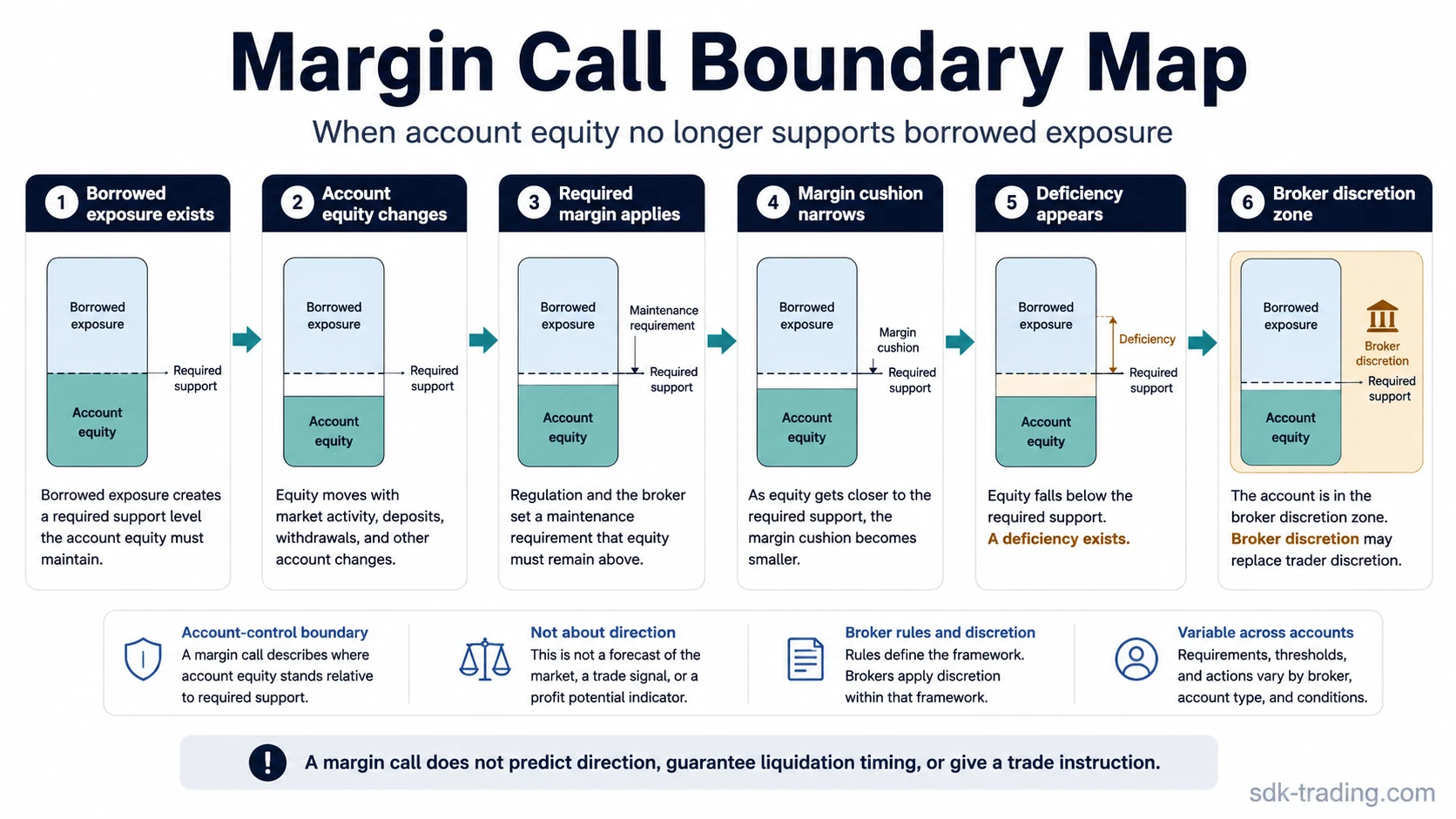
Margin Call Boundary Map
A margin call is easiest to understand as a boundary sequence. Borrowed exposure creates a required support level. Account equity moves as open profit, open loss, collateral value, and account balances change. When the cushion between equity and the requirement disappears, a deficiency can appear.
- Borrowed exposure exists: The account uses margin, so the position is supported by both trader equity and broker-financed exposure.
- Account equity changes: Open losses, open gains, collateral changes, cash movements, and position value changes alter the equity base.
- A required support level applies: Maintenance margin, house requirements, product rules, and account rules define the minimum required support.
- The margin cushion narrows: Equity moves closer to the required threshold or the required threshold rises.
- A deficiency appears: The account no longer satisfies the support requirement.
- Broker discretion can replace trader discretion: The broker may issue a call, restrict activity, or liquidate positions according to the applicable rules.
Boundary: A margin call does not predict market direction. It does not mean the position will recover, fail, or become profitable. It only shows that the account-support relationship has crossed a margin threshold.
Margin Call vs Ordinary Loss
An ordinary trading loss reduces account value or open position value. A margin call requires something more specific: the loss or requirement change must push the margin account below the required support threshold.
| Situation | What it means | Margin-call relevance |
|---|---|---|
| Ordinary loss | A position or account loses value. | No margin call exists if the account still satisfies required support. |
| Drawdown | The account declines from a prior high or reference point. | A drawdown can happen without breaching a margin threshold. |
| Margin deficiency | Account equity is below the required margin support level. | This is the threshold condition that can create a margin call. |
| Liquidation | Positions are closed by the broker or account holder. | Liquidation may happen after or alongside a margin-call condition, depending on rules and urgency. |
This distinction matters because a margin call is not just a measure of pain. It is a change in who controls the next step. A trader may still be analyzing the position, but the account may already be inside a broker-controlled enforcement zone.
Simple Margin Call Example
Example: Suppose a margin account holds positions worth $20,000, supported by $10,000 of trader equity and $10,000 of borrowed exposure. If the maintenance requirement is 30%, the account must maintain at least $6,000 of equity support against the $20,000 position value. If losses reduce account equity below the required level, the account can move from having a margin cushion to having a margin deficiency.
The numbers are only a threshold illustration. They do not describe what a trader should do, whether the position is good or bad, or whether the market will continue in the same direction. The example only shows how account equity and maintenance margin interact.
If the same account loses money but remains above the required support level, the account has a loss but not necessarily a margin call. If the required support level is breached, the issue becomes account control rather than ordinary unrealized loss.
What Traders Commonly Misunderstand
The most common misunderstanding is treating every large loss as a margin call. A loss becomes a margin-call issue only when it interacts with borrowed exposure and a required account-support threshold.
| Misunderstanding | Cleaner interpretation |
|---|---|
| A margin call means the trade is simply losing money. | A margin call means the account has crossed a required support boundary tied to margin exposure. |
| A margin call always happens after the same percentage loss. | Thresholds vary by broker, product, account type, concentration, volatility, and house rules. |
| A margin call is the same as slippage. | Slippage is an execution-price issue. A margin call is an account-equity and margin-requirement issue. |
| A margin call always leaves the trader in full control. | Broker rules may allow restriction or liquidation when the account no longer satisfies required support. |
Types of Margin Calls
Different margin calls can arise from different rule sets. The terms vary by broker and jurisdiction, but the practical idea remains the same: the account must meet a required support condition.
| Type | Basic meaning |
|---|---|
| Maintenance call | The account falls below the ongoing equity support required to hold the margin position. |
| Reg T call | The account has an issue tied to initial margin or buying-power requirements under applicable rules. |
| House requirement call | The broker applies a stricter internal requirement than a general minimum. |
| Minimum equity call | The account no longer satisfies a minimum equity condition required for the account or product. |
These labels should not be treated as universal across every platform. The controlling documents are the broker’s account agreement, product rules, margin policy, and applicable regulatory framework.
Limits of Margin Call Rules
Limitation: Margin requirements vary by broker, product, account type, position type, concentration, volatility, and market conditions. A threshold that applies to one account may not apply to another account with a different broker, instrument, or risk profile.
A margin call also does not guarantee advance warning. In fast markets, stressed products, concentrated positions, or accounts with rapidly changing collateral value, broker enforcement can happen quickly. Some rules may allow liquidation without waiting for the trader to make a discretionary decision.
The threshold should therefore be understood as an account-risk boundary, not as a market forecast. It describes the relationship between account equity and required support. It does not say where price should move next.
FAQ
Is a margin call the same as a trading loss?
No. A trading loss reduces position or account value. A margin call happens only when the account falls below the required equity support for margin exposure.
Can a broker liquidate positions after a margin call?
Yes. Depending on the account agreement, product rules, and market conditions, a broker may restrict activity or liquidate positions when required margin support is not maintained.
Does every margin account use the same margin-call threshold?
No. Margin-call thresholds can vary by broker, account type, product, position concentration, volatility, and house requirements.