Market euphoria changes how evidence and risk are weighted. As favorable price action, repeated bullish narratives, and social reinforcement build, confidence can become less conditional. Participants may then require less evidence for further upside while applying less weight to valuation, downside scenarios, position risk, or conflicting information.
Definition: Market euphoria is a collective psychology state in which confidence becomes strong enough to distort evidence weighting and weaken normal risk restraint. It is more than simply feeling positive about a rising market.
The important boundary is behavioral. Strong price performance can be justified. Optimism can remain evidence-based. Euphoria becomes more relevant when the standard used to accept bullish evidence becomes easier while the standard used to take risk evidence seriously becomes harder.
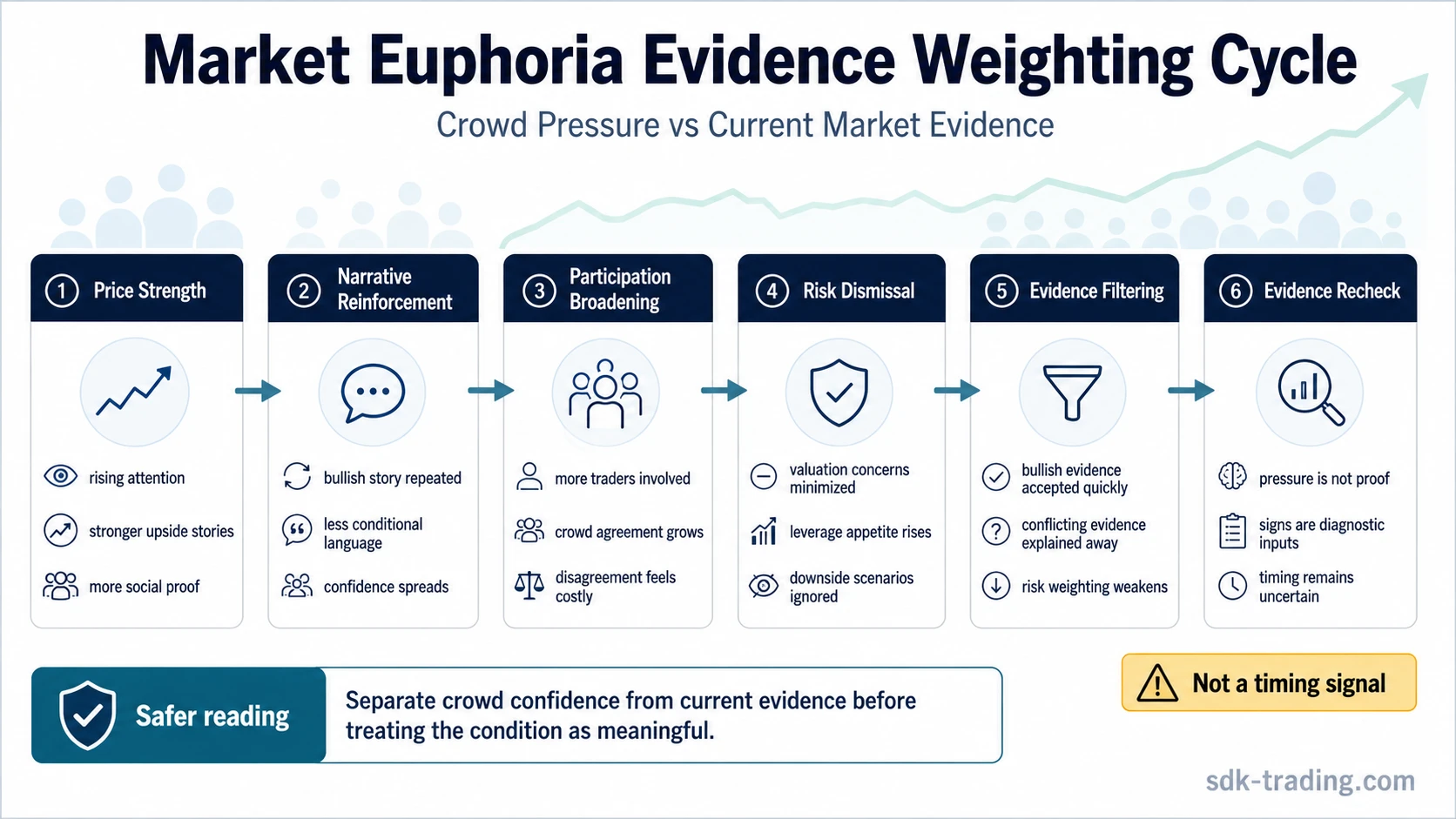
How Market Euphoria Changes the Decision Process
Euphoria usually develops through reinforcement rather than one sudden emotional event.
| Stage | What changes | Decision effect |
|---|---|---|
| 1. Favorable feedback | Price rises, recent decisions appear successful, or a popular theme keeps working. | Confidence in the existing view increases. |
| 2. Narrative reinforcement | Explanations for further upside become more repeated and more certain. | The bullish interpretation begins to feel increasingly self-evident. |
| 3. Social reinforcement | More participants, media, commentators, or communities repeat the same view. | Agreement itself starts to feel like evidence. |
| 4. Lower evidence threshold | Bullish information is accepted with less scrutiny. | Weak supporting evidence can receive too much weight. |
| 5. Weaker risk restraint | Valuation, concentration, leverage, downside scenarios, or invalidation receive less attention. | Exposure can become more aggressive without an equivalent improvement in evidence. |
| 6. Behavioral change | Participation becomes less conditional and more confidence-driven. | Position size, patience, entry quality, or willingness to reassess can deteriorate. |
Market Euphoria vs Normal Optimism
A bullish market is not automatically euphoric. Investors can have strong reasons for expecting further gains while still discussing risk, valuation, alternative scenarios, and conditions that would weaken the thesis.
| Normal optimism | Market euphoria |
|---|---|
| Confidence remains conditional on evidence. | Confidence becomes increasingly self-reinforcing. |
| Conflicting evidence is still considered. | Conflicting evidence is more easily dismissed or rationalized. |
| Risk and position size remain part of the decision. | Risk restraint can weaken as confidence rises. |
| A stronger price move can lead to reassessment. | A stronger price move itself becomes part of the justification for even more confidence. |
Diagnostic boundary: rising prices and positive sentiment are not enough. The more important question is whether the process used to evaluate evidence has changed.
Observable Signs of Market Euphoria
No single measure establishes euphoria. The reading becomes more defensible when several independent signs point toward the same change in risk perception and evidence weighting.
| Observed behavior | What it can indicate | What prevents overreading |
|---|---|---|
| Bullish narratives become less conditional | Confidence is becoming harder to challenge. | A strong narrative may still be supported by improving fundamentals. |
| Negative evidence is repeatedly rationalized away | Evidence filtering may be increasing. | Some negative information can genuinely be immaterial. |
| Position size or leverage appetite rises with confidence | Risk restraint may be weakening. | Higher exposure can still follow a defined risk framework. |
| Participation expands because others appear successful | Social reinforcement is influencing decisions. | Broader participation alone is not evidence of irrational behavior. |
| Valuation or concentration concerns stop affecting decisions | Risk evidence is receiving less weight. | Expensive or concentrated markets can remain structurally strong for long periods. |
Market Euphoria and FOMO Are Related but Different
FOMO trading describes pressure on an individual to participate because others appear to be benefiting. Market euphoria is broader. It describes a collective environment in which confidence, social reinforcement, and risk dismissal begin to reinforce each other.
A trader can experience FOMO without the wider market being euphoric. The opposite is also possible: a euphoric environment can exist even when one individual trader feels cautious.
Why Euphoria Is Not a Market-Timing Signal
Even a strong euphoric reading does not establish an exact market top. The same reinforcement process that creates distorted confidence can continue while price keeps rising.
Euphoria describes the quality of the decision environment. It does not define when available liquidity will change, when buyers will lose control, or when price structure will break.
Limitation example: A market can show aggressive narratives, broad enthusiasm, and weak attention to valuation while price continues making higher highs and holding higher lows. The euphoric condition may be real, but using that condition alone to call an immediate reversal would add a timing conclusion that the psychology evidence does not provide.
For that reason, market euphoria is more useful as a reason to recheck evidence, assumptions, exposure, and risk than as a directional forecast.
A Practical Evidence Recheck
When euphoric pressure appears possible, the useful response is to test whether the decision process has changed.
| Recheck | Question |
|---|---|
| Evidence | Would the same information still look convincing if recent price performance were removed from the story? |
| Contradictory information | Is conflicting evidence being evaluated or merely explained away? |
| Risk | Has acceptable position risk increased only because recent outcomes were favorable? |
| Invalidation | Are there still observable conditions that would weaken the bullish interpretation? |
| Behavior | Has confidence changed entry quality, patience, sizing, or willingness to reassess? |
Interpretation limit: market euphoria can identify a deterioration in evidence handling and risk restraint. It cannot determine future price direction or the timing of a reversal.