Emotional discipline in trading is the ability to keep the decision process stable when fear, greed, regret, excitement, or uncertainty starts pressuring judgment.
The useful distinction is not whether the final trade worked. The sharper distinction is which part of the decision became less objective: the trigger, the timing, the risk comfort, the recovery impulse, or the review after the outcome.
That makes emotional discipline most useful as a classifier: name the pressure that changed the decision before choosing the deeper concept to review.
Definition: Emotional discipline in trading means separating market evidence from emotional pressure so that a trade idea, skipped trade, exit decision, or review note is judged by process quality rather than by discomfort, urgency, or the most recent result.
Key Points
- Emotional discipline is process stability under trading pressure, not the absence of emotion.
- Different emotional failures create different behavior distortions.
- FOMO, panic selling, revenge trading, trading anxiety, and market euphoria should be separated instead of merged into one broad discipline label.
- The stronger diagnostic step is identifying the distorted decision layer, not judging the trade only after the result is known.
How Emotional Pressure Changes a Trading Decision
Emotional pressure changes a trading decision by narrowing attention. A trader may stop comparing evidence, may overweight the most recent candle, may treat discomfort as information, or may try to repair a previous result instead of judging the current setup.
That pressure can appear before a trade, during risk management, after a loss, after a favorable run, or during review. The same broad label, “lack of discipline,” is too blunt because each pressure point changes a different part of the process.
| Decision layer | How pressure can distort it | Cleaner diagnostic check |
|---|---|---|
| Trigger | The trade idea starts from urgency, fear, or excitement instead of evidence. | Identify whether the idea came from market structure or emotional pressure. |
| Timing | The trader rushes, freezes, or enters late because waiting feels uncomfortable. | Separate evidence-based timing from discomfort with waiting. |
| Risk comfort | Exposure feels acceptable only because emotion is high or recent results are vivid. | Check whether the same decision still makes sense without the recent outcome. |
| Recovery impulse | The next action is shaped by a desire to erase a prior loss or mistake. | Distinguish the current setup from the previous emotional state. |
| Review | The outcome rewrites the decision record and makes uncertainty look obvious afterward. | Separate what was known before the result from what was only known after it. |
Which Emotional Pattern Fits the Problem?
Emotional discipline becomes more useful when the behavior is classified by the pressure that changed the decision. A missed move, a losing trade, a strong favorable run, and a stressful open position can all create discipline problems, but they do not point to the same deeper concept.
| Trader problem | Likely emotional pattern | What changed in the decision | What to inspect next |
|---|---|---|---|
| A move was missed, and entering late starts to feel necessary. | FOMO trading | Urgency replaced the original evidence threshold. | Compare the late-entry urge with the evidence that existed before the move became obvious. |
| After favorable conditions, confidence expands faster than the decision record supports. | Market euphoria | Recent positive feedback made risk feel easier to accept. | Check whether confidence rose because evidence improved or because the environment felt rewarding. |
| A position is closed mainly to end fear, stress, or discomfort. | Panic selling | Emotional relief became more important than the original decision record. | Separate evidence of invalidation from the need to reduce discomfort immediately. |
| A loss creates pressure to trade again so the account or ego feels repaired. | Revenge trading | The next decision became tied to recovery rather than a fresh setup. | Check whether the trade idea would still exist without the previous loss. |
| The trader freezes, over-monitors, hesitates, or repeatedly rechecks the same information. | Trading anxiety | Uncertainty became hard to tolerate, so the process stalled or became repetitive. | Identify whether more information is actually needed or whether uncertainty is being managed through repetition. |
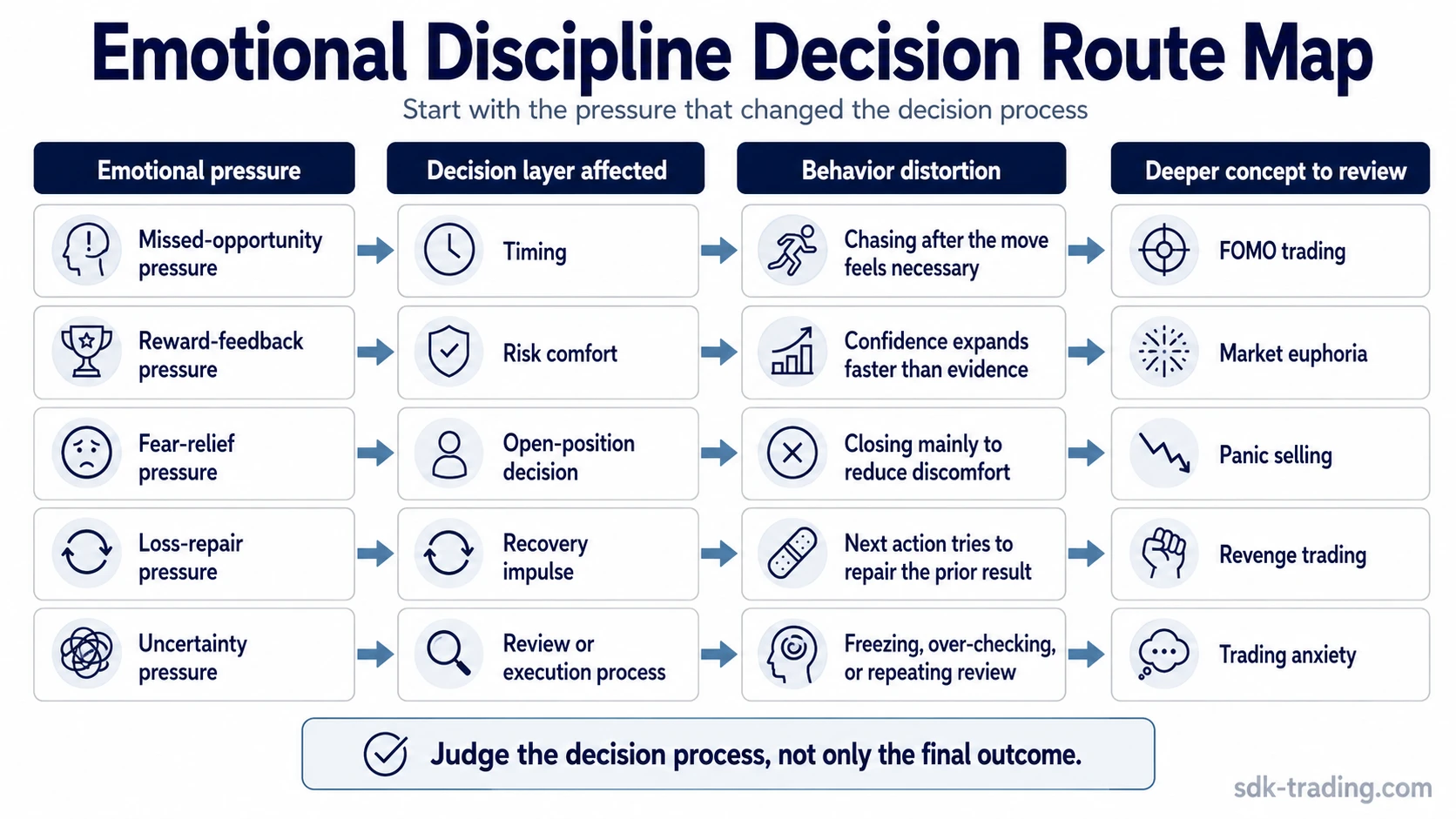
Core Emotional Discipline Routes
The main emotional discipline patterns can be grouped by the kind of pressure that takes control. The point is to name the pressure accurately enough that the next concept is specific, not generic.
- Missed-opportunity pressure: chasing after a move already feels obvious.
- Reward-feedback pressure: confidence, size comfort, or conviction expands after favorable conditions.
- Fear-relief pressure: closing or reducing exposure becomes a way to end discomfort.
- Loss-repair pressure: the next trade becomes emotionally attached to getting back what was lost.
- Uncertainty pressure: hesitation, over-checking, and stalled decisions replace clean review.
Note: One trade can involve more than one emotional pressure. The cleaner classification starts with the behavior that changed first, then checks whether a second emotion amplified it.
Broad Discipline Mechanisms
Broad emotional discipline still matters, but it works best as a stabilizing layer. It keeps decisions comparable from one situation to the next and reduces the chance that each new emotional state creates a new rule.
| Mechanism | What it stabilizes | Boundary |
|---|---|---|
| Plan adherence | The gap between the intended process and the action taken under pressure. | A plan can reduce improvisation, but it does not identify which emotion distorted the decision. |
| Journal review | The decision record before and after the outcome. | Review is more useful when it records uncertainty, not only the final result. |
| Pause rule | The impulse to act immediately after fear, excitement, or frustration rises. | A pause can interrupt urgency, but it is not a trade rule or a market signal. |
| Risk consistency | The tendency to accept different exposure only because emotion has changed. | Consistency means the decision remains comparable, not that risk disappears. |
| Outcome review | The habit of judging a decision only by what happened afterward. | A good outcome can still come from weak process, and a weak outcome can still come from a defensible process. |
Emotions in trading can describe the broader emotional field, while emotional discipline is the process layer that asks how those emotions changed the decision.
Emotional Discipline Example in Context
Price has already moved without the trader. The next candle makes the missed move feel more urgent, and the trader starts looking for a reason to enter late. The issue is not whether the move continues. The issue is whether the decision standard changed after the opportunity felt missed.
If the main pressure is urgency after a missed move, the better fit is FOMO trading. If the same trader is acting after a loss and trying to recover emotionally, the better fit may be revenge trading. If the trader cannot act because uncertainty feels intolerable, trading anxiety becomes the more relevant pattern.
Where Broad Discipline Stops
Boundary: Broad emotional discipline should not replace the specific emotional pattern. “Be more disciplined” is too vague when the actual issue is chasing, freezing, forced recovery, fear-driven liquidation, or confidence expansion after favorable conditions.
Multiple emotions can overlap, but classification starts with the first behavior distortion. A trader who chases a missed move needs a different review check than a trader who exits mainly to reduce fear. A trader who expands risk after favorable conditions needs a different check than a trader who cannot act because uncertainty feels too uncomfortable.
The fear and greed cycle can help explain broad shifts in emotional pressure, but individual behavior still needs a more precise label when the goal is decision review.
FAQ
Can one trading decision involve more than one emotional pattern?
Yes. A missed move can create FOMO, a later loss can create revenge pressure, and uncertainty can create hesitation. Start with the behavior that changed first, then check whether another emotion amplified it.
How do I know whether the problem is FOMO, anxiety, panic selling, or revenge trading?
Start with the behavior that changed first. Chasing a missed move points toward FOMO, freezing or over-checking points toward anxiety, closing mainly for relief points toward panic selling, and trading to repair a prior loss points toward revenge trading.
Is emotional discipline the same as ignoring emotions?
No. Emotional discipline means recognizing emotional pressure and checking whether it changed the decision process. Ignoring emotion can hide the same distortion that should be reviewed.