Revenge trading is a post-loss decision-pressure pattern where the previous loss starts shaping the next trade more than the current setup. The defining feature is not simply trading after a loss. It is letting the loss shorten reassessment, lower entry criteria, increase size or frequency, or override the original plan.
Core definition: Revenge trading happens when a trader tries to compensate for a recent loss by forcing new exposure before the next opportunity has been judged on its own evidence. The pressure usually comes from wanting to get back to even, prove the prior idea was right, recover confidence, or remove the discomfort of being wrong.
Key Points
- Revenge trading is defined by compensation pressure, not by the existence of a loss alone.
- A valid post-loss trade can still be planned if the setup, size, risk, and criteria are unchanged.
- The pattern becomes more likely when the reset window shrinks and the trader accepts weaker evidence.
- The previous loss is information about trader state. It is not market evidence for the next trade.
What Is Revenge Trading?
Revenge trading means that a trader’s next decision is being pulled by the need to repair a loss instead of by a fresh reading of the market. The trade may look like a normal re-entry from the outside, but the internal process has changed. The trader is no longer asking whether the new setup meets the plan. The trader is trying to erase the last result.
The loss can create anger, frustration, shame, fear, greed, or a threat to identity. Those emotions do not automatically make the next trade wrong. They become a problem when they change how evidence is weighted. A setup that would normally be rejected may suddenly look acceptable because the trader wants action, closure, or a quick recovery.
Important boundary: Revenge trading is a decision-process problem. It does not prove that the next market move will fail, and it does not prove that every post-loss trade is emotional. The question is whether the trader’s standards changed because of the previous loss.
When a Post-Loss Trade Is Not Revenge Trading
Not every trade after a loss is revenge trading. A trader can lose, reassess, and take another trade if the next setup independently meets the planned criteria. The diagnostic boundary is whether the new trade would still make sense if the previous loss had not happened.
| Behavior | Revenge trading reading | Not revenge trading if… | What to check |
|---|---|---|---|
| Fast re-entry after a loss | The trader is trying to recover immediately. | The same re-entry condition was already part of the plan. | Was the reset window skipped or respected? |
| Larger size after losing | Size increases to win back the prior loss faster. | Size remains inside the original risk framework. | Did the prior result change exposure? |
| Repeated trades in a short period | The trader is chasing activity instead of waiting for evidence. | Each trade has a separate, pre-defined trigger. | Are the criteria independent or recycled? |
| Taking a weaker setup | The trader accepts lower quality because action feels necessary. | The setup still meets the same quality threshold used before the loss. | Did the standard drop after the loss? |
| Returning to the same idea | The trader wants to prove the original idea was right. | New evidence changes the setup and invalidation is still respected. | Is the trade based on new evidence or attachment to the old idea? |
How Revenge Trading Forms
The revenge trading loop usually starts with a loss that feels unresolved. The trader may see the loss as unfair, avoidable, embarrassing, or inconsistent with the prior analysis. That emotional pressure can create a compensation motive: the next decision is expected to repair the emotional discomfort as well as the financial loss.
- Loss event: A trade closes at a loss, or an unrealized loss creates pressure.
- Emotional pressure: Frustration, anger, shame, fear, or urgency increases.
- Compensation motive: The trader wants to recover the loss, prove the idea, or regain control.
- Shortened reassessment: The normal pause, review, or criteria check becomes compressed.
- Lower standards or larger exposure: The trader accepts weaker setups, increases size, repeats trades, or ignores parts of the plan.
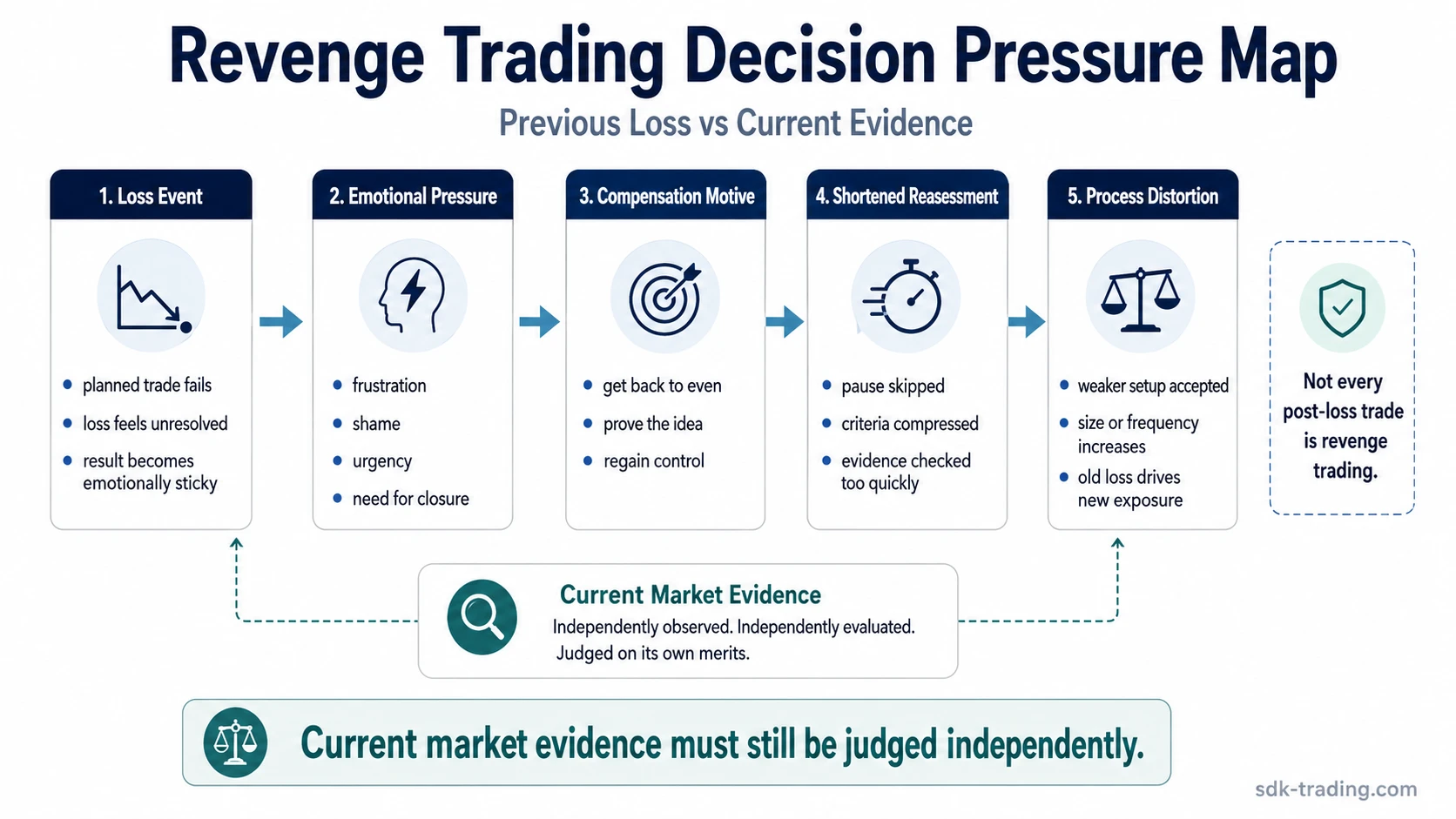
The loop can become difficult to recognize because the trader may still use market language to justify the decision. A chart level, indicator, pattern, or headline can become a rationalization if the real driver is the need to recover. The same market information would have been judged differently without the prior loss pressure.
Common Warning Signs of Revenge Trading
Revenge trading often appears as a change in behavior immediately after a loss. The strongest warning is not one isolated action, but a cluster of changed standards.
| Warning sign | Why it matters | Diagnostic boundary |
|---|---|---|
| Trying to get back to even | The account result becomes the main decision anchor. | The next setup must stand on current evidence, not on the prior loss. |
| Ignoring the original plan | The trader changes rules after emotional pressure rises. | A planned exception is different from a post-loss improvisation. |
| Increasing trade frequency | More activity can become a substitute for better evidence. | Each trade needs its own criteria, not a shared recovery motive. |
| Doubling down or averaging down impulsively | The trader may be defending the original idea instead of reassessing it. | Additional exposure needs pre-defined criteria and invalidation logic. |
| Accepting lower-quality setups | The threshold drops because the trader wants action. | The same setup quality standard must apply before and after the loss. |
Limitation: A warning sign is not proof by itself. The stronger reading comes from motive, timing, rule changes, and evidence quality moving together.
Revenge Trading Psychology
The psychology behind revenge trading is usually a pressure shift. The trader stops treating the next trade as a separate decision and starts treating it as a way to repair the previous outcome. Anger can push the trader toward immediate action. Shame can push the trader to prove competence. Fear can push the trader to recover before the loss feels permanent. Greed can appear when the trader believes a larger trade can erase the damage quickly.
Loss aversion can make the prior loss feel more important than the quality of the next setup. The trader may give more weight to recovery than to process consistency. That is why revenge trading can happen even when the trader understands the market conceptually. The problem is not lack of vocabulary. The problem is that emotional pressure changes the weighting of evidence.
Useful test: If the same trade would feel unnecessary without the previous loss, the trade may be carrying compensation pressure. If it would still meet the same criteria without the loss, the revenge-trading reading is weaker.
Simple Revenge Trading Example
A trader takes a planned breakout trade and exits at a loss after the setup fails. A few minutes later, price moves back near the same area. Instead of checking whether the breakout has acceptance, follow-through, and a valid invalidation point, the trader enters again with larger size because the first loss feels unfair. The second trade is not being judged as a separate setup. It is being used to recover the first result.
The same market sequence could be different if the trader had a planned re-entry rule. For example, a second trade after a failed first attempt may still be process-consistent when the trader waits for fresh evidence, uses the same risk rules, and accepts that the previous loss does not create a right to recover. The difference is not the timing alone. The difference is whether the decision process stayed intact.
Revenge Trading vs Nearby Emotional Pressure States
Revenge trading overlaps with other trading psychology concepts, but it has a specific trigger and motive. The core trigger is a prior loss. The core motive is compensation.
| Concept | Main pressure | How it differs from revenge trading |
|---|---|---|
| Panic selling | Urgent exit pressure during fear or perceived danger. | Panic selling focuses on getting out. Revenge trading focuses on getting back in or adding risk to recover. |
| Trading anxiety | Anticipatory stress, hesitation, overchecking, or avoidance. | Trading anxiety can reduce action. Revenge trading often increases action after a loss. |
| FOMO trading | Missed-opportunity pressure. | FOMO is usually driven by fear of missing a move. Revenge trading is driven by pressure to repair a loss. |
| Fear and greed | Broad emotional pressure categories. | Fear or greed can contribute to revenge trading, but they do not define it without the post-loss compensation motive. |
| Market euphoria | Crowd-level optimism and risk dismissal. | Market euphoria is a broader crowd state. Revenge trading is an individual decision-pressure pattern. |
The Main Misunderstanding About Revenge Trading
The common mistake is treating revenge trading as a synonym for any trade after a loss. That makes the concept too broad. Losses are part of trading, and a disciplined trader may still take a valid setup after a losing trade. The better diagnostic question is whether the loss changed the trader’s process.
Core limitation: The previous loss can explain why action feels urgent, but it does not validate or invalidate the next market opportunity. Current evidence still has to be judged separately.
A revenge-trading reading becomes stronger when several elements appear together: a recent loss, a shorter reassessment window, weaker criteria, increased size or frequency, and language focused on recovery. It becomes weaker when the trader pauses, applies the same standards, respects invalidation, and treats the next trade as independent from the prior result.
Revenge Trading FAQ
What is revenge trading?
Revenge trading is a post-loss decision-pressure pattern where a trader tries to recover, prove, or repair a loss by forcing new exposure before the next setup has been judged on its own evidence.
Is every trade after a loss revenge trading?
No. A post-loss trade is not automatically revenge trading. The revenge-trading reading becomes stronger when the loss changes the trader’s criteria, timing, size, frequency, or willingness to ignore the original plan.
What causes revenge trading?
Revenge trading can form when anger, frustration, shame, fear, greed, or identity pressure makes recovery feel more important than a fresh setup review. The emotional driver matters only when it changes the decision process.
How can revenge trading be recognized?
It can be recognized by checking whether the next trade is being used to recover a prior result. Warning signs include rushed re-entry, larger size, repeated trades, weaker criteria, and ignoring the original plan after a loss.
How is revenge trading different from panic selling?
Panic selling is usually exit pressure under fear. Revenge trading is usually re-entry or additional exposure pressure after a loss. One is focused on escaping risk, while the other is focused on recovering from a prior result.