Emotions in trading are pressure states that can change how a trader weighs evidence, follows rules, changes sizing decisions, or reacts to uncertainty.
They are not automatically a problem. They become a trading problem when fear, greed, regret, FOMO, hope, or frustration starts replacing the current evidence review.
The useful distinction is whether the emotion describes pressure on the trader or a real change in market evidence.
Definition: Emotions in trading are psychological pressure states that can influence judgment during market uncertainty, especially when price movement, recent results, missed opportunities, or unrealized gains and losses start to carry more weight than the trading process itself.
Key Points
- Trading emotions can affect evidence weighting, timing pressure, position handling, and rule discipline.
- Fear, greed, hope, regret, overconfidence, frustration, FOMO, and panic are best understood as pressure types, not fixed personality labels.
- Emotional awareness is not the same as emotional suppression. The practical goal is to notice when a feeling starts changing the evidence review.
- A cleaner process asks what changed, what stayed the same, and whether a rule is being overridden under pressure.
What Emotions Affect in Trading Decisions
Trading decisions are rarely shaped by information alone. A trader may see the same chart, rule set, or market condition differently after a recent loss, a strong winning streak, a missed move, or a sudden price spike.
The important distinction is not whether emotion exists. The important distinction is whether the emotion changes the decision process. Fear may make risk feel larger than the evidence suggests. Greed may make weak evidence feel urgent. Hope may keep an outdated view alive after market behavior has changed.
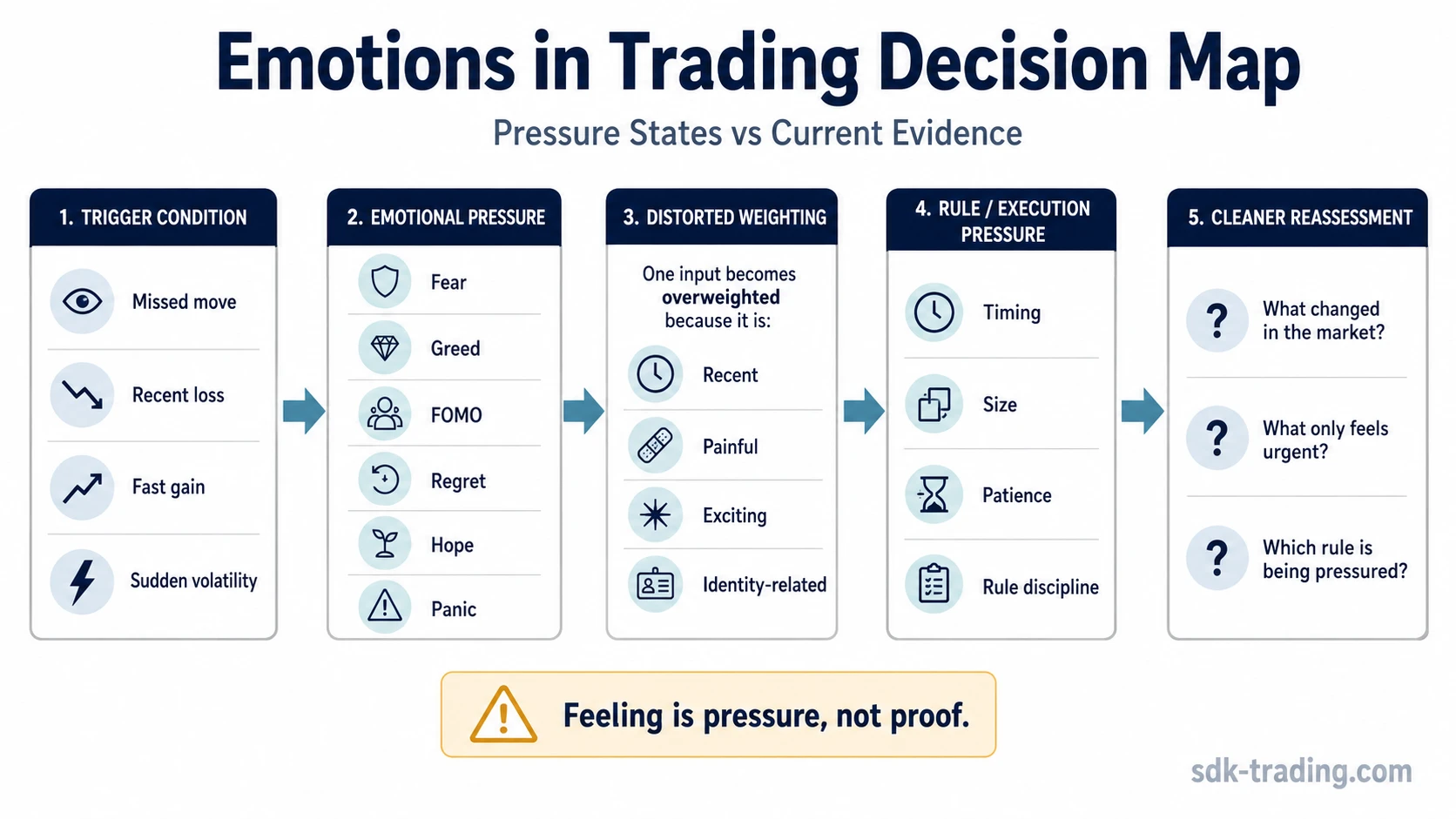
Emotions often distort trading through four channels: evidence weighting, timing pressure, sizing pressure, and rule changes. The distortion appears when the trader gives more authority to the feeling than to the current market evidence and the predefined process.
Emotion Awareness vs Emotion Suppression
Emotional discipline does not require removing emotion from trading. Markets involve uncertainty, so emotional response is normal. Treating every emotion as a defect can hide the pressure until it appears as rushed timing, larger size, or rule changes.
A cleaner review separates the feeling from the decision. The feeling is information about pressure. It is not automatically information about the market.
| Response | What it does | Trading-process risk |
|---|---|---|
| Suppressing emotion | Tries to ignore the pressure state | The pressure may still appear later as rushed timing, larger size, or rule changes |
| Following emotion | Treats the feeling as if it is evidence | The decision can drift away from the current chart, plan, or risk boundary |
| Observing emotion | Names the pressure before reassessing the evidence | The decision still needs a process check, but the distortion becomes easier to detect |
Common Emotional Pressures in Trading
Common trading emotions matter because each one can push the decision process in a different direction. The same market movement can create fear for one trader, greed for another, and regret for a third depending on position, expectation, and recent experience.
| Emotional pressure | Typical trigger | Decision distortion |
|---|---|---|
| Fear | Losses, volatility, uncertainty, or fast adverse movement | Evidence may be interpreted as more threatening than it is |
| Greed | Fast gains, strong momentum, or repeated favorable outcomes | Weak evidence may feel stronger because the trader wants more exposure |
| FOMO | A move starts without the trader | Urgency may replace selectivity and patience |
| Panic | Sudden loss pressure or perceived loss of control | The trader may react before reassessing whether the evidence has actually changed |
| Hope | A weakening idea remains emotionally important | The trader may keep defending an outdated scenario |
| Regret | A missed move, early exit, or prior mistake | The next decision may become compensation for the previous one |
| Overconfidence | A winning streak or recent correct call | The trader may reduce evidence standards or ignore invalidating information |
| Frustration | Blocked progress, repeated losses, or choppy conditions | The trader may abandon the process in order to force resolution |
Failure-Mode Map for Emotional Decisions
The most useful way to analyze emotions in trading is to map the pressure to the process change. The issue is not the emotion itself. The issue is the point where a feeling starts changing what evidence counts, which rule applies, or how much urgency the decision appears to carry.
| Trigger condition | Emotional pressure | Common misread | Execution distortion | Cleaner reassessment question |
|---|---|---|---|---|
| Price moves quickly after a missed entry | FOMO | The move feels like proof that action is urgent | Timing discipline weakens | Has the evidence improved, or has urgency increased? |
| A recent loss remains emotionally fresh | Fear or regret | Similar conditions feel more dangerous than the process suggests | Decision standards may become inconsistent | Is the current evidence weaker, or is the previous loss being overweighted? |
| A position or idea starts going against expectation | Hope | The original view feels more important than the new information | Invalidating evidence may be minimized | What evidence would change the original scenario? |
| A strong winning streak creates confidence | Overconfidence | Recent correctness feels like current evidence quality | Rules may become looser or less explicit | Would the same decision pass the process without the recent wins? |
| Price accelerates against a held view | Panic | The discomfort feels like a complete evidence change | Reaction speed can replace structured reassessment | What specifically changed in market behavior, and what only changed emotionally? |
| Several decisions fail to resolve cleanly | Frustration | The market feels as if it must offer a decisive answer now | The trader may force action in unclear conditions | Is the market offering evidence, or only pressure to act? |
How Emotions Distort Evidence Weighting
Evidence weighting changes when one input becomes too influential because it is recent, painful, exciting, or tied to identity. A trader may technically review the same evidence, but the emotional pressure can change which part of the evidence receives the most attention.
A recent loss can make neutral information feel threatening. A missed move can make ordinary momentum feel urgent. A strong prior opinion can make conflicting evidence feel less important. In each case, the emotional pressure does not create new market evidence. It changes how existing evidence is ranked.
Process note: A cleaner review separates three questions: what changed in the market, what stayed the same, and which rule is being pressured by the emotion.
How to Control Emotions in Trading Without Suppressing Them
Controlling emotions in trading is better framed as process hygiene than as emotional elimination. A trader cannot remove uncertainty from the market, but the decision process can make emotional interference easier to detect.
- Name the pressure: Identify whether the decision is being influenced by fear, greed, FOMO, hope, regret, overconfidence, panic, or frustration.
- Separate feeling from evidence: Ask what new information actually appeared and what only feels more urgent.
- Check the rule being pressured: Look for changes in timing, size, risk tolerance, patience, or exit logic.
- Use a review record: Journaling can expose repeated moments where emotion changes the process before the trader notices it live.
- Reduce decision noise: Fewer ambiguous decisions can make it easier to see when a real evidence change has occurred.
Boundary: Process discipline does not remove market uncertainty or create a profitable outcome by itself. It only reduces the chance that a decision is being driven mainly by unexamined emotional pressure.
Simple Emotions in Trading Example
Price advances quickly after a trader decided to wait for clearer evidence. The move looks clean in hindsight, and the missed opportunity creates urgency. The next similar setup now feels more important than it did before.
The tempting read is that the market has become easier to interpret. The weak point is that the feeling may come from the missed move rather than from better evidence. A cleaner review asks whether the next setup has clearer structure, cleaner confirmation, or better rule alignment than the earlier one. If the next setup lacks the same structure, confirmation quality, or rule alignment, the emotional pressure has increased faster than the evidence quality.
Diagnostic use: The practical check is not whether the trader feels regret. The check is whether regret is changing the evidence threshold for the next decision.
Boundaries With FOMO and Panic Selling
Emotions in trading describe the broader pressure system behind decision distortion. Specific emotional patterns deserve separate treatment when the pressure becomes narrow enough to change the decision in a recognizable way.
FOMO trading focuses on missed-opportunity urgency. The pressure usually appears when price moves without the trader and the next decision starts to feel time-sensitive before the evidence has improved.
Panic selling focuses on acute fear-driven exit pressure. The pressure usually appears when discomfort, loss perception, or sudden market movement causes reaction speed to replace structured reassessment.
Common Mistakes With Trading Emotions
| Mistake | Why it creates risk | Cleaner interpretation |
|---|---|---|
| Trying to remove all emotion | It can make the trader ignore pressure until it appears as a process break | Emotion can be observed without being allowed to control the decision |
| Treating a recent feeling as evidence | Fresh pain or excitement can outweigh the current market information | Recent emotion should be separated from actual evidence change |
| Changing rules mid-decision | The trader may call the change adaptation when it is actually pressure | Rule changes need a clear evidence reason, not only discomfort or urgency |
| Confusing confidence with confirmation | A strong belief can feel like stronger evidence | Confirmation depends on observable conditions, not conviction alone |
| Using emotion as a market prediction | Feeling fearful, greedy, or impatient does not prove what price should do next | Emotion is a pressure signal about the trader’s state, not a standalone market signal |
Limitations of Emotional Discipline
Emotional discipline can improve process consistency, but it does not make market outcomes predictable. A calm trader can still be wrong, and an emotional trader can still occasionally be correct. The difference is that a disciplined process makes errors easier to review because the decision path is more visible.
Emotion review is also not a substitute for market evidence. It works best when paired with a clear process for evaluating structure, risk, confirmation, invalidation, and decision timing. Without that process, emotional awareness can become another vague checklist rather than a practical control layer.
Important limitation: Emotional control should not be framed as a guarantee of better results. It is a way to reduce the chance of avoidable rule-breaking and evidence distortion, not a promise of trading success.
FAQ
What are the most common emotions in trading?
Common emotions in trading include fear, greed, hope, regret, FOMO, panic, overconfidence, impatience, and frustration. The important issue is how each emotion changes evidence weighting, timing pressure, or rule-following.
Should traders try to remove emotions completely?
No. A more realistic goal is to notice when emotion starts changing the decision process. Suppressing emotion can hide pressure, while observing emotion can make rule changes and evidence distortion easier to detect.
How do emotions affect trading decisions?
Emotions can affect trading decisions by making recent, painful, exciting, or identity-protecting information feel more important than the current evidence. This can change timing, size, patience, or rule discipline.