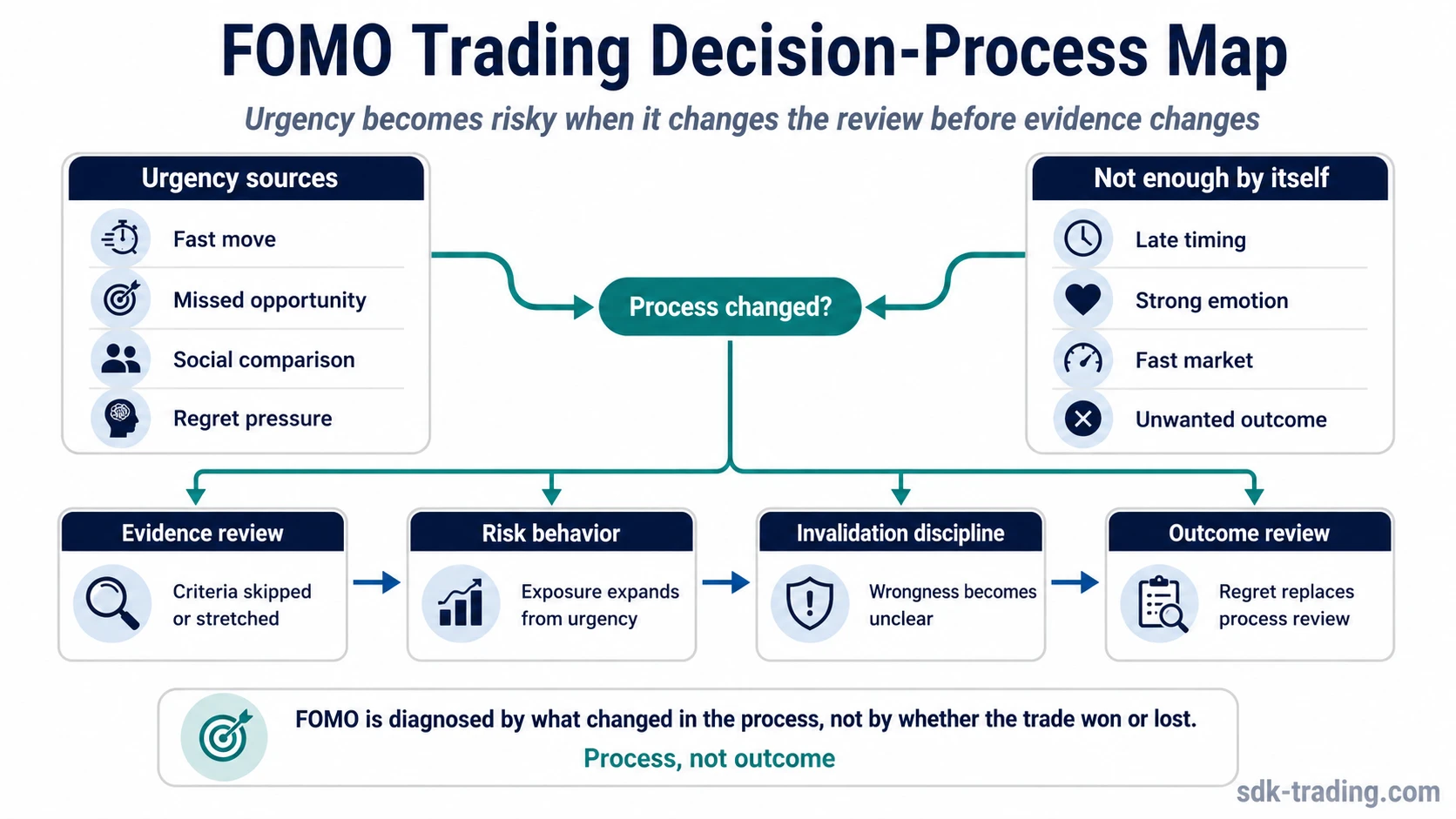
FOMO trading is emotional urgency that changes the trading decision process before the evidence, risk, or invalidation has changed.
The issue is not simply noticing a fast move, feeling pressure, or entering later than planned. FOMO becomes a trading problem when fear of missing out changes how a trader reviews evidence, sizes risk, treats invalidation, or judges the decision after the outcome.
Definition: FOMO trading means making or changing a trade because the fear of missing a perceived opportunity becomes stronger than the original decision process. The pressure usually comes from a fast price move, recent missed trades, social comparison, or regret about being left behind.
- FOMO trading is a process problem, not an outcome label.
- A late entry is not automatically FOMO if evidence, risk, and invalidation still match the plan.
- FOMO becomes easier to recognize when urgency leads to abandoned criteria, increased size, flexible invalidation, or regret-based review.
- A profitable result does not prove the decision was sound, and a losing result does not prove the trade was FOMO-driven.
What Is FOMO Trading?
FOMO trading is the fear-of-missing-out version of trading pressure. It appears when a trader feels that an opportunity is disappearing and reacts before the decision record supports the change.
That pressure can be emotional, but the classification should be practical. The question is not whether the trader felt excitement, anxiety, or regret. The question is whether those feelings changed the process used to decide, size, invalidate, or review the trade.
Useful boundary: FOMO is not the emotion itself. The trading risk begins when the emotion changes the evidence standard or risk behavior before the market evidence has changed.
When a Trade Becomes FOMO-Driven
A trade becomes more likely to be FOMO-driven when urgency starts replacing planned criteria. The same market move can be handled with discipline by one trader and with FOMO by another, because the difference sits in the decision process.
| Decision layer | FOMO pressure appears when | FOMO pressure weakens when |
|---|---|---|
| Entry decision | The plan changes because the move feels urgent. | The plan already allowed action under the new evidence. |
| Evidence review | Setup criteria are skipped, stretched, or reinterpreted to justify participation. | The same criteria are checked with the same standard as before the move. |
| Risk behavior | Size increases, risk limits move, or exposure is added without a plan-based reason. | Risk stays within the planned limit and is not expanded to compensate for a missed move. |
| Invalidation | The invalidation point becomes flexible, unclear, or ignored after entry. | Invalidation stays defined before action and remains respected after action. |
| Review quality | The outcome is judged mainly through regret, relief, or frustration. | The review separates decision quality from the final result. |
How FOMO Changes Trading Decisions
FOMO changes decisions by compressing the review process. A trader who normally waits for evidence may start treating speed as confirmation. A trader who normally controls size may increase exposure because a missed move feels like a mistake that must be repaired.
Several pressures can feed that shift. Social comparison can make other traders’ participation feel like evidence. Regret aversion can make inaction feel worse than taking a weak trade. Recency pressure can make the latest move feel more important than the broader decision record. Scarcity belief can make the setup feel like the last available chance.
Social-media pressure can intensify the same mechanism because visible excitement, screenshots, and confident commentary can make participation feel normal even when the trader’s own criteria have not been met.
Illustrative scenario: A trader sees a fast move after several missed opportunities. The fast move is not the problem by itself. The FOMO reading becomes stronger only if the trader changes the plan, increases risk, drops invalidation, or reviews the trade mainly through regret instead of evidence.
FOMO Trading Signs
FOMO trading signs are easiest to recognize when they are tied to specific decision layers. The signs are less useful as personality labels and more useful as review questions.
| Sign | Decision-process distortion |
|---|---|
| Late chasing after a fast move | Speed starts to replace evidence as the reason for action. |
| Abandoned setup criteria | The trade no longer meets the conditions that were required before the move. |
| Unplanned size increase | Risk expands because the trader wants to compensate for being late or missing earlier movement. |
| Overtrading after missed opportunities | The next trade becomes a reaction to regret rather than a separate decision. |
| Flexible invalidation | The reason to exit or stop trusting the idea becomes less clear after entry. |
| Compulsive checking | Attention shifts from evidence review to emotional reassurance. |
| Reactive exits | The trade is managed from discomfort rather than from the original decision conditions. |
| Post-outcome regret loop | The review focuses on what could have been gained or avoided instead of whether the decision process was followed. |
Planned Trade vs FOMO Trade
The clearest distinction is not whether the trade was early or late. The distinction is whether the decision was still governed by evidence, risk limits, invalidation, and review discipline.
| Decision layer | Planned trade | FOMO-driven distortion | What weakens the FOMO reading |
|---|---|---|---|
| Evidence review | The trader checks the same setup criteria before acting. | The trader lowers the evidence standard because the move feels urgent. | New evidence objectively satisfies the original criteria. |
| Risk behavior | Position size and exposure remain within the planned risk boundary. | Risk increases because missing the move feels unacceptable. | Risk remains defined and proportionate to the original plan. |
| Invalidation discipline | The trade has a clear point where the idea is no longer valid. | Invalidation becomes flexible after the trader has already acted. | The invalidation condition is defined before action and respected afterward. |
| Behavioral driver | The trade follows a prepared decision process. | The trade is driven by fear of being left behind. | The action can be explained without relying on urgency, regret, or comparison. |
| Post-outcome review | The result is reviewed against the decision process. | The result is used to justify or condemn the decision mainly because of how it felt afterward. | The review separates process quality from the outcome. |
What FOMO Trading Is Not
Not every late trade is FOMO trading. A trader can enter later than ideal and still follow a valid process if the evidence, risk, and invalidation remain intact.
Not every missed move means action was required. A missed move can create frustration, but frustration does not prove that the next trade has enough evidence.
Important limitation: The trade outcome is not the diagnostic test. A profitable impulsive trade can still come from a weak decision process, and a losing planned trade can still be process-consistent. FOMO is evaluated by what changed before, during, and after the decision.
FOMO Trading and Nearby Emotional Pressures
FOMO trading overlaps with other emotional pressures, but it should not be treated as a label for every emotional trade.
Market euphoria describes broader crowd excitement that can make opportunity feel obvious or urgent. FOMO is narrower: it focuses on the individual trader’s fear of being left out and the process changes that follow.
Panic selling sits on the opposite side of emotional pressure. FOMO often pulls a trader toward participation, while panic selling pushes a trader toward urgent exit behavior. Both can distort evidence review and invalidation discipline when pressure takes control of the process.
How to Review a Possible FOMO Trade
A trade can be reviewed by asking what changed at each decision layer.
- Evidence: Did the trade meet the same conditions that were required before the move?
- Risk: Did exposure stay within the planned boundary, or did urgency increase it?
- Invalidation: Was the point of being wrong defined before action and respected afterward?
- Behavior: Was the decision made from a plan, or from the fear of being left behind?
- Review: Was the result evaluated by process quality, or mainly by regret and relief?
This review does not require pretending emotion was absent. It only separates normal emotional pressure from a process change that made the trade less objective.
FAQ
What does FOMO mean in trading?
FOMO means fear of missing out. In trading, it describes urgency to participate because a perceived opportunity seems to be disappearing. It becomes a trading problem when that urgency changes evidence review, risk behavior, invalidation, or decision review.
How can you recognize FOMO trading?
FOMO trading can be recognized by process changes: skipped setup criteria, unplanned size increases, flexible invalidation, reactive entries or exits, and post-outcome review dominated by regret instead of evidence.
Is every late entry a FOMO trade?
No. A late entry is not automatically FOMO if the evidence, risk, and invalidation still match the planned decision process. The FOMO reading becomes stronger when the entry is late because urgency replaced the original criteria.