A trading checklist can be fully completed and still support a weak decision. The problem appears when a checked box is treated as proof that a criterion is meaningfully satisfied, even though the evidence is weak, conditions have changed, or a new reason not to act has appeared.
Edge case: A trader checks every item before a trade. The setup is present, risk is defined, and position size follows the plan. Minutes later, the market condition that supported the setup changes, but the trader still treats the completed checklist as permission to continue. The checklist was completed correctly. The decision gate was not updated correctly.
Core idea: a trading checklist is a short criteria gate that tests whether a decision still satisfies predefined rules. It should remain narrower than a full trading plan and should never turn completion itself into proof that a decision is valid.
A Checked Box Is Not the Same as a Satisfied Criterion
The useful question is not simply whether a checklist item can be marked yes. The question is whether the underlying condition still meets the standard required by the trading process.
| Checklist item | Weak version | Stronger decision check |
|---|---|---|
| Setup present | A recognizable pattern or condition exists. | Does it meet the minimum quality required by the plan? |
| Risk defined | A stop or loss boundary has been entered. | Is the risk still acceptable relative to the current structure and position size? |
| Market context checked | The environment was reviewed earlier. | Has anything changed since that review? |
| Emotional state checked | The trader does not feel obviously emotional. | Is urgency, frustration, boredom, FOMO, or recent performance changing the decision standard? |
| Rules followed | No explicit rule appears to be broken. | Is the trader stretching an interpretation to make the decision fit the rules? |
Boundary condition: checklist completion should confirm that a process test has been performed. It should not automatically confirm that the decision passed that test.
Use Thresholds, Not Vague Yes-or-No Questions
A weak checklist often uses broad items such as “good setup,” “risk okay,” or “market looks strong.” Those questions are easy to answer in whatever way supports the decision the trader already wants to make.
A stronger checklist ties the question to an observable threshold.
| Vague question | More useful threshold question |
|---|---|
| Is the setup good? | Which required conditions are present, and which are still missing? |
| Is risk acceptable? | Does the planned loss remain inside the predefined risk boundary at the current size? |
| Is confirmation present? | What specific observable event satisfies the confirmation rule? |
| Am I calm? | Would I make the same decision if the recent win, loss, or fast price move had not happened? |
A Trading Checklist Also Needs Veto Conditions
A checklist should not only collect reasons to proceed. It also needs conditions that can stop the decision even when several positive criteria are present.
| Possible veto condition | Why it matters |
|---|---|
| Required structure has changed | The original setup may no longer describe the current market state. |
| Risk has moved outside the planned boundary | The decision no longer fits the original risk framework. |
| A required confirmation failed | Other checked items should not override a failed mandatory condition. |
| Decision frequency is increasing under pressure | The checklist may be getting used to justify overtrading rather than control it. |
| The evidence is stale | A condition that was valid earlier may no longer be relevant at the decision point. |
This creates an important asymmetry: five acceptable conditions do not necessarily cancel one critical veto. Some criteria are required, while others are only supportive.
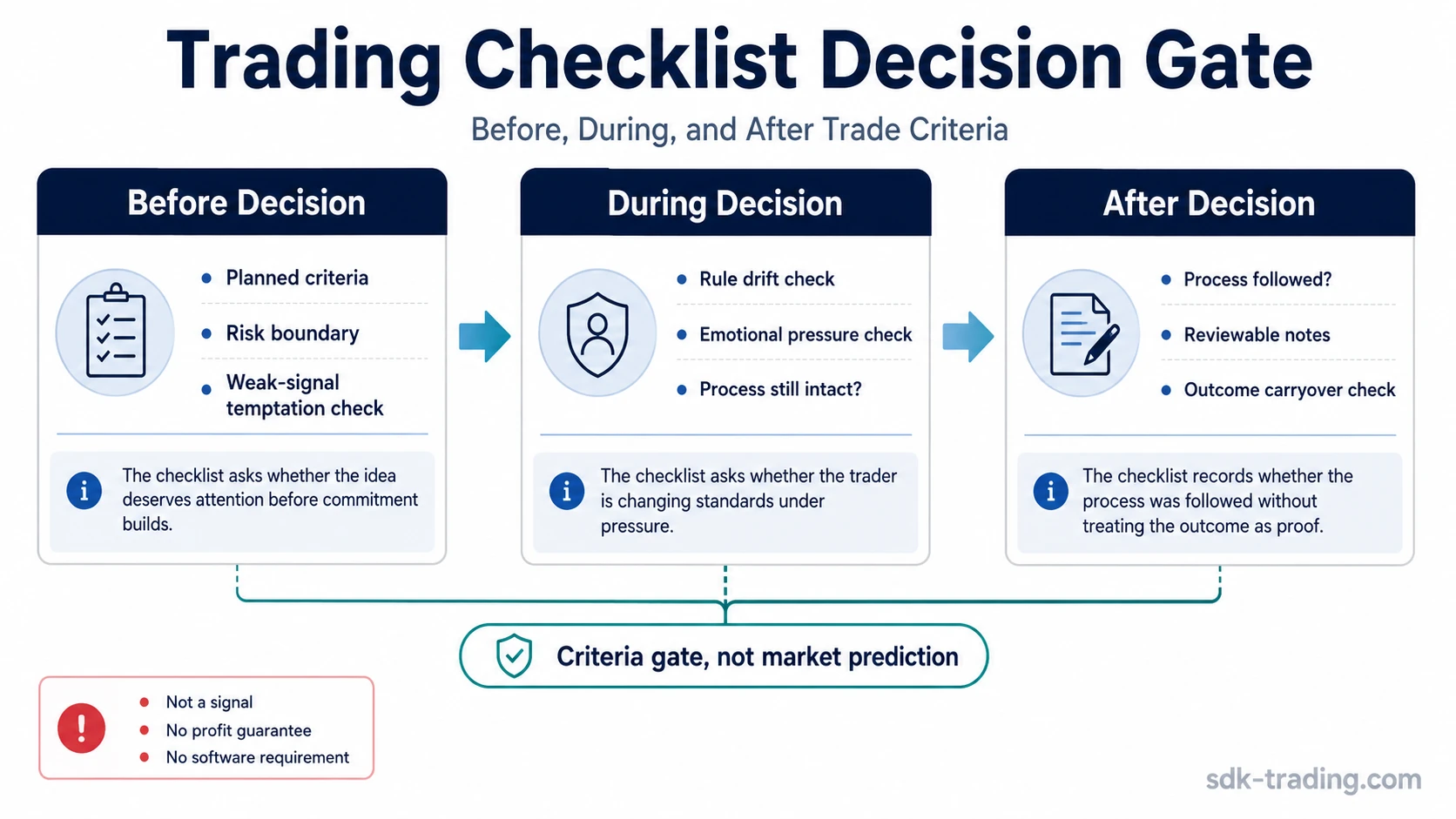
Before, During, and After the Trade Have Different Jobs
The checklist can be used at several stages, but the questions should change with the stage.
| Stage | Main job | Useful question |
|---|---|---|
| Before | Test whether the planned decision qualifies. | Do the required criteria and thresholds actually exist now? |
| During | Detect decision drift or changed conditions. | Has the market changed, or am I changing the rules because of discomfort? |
| After | Separate process quality from outcome. | Which criteria were satisfied, stretched, ignored, or added after the fact? |
Checklist Failure Can Happen Even When the Checklist Is Used
The most important failure mode is not forgetting the checklist. It is using the checklist mechanically.
Common mistake: A trader sees a fast move and checks that the setup, risk, and size are acceptable. The boxes are technically completed, but the setup criterion is being interpreted more loosely than usual because the trader is afraid of missing the move. The checklist is present, yet the decision standard has already drifted.
The useful review question is therefore not “Did I use my checklist?” It is “Did I apply the same thresholds that I would have used without the current emotional pressure?”
Keep the Checklist Smaller Than the Trading Plan
The trading plan defines the broader rules, methods, risk logic, and boundaries. The checklist should extract only the small number of conditions that need to be tested at the decision point.
If every rule, explanation, scenario, journal field, and market observation is copied into the checklist, it stops functioning as a fast control mechanism. A shorter checklist with clear thresholds and veto conditions is usually easier to apply consistently under pressure.
Interpretation limit: a checklist can make process drift easier to detect. It cannot remove uncertainty, create discipline by itself, or predict whether a trade will succeed.
A Practical Checklist Structure
A compact checklist can follow this sequence:
| Step | Question |
|---|---|
| 1. Observation | What market condition is actually present? |
| 2. Criterion | Which predefined rule does that observation relate to? |
| 3. Threshold | Is the criterion satisfied strongly enough to qualify? |
| 4. Veto | Has anything appeared that should stop the decision? |
| 5. Risk | Does the decision still fit the predefined risk boundary? |
| 6. State check | Is emotional pressure changing how any of the previous answers are being judged? |
| 7. Review | Afterward, which answers remained valid and which were stretched or ignored? |