A trading routine is a repeatable process for preparing, checking trade conditions, managing session behavior, recording decisions, and reviewing deviations. It supports execution discipline by making the decision process more consistent, but it does not replace a trading plan, checklist, journal, or risk rules.
Definition: A trading routine is the recurring sequence around a trading session that tells a trader when to prepare, when to check criteria, when to observe, when to record decisions, and when to review process quality.
The value is the order it creates around decision-making. Instead of reacting to every movement, alert, or idea, the trader has a defined path for preparation, observation, action support, recordkeeping, and review.
A routine is not a signal, strategy, or setup. It does not make a trade valid. It only makes the process more repeatable so that plan checks, risk boundaries, and review habits are less dependent on mood, pressure, or market noise.
Key Points
- A trading routine is a repeated preparation, session, record, and review structure.
- The routine supports discipline by reducing unstructured decisions during the trading session.
- It should work with the trading plan, not replace the plan’s criteria or risk rules.
- A useful routine creates boundaries before, during, and after trading instead of adding more activity.
- The routine should be judged by process consistency, not by whether one trade wins or loses.
What Is a Trading Routine?
A trading routine is the repeated sequence a trader follows around the trading session. It can include preparation, context review, plan review, eligible-decision checks, observation rules, decision recording, and post-session review.
It does not decide what is tradable by itself. That job belongs to the plan criteria and risk rules. The routine decides when those checks happen and helps prevent the session from becoming a chain of improvised reactions.
Process role: The operating sequence gives preparation, execution support, records, and review a fixed place in the session instead of leaving them to memory or pressure.
A routine can be simple. It does not need to be a long schedule, a scanner workflow, or a list of market predictions. The core question is whether it makes the trader’s process easier to repeat and harder to distort during pressure.
Why a Routine Supports Trading Discipline
Trading discipline depends on repeating the same decision process when market conditions create pressure. A routine helps because fewer choices need to be invented during the session.
Without a routine, the trader may start the session by reacting to price movement, alerts, chat messages, headlines, or recent outcomes. With a routine, the session begins with a defined order: prepare the context, check the plan, define what is eligible, observe only relevant conditions, record decisions, and review deviations later.
This matters most when activity starts to expand beyond the plan. A routine can help reduce overtrading by forcing extra activity to pass through the same criteria, risk boundaries, and review process as any planned decision.
Boundary: A routine can reduce process drift, but it cannot create discipline if the trader ignores it during pressure. The routine only works when it is short enough, clear enough, and specific enough to be repeated.
Trading Routine vs Trading Plan, Checklist, and Journal
Trading routine, trading plan, checklist, and journal are related, but they do different jobs. Confusing them makes the routine either too vague or too overloaded.
| Concept | Main role | What it should not become |
|---|---|---|
| Trading routine | The repeated sequence that organizes preparation, session behavior, records, and review. | A signal, strategy, or proof that a trade is valid. |
| Trading plan | The rules, criteria, risk boundaries, and decision logic that define eligible trading behavior. | A vague intention to be disciplined. |
| Trading checklist | The immediate verification step before a decision is made. | A full routine, journal, or strategy manual. |
| Trading journal | The record of decisions, context, deviations, and later review notes. | A replacement for planning before the session. |
| Overtrading | A process failure where activity expands beyond criteria, risk boundaries, review spacing, or record support. | A label for every active session or every losing trade. |
The simplest distinction is that the trading plan defines the rules, while the routine makes sure those rules are checked at the right time. The checklist verifies the immediate decision, and the journal records what happened for later review.
Before, During, and After Trading
A trading routine is usually easiest to manage when it is split into three phases: before trading, during trading, and after trading. The phases should define process boundaries, not exact time prescriptions.
| Routine phase | Process question | Useful boundary |
|---|---|---|
| Before trading | What context, plan criteria, and risk boundaries must be reviewed before decisions begin? | Do not begin the session from reaction alone. |
| During trading | Which conditions are eligible for attention, and which activity should be ignored or recorded for later? | Do not expand activity beyond the plan because the market is moving. |
| After trading | What was done, what was skipped, what deviated, and what needs review after emotional distance improves? | Do not rewrite the plan from one outcome or one emotional session. |
The structure should be specific enough to repeat but not so detailed that it becomes fragile. A trader using different markets, timeframes, or session lengths may need a different routine, but the same principle remains: the routine should protect the decision process from avoidable drift.
A Compact Trading Routine Flow
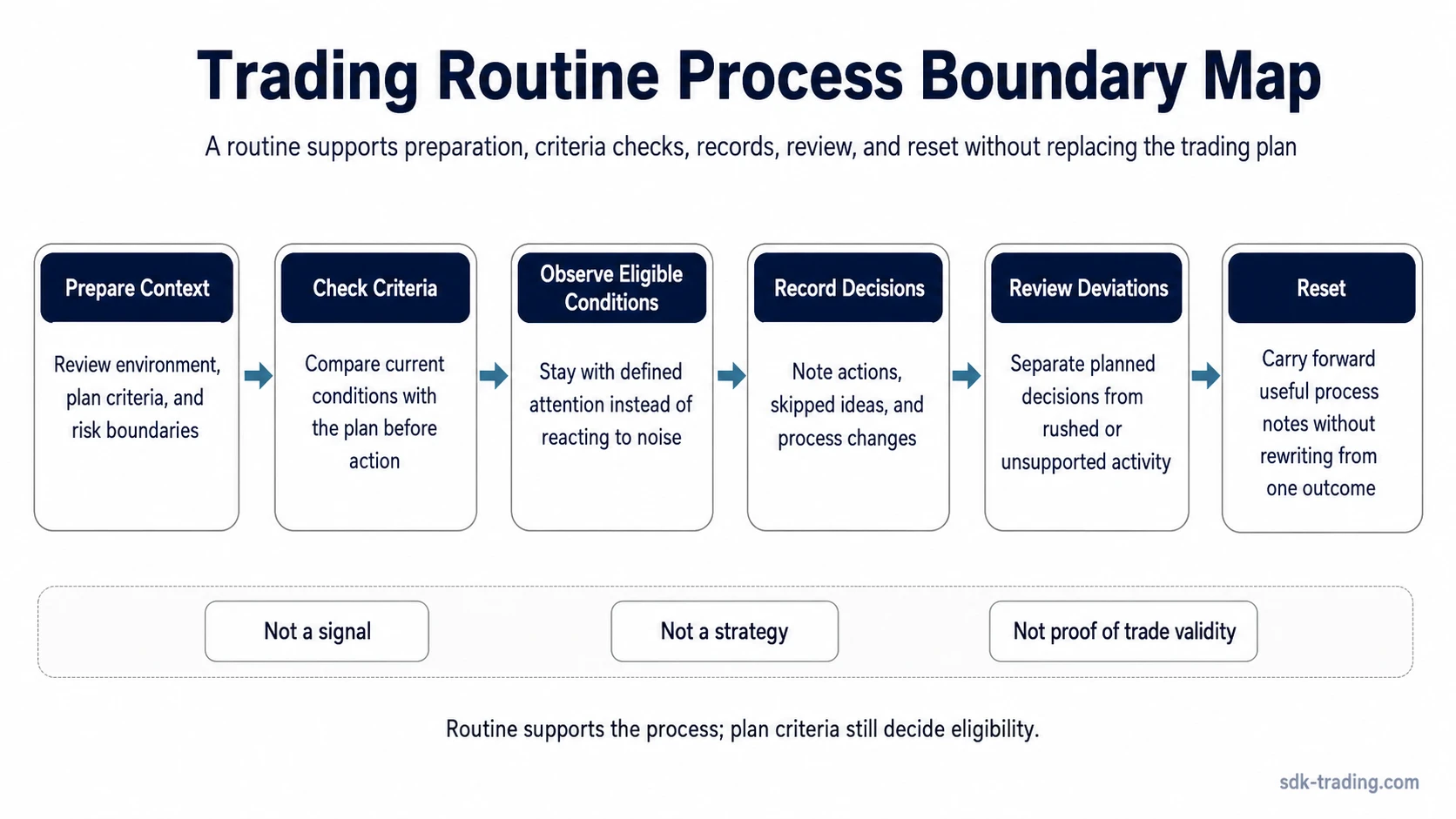
A simple routine can follow a process flow rather than a fixed clock schedule.
- Prepare context: Review the market environment, planned conditions, and risk boundaries before decisions begin.
- Check eligibility: Compare the current situation with the plan criteria before treating it as actionable.
- Observe session behavior: Stay with the defined decision process instead of adding activity because of pressure or boredom.
- Record decisions: Note what was done, what was skipped, and where the process changed.
- Review deviations: Separate plan-based decisions from emotional, rushed, or unsupported activity.
- Reset: Carry useful process notes forward without rewriting the whole routine from one outcome.
Illustrative example: A trader begins by reviewing the plan criteria and deciding which conditions are eligible for attention. During the session, an extra idea appears, but it does not match the defined criteria. The routine does not need to predict the outcome of that idea; it only requires the trader to either ignore it or record it for later review instead of acting outside the process.
Common Trading Routine Mistakes
This structure becomes weaker when it adds activity instead of creating boundaries. The common mistakes usually come from treating the routine as a performance tool, a schedule to copy, or a substitute for clearer rules.
| Mistake | Why it weakens the routine | Safer interpretation |
|---|---|---|
| Copying another trader’s schedule | The copied routine may not match the trader’s market, timeframe, plan, or review needs. | Build the routine around the decisions that actually need preparation, checking, recording, and review. |
| Turning the routine into scanner hunting | The session can become a search for activity instead of a process for filtering decisions. | Use the routine to define eligible attention, not to justify constant searching. |
| Treating the routine as proof | Completing the routine does not mean the current trade idea is valid. | The routine supports the process; the plan criteria still decide whether the idea qualifies. |
| Adding activity after losses or boredom | The routine stops acting as a boundary when emotional pressure overrides it. | Extra activity should be recorded and reviewed, not automatically absorbed into the session. |
| Reviewing too soon after pressure | Immediate review can become emotional self-justification instead of process analysis. | Use review spacing so deviations are evaluated with more distance and less urgency. |
What a Trading Routine Cannot Do
A trading routine is a process tool, not an edge by itself. It cannot make a weak plan strong, turn an unclear setup into a valid one, or remove the need for risk boundaries.
- It cannot create trade validity: A decision still needs to meet the plan criteria.
- It cannot replace risk rules: Routine consistency does not define acceptable risk by itself.
- It cannot fix an unclear plan: If the plan is vague, the routine may only repeat vagueness more consistently.
- It cannot remove uncertainty: A good process can still produce losing outcomes.
- It cannot prevent unsupported activity if ignored: The routine only functions as a boundary when it is followed.
Core limitation: A routine should be measured by process consistency, not by the result of a single trade or session. The question is whether preparation, criteria checks, records, and review happened as intended.
How to Keep a Trading Routine Useful
A useful trading routine should be short enough to repeat, clear enough to follow under pressure, and specific enough to reveal when the process has drifted.
The routine should answer practical process questions:
- Was preparation completed before decisions began?
- Were plan criteria checked before action was considered?
- Was activity kept inside defined risk and process boundaries?
- Were decisions and deviations recorded?
- Was review separated from the emotional pressure of the session?
- Did the routine reduce unsupported extra activity?
The routine can change when the plan, market, timeframe, or review needs change. It should not change only because one outcome felt good or bad. A routine that changes after every session stops being a routine and becomes another form of reaction.
Practical test: A routine is useful when it makes the correct process easier to repeat and unsupported deviations easier to notice.
FAQ
Is a trading routine the same as a trading checklist?
No. A trading checklist is usually an immediate verification step before a decision. A trading routine is broader because it organizes preparation, session behavior, records, and review around the full trading process.
What should be included in a trading routine?
Preparation, plan review, eligible-condition checks, session behavior boundaries, decision records, deviation notes, and review spacing.
How do you develop a daily trading routine?
Start with the decisions that need structure: what must be checked before trading, what counts as eligible during the session, what must be recorded, and when review should happen. The routine should fit the trader’s plan, market, timeframe, and review needs.