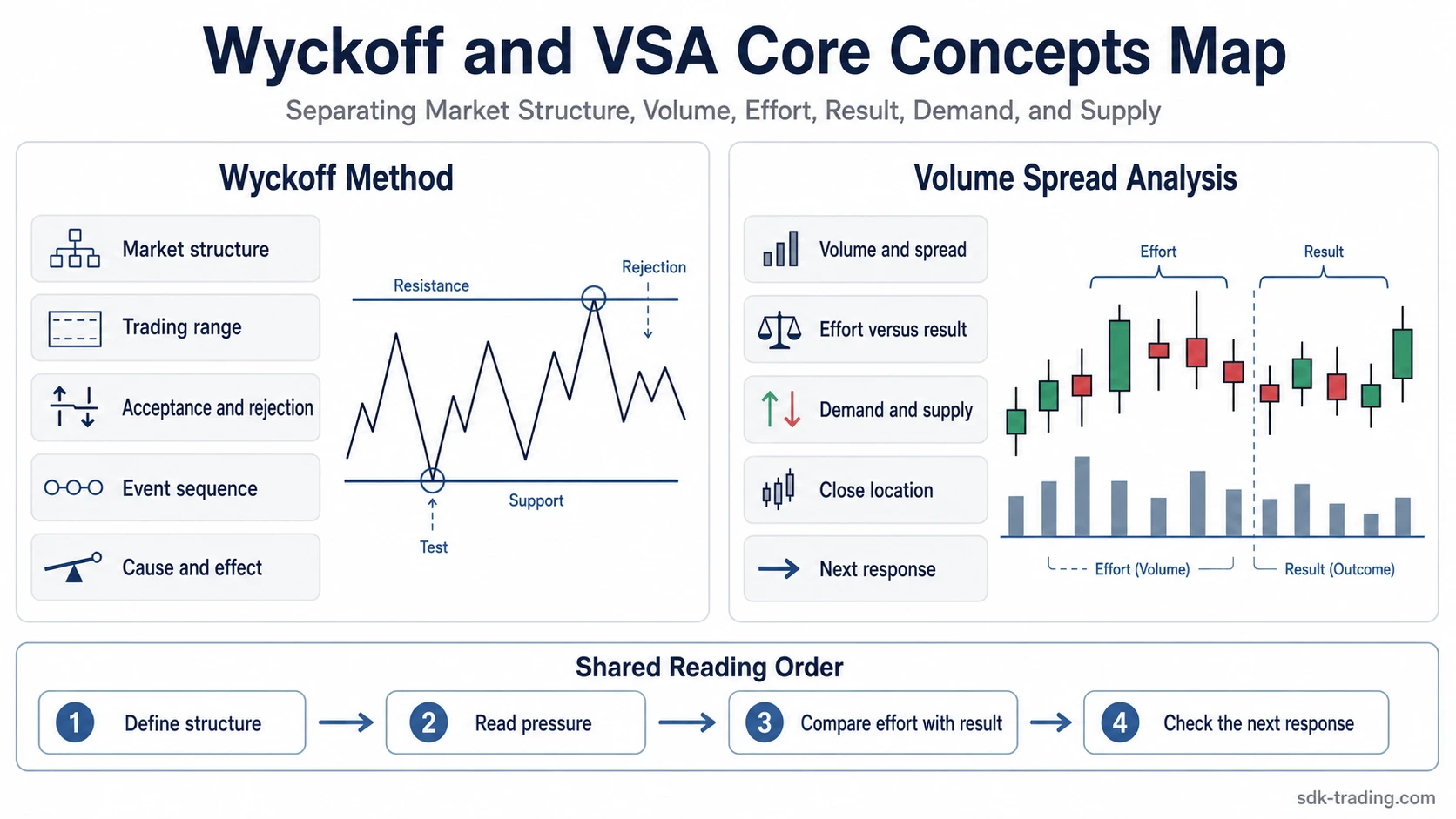
Wyckoff and VSA core concepts organize the two main ways to read this part of market behavior: the Wyckoff Method for market structure and Volume Spread Analysis for volume, effort, result, and pressure inside that structure.
Use Wyckoff when the question is about range structure, structural context, acceptance, rejection, or price behavior around important areas. Use VSA when the question is about volume, spread, close location, demand, supply, and follow-through.
Key Points
- Wyckoff concepts focus on market structure, trading ranges, structural context, acceptance, rejection, and price behavior around important areas.
- VSA concepts focus on the relationship between volume, spread, close location, effort, result, and the next market response.
- The two frameworks overlap, but they do not do the same job: Wyckoff gives the structure map, while VSA helps read pressure inside that structure.
- The practical choice is usually structure first, pressure second, and confirmation through the next response.
Choose the Right Framework
| Reader need | Use | What it helps clarify |
|---|---|---|
| You want the broader market-structure framework. | Wyckoff Method | Trading ranges, structural context, acceptance, rejection, and the logic of price behavior inside structure. |
| You want to read volume against price movement. | Volume Spread Analysis | Effort versus result, spread, close location, volume quality, demand, supply, and confirmation through the next response. |
If the question is “where is price inside the larger campaign or range?”, the Wyckoff framework is the cleaner starting lens. If the question is “does the volume support this price movement?”, VSA is the cleaner starting lens.
What Core Concepts Means in Wyckoff and VSA Trading
In Wyckoff and Volume Spread Analysis, core concepts are the basic lenses used before a trader labels a move as strength, weakness, absorption, demand failure, supply pressure, or structural change.
The useful distinction is simple: structure comes first, then volume interpretation tests the quality of that structure. A rally near resistance means less without knowing whether effort is producing progress. A high-volume reaction means less without knowing whether price is being accepted, rejected, or absorbed afterward.
The stronger reading separates what price is doing, where it is happening, how much effort appears behind the move, and whether the next response supports or weakens the interpretation.
Core Concept Map
| Concept area | Main question | What to avoid |
|---|---|---|
| Market structure | Where is price relative to the range, trend, or key reaction area? | Labeling every sideways area too early. |
| Effort versus result | Is the volume producing proportionate price progress? | Calling volume bullish or bearish without checking the result. |
| Acceptance and rejection | Does price hold beyond an area, or does it return quickly? | Treating every breakout attempt as meaningful before acceptance appears. |
| Demand and supply | Is buying or selling becoming more effective in the current location? | Using demand and supply labels without later confirmation from price behavior. |
| Tests and failures | Does the market revisit an area with stronger or weaker response? | Assuming a test has succeeded before the follow-through is visible. |
How Wyckoff and VSA Work Together
Wyckoff gives the structural setting. It asks whether price is advancing, declining, rotating, testing a boundary, failing near an area, or preparing to leave a range. Without that setting, a single bar or volume event can be overread.
VSA adds the pressure test. It asks whether the visible effort is producing enough result, whether a wide spread is being accepted or rejected, whether low volume shows lack of participation, and whether the next bars confirm or contradict the reading.
A common mistake is reversing the order. Reading one high-volume bar first and then forcing a structural label around it can make the analysis too mechanical. The safer sequence is structure first, pressure second, response third.
Where These Concepts Fit in a Trading Process
The concepts are most useful when they reduce interpretation errors. They help a trader avoid treating every strong candle as strength, every high-volume reaction as weakness, or every range as a finished conclusion.
A cleaner process separates three checks. First, define the structure. Second, read the effort and result inside that structure. Third, wait for the next response to support or weaken the interpretation.
This does not turn Wyckoff or VSA into a prediction engine. It makes the reading conditional: the interpretation improves when structure, volume behavior, and follow-through point in the same direction, and weakens when they conflict.
Common Misreadings
| Misreading | Safer interpretation |
|---|---|
| High volume automatically confirms strength. | High volume shows activity. The result and next response decide whether that activity helped buyers or sellers. |
| A range automatically has one fixed meaning. | A range is only a structure. Its meaning depends on tests, failures, acceptance, rejection, and later direction. |
| Low volume always means weakness. | Low volume can show lack of participation, but the location and subsequent response determine whether that matters. |
| Wyckoff and VSA are separate signal systems. | They are better treated as complementary interpretation tools: structure, pressure, and response. |
Choosing Between the Two Frameworks
Start with the Wyckoff framework if you need the larger structure: where price is acting inside a range, whether it is accepting or rejecting an area, and how the structural reading is changing.
Start with VSA if you already understand the structure but need to judge whether the volume and price relationship supports the current reading.