The Wyckoff Method is a market analysis framework for reading price and volume through supply, demand, accumulation, distribution, and later confirmation or invalidation. It helps traders organize what is happening inside a market range instead of treating every candle, volume spike, phase label, or spring attempt as a complete signal.
Its practical value is range discipline. A market may look like accumulation, distribution, or a spring setup before the evidence is complete. The method keeps those ideas conditional until price behavior, volume behavior, and follow-through support the read.
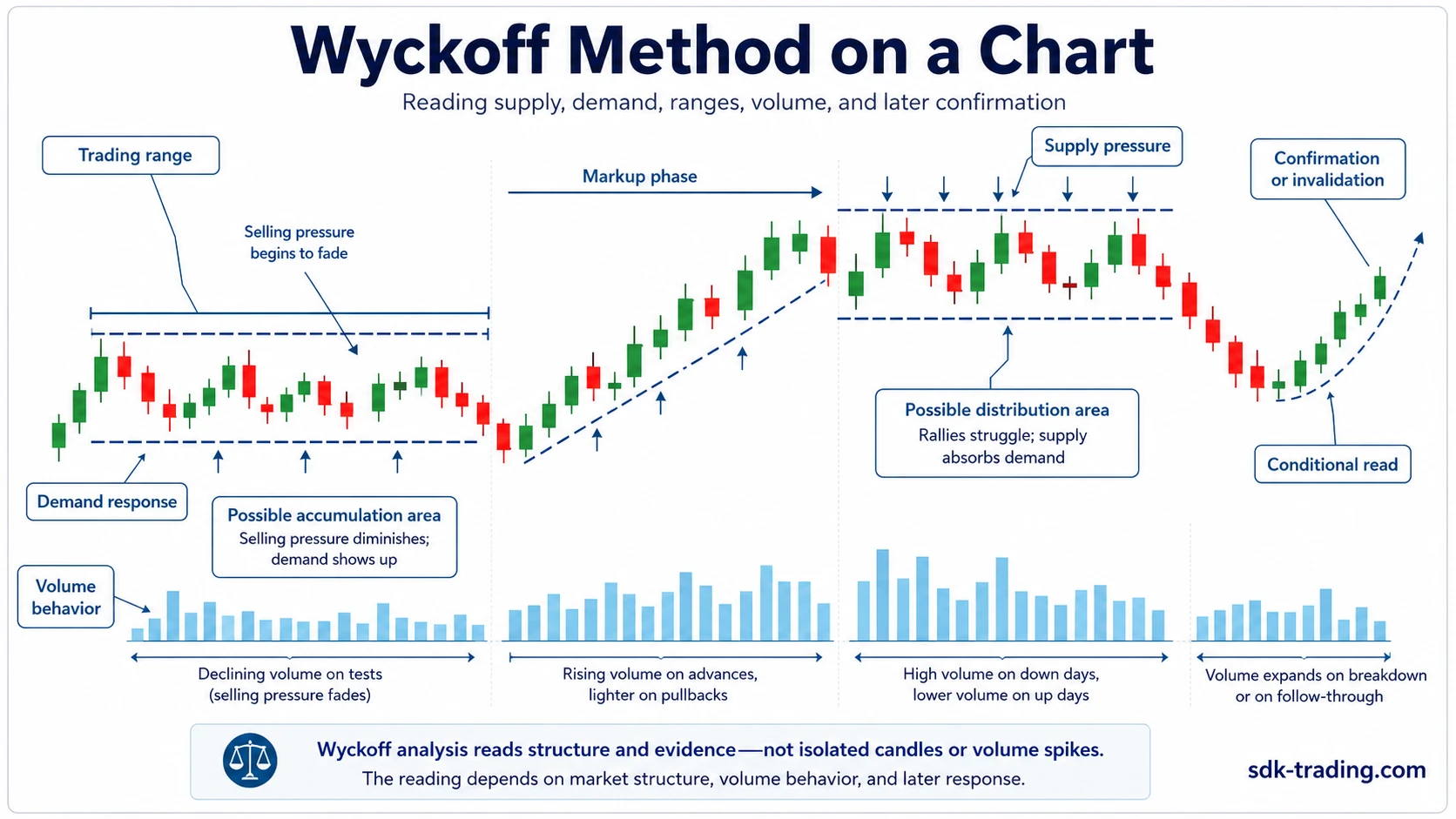
Key Points
- The Wyckoff Method studies supply and demand through price behavior, volume, and market structure.
- It often uses ranges, phases, schematics, and event labels to organize market behavior.
- It does not provide fixed entries, exits, targets, or guaranteed market paths.
- The most common mistake is forcing a spring or accumulation read onto every range before the range has confirmed that interpretation.
What Is the Wyckoff Method?
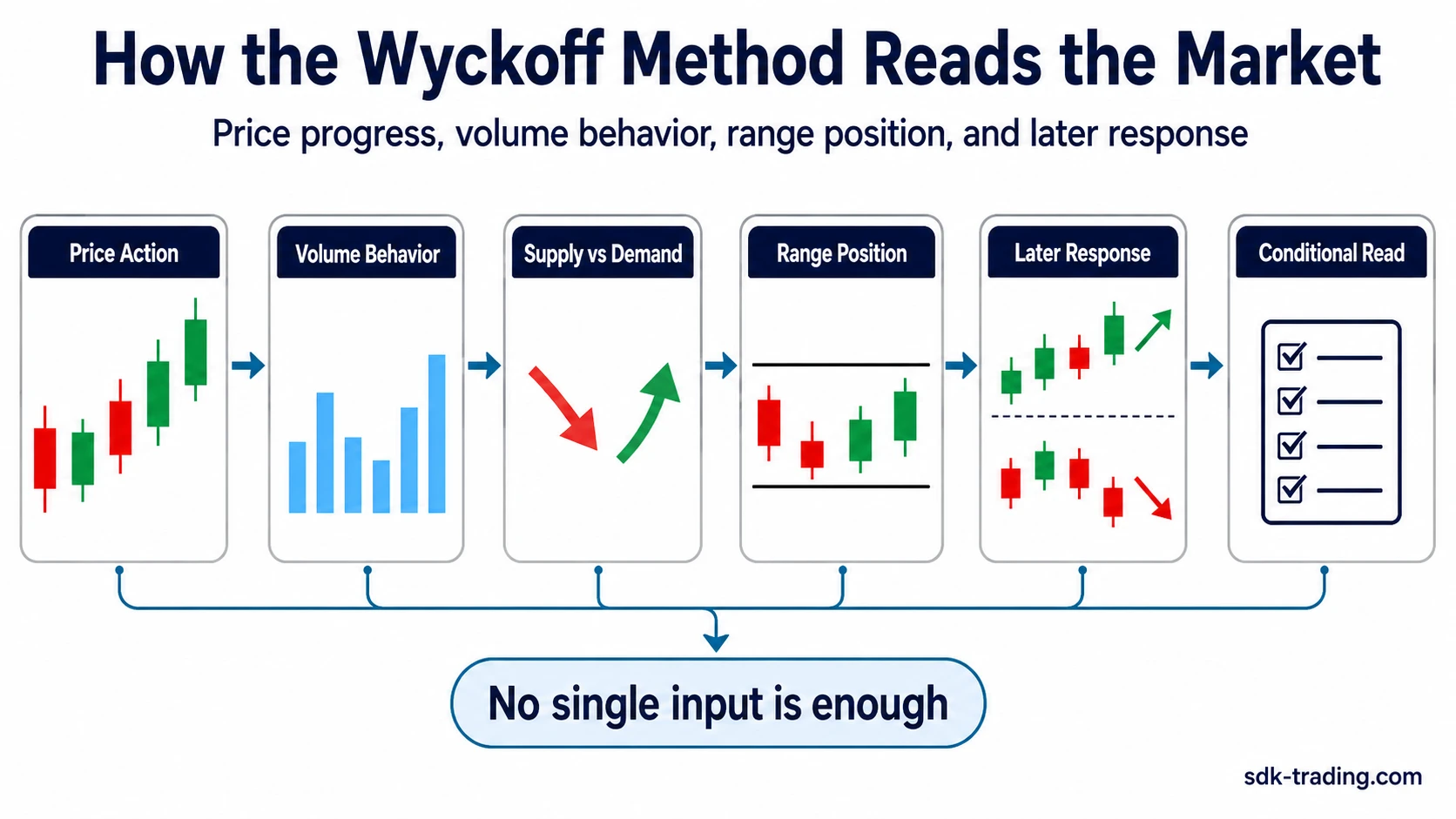
The Wyckoff Method is a structured way to judge whether supply or demand appears to be gaining control. Instead of asking only whether price moved up or down, the method compares price progress, volume behavior, range position, and later response.
Wyckoff Method in one sentence: the Wyckoff Method reads whether supply or demand is gaining control inside a market structure by comparing price progress, volume behavior, range position, and later confirmation.
In simple terms, Wyckoff analysis treats the market as a contest between buying pressure and selling pressure. A range may suggest possible Wyckoff accumulation if selling pressure fades and demand begins to absorb available supply. The same range may suggest possible Wyckoff distribution if rallies struggle, supply appears on advances, and demand fails to create sustained progress.
Why It Is Called a Method or Theory
The terms Wyckoff Method and Wyckoff theory are often used together because they point to the same body of market-reading ideas. “Theory” describes the underlying view of supply, demand, composite activity, and price-volume behavior. “Method” describes how those ideas are applied to charts, ranges, phases, tests, and confirmation logic.
This does not mean the market must follow a fixed script. Wyckoff gives traders a vocabulary for reading structure, but the conclusion remains conditional. A range can resemble accumulation and still fail. A distribution read can weaken if demand returns and price accepts higher levels.
Who Was Richard D. Wyckoff?
Richard D. Wyckoff was an early twentieth-century technical market analyst whose work became one of the foundations of price-volume market analysis. He studied how large operators accumulated and distributed stock, focusing on price movement, volume, supply, demand, and the position of price inside a broader market structure.
In modern chart analysis, the Wyckoff Method is used less as a fixed prediction system and more as a framework for organizing evidence. The core idea is that markets often move through periods of accumulation, markup, distribution, and markdown, while traders look for signs that supply or demand is changing control.
How the Wyckoff Method Reads the Market
Wyckoff analysis combines several inputs. None of them is enough by itself. The value comes from checking whether price action, volume, supply, demand, and range behavior support the same conclusion or contradict one another. This is why the method often overlaps with Volume Spread Analysis, although Wyckoff usually places more emphasis on range structure, phases, and campaign logic.
| Component | What it helps read | Limitation |
|---|---|---|
| Price action | Where price is accepted, rejected, compressed, or expanded. | A price move alone does not prove control by buyers or sellers. |
| Volume | Whether participation expands or contracts during movement or testing. | Volume needs context; high volume can reflect absorption, panic, or active supply. |
| Supply | Where selling pressure appears, fades, or overwhelms demand. | Visible selling does not always mean the market must fall. |
| Demand | Where buying interest appears, fails, or absorbs available supply. | Demand must be confirmed by behavior after the first reaction. |
| Accumulation | A possible process where buyers may be absorbing available supply inside a range. | Accumulation is a reading, not proof that markup must follow. |
| Distribution | A possible process where supply is transferred to weaker buyers before weakness develops. | Distribution is not confirmed only because price stops rising. |
| Phases | A way to organize the progress of a range from early behavior to later confirmation. | Real markets do not always match clean textbook phase labels. |
| Schematics | Reference models for comparing a current range with common Wyckoff structures. | A schematic is a map for comparison, not a forecast template. |
| Confirmation and invalidation | Whether later behavior supports or weakens the current read. | A read should change when the evidence changes. |
The Three Wyckoff Laws
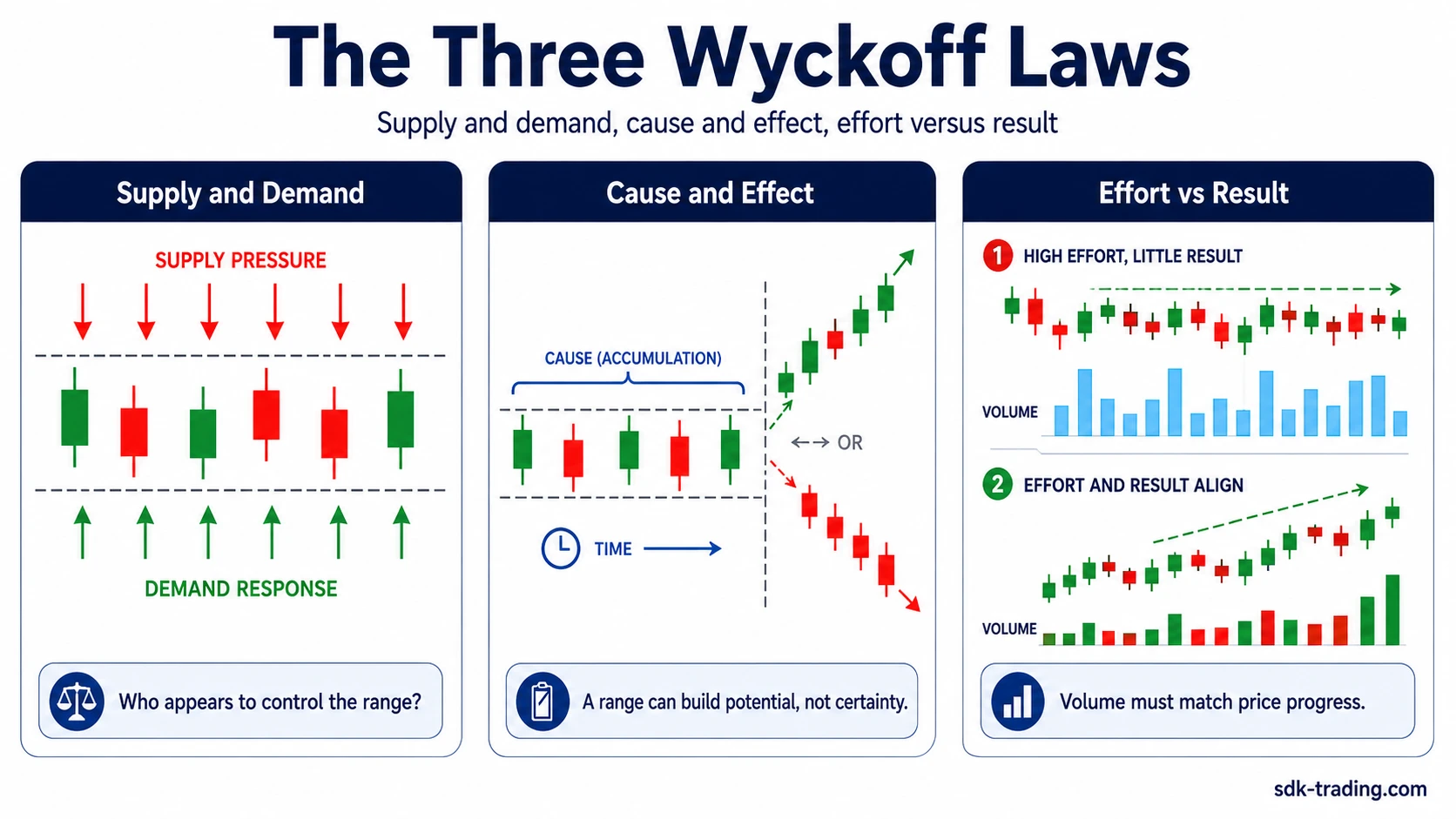
The Wyckoff Method is often explained through three core laws. These laws help traders connect price movement, volume, range behavior, and later confirmation.
| Wyckoff law | What it means | Why it matters |
|---|---|---|
| Supply and demand | Price tends to rise when demand is stronger than supply and fall when supply is stronger than demand. | It gives the method its basic reading logic. |
| Cause and effect | A trading range may build the cause for a later markup or markdown. | It connects range development with later movement. |
| Effort versus result | Volume is compared with price progress to judge whether activity is producing meaningful movement. | It helps identify absorption, weakness, or failed progress. |
The Wyckoff Five-Step Approach
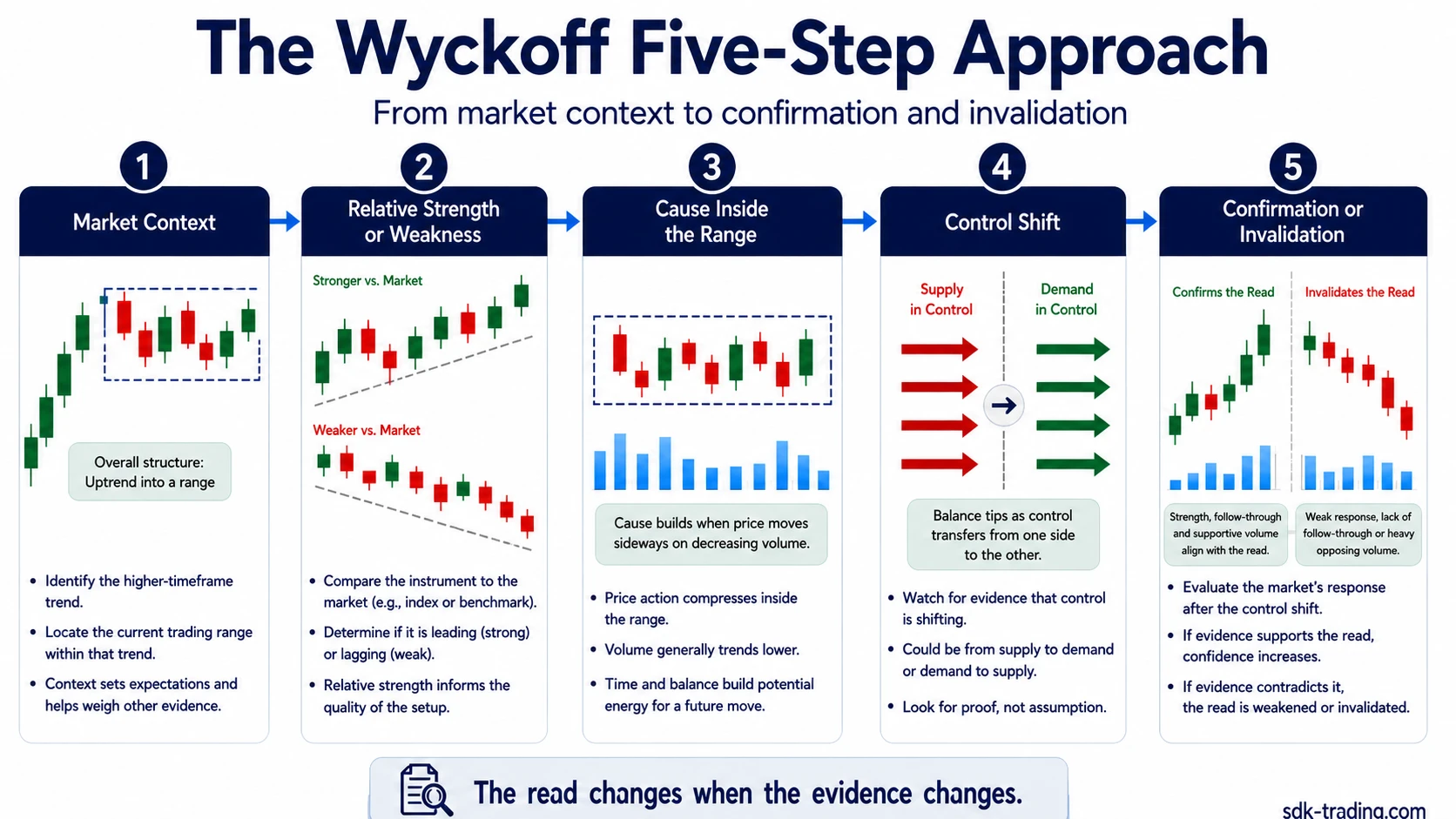
The Wyckoff Method is also commonly taught through a five-step approach. The steps help traders move from broad market context to relative strength, structure, cause, and timing. In modern use, these steps should be treated as an analytical checklist rather than a mechanical trade plan.
- Determine the market position: judge whether the broader market is trending, ranging, strengthening, or weakening.
- Select instruments in harmony with the market: compare whether an instrument is acting stronger or weaker than the broader market.
- Look for sufficient cause: study whether a range may have built enough structure for a later move.
- Assess control shift: check whether price and volume behavior suggest that supply or demand is changing control.
- Time participation carefully: use later confirmation and invalidation instead of acting on a single event.
The Composite Man Concept
The Composite Man is a Wyckoff concept used to simplify the behavior of large market interests. Instead of treating every price move as random, the analyst studies whether the market appears to be accumulating inventory, distributing inventory, testing supply, or testing demand.
The concept should not be read as proof that one actor controls the market. It is a model for organizing market behavior and avoiding purely reactive interpretation of individual candles.
The Wyckoff Market Cycle
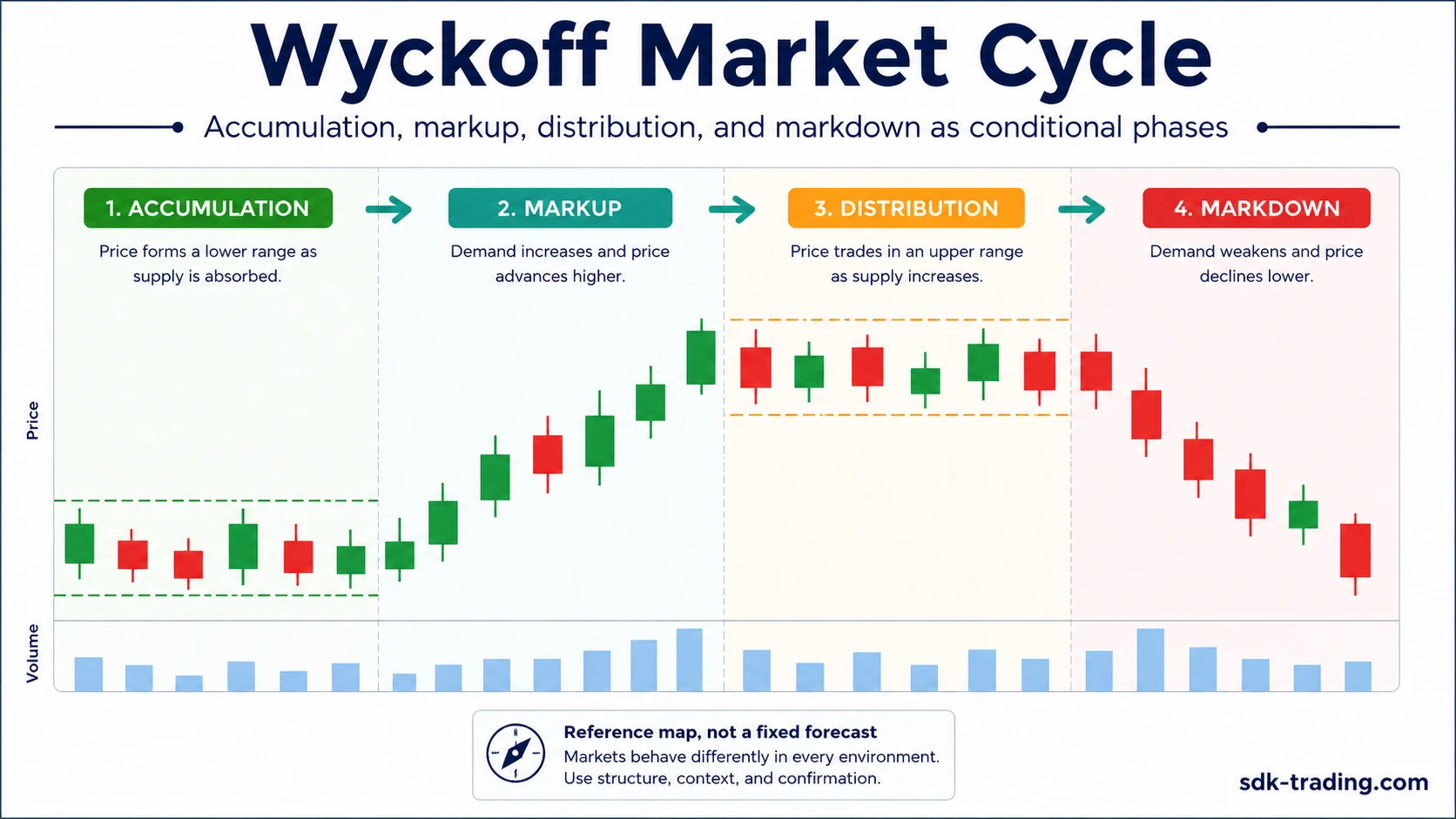
The Wyckoff market cycle is commonly described through four broad stages: accumulation, markup, distribution, and markdown. Its practical value is as a map of possible control shifts, not as a fixed sequence that every market must follow cleanly.
- Accumulation: a range where selling pressure may be absorbed before a later advance.
- Markup: a rising phase where demand is strong enough to create sustained progress.
- Distribution: a range where supply may appear after an advance and demand may weaken.
- Markdown: a declining phase where supply overwhelms demand.
Wyckoff Schematics and Phases
A Wyckoff schematic is a reference model used to compare how accumulation or distribution may develop inside a trading range. It can help organize events such as tests, springs, upthrusts, signs of strength, signs of weakness, and later confirmation.
The practical value is not in forcing the chart to match a textbook model. A schematic is useful only when current price and volume behavior support the proposed read. If the evidence changes, the phase label should change with it.
Wyckoff Method vs Common Misread
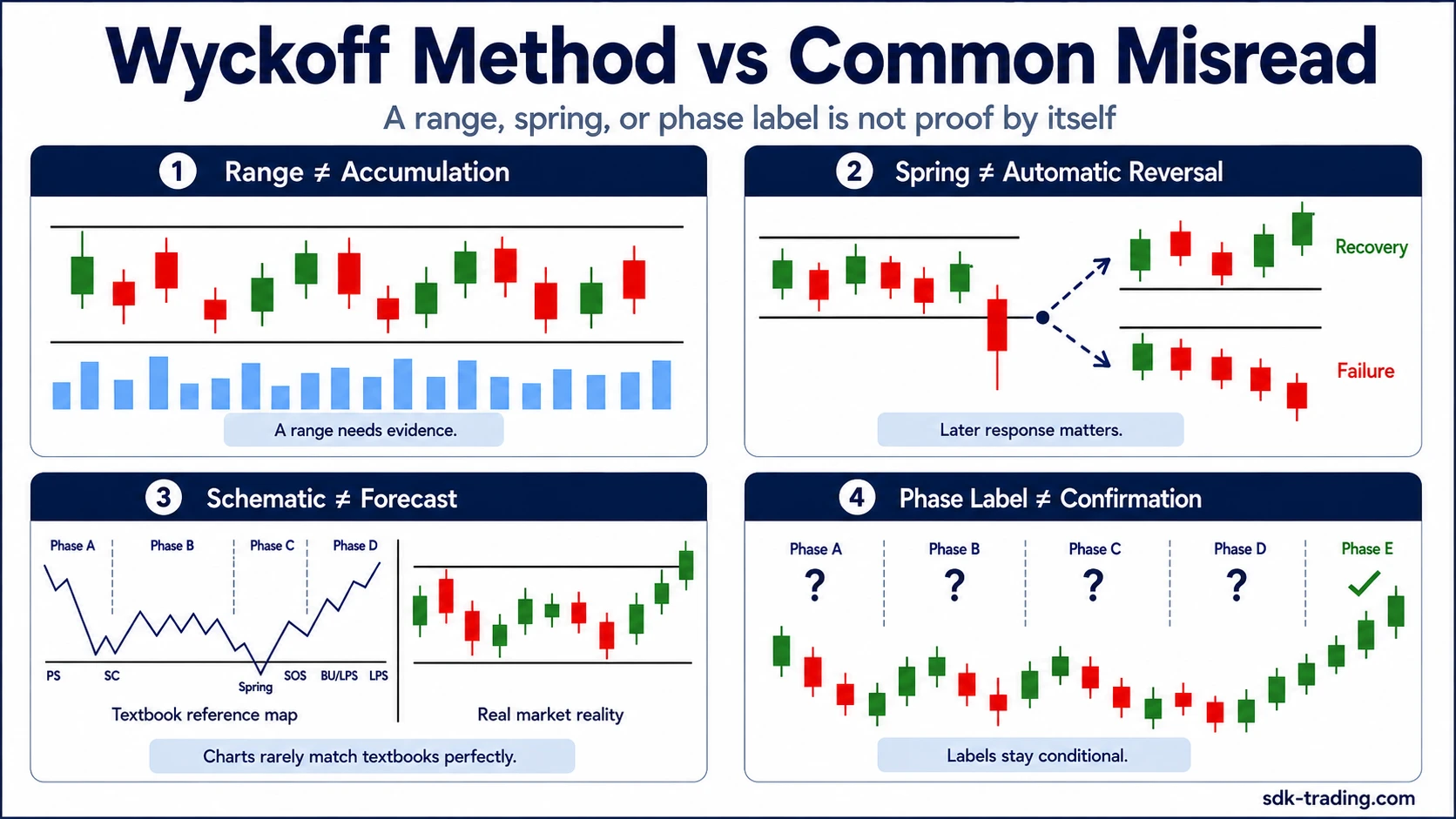
Wyckoff analysis is most useful when it prevents premature labeling. The same range can look like accumulation, distribution, re-accumulation, or failed structure before the evidence becomes clear enough to separate those readings.
| Common misread | Safer Wyckoff read |
|---|---|
| Every range after a decline is accumulation | A range is only a possible accumulation context until supply weakens and demand improves. |
| Every move below a range is a spring | A spring needs recovery behavior, acceptance back inside the range, and later confirmation. |
| A schematic predicts the next move | A schematic is a comparison map, not a forecast template. |
| A phase label confirms the market path | A phase label remains provisional until later price and volume behavior support it. |
What Confirms or Breaks a Wyckoff Read
A Wyckoff read becomes more useful when range behavior starts to narrow the number of reasonable interpretations. For an accumulation read, that may mean selling waves become less effective, downside tests fail to create continuation, and price begins to accept higher areas. For a distribution read, it may mean rallies show poor progress, supply appears near the upper part of the range, and later weakness confirms that demand is failing.
The read weakens when the market rejects the proposed campaign logic. A spring should not be treated as confirmed if price breaks below the range but cannot recover back inside it. The same caution applies to an upthrust or UTAD: the event matters only if later behavior supports the interpretation instead of accepting the opposite side of the range.
What the Wyckoff Method Is Not
The main mistake is treating Wyckoff as a signal system. A spring, upthrust, test, phase label, or volume event does not automatically create a trade. The method is designed to organize evidence, not replace judgment, risk definition, or confirmation.
- It is not a standalone buy or sell signal.
- It is not a fixed prediction map for what price must do next.
- It does not provide exact entries, exits, stop-loss levels, or targets.
- It is not reliable when range evidence, volume behavior, and follow-through disagree.
A clean Wyckoff read separates observation from interpretation. A range test is an observation; the idea that supply or demand is changing control remains an interpretation until later behavior supports it.
A Practical Wyckoff Reading Scenario
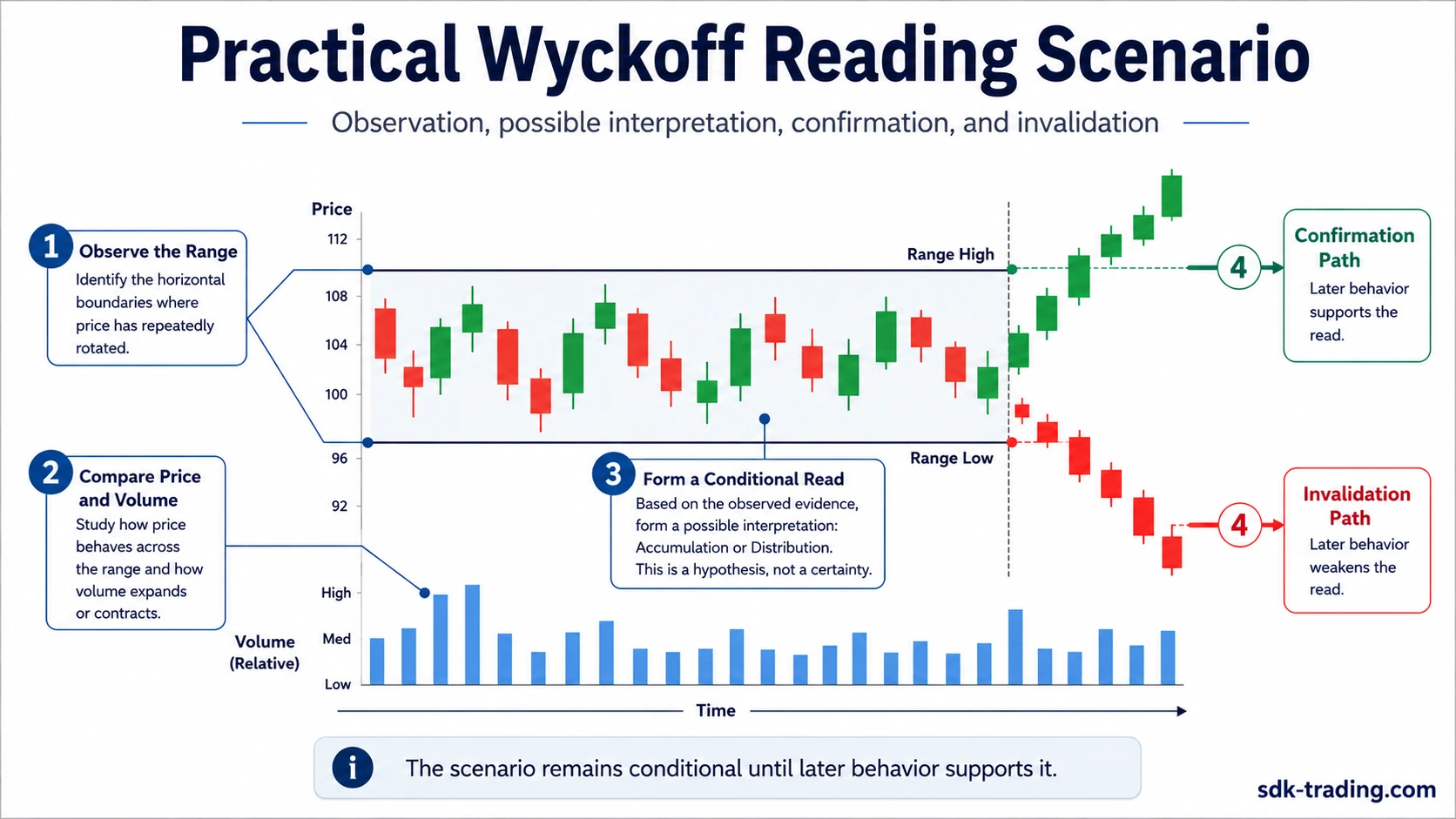
Consider a market that has been moving sideways after a decline. Early in the range, rallies fail quickly and downswings attract heavy volume. Later, the selling waves become smaller, the lower part of the range is tested without strong downside follow-through, and price begins to hold above prior reaction areas.
The observation is that selling appears less effective than it was earlier in the range. The possible interpretation is that supply may be weakening. That does not mean the range is automatically accumulation, and it does not mean price must rise. The read becomes stronger only if later behavior shows demand improving, downside tests failing, and price accepting higher levels inside or above the range.
The same logic works in reverse. If a market holds a range after an advance, but rallies begin to show poor progress while supply appears near the upper boundary, the analyst may watch for signs of distribution. The read remains conditional until later behavior confirms or invalidates it.
Wyckoff Method FAQ
Is the Wyckoff Method a trading strategy?
No. The Wyckoff Method is a market analysis framework. It can support a trading process, but it does not provide mechanical entries, exits, or guaranteed signals.
What does the Wyckoff Method mainly study?
It studies the relationship between price, volume, supply, demand, ranges, accumulation, distribution, and later confirmation or invalidation.
Is Wyckoff theory the same as the Wyckoff Method?
In most trading education contexts, the terms overlap. Wyckoff theory refers to the underlying ideas, while the Wyckoff Method refers to applying those ideas to market structure and price-volume behavior.
Can Wyckoff analysis predict the market?
No. Wyckoff analysis can help form conditional interpretations, but it cannot guarantee what price will do next.
What are the three laws of the Wyckoff Method?
The three commonly cited Wyckoff laws are supply and demand, cause and effect, and effort versus result. They help traders compare price movement, volume, range behavior, and later confirmation.