UTAD in Wyckoff trading means Upthrust After Distribution. It describes a late-stage distribution event where price probes above a prior range high, then fails to build durable acceptance above that upper area.
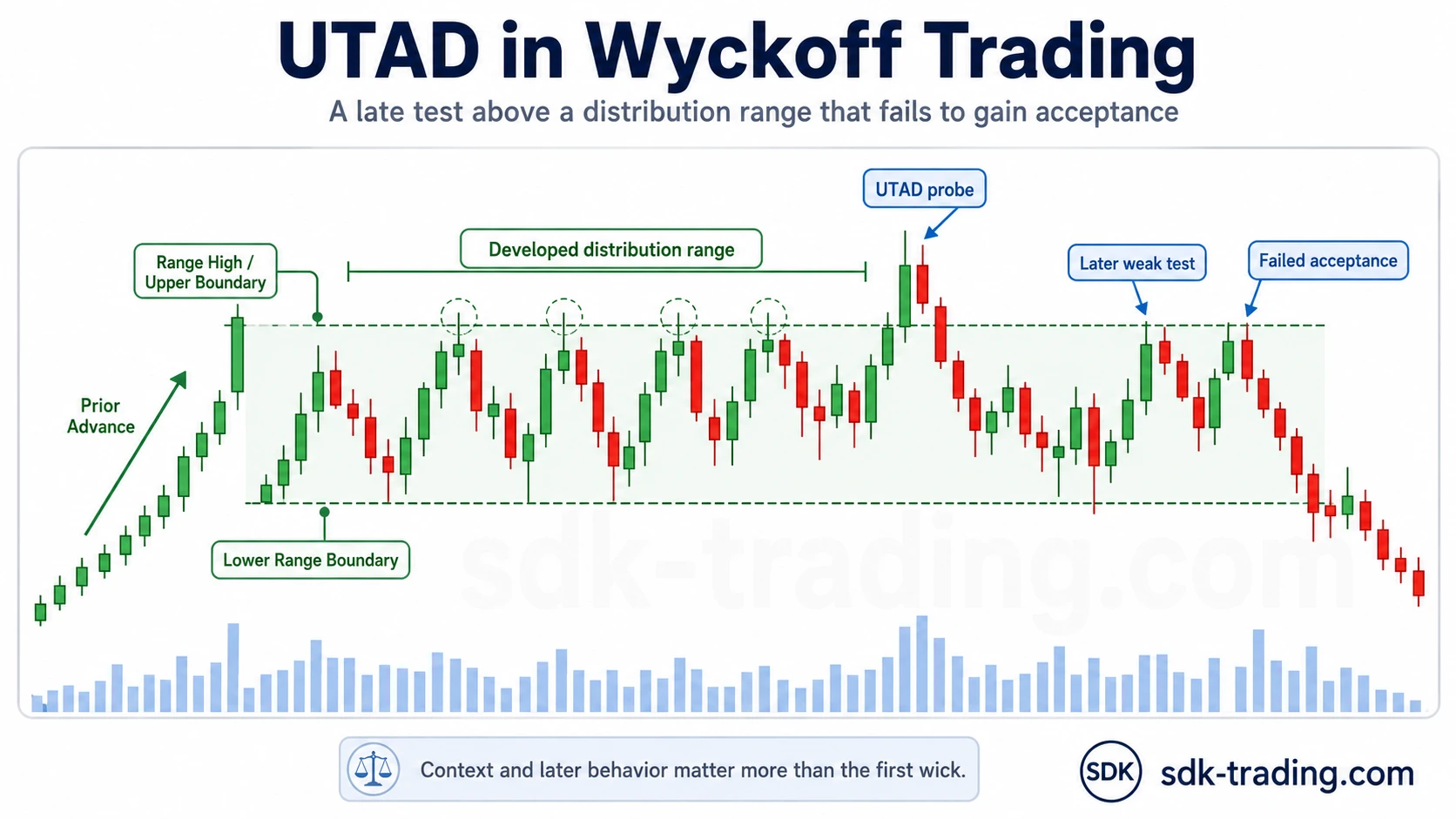
The important point is not the wick, the breakout label, or the acronym by itself. A UTAD reading depends on context: a developed upper range, distribution-like background, an upside probe, and later behavior that shows whether the higher area was rejected or accepted.
Key Points
- UTAD stands for Upthrust After Distribution.
- It belongs to the upper side of a Wyckoff distribution range.
- The probe above the prior high is only the first condition.
- Failed acceptance above the range high strengthens the reading.
- Sustained acceptance above the same area weakens or cancels the UTAD interpretation.
- UTAD is not a standalone sell signal and does not guarantee reversal.
What UTAD Means in Wyckoff Trading
UTAD stands for Upthrust After Distribution. In Wyckoff logic, the useful definition is narrower than “any failed breakout.” Price tests above the upper boundary after a Wyckoff distribution structure has already developed, then struggles to hold that higher area.
A range high gives the reading a reference point. Without a prior upper boundary, there is no clear area being tested. Without distribution-like background, the same move can be a generic failed breakout, a normal pullback after a breakout attempt, or a temporary volatility event rather than UTAD.
The event becomes more useful when the market first appears to offer higher acceptance, then fails to maintain it. That failure can show up through a return below the prior high, weak follow-through above the range, or later rejection near the same upper area.
UTAD Conditions
A UTAD case is strongest when the sequence is evaluated as a process rather than as a single candle. The upper probe creates the test; later acceptance or rejection gives the test its meaning.
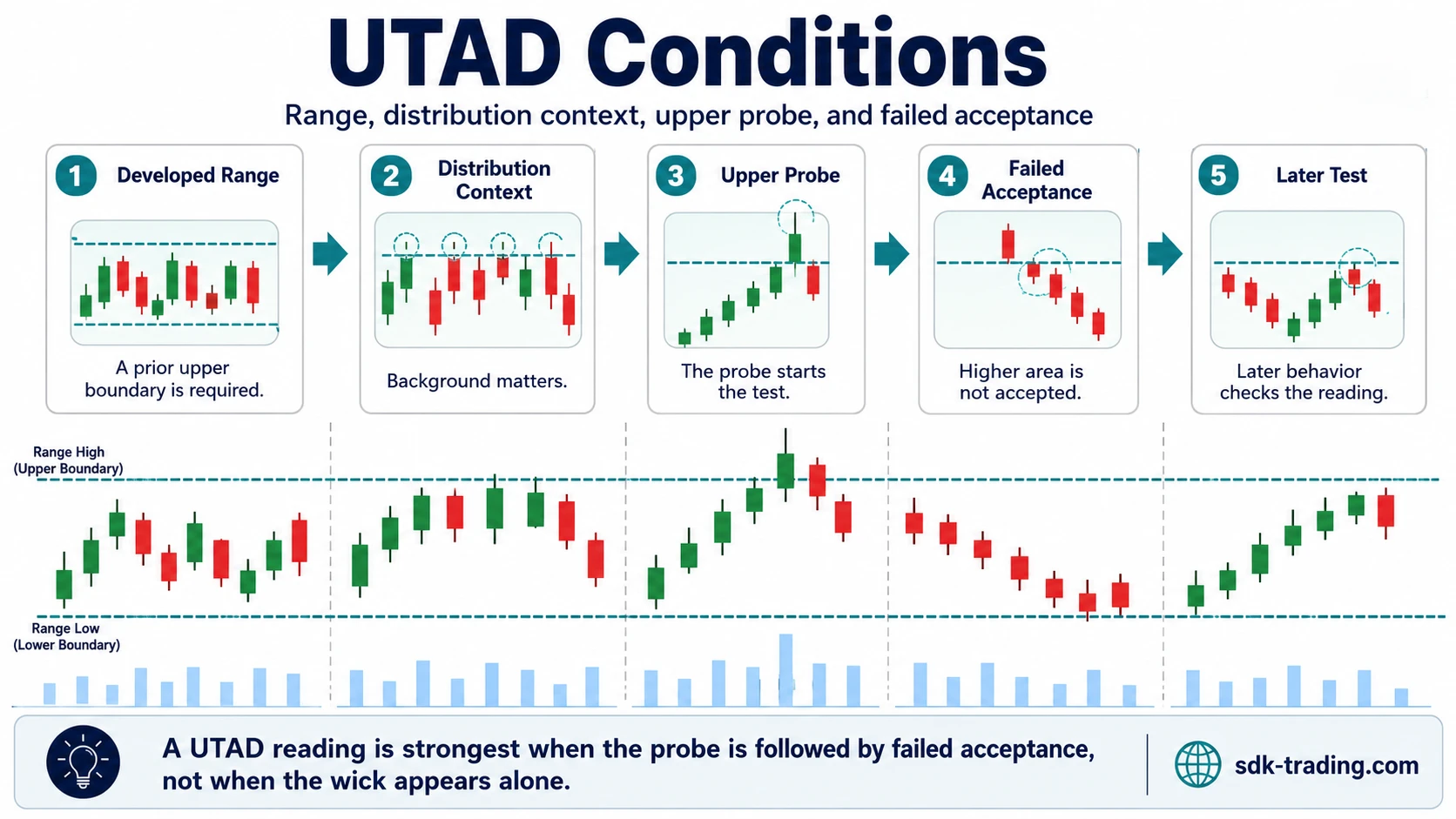
| Condition | Why it matters | Interpretation impact |
|---|---|---|
| Developed range | The market has a prior upper boundary that can be tested. | Shows which range high must later be accepted or rejected. |
| Distribution-like background | The market has already shown supply, weak result, or poor higher progress. | Separates UTAD from a random failed breakout. |
| Probe above the range high | Price briefly tests above the prior upper area. | Starts the UTAD test, but does not complete the reading by itself. |
| Failed acceptance above the upper area | Price cannot hold or build structure above the prior high. | Strengthens the UTAD case. |
| Acceptance above the upper area | Price holds above the prior high and builds value there. | Weakens or cancels the UTAD interpretation. |
Why the Upper Probe Is Not Enough
A move above the range high only shows that price tested the upper area. It does not prove UTAD by itself. The reading becomes stronger only when late-distribution context is already present and price later fails to hold above that prior high.
Interpretation limit: A wick above the range high can be part of UTAD, but the wick is not the evidence by itself. The useful evidence is the market’s inability to accept higher prices after the probe.
UTAD vs Upthrust vs Upthrust After Distribution
UTAD is related to upthrust, but the terms should not be treated as identical. A generic upthrust can describe a failed move above an upper boundary. UTAD adds the late-distribution role and depends more heavily on where the test appears inside the range sequence.
The distinction also matters against upthrust-after-distribution. That phrase describes an upthrust after distribution-like background, while UTAD is usually read as the narrower late-stage test above the upper area.
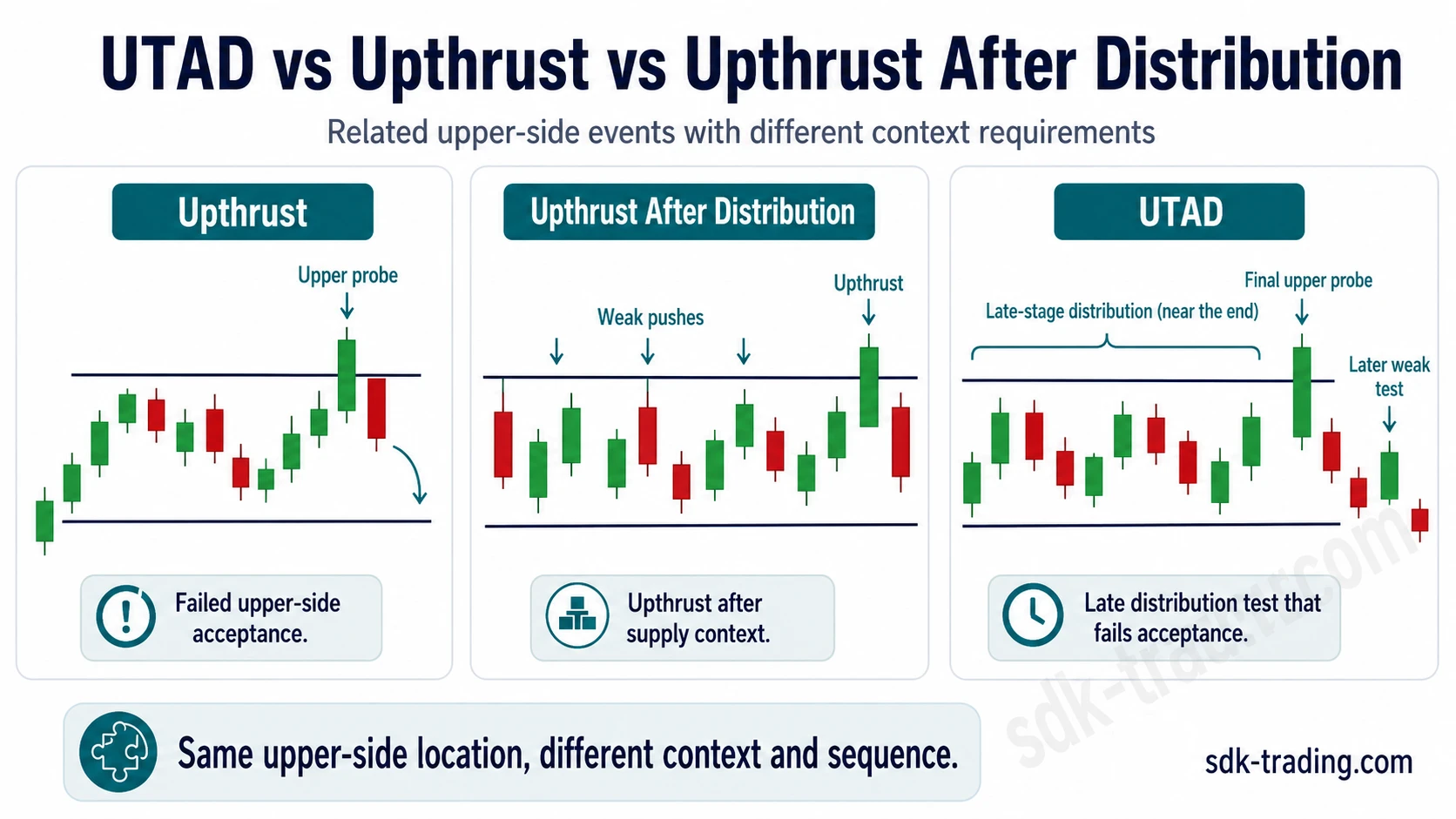
| Concept | Main idea | Context needed | What weakens the interpretation |
|---|---|---|---|
| Upthrust | A probe above an upper boundary that fails to gain acceptance. | A clear resistance or range-high reference. | Price holds above the prior high and accepts higher value. |
| Upthrust After Distribution | An upthrust that appears after distribution-like background. | A developed range with evidence of supply or weak higher progress. | The market continues building above the prior upper area. |
| UTAD | A late-distribution test above the range high that later fails acceptance. | Late-range distribution logic, upper-boundary probe, and later rejection or failed acceptance. | Sustained acceptance above the upper area or strong continuation above the range. |
UTAD Example in Context
A market has spent time rotating near the upper half of a developed range. Several attempts to push higher have produced limited progress, and each new test near the high attracts more supply than follow-through. Price then moves briefly above the prior range high.
Calling the move a confirmed UTAD immediately is premature. At that moment, price has only tested the upper area. A stronger UTAD case needs failure above the range after a developed distribution background.
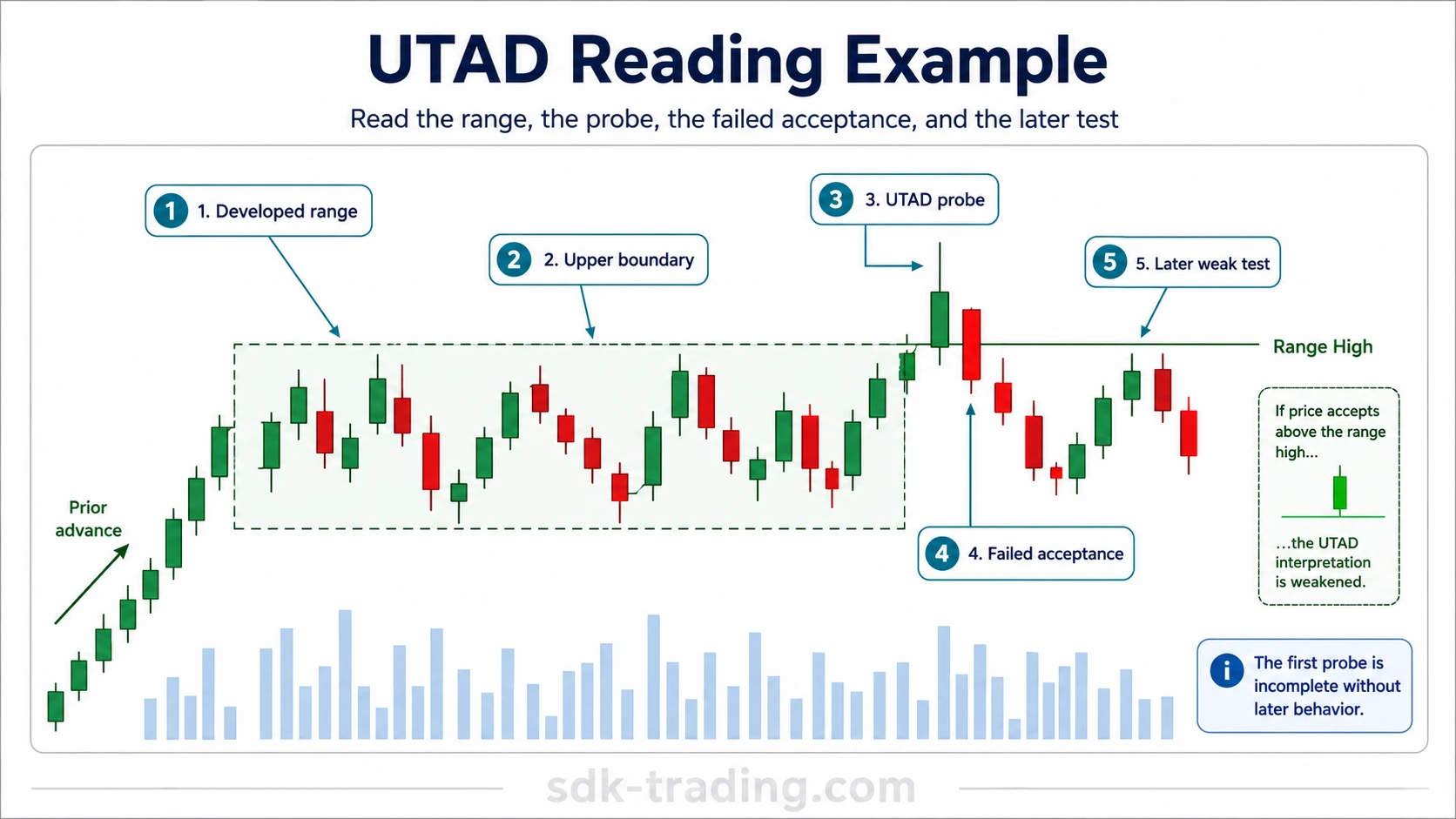
The stronger case appears if price returns below the prior high, fails to recover the upper area, and later rejects another test near the same boundary. The weaker case appears if price remains above the range high, consolidates there, and begins to treat the old high as accepted structure rather than rejected excess.
The later test matters because it shows whether the old range high still acts as supply. A weak recovery into the same upper area gives the UTAD case more structure than the first probe alone.
What Confirms or Weakens a UTAD Reading
A UTAD case becomes more defensible when the market cannot continue above the upper boundary after the probe. Failed follow-through, return below the range high, and later rejection near the same area all support the idea that the higher area was tested but not accepted.
The interpretation weakens when the market holds above the prior range high and builds structure there. Acceptance does not need to be perfect or immediate, but if price continues to defend the higher area, the UTAD idea becomes less useful.
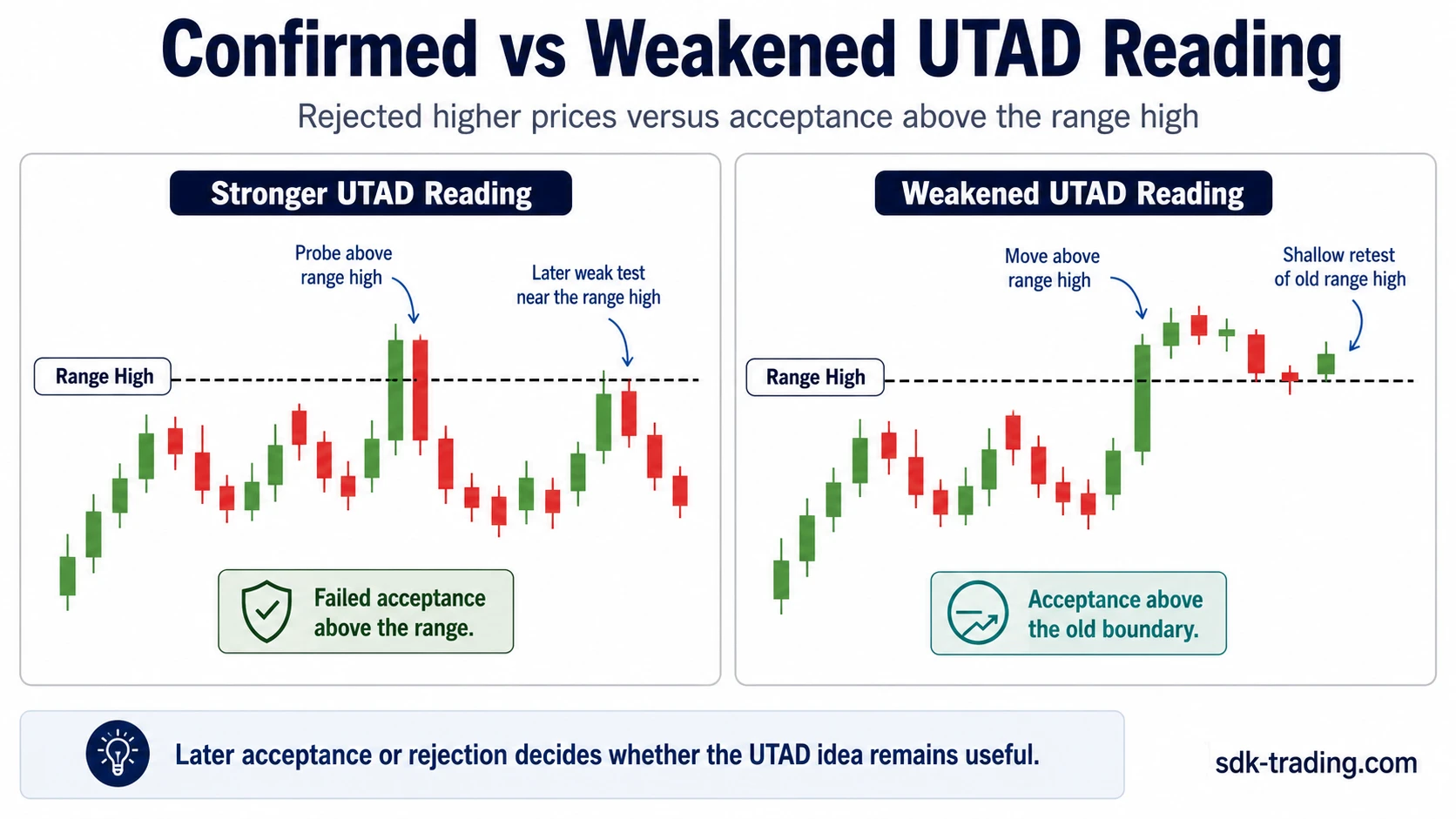
| Later behavior | Interpretation |
|---|---|
| Quick return below the prior high | Supports failed acceptance above the range. |
| Weak recovery attempt near the upper boundary | Supports a rejected higher-area interpretation. |
| Rotation above the prior high with stable acceptance | Weakens the UTAD case. |
| Continuation above the upper area | Can cancel the UTAD interpretation. |
Common UTAD Reading Mistakes
UTAD should not be reduced to a single candle pattern. A sharp wick above a range high can be part of the event, but the wick is only surface behavior. The interpretation depends on the surrounding range, the distribution context, and the market’s later ability or failure to accept higher prices.
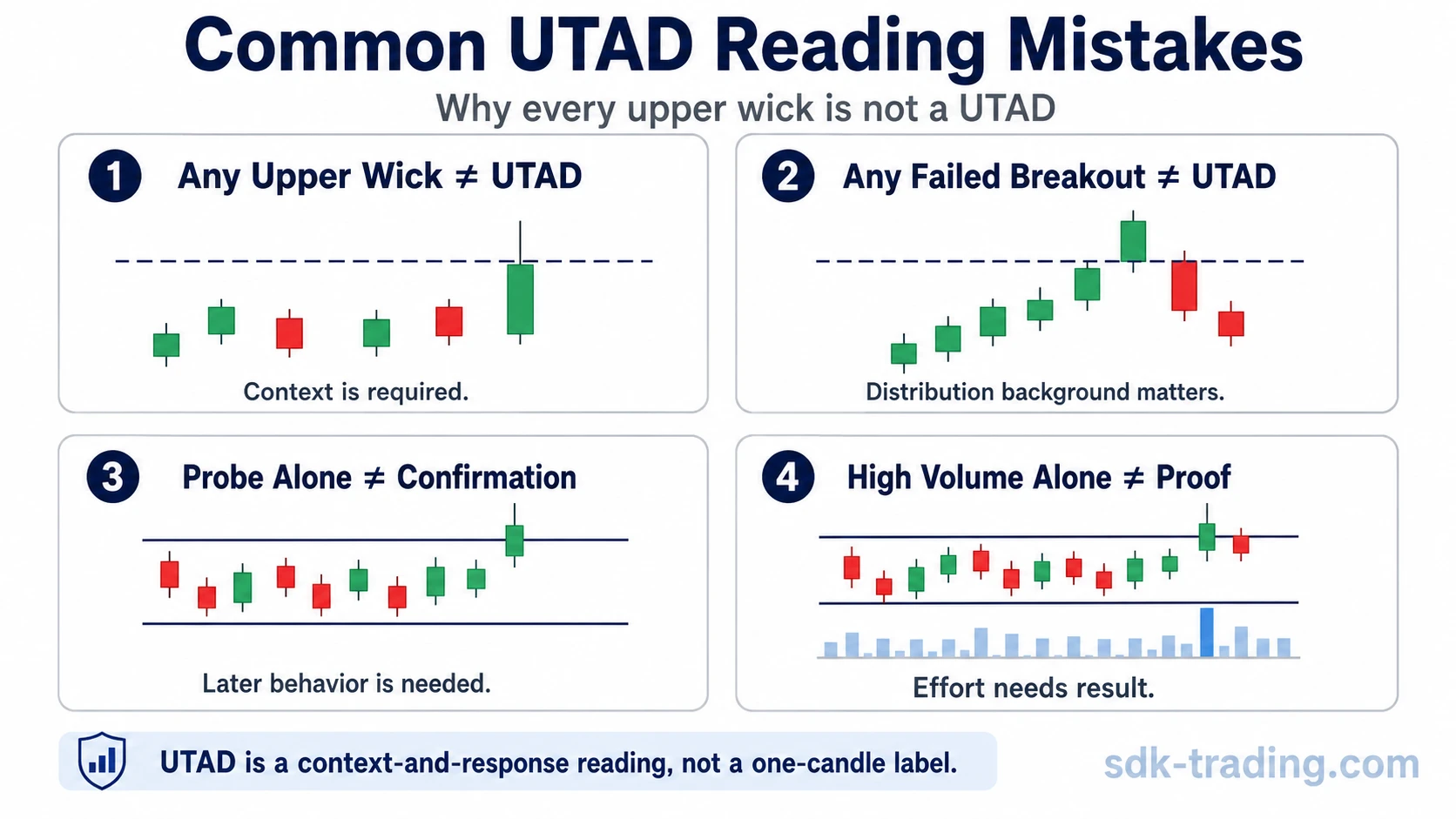
| Misread | Why it is weak | Cleaner reading rule |
|---|---|---|
| Any upper wick is called UTAD | A wick can appear without a developed distribution range. | Check the range and background before labeling the event. |
| Any failed breakout is called UTAD | A failed breakout can occur without late-distribution context. | Separate generic failed acceptance from UTAD placement. |
| The first probe is treated as confirmation | The market has only tested the upper area, not yet shown a full response. | Wait for failed acceptance or later rejection evidence. |
| High volume is treated as proof | Volume can show effort, but the result still needs interpretation. | Compare effort with result, follow-through, and acceptance. |
That distinction prevents two common errors: labeling every failed breakout as UTAD and assuming that one dramatic rejection candle guarantees reversal. A UTAD case can be useful, but it remains conditional until later behavior supports or invalidates it.
UTAD FAQ
What does UTAD mean in Wyckoff trading?
UTAD means Upthrust After Distribution. In Wyckoff trading, it describes a late-distribution test above a prior range high where price fails to build durable acceptance above the upper area.
Is UTAD the same as an upthrust?
UTAD is related to an upthrust, but it is narrower. An upthrust can describe a failed move above an upper boundary, while UTAD depends on late-distribution context and later acceptance or rejection behavior.
What confirms or weakens a UTAD reading?
Failed acceptance above the range high, a return below the prior high, and later rejection near the same upper area can strengthen the reading. Sustained acceptance above the upper area weakens or cancels it.
Can UTAD fail?
Yes. A UTAD interpretation can fail when price holds above the prior range high and builds acceptance there. In that case, the upper probe is no longer acting as a rejected higher-area test.