Wyckoff events in trading ranges are structural tests that show how price interacts with range boundaries, failed breaks, and later retests. The label is useful only when it points to a specific range role: lower-boundary rejection, upper-boundary failure, or a later distribution test.
Wyckoff event readings become clearer when they are separated by range position. Lower-boundary events test whether downside pressure is being rejected, while upper-boundary events test whether higher prices are being accepted or rejected. Later distribution events depend on sequence, not only on a single failed breakout.
Key Points
- Wyckoff events are range-based structural tests, not isolated candle patterns.
- Lower-boundary events focus on failed downside acceptance and possible supply exhaustion.
- Upper-boundary events focus on whether a push above resistance is accepted or rejected.
- Late distribution events depend on prior weakness inside the range, not only on one failed upside break.
- The label is weak when the range boundary is unclear or price accepts the broken area instead of returning inside the range.
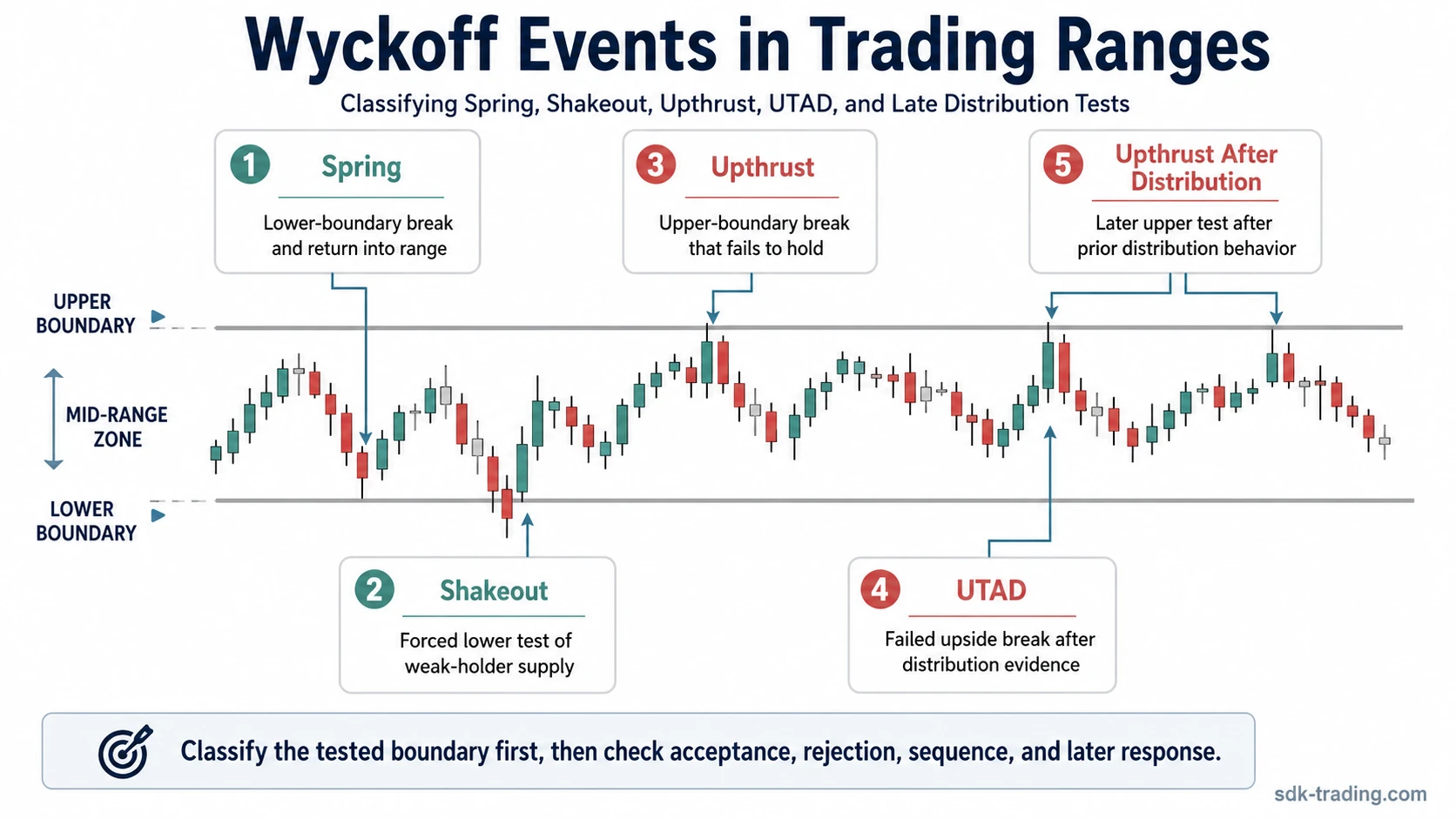
How Wyckoff Events Are Grouped Inside Trading Ranges
The cleanest way to read Wyckoff event terminology is by boundary location. A lower test asks whether downside pressure can continue. An upper test asks whether higher prices can hold. A later distribution test asks whether a previous upper failure is becoming part of a broader distribution sequence.
Several event names can look similar on a chart. A brief move outside a range is not enough by itself; the structural role comes from the tested boundary, the return or acceptance after the break, and whether later reactions respect the same area.
Wyckoff Event Map
Wyckoff event labels become more useful when they are tied to a specific range position. The same visual idea, a temporary break outside a boundary, can describe different conditions depending on whether it happens below support, above resistance, or after distribution behavior has already appeared.
| Range position | Event reading | What the label separates |
|---|---|---|
| Lower boundary | Wyckoff spring | A downside break that returns into the range instead of accepting lower prices. |
| Lower boundary or visible lows | Wyckoff shakeout | A forced lower move that tests weak-holder supply without becoming sustained downside continuation. |
| Upper boundary | Wyckoff upthrust | An upside break that fails to hold above resistance and returns back into the range. |
| Late distribution area | Wyckoff UTAD | A failed upside break that appears after distribution evidence is already developing. |
| After prior distribution behavior | Upthrust after distribution | A later upper test that checks whether demand is still failing near higher prices. |
Lower Tests, Upper Tests, and Late Distribution Tests
Lower-boundary events are mainly about rejection of lower prices. If price breaks below a visible range and quickly returns inside, the question becomes whether supply still has enough effect to continue the decline.
Upper-boundary events ask the opposite question. If price pushes above resistance but cannot hold there, the failed acceptance can point to weaker demand near higher prices. That does not make every failed breakout the same event; the surrounding range position decides which label is more precise.
Late distribution tests need extra care because they can overlap with ordinary upper-boundary failures. The difference is sequence. A late distribution event depends on prior evidence that upward progress has already weakened inside the range.
When the Event Label Is Not Strong Enough
A Wyckoff event label is premature when the range itself has not formed clearly. If there is no repeated boundary, no meaningful return into the range, or no later reaction around the tested area, the event name may add more certainty than the chart supports.
The safer use is classificatory rather than predictive. First identify the tested boundary. Then decide whether the move was accepted or rejected. Only after that does the event label help organize the reading.