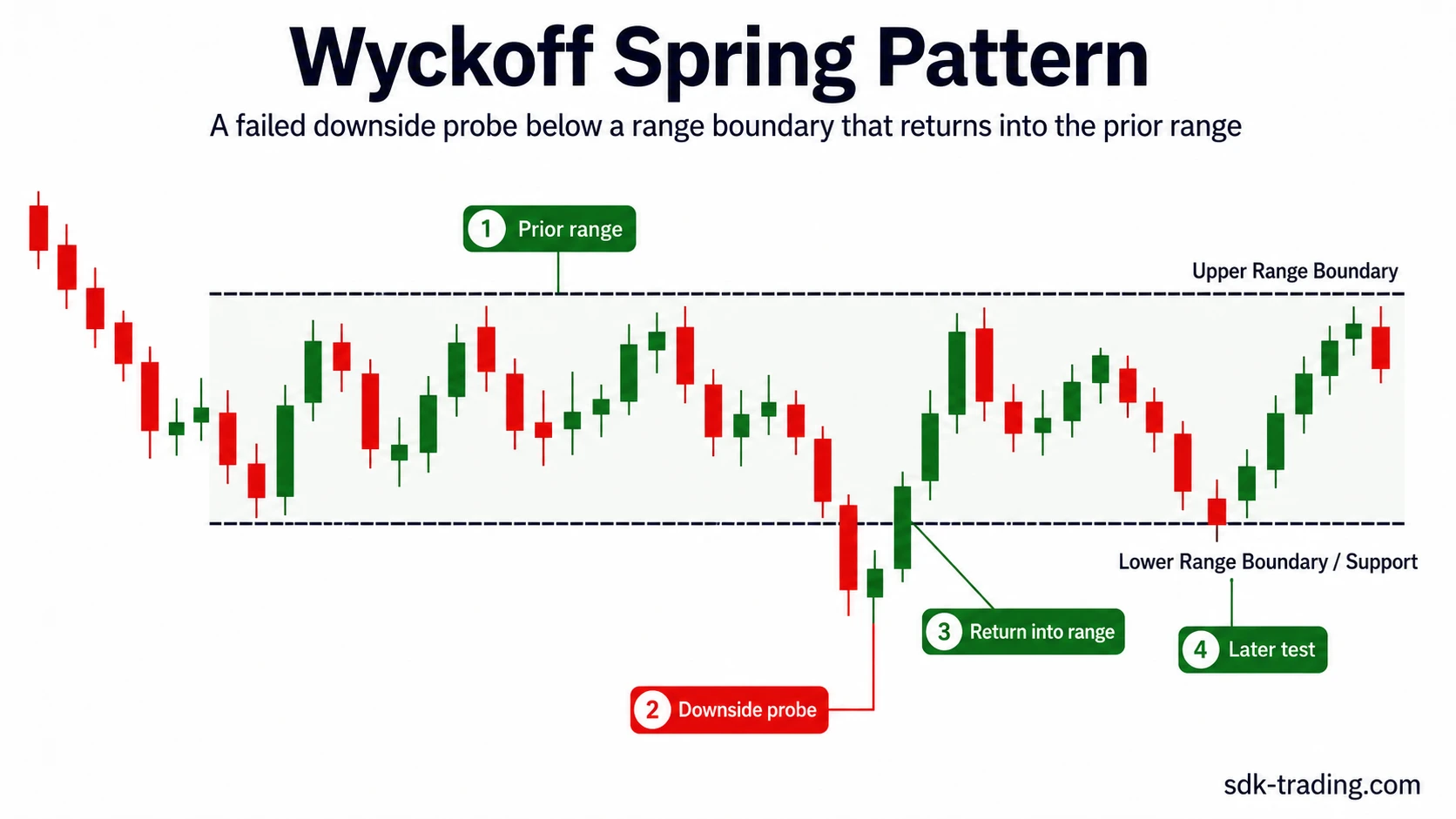
A Wyckoff spring pattern is a failed downside probe below the lower boundary of a trading range. The move becomes meaningful only if price returns into the prior range instead of accepting lower prices below support. The reading depends on boundary context, accumulation structure, volume, spread, close location, and the later spring test.
What a Wyckoff Spring Pattern Means
A Wyckoff spring belongs to range-based market-structure reading. It appears when price moves below a prior support area or lower range boundary, attracts attention as a possible breakdown, and then returns into the prior area. The break below the boundary is only the first condition. The stronger question is whether lower prices were accepted or rejected after the probe.
Definition: A Wyckoff spring is a failed downside probe below a defined trading-range boundary. The defining behavior is not the break itself, but the inability of price to stay below the range after returning or closing back inside the prior area.
Key points:
- A Wyckoff spring needs a visible lower boundary, not only a long lower wick.
- The central behavior is failed lower acceptance after a downside probe.
- Spring readings are usually discussed in accumulation or lower-range context.
- Volume and spread matter only when compared with price result and follow-through.
- The reading weakens if price begins accepting below the former range boundary.
Wyckoff Spring Pattern vs Ordinary Support Break
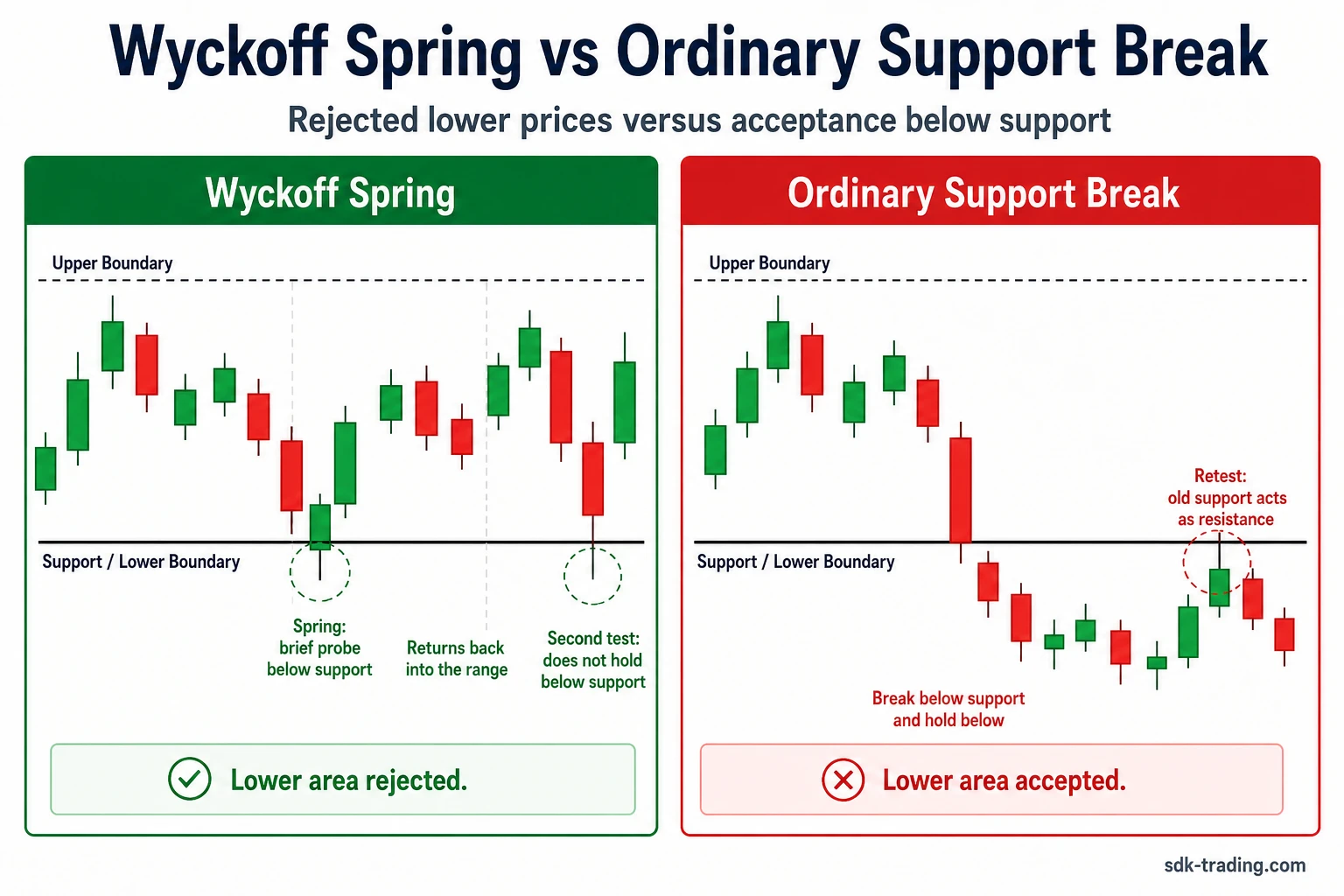
A spring pattern is different from an ordinary support break because the market does not keep building activity below the former boundary. A normal support break can continue lower, retest the broken area from below, or begin treating the old support area as resistance. A spring reading needs the opposite behavior: a probe below the boundary followed by a return into the prior range.
The practical distinction is acceptance. If price quickly returns into the range, the market has not yet confirmed that lower levels are being accepted. If price remains below the former boundary and continues to build structure there, the behavior looks less like a spring and more like a downside transition.
| Condition | Spring Pattern Reading | Ordinary Support Break Reading |
|---|---|---|
| Boundary | A prior lower range boundary is visible before the probe. | Support may break without a later failed-acceptance structure. |
| Lower move | Price briefly probes below the boundary. | Price breaks below support and may keep trading lower. |
| Return | Price returns into the prior range. | Price fails to reclaim the former support area. |
| Later behavior | A later test helps judge whether lower prices are still rejected. | A retest from below may show that former support is becoming resistance. |
Wyckoff Spring in Phase C of Accumulation
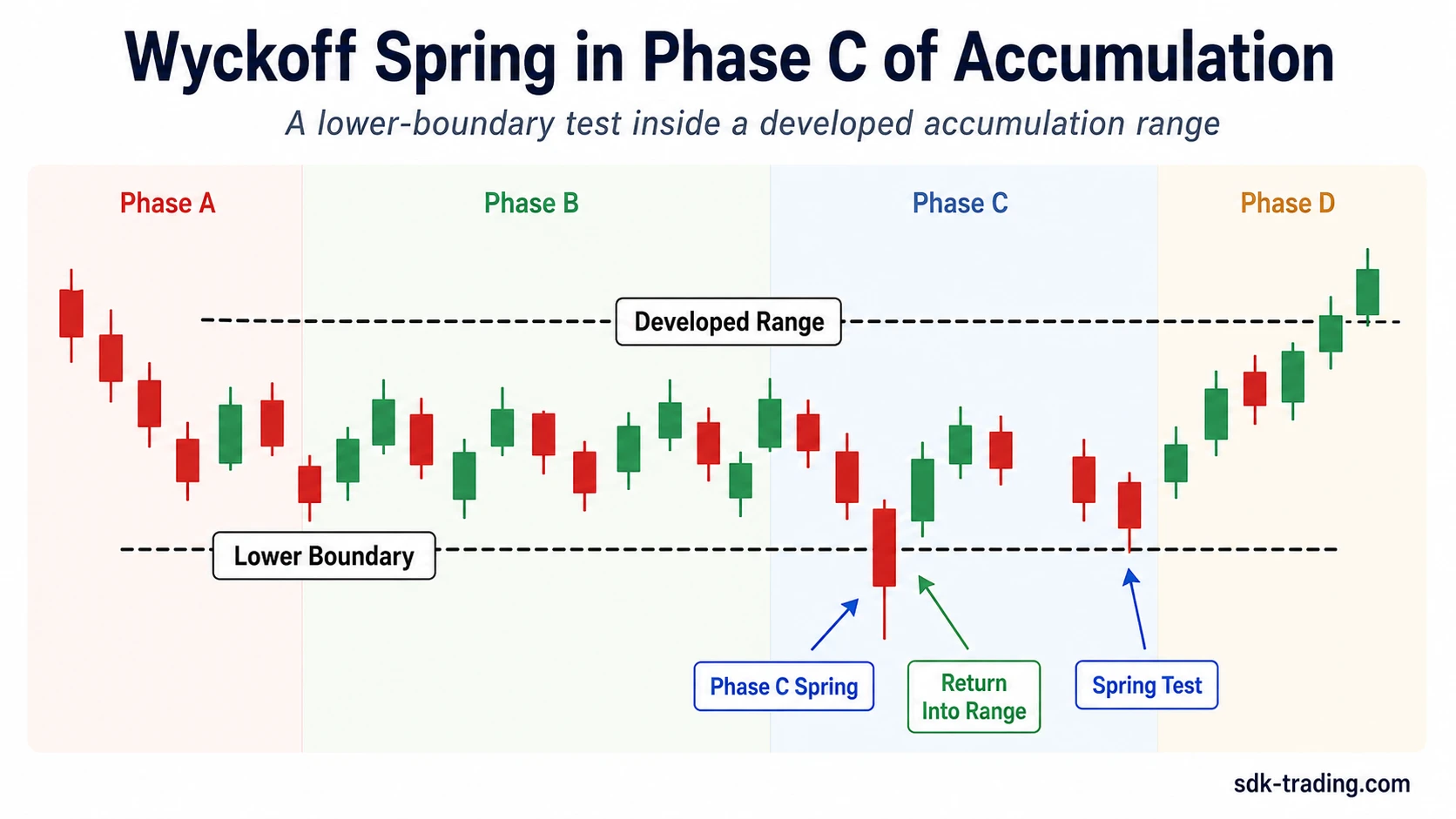
A Wyckoff spring is usually discussed near Phase C of an accumulation range. By that point, the market has already formed a recognizable trading range, the lower boundary is visible, and the downside probe tests whether price can remain below support. The spring reading becomes possible only when that lower break fails and price returns into the prior range.
Not every Wyckoff accumulation structure includes a spring. Some accumulation structures develop without a clear move below the lower boundary. The spring label becomes weaker when the range is still undefined, when the boundary is created only after the fact, or when price continues accepting below support.
Phase C context: A spring is a lower-boundary event inside an accumulation range. Phase C gives the event its structural context, but the spring still needs failed lower acceptance, a return into the range, and later behavior that does not confirm a real breakdown.
How to Identify a Wyckoff Spring
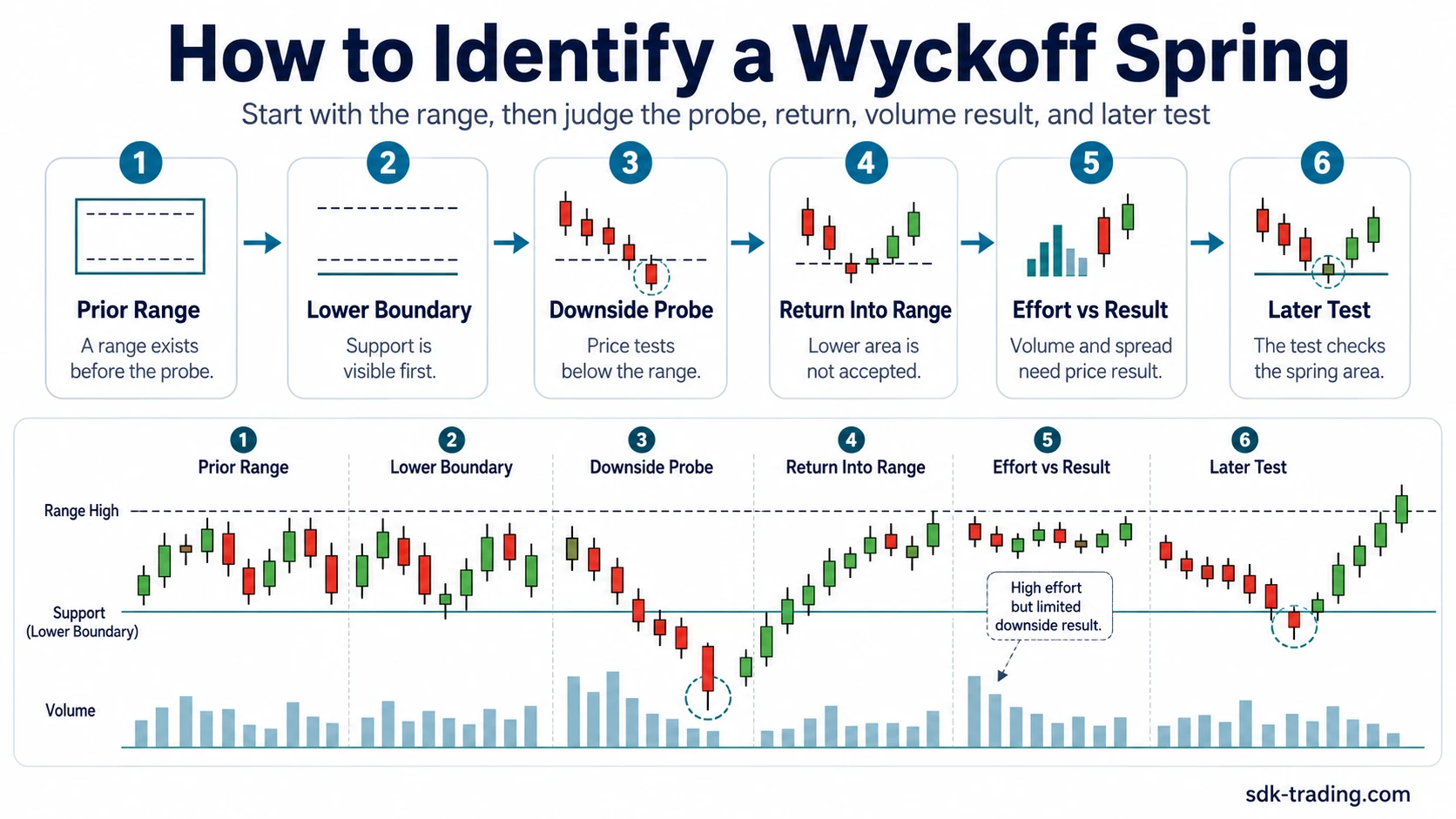
Identifying a Wyckoff spring starts with the range, not with the candle. A long lower shadow or a fast rebound can be part of the reading, but those features do not create the pattern by themselves. The lower boundary must exist first, and the move below that boundary must fail to produce sustained acceptance.
| Identification Step | What to Look For | What Makes the Reading Weaker |
|---|---|---|
| Prior range | Price has already rotated inside a recognizable trading range. | The range is loose, unclear, or defined only after the move. |
| Lower boundary | The support area or lower range boundary was visible before the probe. | The move is only a random lower print inside noisy price action. |
| Downside probe | Price moves below the prior boundary and tests lower prices. | The break continues lower without rejection. |
| Return into range | Price reclaims the prior range instead of building below it. | Price fails to recover and starts accepting below support. |
| Volume and spread | Effort is compared with result, close location, and follow-through. | Volume is treated as confirmation without checking price result. |
| Later test | Later behavior shows weaker downside result or less lower acceptance. | The later test expands lower and holds below the boundary. |
Range Probe, Return, and Spring Test
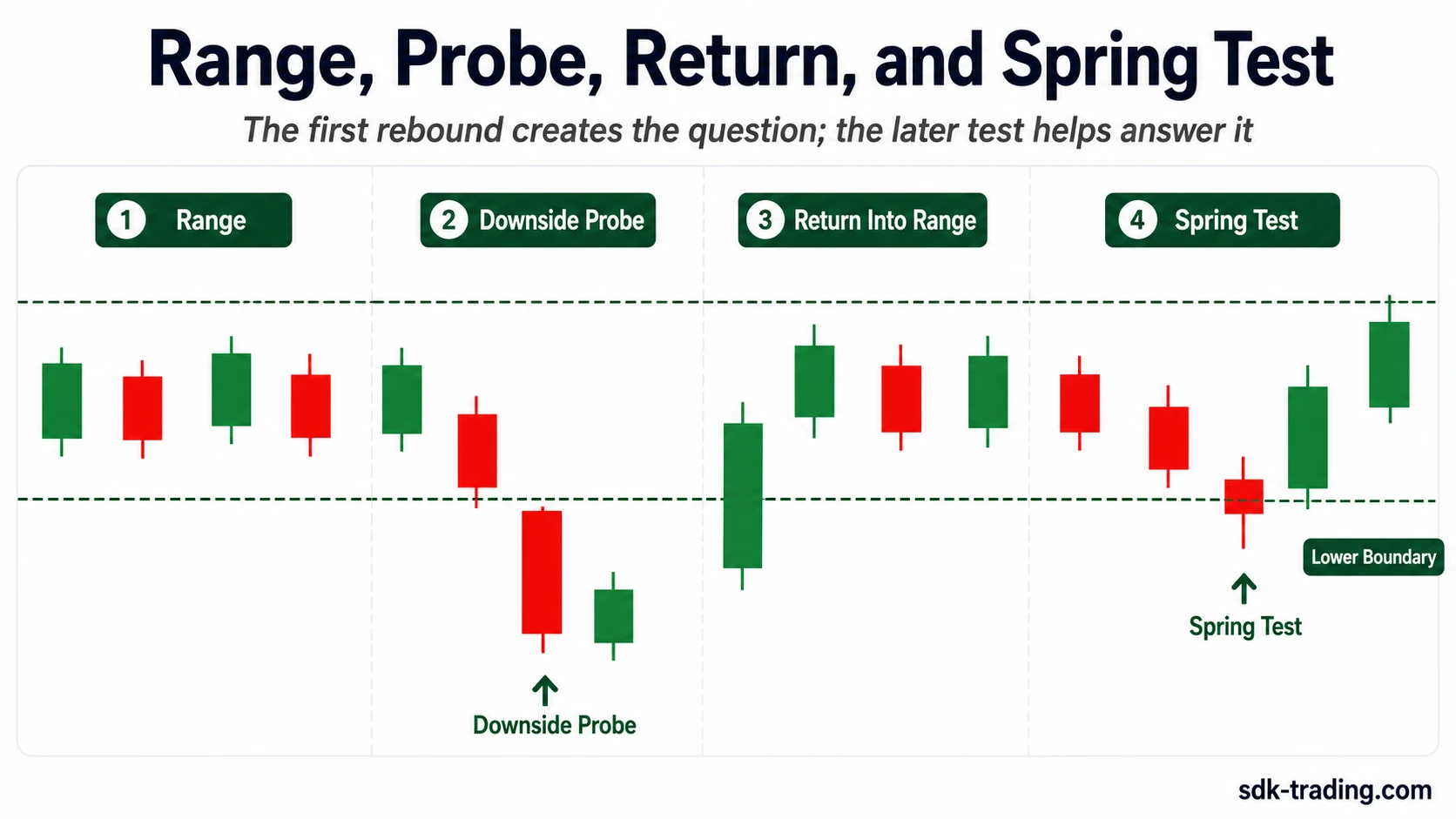
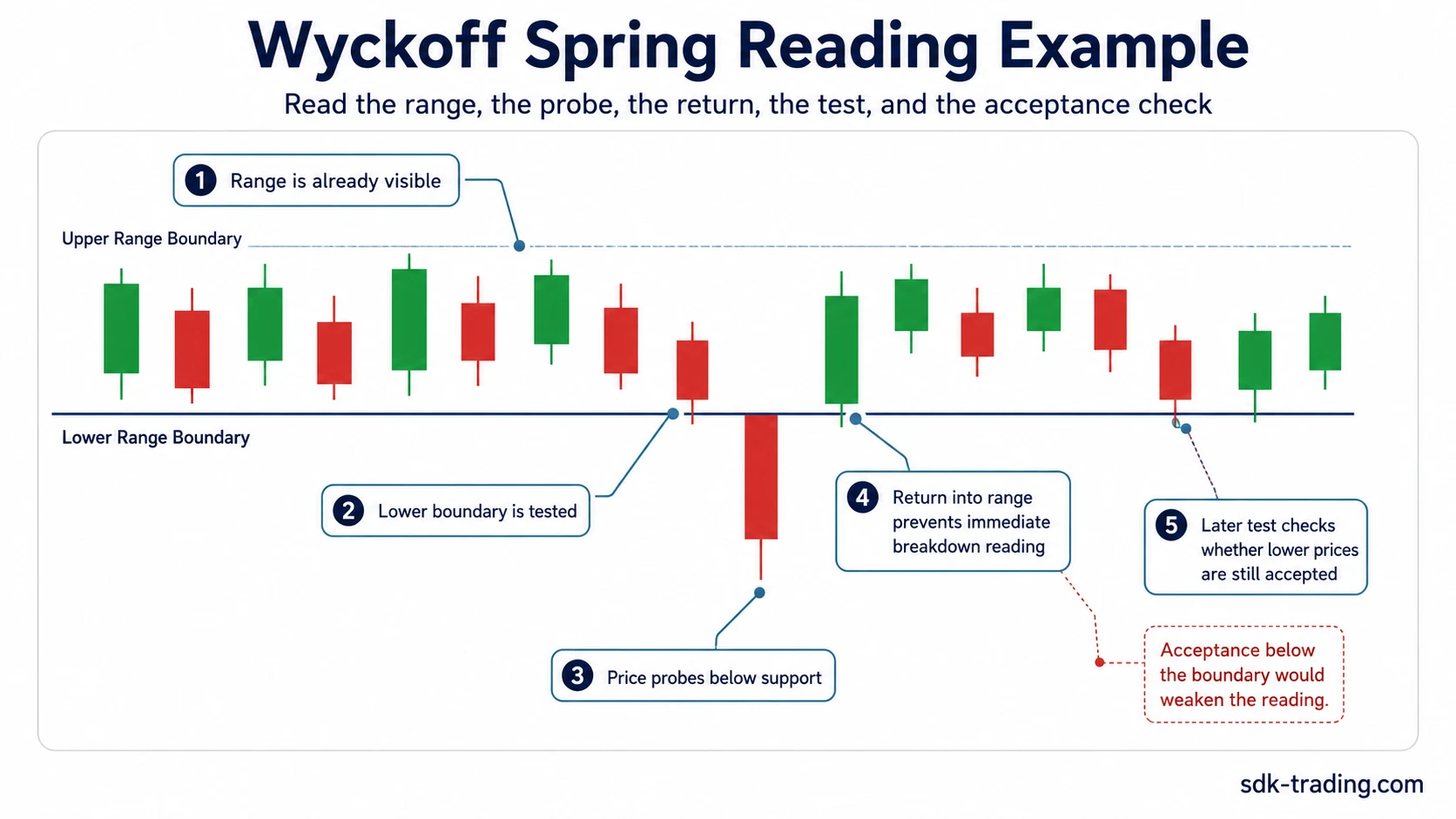
A common spring sequence begins with a market rotating inside a range. Price presses below the lower boundary, briefly expands activity, and then returns into the prior range. That return makes the spring reading possible, but it does not complete the interpretation. The later spring test often carries more information than the first break.
A spring test checks whether supply still appears near the spring area. A stronger test usually shows weaker downside result, narrower spread, controlled or lower volume, and no sustained acceptance below the prior boundary. A weak test does the opposite: it pushes lower with stronger result, holds below the range, or fails to reclaim the prior area.
Spring test: A Wyckoff spring test is later price behavior near the spring area that checks whether lower prices are still being accepted. The first rebound creates the question; the test helps answer it.
What Happens After a Wyckoff Spring
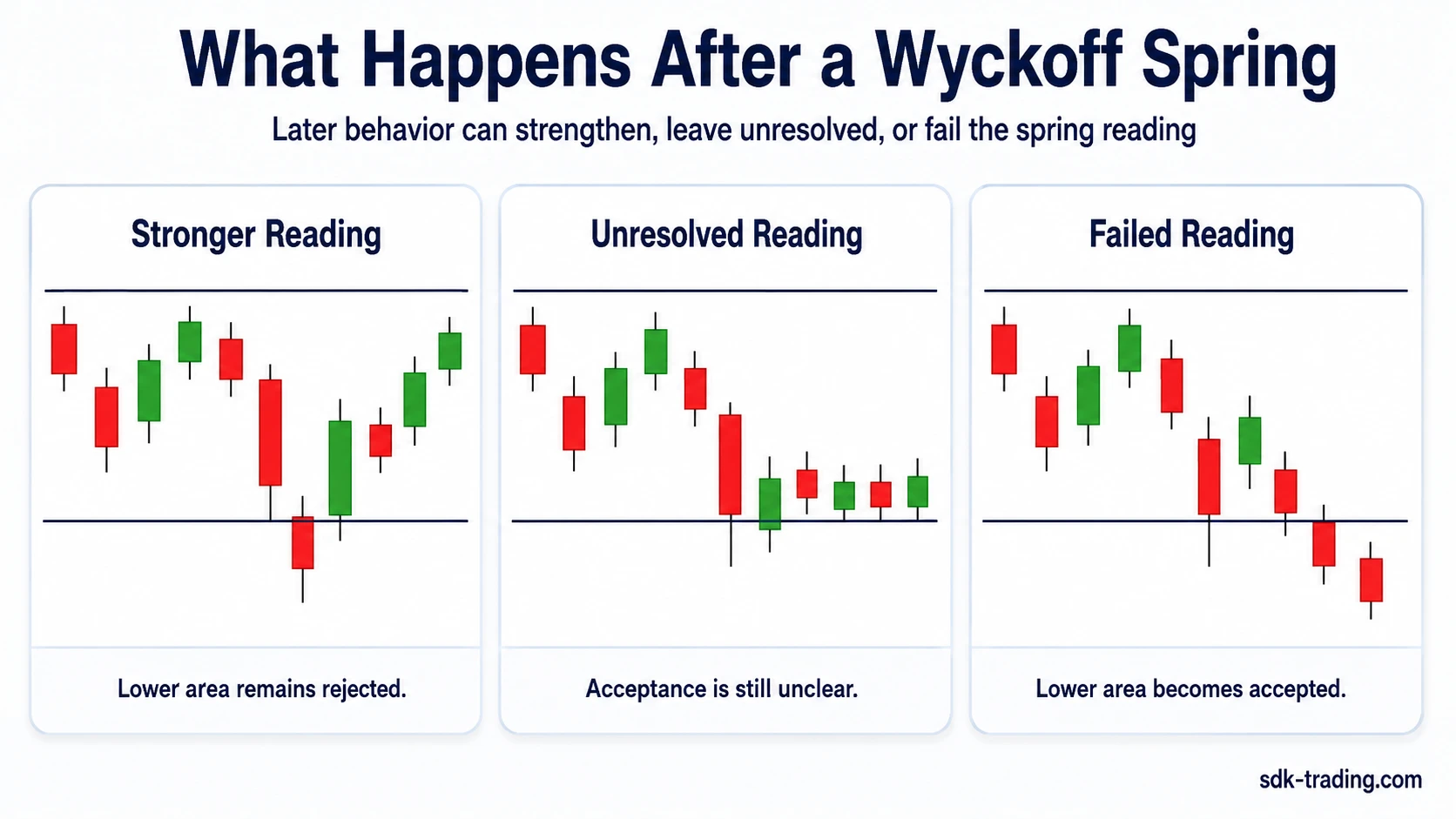
After a spring, the next useful question is whether the market can stop accepting lower prices and begin showing stronger behavior inside the range. A spring test may appear first. If that test shows weaker downside result, the structure can later develop into a sign of strength, a higher-quality retest, or a move toward the upper side of the range.
The sequence is not automatic. A spring does not guarantee markup, breakout, or continuation. The reading improves only if later behavior supports rejection below the range and shows that supply is no longer producing stronger downside progress.
| After-Spring Behavior | What It Can Suggest | What Weakens It |
|---|---|---|
| Spring test | Lower prices are tested again after the initial recovery. | The test breaks lower with stronger downside result. |
| Weaker downside result | Supply may be producing less progress than before. | Volume and spread expand lower again. |
| Sign of strength | Price begins showing stronger demand-side behavior inside or above the range. | The move fails quickly and returns to lower-boundary weakness. |
| Return to range midpoint or upper boundary | The market is no longer operating below the former support area. | The move stalls and price accepts below support again. |
How Volume, Spread, and Close Location Change the Reading
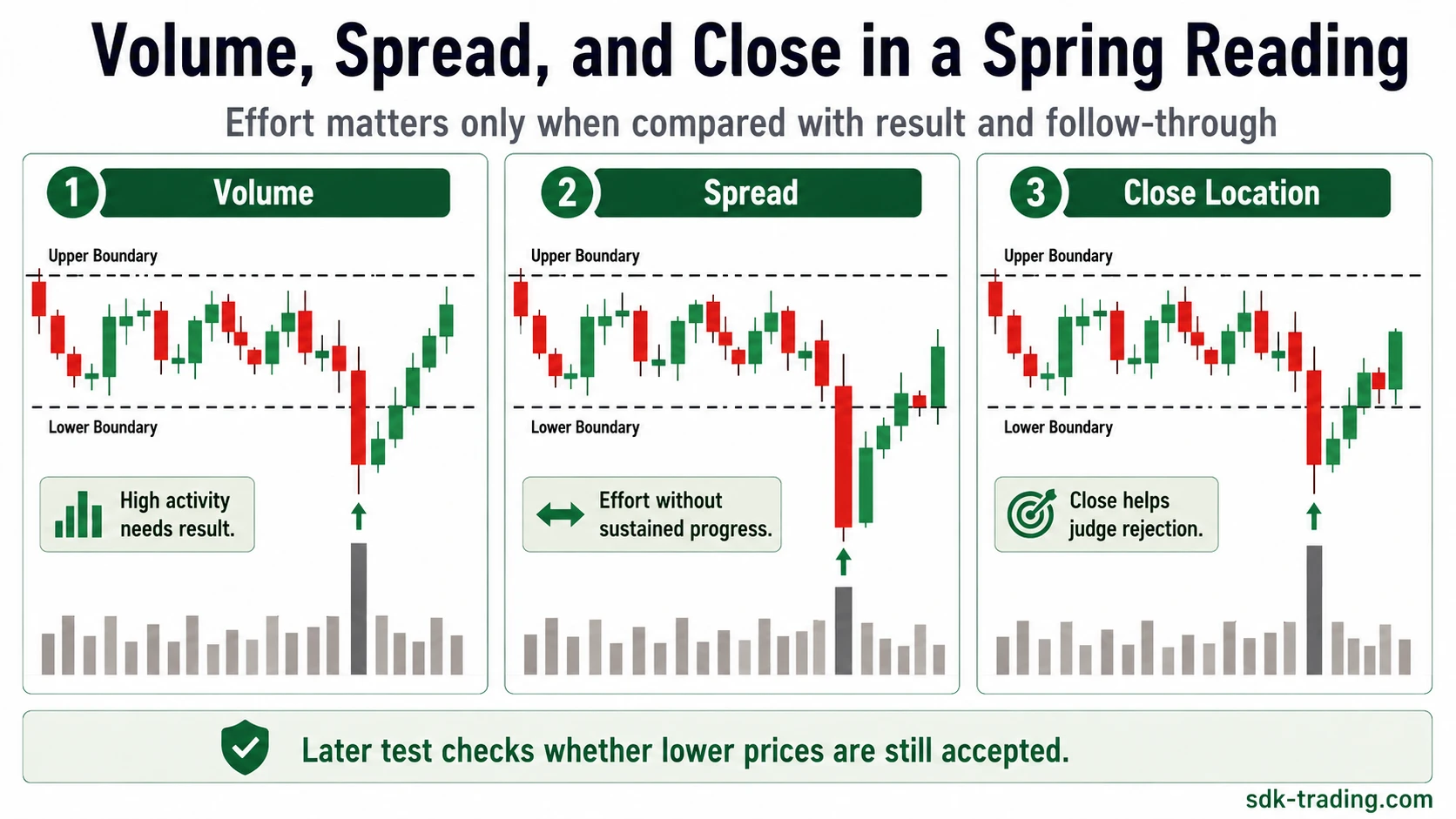
Volume, spread, and close location matter because they connect effort with result. A downside probe on high activity does not automatically confirm accumulation. The useful question is whether that activity produced sustained downside progress or whether the market failed to stay below the prior boundary despite the effort.
A wide spread below support can show aggressive activity, but the reading changes if the candle closes back inside the range or if the next bars cannot continue lower. A close near the low and later acceptance below support is weaker than a close back inside the range followed by a test that produces less downside progress.
| Reading Element | Cleaner Spring Clue | Weaker or Failed Reading |
|---|---|---|
| Volume | Activity appears, but price fails to continue lower and returns into the range. | Activity produces sustained downside progress below the boundary. |
| Spread | Wide downside effort does not create continued lower acceptance. | Wide spread continues lower with follow-through. |
| Close location | Price closes back inside or near the prior range instead of staying below it. | Price closes weakly below the former support area. |
| Later test | The test shows narrower spread, weaker downside result, or less lower acceptance. | The test expands lower and confirms acceptance below the range. |
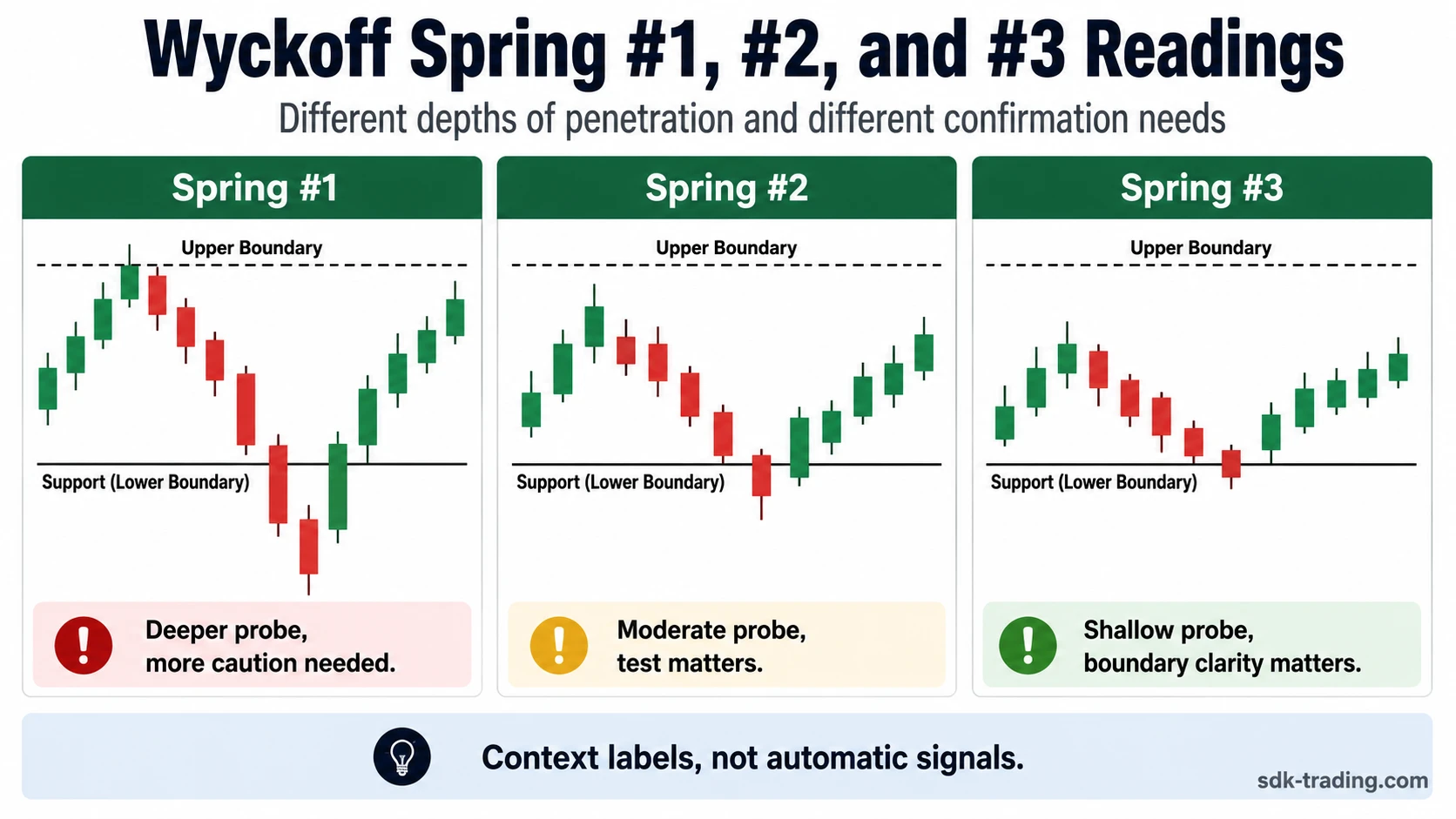
Wyckoff Spring #1, #2, and #3 Readings
Some Wyckoff traders classify springs as Spring #1, Spring #2, and Spring #3 based on the depth of penetration below support, volume behavior, and the quality of the later test. These labels should not be treated as mechanical trading signals. They are reading categories that describe how aggressive the downside probe was and how much confirmation the structure may need afterward.
| Spring Reading | Typical Structure | What Needs More Caution |
|---|---|---|
| Spring #1 | A deeper downside penetration below support, often with heavier activity and a sharper test of lower prices. | Because the lower move is more aggressive, the later test and recovery behavior matter more. Without recovery, it can become a real breakdown. |
| Spring #2 | A moderate break below the lower boundary that returns into the range without building sustained acceptance below support. | The reading depends on whether the return into the range is followed by weaker downside result on later tests. |
| Spring #3 | A shallow probe below support, often with less downside result and a quicker return into the prior range. | The move can be too small to classify confidently if the boundary was imprecise or the range was not well developed. |
| High-volume spring reading | Large activity appears during the downside probe, but price fails to continue lower. | High volume is not bullish by itself; it must be compared with spread, close location, and follow-through. |
| Low-volume test reading | After the spring, a later test shows reduced downside result and less aggressive selling pressure. | Low volume alone is not enough if price still accepts below the boundary. |
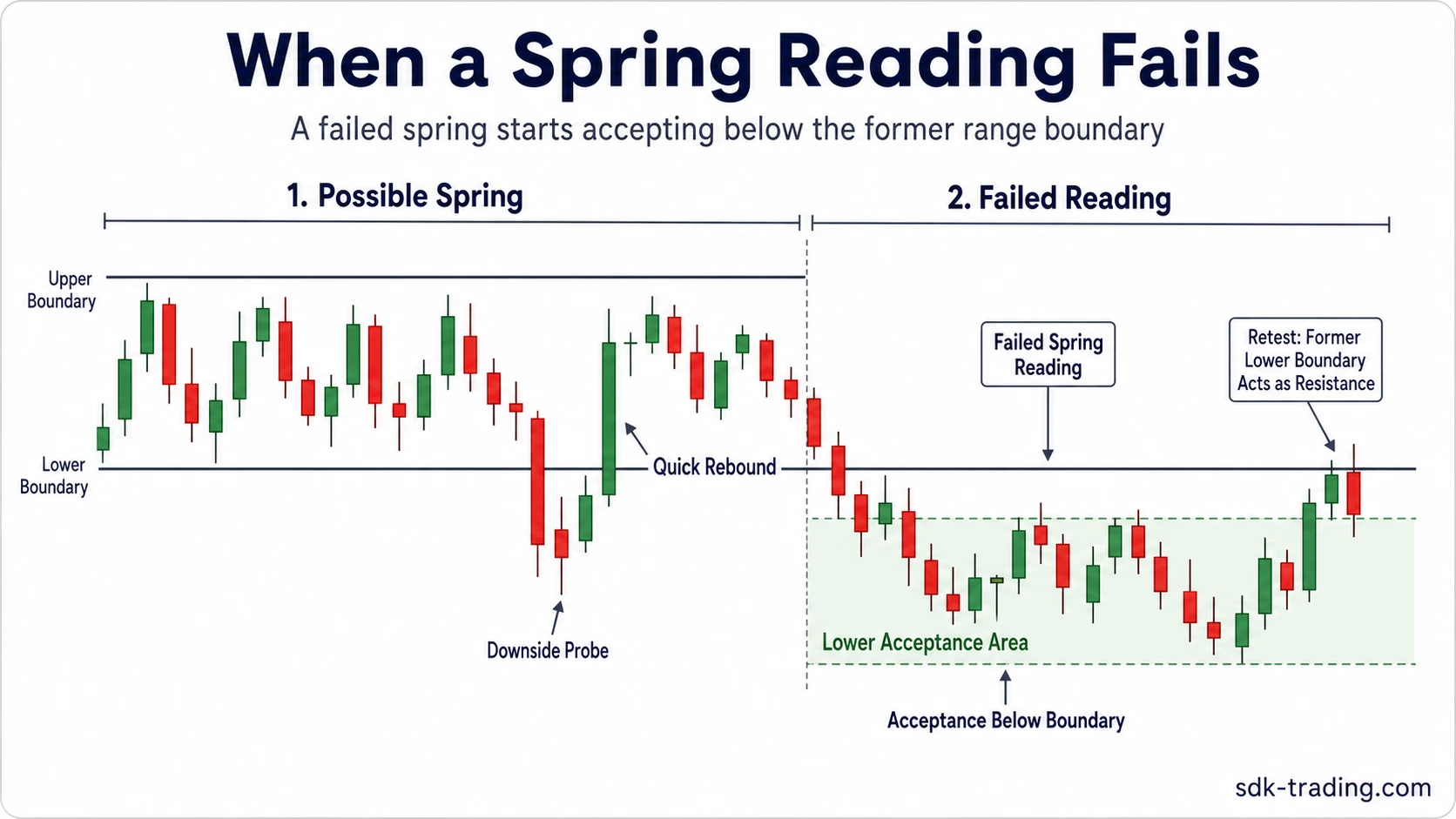
When a Spring Reading Fails
A spring reading fails when the market stops rejecting the lower area. If price begins operating below the former range boundary, builds acceptance there, and cannot reclaim the prior range, the structure no longer supports a failed-probe interpretation.
A quick rebound into the range can still fail if later behavior turns lower again. A defensible spring reading needs the failed lower probe, the return into the prior area, and later evidence that the market is not building acceptance below the boundary.
Limitation: A long lower shadow, single reversal candle, or quick rebound does not create a Wyckoff spring on its own. The range boundary, the return into the prior area, and the later evidence around acceptance are all part of the reading.
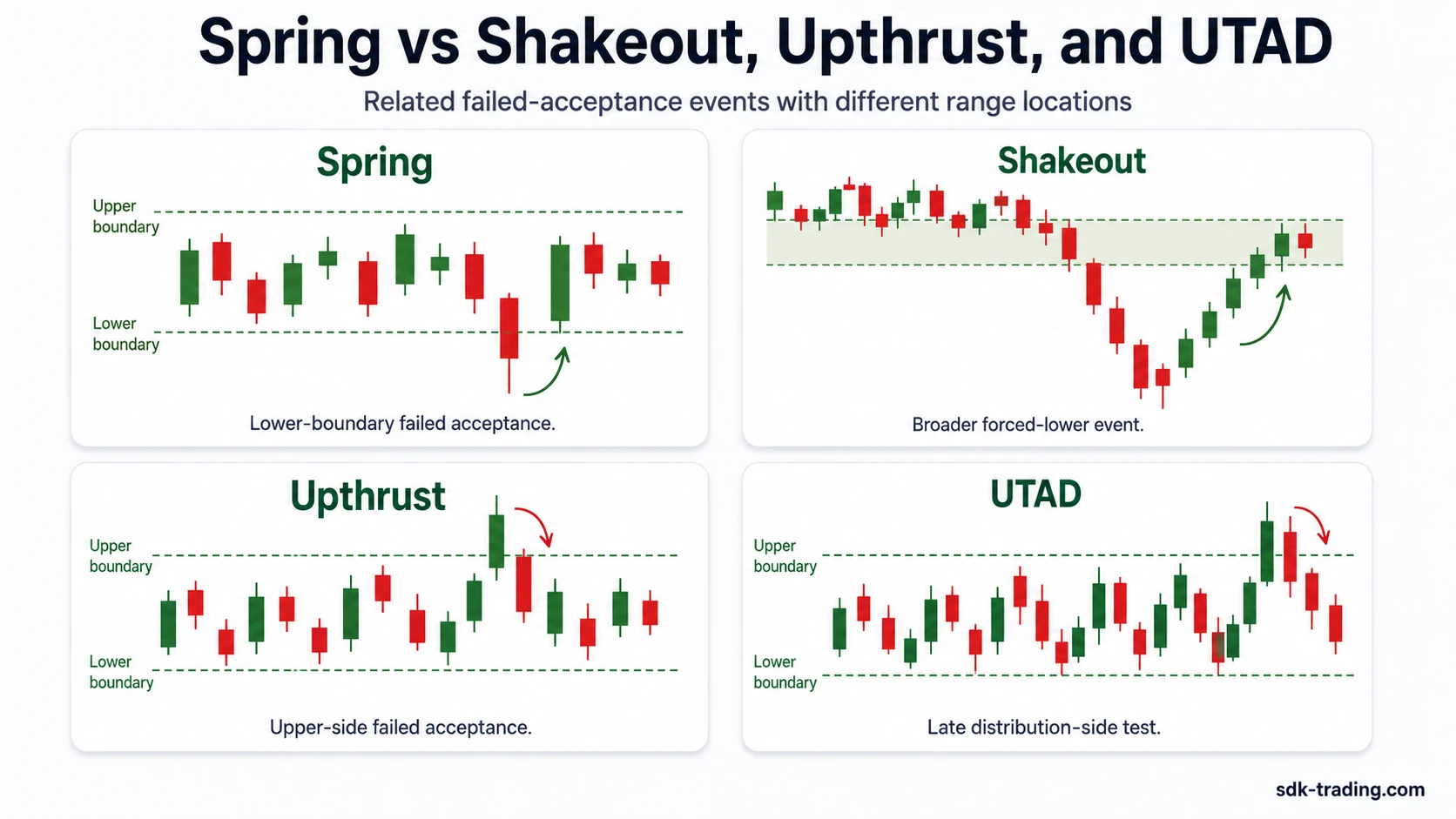
Spring vs Shakeout, Upthrust, and UTAD
A spring and a shakeout can both involve a failed downside break, but the scope is different. A spring is the narrower Wyckoff event tied to a defined lower range boundary, while shakeout language can describe a broader forced-lower move that later fails below a prior area.
An upthrust is the opposite-side event. Instead of probing below support and returning into the range, price pushes above resistance and then fails to hold the higher area. Both concepts depend on failed acceptance, but they occur on different sides of the range.
A distribution-side upper-boundary event belongs to UTAD logic. It is usually discussed after a distribution structure has developed. A spring belongs to the lower-boundary side of the range and is usually associated with accumulation or failed downside continuation.
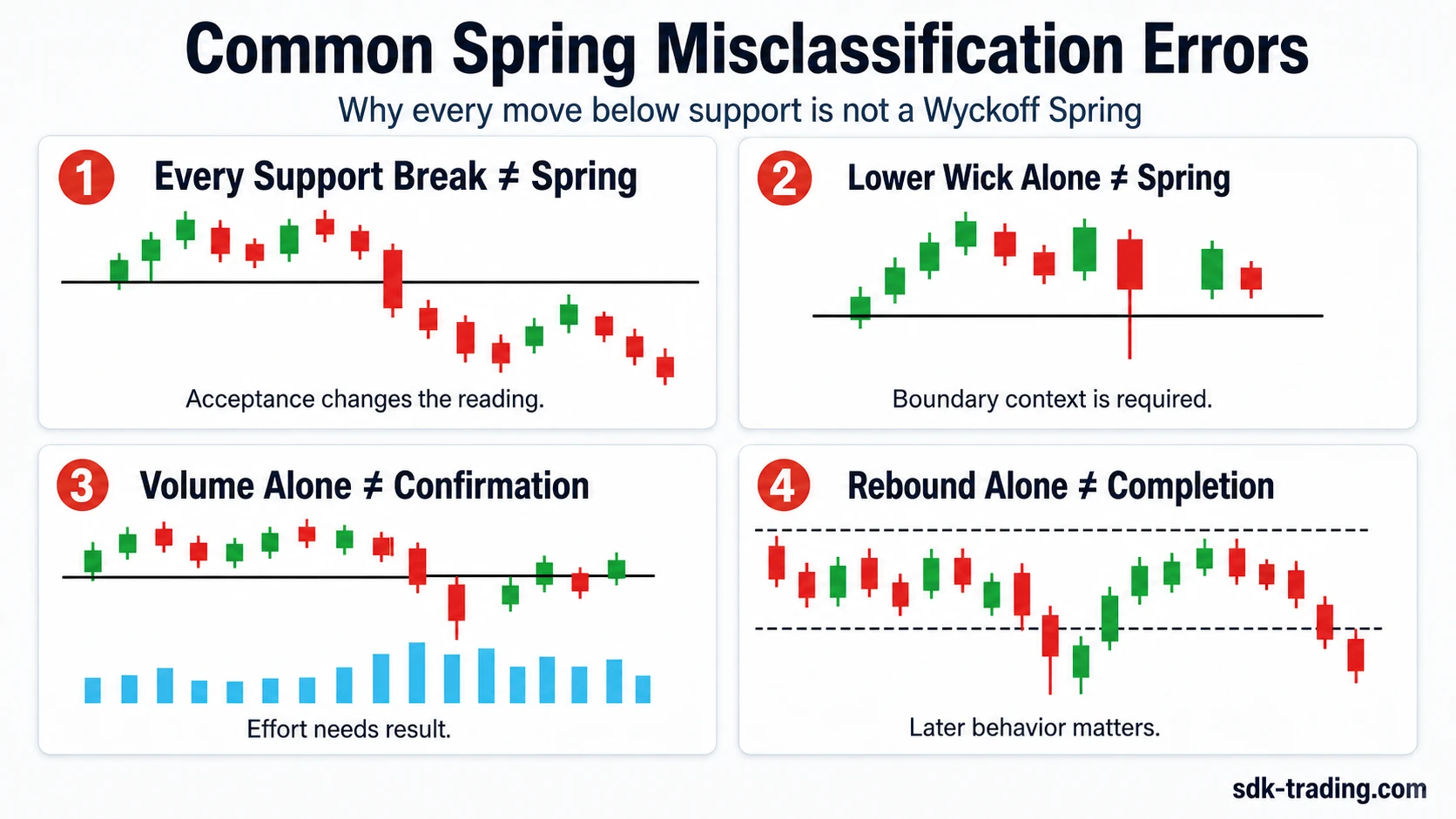
Common Misclassification Errors
| Error | Why it is wrong | Cleaner spring reading |
|---|---|---|
| Calling every move below support a spring | A spring requires a prior boundary and failed lower acceptance. If price breaks below support and begins to hold below it, the interpretation changes. | Treat the move as a spring only when price fails to accept below the prior boundary and returns into the range. |
| Reading the candle shape alone | A long lower shadow can look persuasive, but the wick does not explain whether the lower area was accepted, whether volume produced meaningful result, or whether a later test weakened the downside case. | Use the candle as one observation, then check boundary behavior, volume result, and the later test. |
| Treating volume as automatic confirmation | High volume can appear during both rejection and continuation. The useful question is whether that effort produced sustained downside progress or whether price returned into the prior range despite the activity. | Read volume through result: continued lower acceptance supports weakness, while return into the range supports failed lower acceptance. |
| Ignoring the later test | The first rebound can be sharp and still incomplete. A stronger reading develops only when later behavior supports the idea that the lower area was rejected rather than accepted. | Wait for the later test to show whether downside pressure is still effective near the spring area. |
FAQ
What is a Wyckoff spring pattern?
A Wyckoff spring pattern is a failed downside probe below the lower boundary of a trading range. Price briefly moves below support, then returns into the prior range instead of accepting lower prices.
Where does a Wyckoff spring usually appear?
A Wyckoff spring usually appears near the lower boundary of an accumulation range or trading range. The boundary must be visible before the probe, otherwise the move may be ordinary fluctuation rather than a spring.
What is a Wyckoff spring test?
A Wyckoff spring test is later price behavior near the spring area that checks whether lower prices are still being accepted. A stronger test usually shows weaker downside result, narrower spread, and no sustained acceptance below the prior range boundary.
Does every Wyckoff accumulation have a spring?
No. A Wyckoff accumulation structure can develop without a spring. A spring is one possible lower-boundary event, usually discussed near Phase C, but the accumulation reading still depends on the full range structure, tests, volume, and later price behavior.
What are Wyckoff Spring #1, #2, and #3?
Wyckoff Spring #1, #2, and #3 are reading categories used to describe different depths of penetration below support and different volume or test conditions. They should be treated as context labels, not as automatic entry signals.
Is a spring the same as a shakeout?
No. A spring is more specifically tied to a downside probe below a lower range boundary, usually in accumulation or range logic. A shakeout can describe a broader failed-lower-acceptance event, including a forced-lower move that later returns to the prior area.
What invalidates a spring reading?
A spring reading weakens or fails when price accepts below the former range boundary, cannot return into the prior area, or later tests produce stronger downside progress instead of rejection.