Wyckoff accumulation in trading is a range-based market-structure reading after prior weakness where downside progress slows, selling pressure appears to be absorbed, and later tests show whether lower prices are being rejected or accepted.
Sequence matters more than shape. A market can stop falling, rotate sideways, and even break below a prior range low without proving accumulation. The reading becomes stronger when downside attempts fail to continue efficiently, price returns into the range, and later tests show weaker supply response.
A spring or shakeout can contribute to the evidence only if the market rejects lower acceptance afterward. The stronger case comes from failed downside continuation, constructive re-entry into the range, weaker selling result, and tests that do not invite renewed supply.
Key Points
- Wyckoff accumulation is a range reading, not one candle, one wick, or one event.
- The reading strengthens when downside progress weakens and lower-area tests fail to continue lower.
- Springs and shakeouts can support the interpretation, but the next response determines whether the lower break was rejected or accepted.
- The reading weakens if price accepts lower levels or supply keeps producing strong downside result.
What Accumulation Looks Like on a Chart
Wyckoff accumulation usually begins as a trading range after prior weakness. Price stops making clean downside progress and starts rotating between an upper area and a lower area. The lower boundary becomes important because repeated attempts to push below it reveal whether sellers are still able to move price efficiently.
Observable evidence can include narrowing downside result, faster recovery after lower probes, weaker follow-through after selling pressure, and tests that hold above or near the lower area. These details matter most when they combine into repeated failure to continue lower.
Volume can help, but volume alone should not be treated as proof of absorption. High activity near the lows may suggest transfer of supply only if the result changes afterward. If heavy volume still produces clean continuation lower, the accumulation reading remains weak.
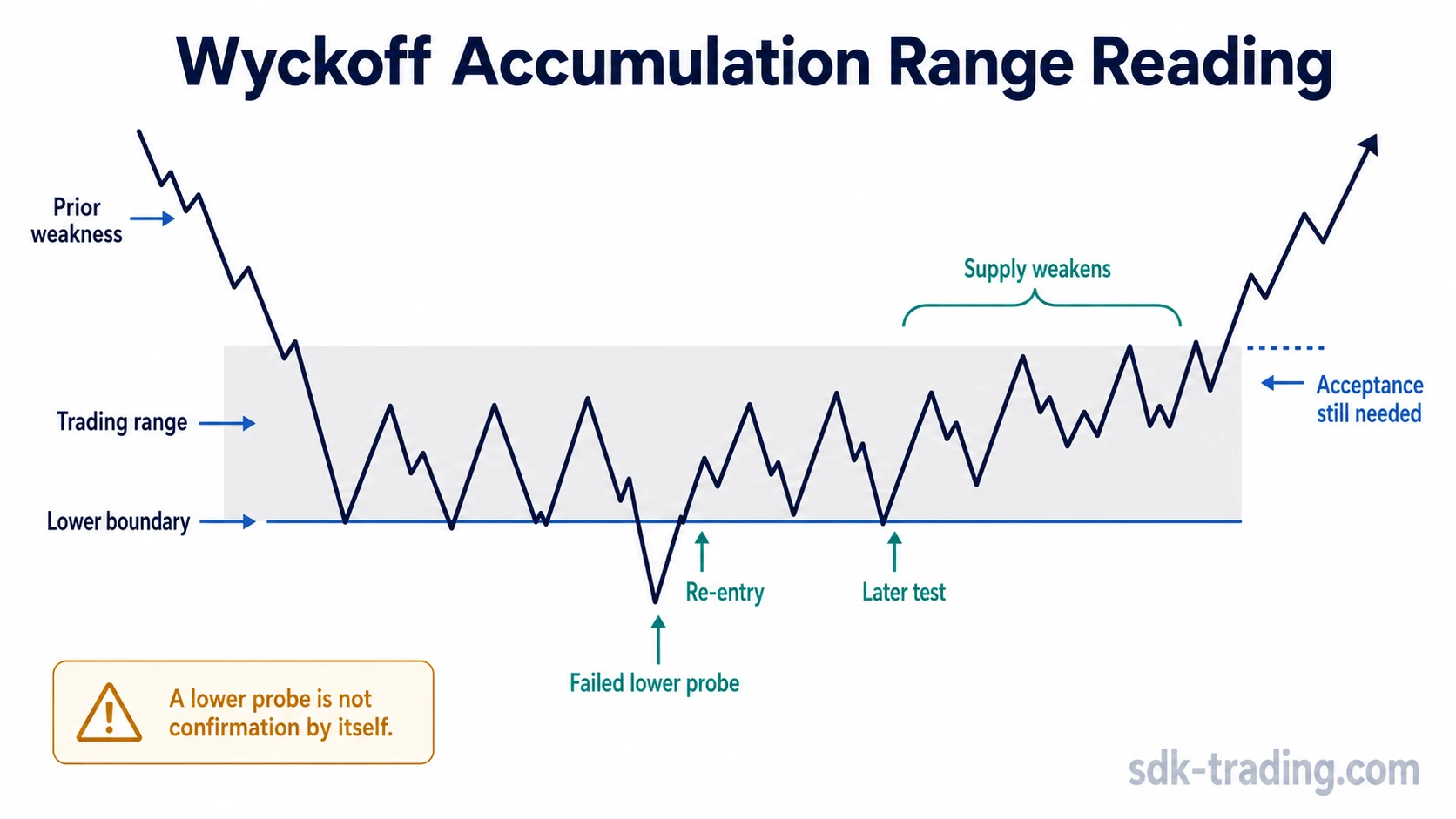
Wyckoff Accumulation Confirmation and Failure Conditions
The useful distinction is not whether a chart visually resembles a textbook base. The stronger question is whether the behavior supports absorption, remains incomplete, or starts to weaken the accumulation reading.
| Observed behavior | What supports the reading | What weakens the reading |
|---|---|---|
| Repeated selling into the lower part of the range produces less downside progress. | Supply may be losing efficiency. | Price later accepts below the range and continues lower with ease. |
| A spring or shakeout briefly breaks the lower boundary and then price re-enters the range. | The lower break supports accumulation only if re-entry holds and selling pressure loses follow-through. | The re-entry fails quickly and sellers regain control below the prior low. |
| Later tests near the lower area hold with weaker selling result. | Supply may be drying up after the earlier lower probe. | Each test produces renewed expansion lower or wider bearish result. |
| Price begins to spend more time in the middle or upper part of the range. | Control may be shifting away from sellers. | The upper range repeatedly rejects price and returns it to new lows. |
| Breaks above the range begin to hold rather than immediately fail. | The structure may be moving toward acceptance above the prior range. | Breakouts above the range fail and price returns to the lower boundary with strong supply. |
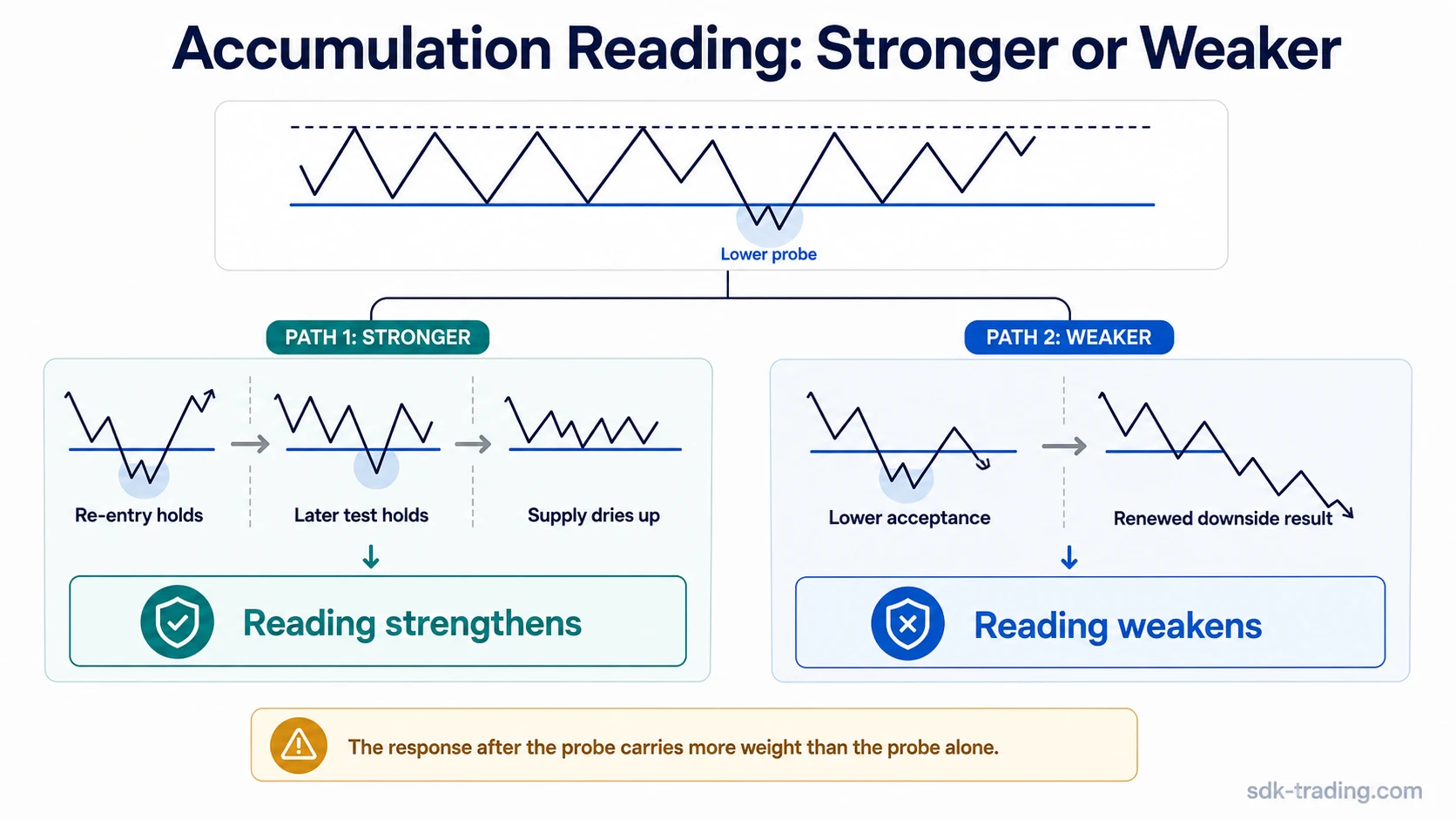
Observable Evidence in an Accumulation Reading
A cleaner accumulation reading usually combines several observations rather than relying on a single label. The lower part of the range matters because failed continuation there can show that sellers are spending effort without gaining proportional result. The middle of the range matters because price behavior there can reveal whether supply still appears quickly. The upper boundary matters because acceptance above it can change the structure from base-building into possible markup.
One common sequence is a prior decline, a range, repeated lower-area tests, a failed break below the range, and behavior that refuses to continue downward. The reading remains conditional until the market shows whether the failed lower break was actually absorbed or whether it was only a pause before renewed weakness.
Accumulation, Schematics, and Distribution
A Wyckoff schematic can help organize the range into phases, tests, and possible transitions. The schematic is a map, not a substitute for evidence. A chart can resemble a phase model while still failing if price accepts lower levels or supply remains dominant.
Wyckoff distribution studies the opposite side of the control shift: possible supply after prior strength. Accumulation is focused on whether downside pressure is being absorbed after weakness. The distinction matters because both can form ranges, but the evidence is read from different sides of the structure.
Common False Positive
The most common false positive is treating a spring or shakeout as automatic accumulation confirmation. A lower break can fail for many reasons, and the label becomes more defensible only when the next sequence supports it.
A stronger reading requires the market to re-enter the range, resist renewed downside continuation, and show that tests are not bringing supply back with the same force. If price breaks lower again and accepts beneath the range, the accumulation interpretation weakens quickly.
Simple Wyckoff Accumulation Example
A market sells into the lower part of a range several times. Each attempt reaches a similar area, but the downside result becomes smaller. A later break below the range briefly draws attention because it looks like weakness, yet price returns back into the range instead of continuing lower.
The tempting read is to call that break a spring and assume accumulation is complete. The safer read is more conditional. The case improves if the next test holds, selling pressure produces less result, and price begins to spend more time away from the lows. The case weakens if the market falls back below the same area and accepts lower prices.
The lower break matters only through the response that follows. The practical comparison is effort versus result: sellers keep applying pressure, but the market stops giving them clean downside progress.
What Can Happen After Accumulation
After a valid accumulation structure, price may move into markup, remain in the range for longer, or fail the base completely. The accumulation label does not guarantee a bullish outcome. It only describes a condition where prior selling pressure may have been absorbed enough to change the balance of control.
Markup becomes more plausible when price accepts above the range and failed tests show that former supply is no longer stopping progress. Continued range behavior remains possible when neither side can gain control. A failed base becomes more likely when lower levels are accepted and downside result improves again.
FAQ
What is Wyckoff accumulation?
Wyckoff accumulation is a trading-range reading where selling pressure weakens, supply appears to be absorbed, and later tests help determine whether the market is building a base after prior weakness.
How long can Wyckoff accumulation last?
Wyckoff accumulation has no fixed duration. It can last for a short range or continue for an extended period, depending on market context, supply, demand, volatility, and whether tests keep holding.
What happens after Wyckoff accumulation?
After accumulation, price can move into markup, continue ranging, or fail the base. The reading is strongest when price accepts above the range and later tests do not bring back dominant supply.