An upthrust in trading is a Wyckoff and VSA reading where price probes above resistance or a range high, then fails to gain acceptance above that area. The break above resistance creates the condition, but the reading depends on whether price can hold value above the prior boundary after the upward effort.
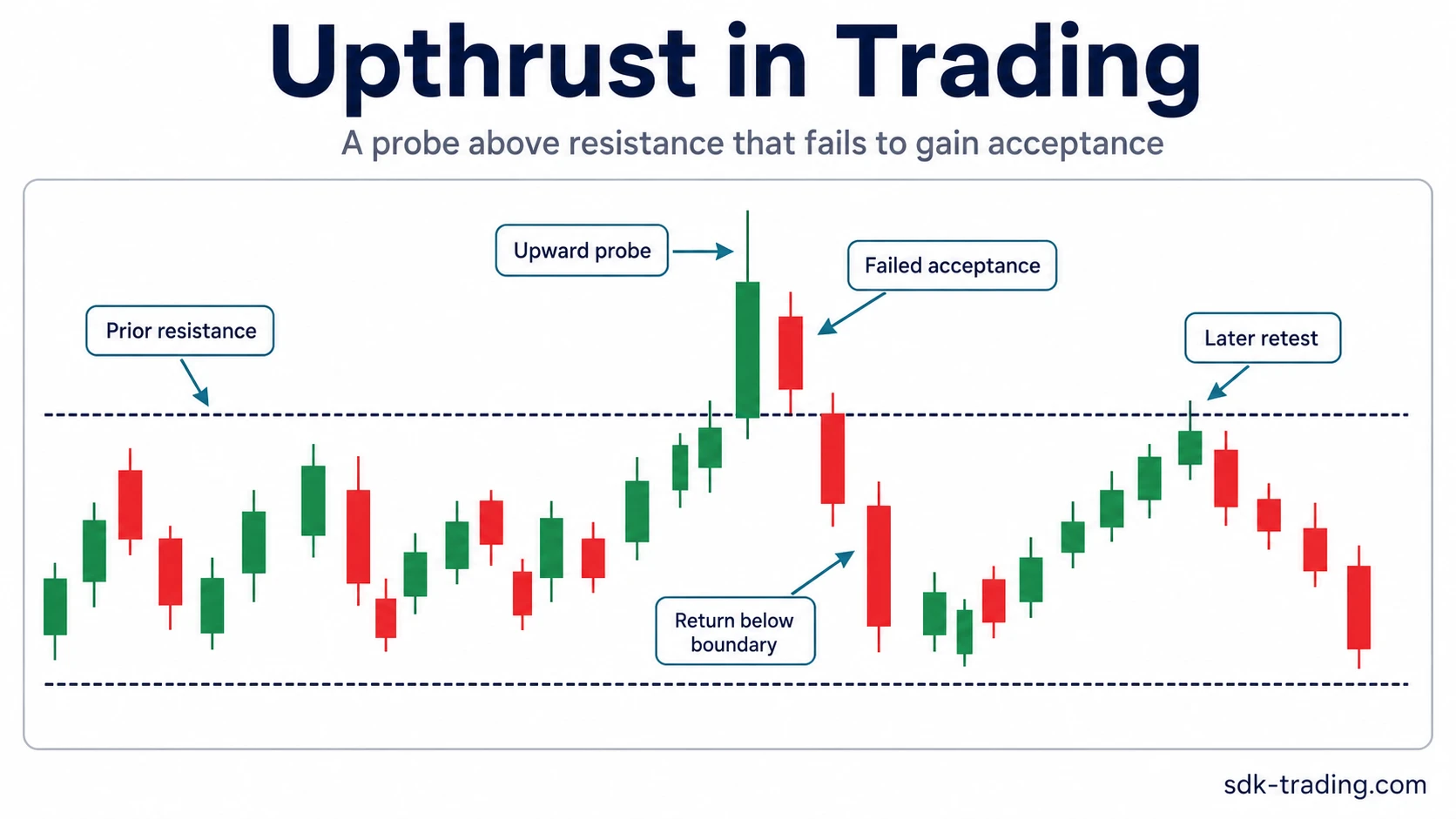
Definition: An upthrust is an upper-boundary probe that moves above a prior resistance area, then shows weak acceptance, rejection, or a return back below that boundary. In Wyckoff and Volume Spread Analysis, the reading depends on effort versus result, close location, volume behavior, and later confirmation or invalidation.
Key Points
- An upthrust belongs to the upper side of a range or resistance area.
- The move above resistance is only the first condition, not proof by itself.
- Failed acceptance above the prior boundary matters more than the wick alone.
- Volume, spread, close location, and later behavior shape the interpretation.
- Acceptance above resistance weakens or invalidates the upthrust reading.
What Is an Upthrust in Trading?
An upthrust starts with a visible upper reference area. That area may be a range high, resistance zone, prior swing high, or distribution-region boundary. Price then pushes above that area and creates the appearance of breakout strength.
The upthrust label becomes relevant only when the higher area fails to hold. A close back below resistance, a close well off the high, or a quick return into the prior range suggests that the breakout attempt did not gain durable acceptance.
Wyckoff and VSA add the effort-versus-result lens. The question is not simply whether price crossed resistance, but whether the upward effort produced sustained progress. High activity with poor follow-through, or visible buying pressure with only a narrow result, can both weaken the breakout interpretation.
How an Upthrust Forms Above Resistance
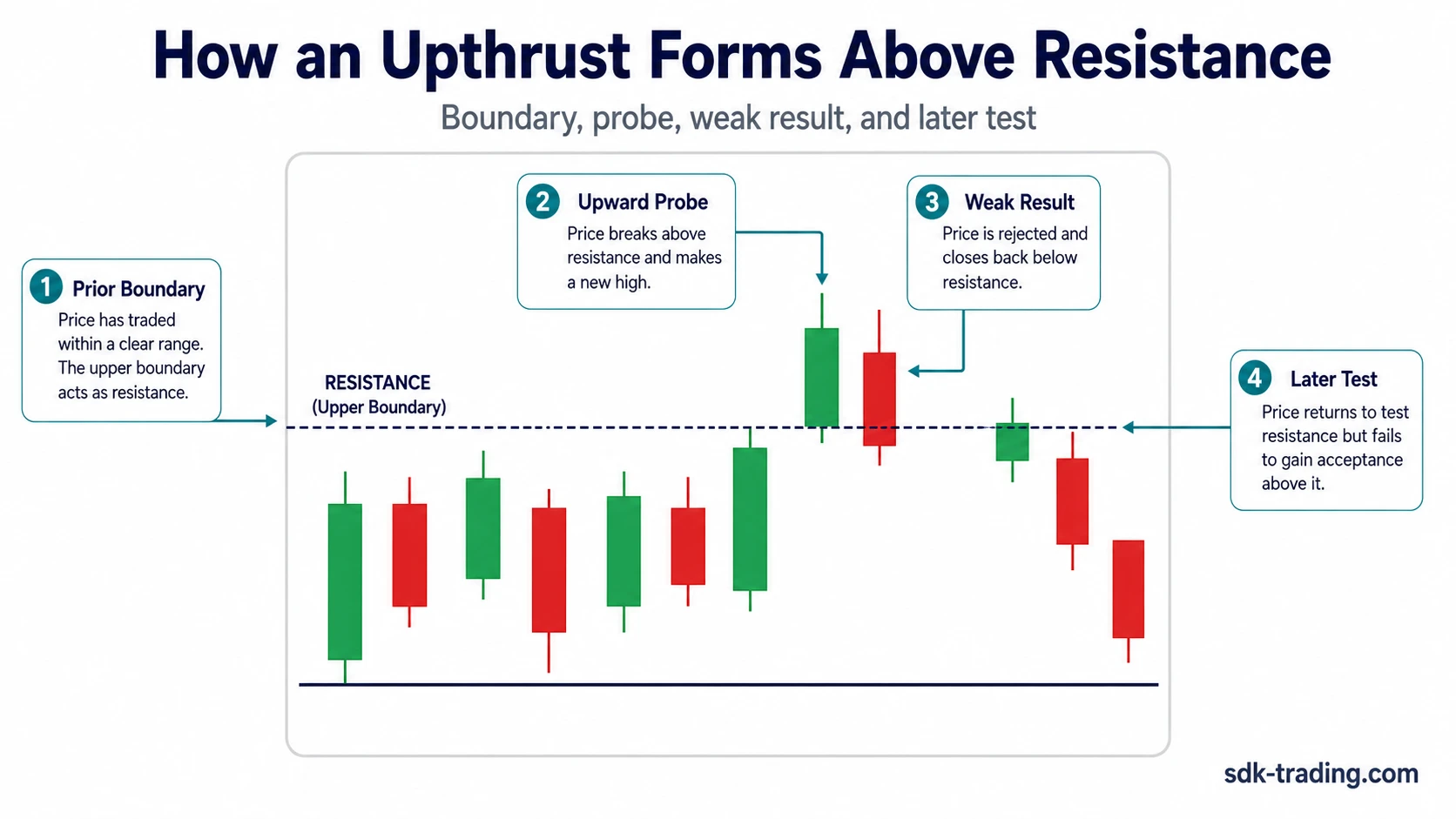
An upthrust usually develops after price has spent enough time below an upper boundary for that area to matter. The prior range gives the move context. Without a meaningful boundary, a move above a recent high may be normal volatility rather than an upthrust candidate.
The sequence starts when price trades above the range high or resistance area and briefly appears to break out. The next part of the sequence is the result: whether price can stay above the boundary, close strongly, and attract continued demand.
Weakness can appear as a close back below resistance, a close well off the high, heavy activity without sustained progress, or a quick return into the prior range. The reading becomes cleaner when a later test also fails to hold above the same area.
| Stage | What to observe | Why it matters |
|---|---|---|
| Prior boundary | Resistance, range high, or prior upper reference area | Creates the level where acceptance or rejection can be judged |
| Upward probe | Price trades above the prior boundary | Creates the condition, but does not confirm the reading |
| Weak result | Close off high, return below resistance, or poor follow-through | Shows that higher prices may not be accepted |
| Later test | Market revisits the upper area and still fails to hold above it | Strengthens the failed-acceptance interpretation |
What Confirms or Weakens an Upthrust Reading
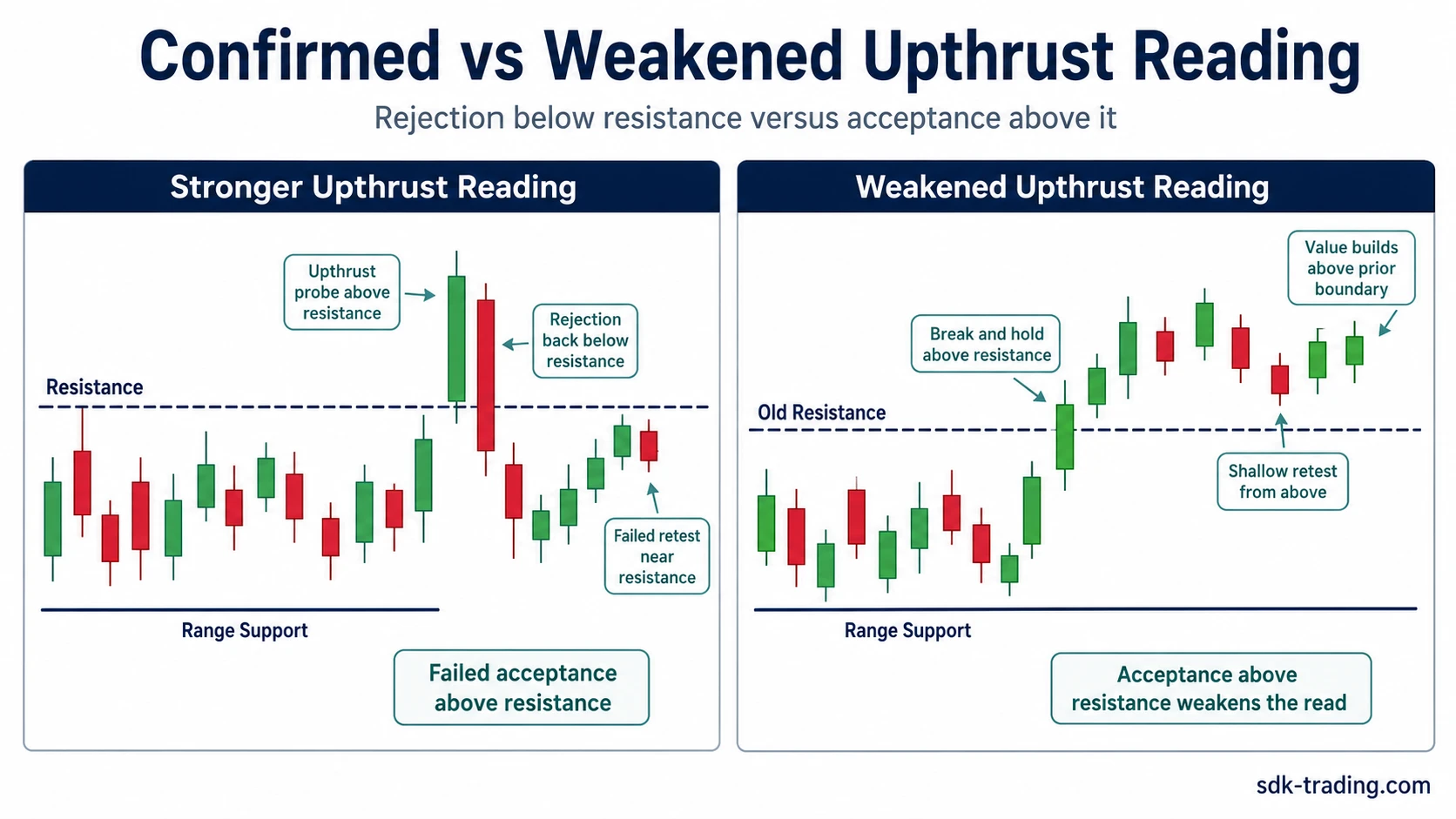
An upthrust reading becomes more defensible when price cannot hold above the prior boundary after the probe. Rejection is stronger when the move above resistance attracts activity but fails to produce continued progress. In VSA terms, the market shows effort, but the result does not support sustained demand above the old range.
Close location matters. A close near the high can suggest that demand still controlled the session or bar. A close back near the prior boundary, below resistance, or well off the high gives a weaker result. Volume matters too, but it does not confirm anything by itself. High activity can reflect participation, absorption, or contested supply and demand. It needs price result and later behavior to carry meaning.
The reading weakens when price accepts above resistance. Acceptance can appear as repeated closes above the prior high, shallow pullbacks that hold the breakout area, stronger demand on tests, or a higher value area forming above the old boundary. Under those conditions, the original probe may be better treated as breakout development rather than an upthrust.
Acceptance test: The upthrust interpretation is strongest when price fails to hold above the prior upper boundary and later behavior confirms rejection. It weakens when the market builds value above resistance and turns the old boundary into support or a stable reference area.
Upthrust vs Related Wyckoff Events
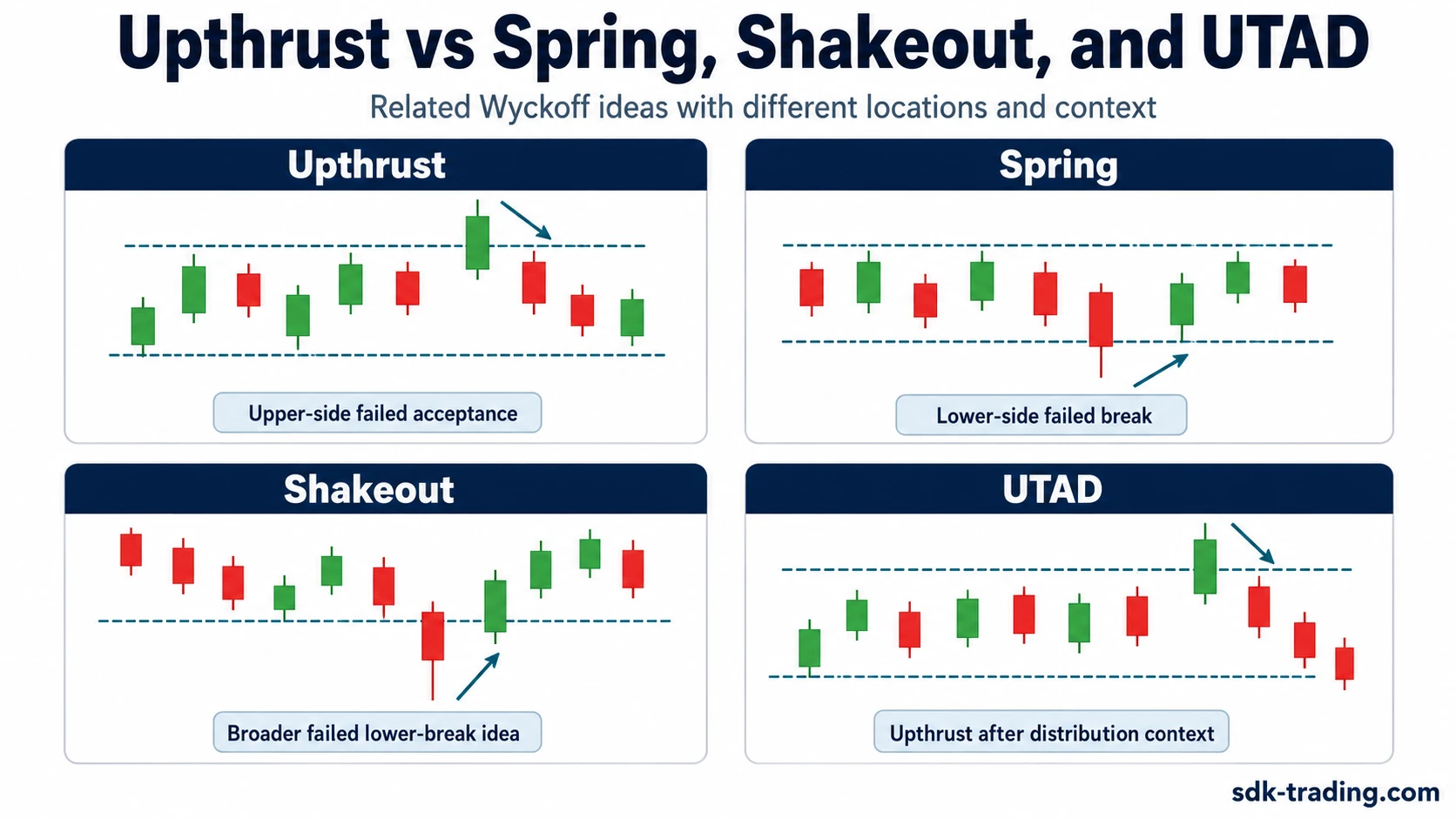
Upthrust overlaps with several Wyckoff and VSA terms, but its boundary is narrower than the surrounding distribution story. It describes the failed upper-side probe itself. The confusion usually comes from treating every failed breakout, distribution event, or stop-driven move as the same structure.
| Concept | Main boundary | Cleaner distinction |
|---|---|---|
| Upthrust | Upper range boundary or resistance | Price probes higher, then fails to accept above the prior boundary. |
| Spring at the lower boundary | Lower range boundary or support | A spring is the opposite-side event, where price probes below support and then returns into the prior area. |
| Shakeout | Usually a broader forced-participation move | A shakeout can describe a wider stop-run or forced-move idea, while an upthrust is specifically upper-side failed acceptance. |
| UTAD | Upper boundary inside distribution logic | UTAD is tied to a distribution-phase reading, while upthrust can describe the general upper-boundary event. |
| Upthrust After Distribution | Upper boundary after distribution evidence | Upthrust After Distribution is the narrower distribution-specific version, where the upthrust occurs after distribution context is already established. |
Upthrust After Distribution Context
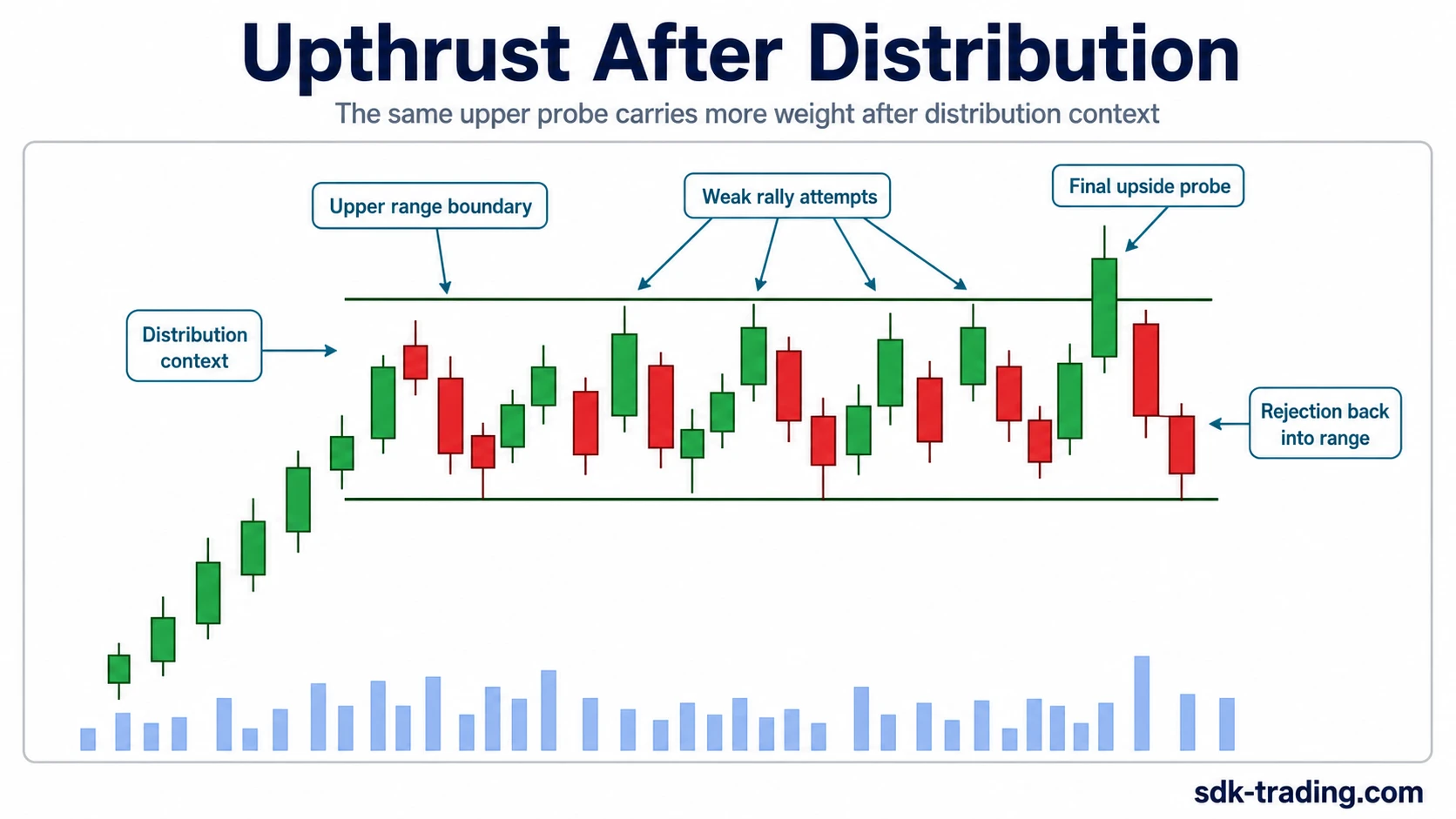
An upthrust carries more weight when it appears after distribution behavior is already visible. In that setting, the upper probe is not judged in isolation. It is read against prior rallies that struggled near the same boundary, weaker progress near the highs, and later failure to hold above the range.
This does not mean every push above a distribution range is automatically an upthrust after distribution. If price breaks above the range and builds stable value there, the distribution reading weakens. The upthrust interpretation becomes more useful only when the probe fails to gain acceptance after the market has already shown distribution-style context.
Example of a Basic Upthrust Reading
A market rotates below a clear resistance area for several attempts. Price then pushes above the prior high and briefly looks like it is breaking out. The move attracts attention because the upper boundary has finally been crossed, but the break only creates the condition to evaluate.
The first warning appears if price cannot stay above that area. The bar may close back near the prior high, below the resistance line, or far away from its intrabar high. If the next attempt also fails to hold above the boundary, the original probe becomes easier to read as failed upward acceptance.
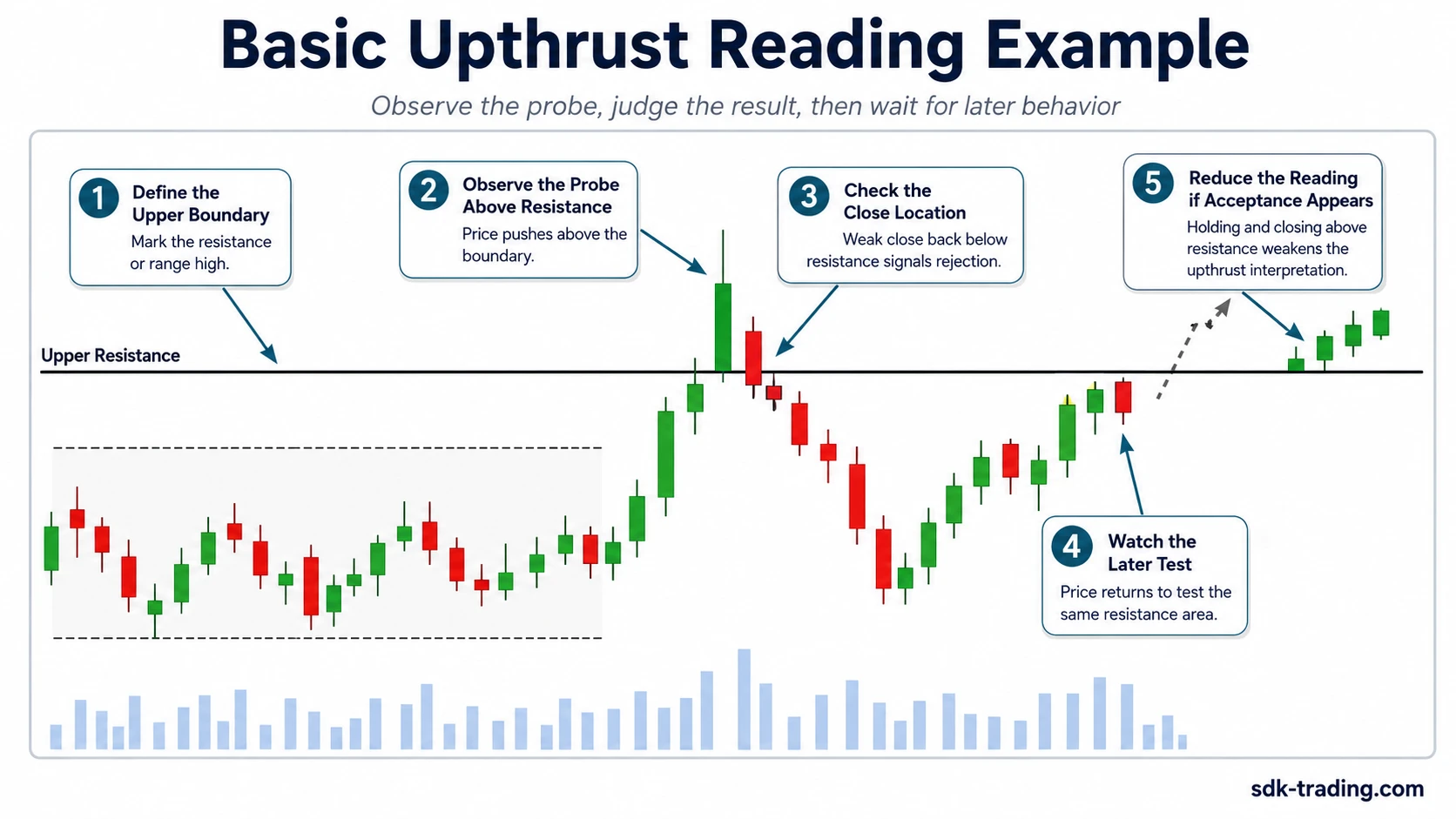
The distinction comes after the break. Weak result above resistance, poor follow-through, and another failed attempt near the same area support the upthrust interpretation. Repeated closes above the prior high, shallow pullbacks, and value building above the old boundary argue against it.
Common Upthrust Reading Mistakes
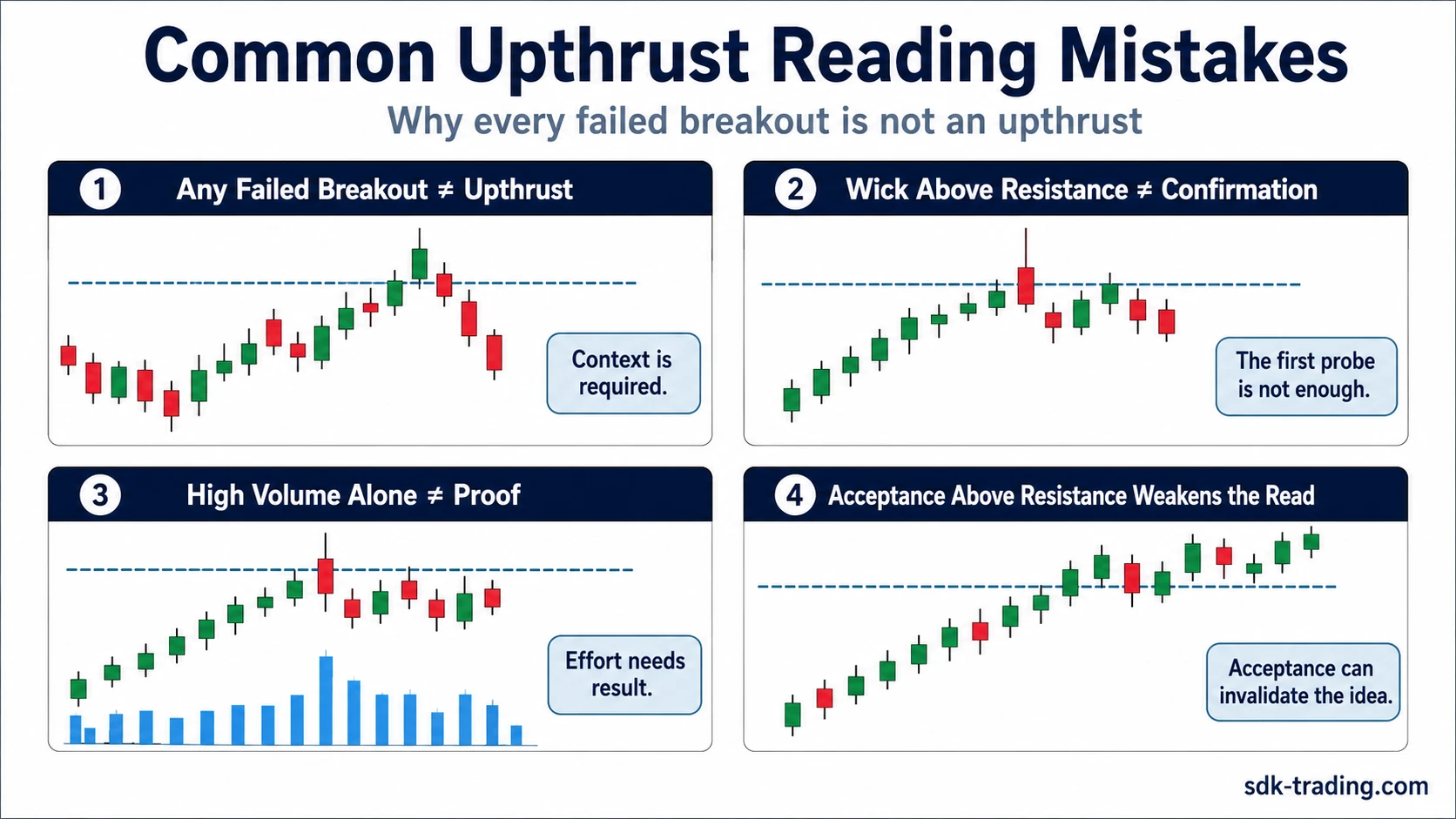
The main mistake is labeling the event too early. An upthrust needs a meaningful upper reference area and enough surrounding behavior to judge acceptance, rejection, effort, and result.
| Mistake | Why it is weak | Cleaner reading |
|---|---|---|
| Calling any failed breakout an upthrust | The level may not have enough range or resistance context. | Start with a meaningful upper boundary before judging the probe. |
| Treating one wick as confirmation | The wick only shows that price traded above the boundary. | Wait for the result after the probe and the later behavior around the same area. |
| Using high volume as proof | Volume shows activity, not the final meaning of that activity. | Read volume together with spread, close location, and follow-through. |
| Ignoring acceptance above resistance | Holding above the old boundary can turn the move into breakout development. | Reduce or discard the upthrust reading if value builds above resistance. |
Practical limitation: An upthrust is a conditional chart-reading concept, not a standalone prediction. The reading should stay provisional until price behavior after the probe shows whether higher prices were rejected or accepted.
FAQ
Is an upthrust always bearish?
No. An upthrust is a conditional failed-acceptance reading above resistance. It can suggest weakness only if later price behavior shows that the market could not hold or build value above the prior boundary.
Is high volume enough to confirm an upthrust?
No. High volume only shows activity. The reading depends on the relationship between volume, spread, close location, follow-through, and later tests around the same upper boundary.
How is an upthrust different from UTAD?
An upthrust is the general upper-boundary failed-acceptance event. UTAD is more specific because it belongs to distribution logic after a distribution context is already present.