A shakeout in trading is a brief downside break below a prior range, support area, or accepted zone that fails to hold lower and returns toward the prior area. In Wyckoff and VSA context, the useful question is not whether price briefly moved lower, but whether the lower break was accepted, rejected, or later tested with reduced downside supply.
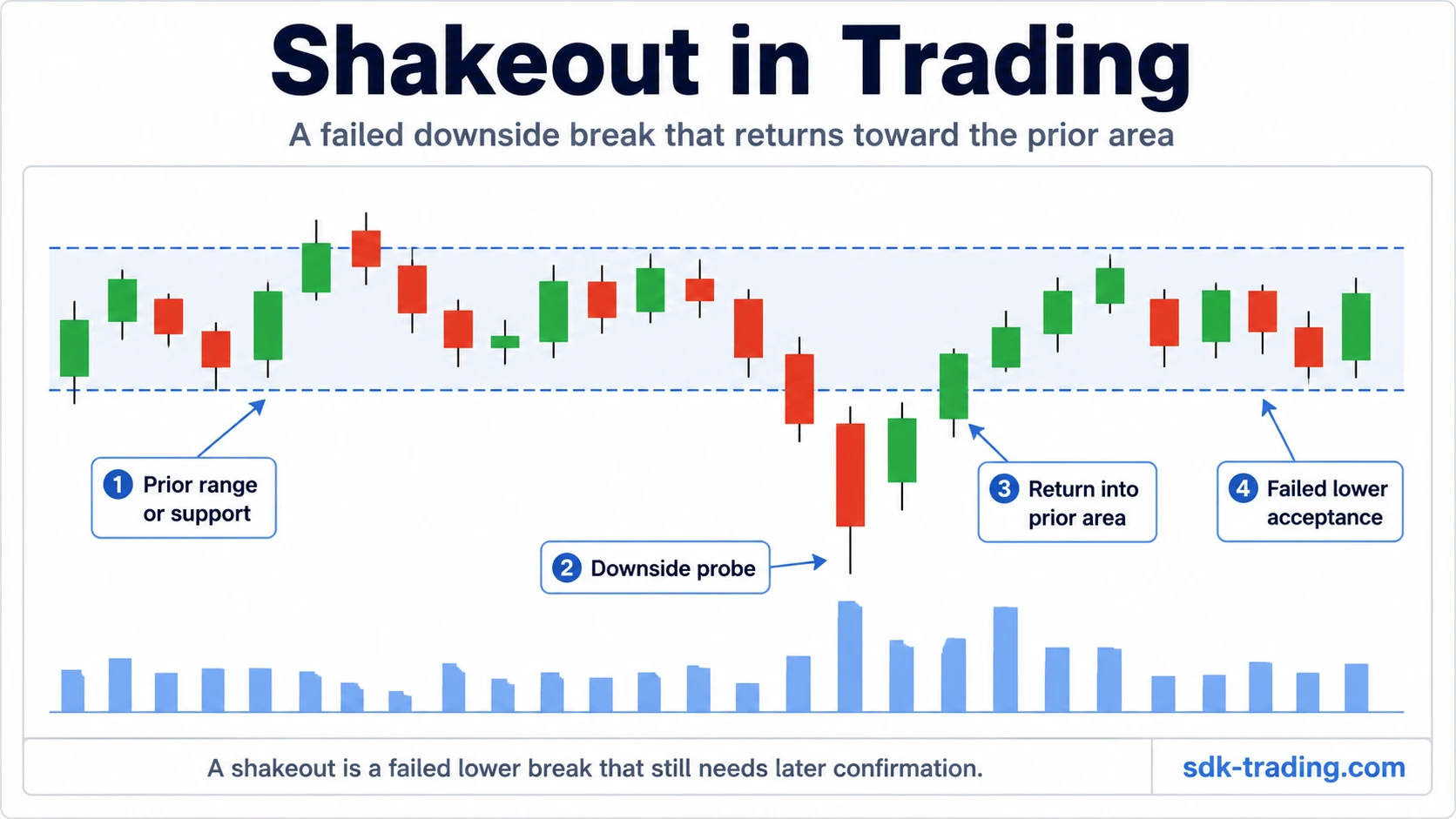
What a Shakeout Means in Trading
In Wyckoff and Volume Spread Analysis, a shakeout refers to a downside probe below a prior trading area, followed by evidence that lower prices were rejected, retested, or accepted. The term is useful only when the surrounding structure, volume, spread, and follow-through support that reading.
A trading shakeout starts with a downside probe through a prior area that already matters. That area may be the lower boundary of a trading range, a support area, or a zone where price was previously accepted. The event becomes meaningful only if the break fails to hold lower and later behavior shows that downside supply may be losing efficiency.
The label stays conditional. A shakeout is a diagnostic event, not proof that accumulation has started. Price pressures the lower area, and the next sequence shows whether that pressure was absorbed, rejected, or extended.
What a Shakeout Means and What It Does Not Confirm
| What it is | What it is not |
|---|---|
| A downside probe below a prior range, support area, or accepted zone. | Any sharp selloff or red candle. |
| A failed lower acceptance event that needs later confirmation. | An automatic bullish reversal signal. |
| A Wyckoff/VSA reading based on price result, spread, volume, and follow-through. | A single-candle pattern by itself. |
| A possible test of supply below a known area. | Proof that institutions definitely took stops. |
| A broader event label that can overlap with a spring. | The same thing as every false breakdown or every spring. |
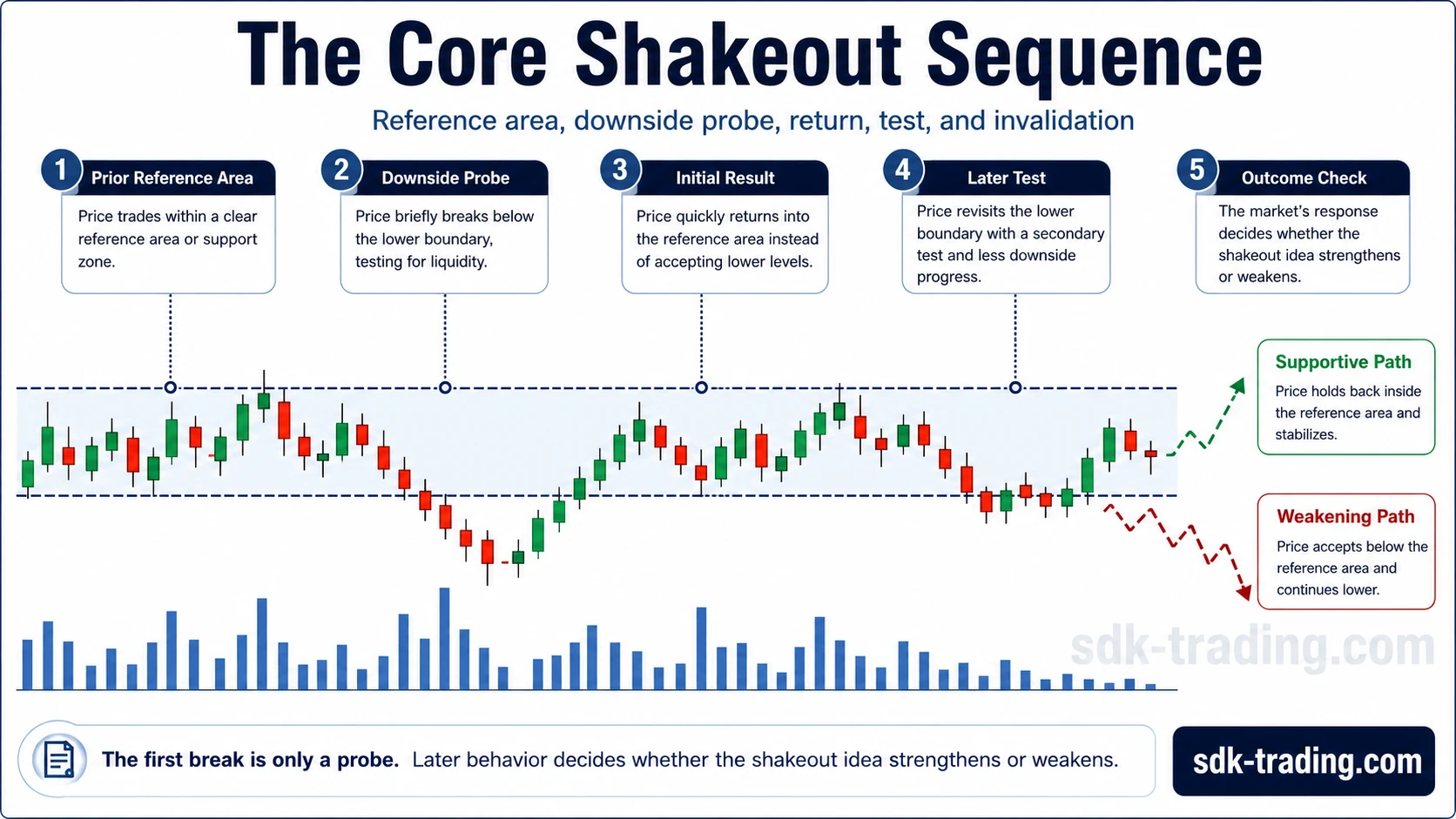
The Core Shakeout Sequence
A useful shakeout reading starts with a prior reference area. Price first rotates near a range boundary, support area, or accepted zone, then probes below it. The probe creates the condition to evaluate, but it does not complete the reading by itself.
The next step is to judge acceptance. If price returns into the prior area and later downside attempts show less progress, the shakeout interpretation becomes more defensible. If price stays below the area and continues lower with expanding downside result, the reading weakens.
The useful sequence is reference area, downside probe, return or failure to return, later test, and invalidation check.
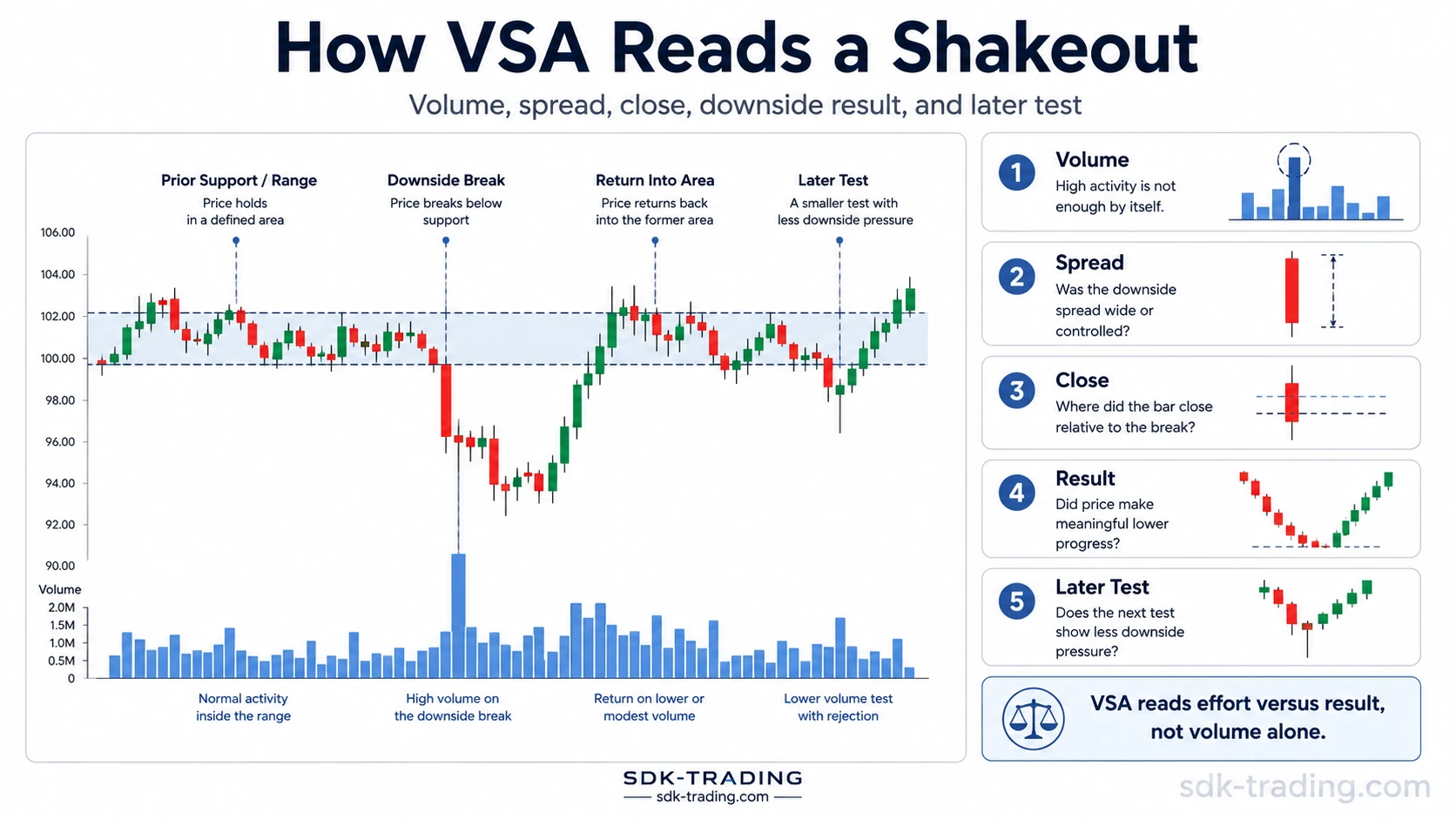
How VSA Reads a Shakeout
Volume Spread Analysis does not treat high volume as enough evidence by itself. High activity only says that participation increased. The reading comes from the relationship between effort and result: the size of the spread, the position of the close, the amount of downside progress, and the quality of the next test.
If heavy activity appears on the downside break but price makes limited additional progress and then returns into the prior area, the shakeout interpretation becomes more credible. The stronger reading appears when later testing shows narrower spread and reduced volume, which can suggest that supply is less effective than it was during the first break.
The opposite is also important. If volume expands and price continues lower with acceptance below the prior area, the event should not be forced into a shakeout label. That behavior is closer to breakdown acceptance than failed lower acceptance.
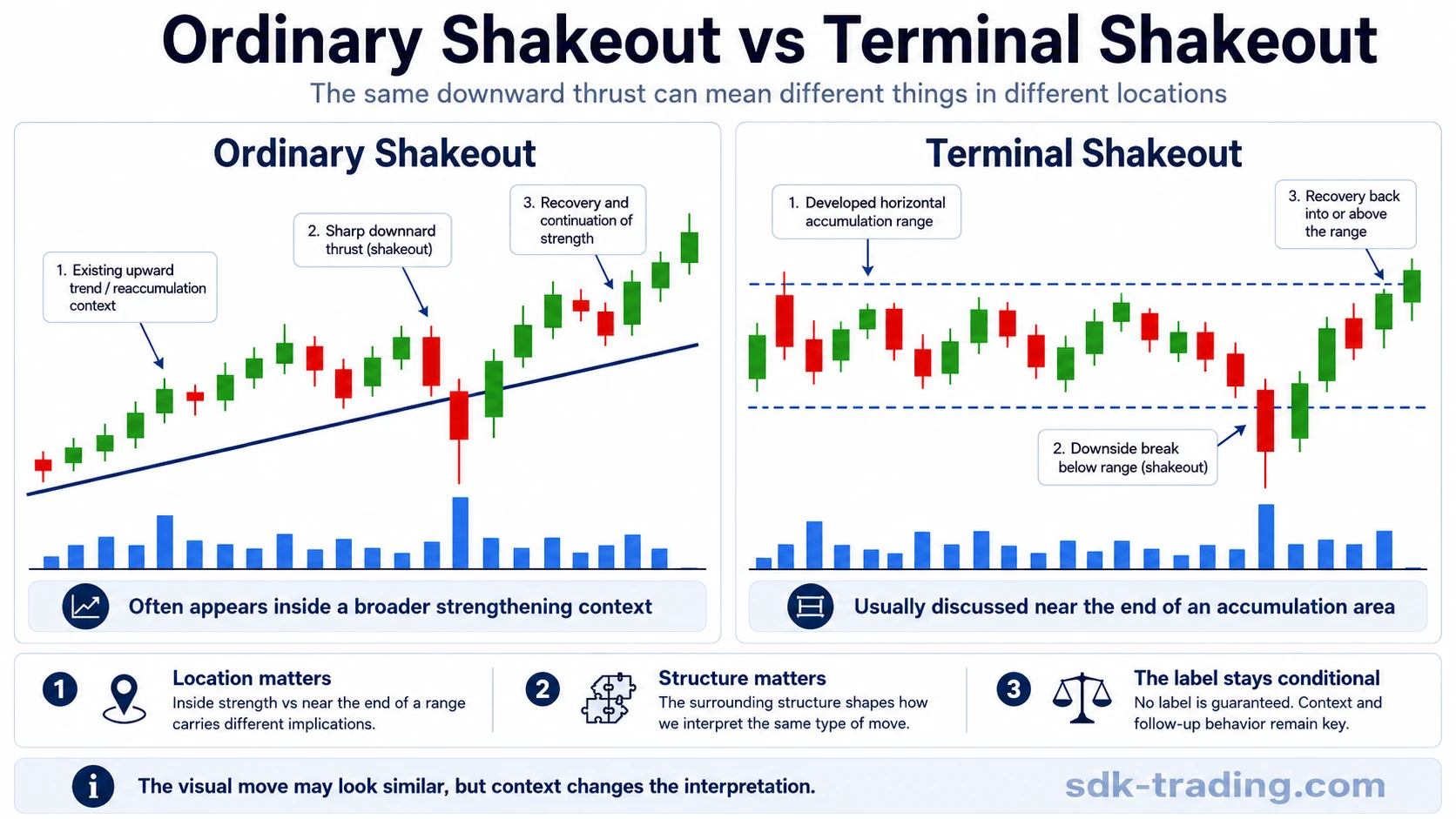
Ordinary Shakeout vs Terminal Shakeout
The term shakeout can describe more than one location. An ordinary shakeout usually appears during an existing upward trend or re-accumulation context, where price makes a sharp downward thrust after prior strength. A terminal shakeout is usually discussed near the end of an accumulation area or trading range, where the downside probe tests the lower boundary before a possible markup phase.
This distinction matters because the same visual move can mean different things depending on location. A sharp downward thrust inside an uptrend is not identical to a lower-boundary test inside a developed accumulation range. The analyst has to identify the surrounding structure before deciding whether the event belongs to a shakeout reading at all.
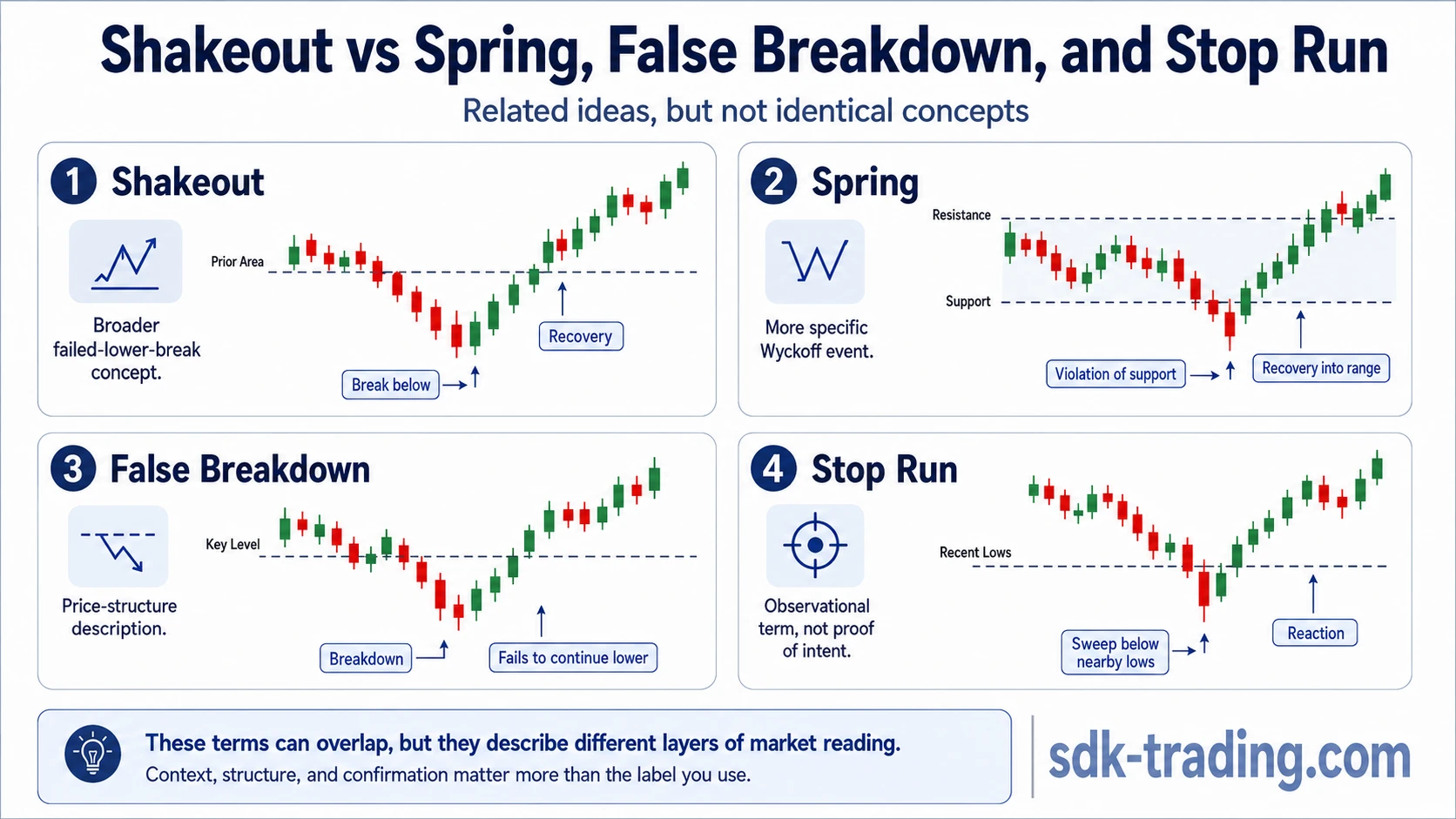
The useful boundary is narrow: a shakeout is the broader trading concept, while a spring is the more specific lower-boundary Wyckoff event inside accumulation.
Shakeout vs Spring, False Breakdown, and Stop Run
A spring is the narrower Wyckoff term. It normally refers to a downside violation of support in an accumulation range, followed by recovery and later evidence that supply has been tested. A shakeout is broader. It can describe the failed downside break itself, a forced-lower move that may pressure weak holders, or a wider VSA/Wyckoff event that still requires context.
A false breakdown is a price-structure description. It says that price broke below a level and failed to continue lower. A shakeout adds a Wyckoff/VSA interpretation layer: the analyst also asks whether volume, spread, close, and later testing support the idea that supply was tested rather than confirmed.
Stop-run language should stay observational rather than intentional. The chart can show that price probed below a known area, pressured weaker participation, failed or succeeded in gaining lower acceptance, and later testing either reduced or confirmed supply. It cannot prove exactly who forced the move or why.
The opposite-side distribution event belongs elsewhere. A downside shakeout should not be confused with an upward failed-acceptance event such as a distribution-side liquidity test.
Why the Secondary Test Matters
A secondary test helps separate a rejected downside probe from a breakdown that has not finished developing. The first break may show activity, but the test shows whether downside supply remains effective.
A stronger test usually shows reduced volume, narrower spread, and an ability to hold above or near the shakeout low. That does not guarantee an upward move. It only supports the idea that selling pressure may be weakening.
A weak test does the opposite. Expanding volume, wider downside spread, or acceptance below the prior shakeout low suggests that the first break should not be forced into a shakeout label.
Example Shakeout Reading
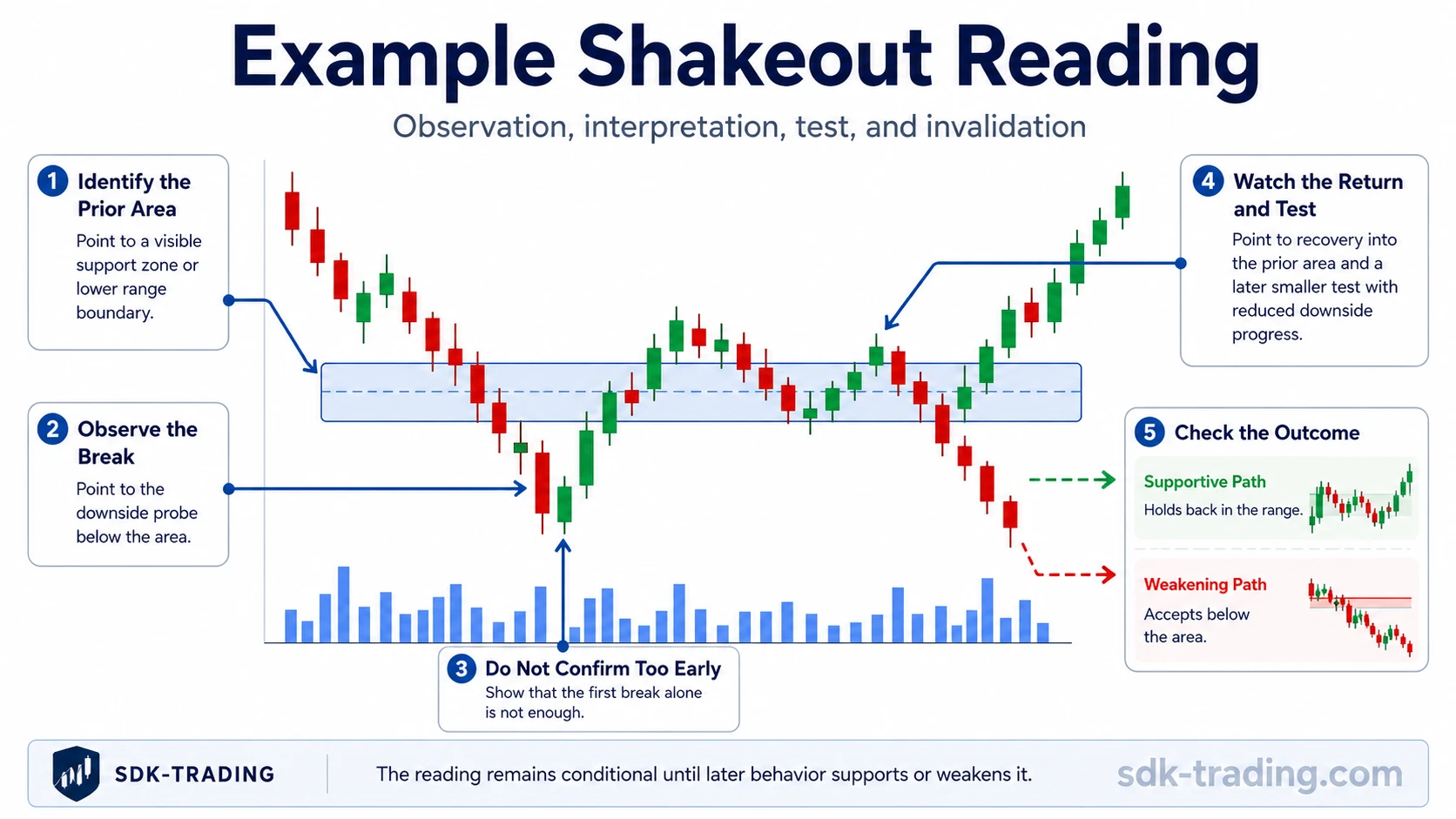
Imagine a market rotating inside a range. Price breaks below the lower boundary on expanded activity. At that point, the chart has created a possible shakeout condition, not a completed interpretation.
The reading improves if price returns into the range and later downside attempts show less spread and lower volume. That sequence suggests that the lower area is not being accepted as easily as the first break implied.
The reading fails if price remains below the range, rejects the old support from underneath, or continues lower with stronger downside result. In that case, the move is closer to breakdown acceptance than failed lower acceptance.
Common Shakeout Mistakes
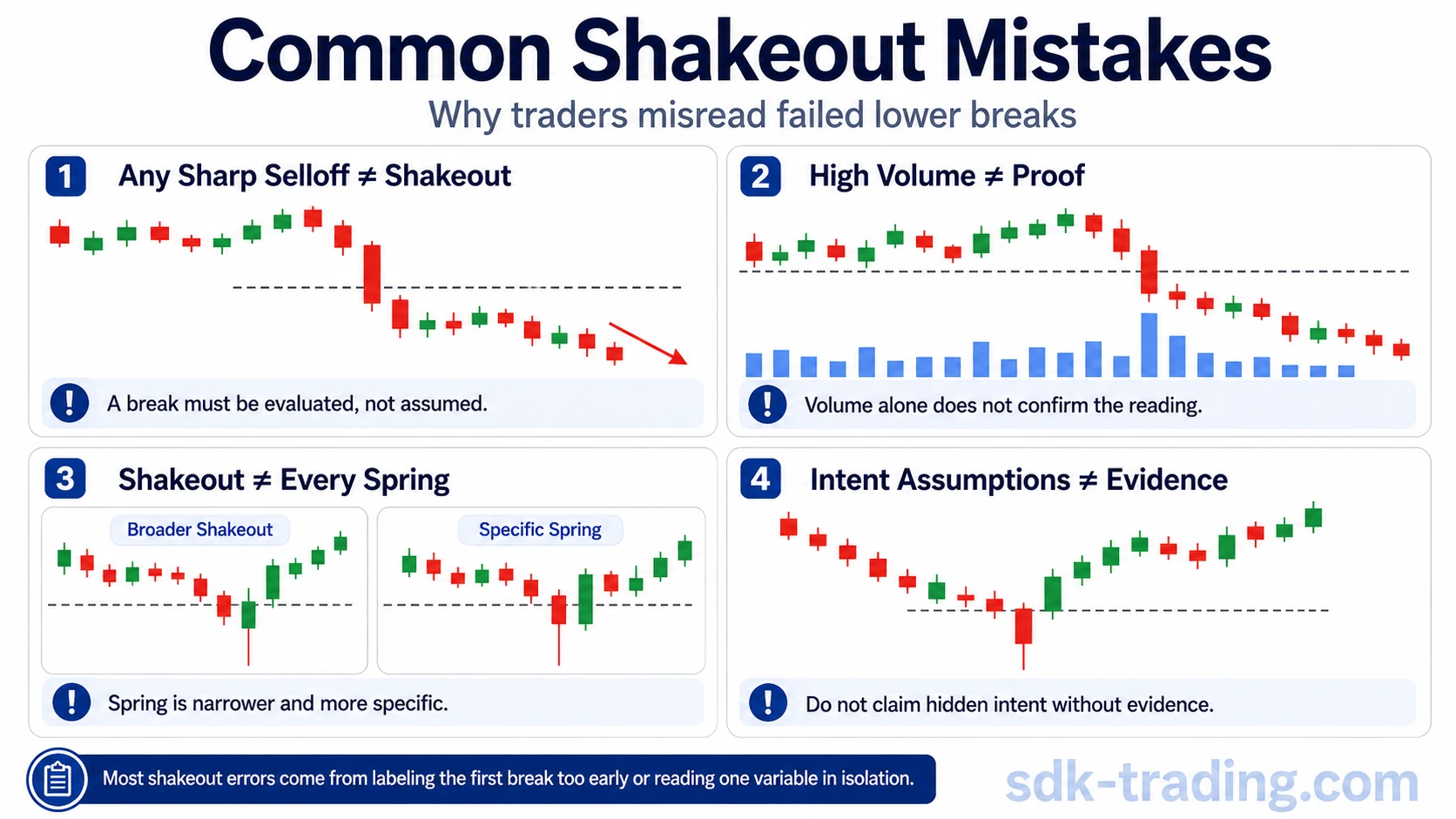
Most shakeout errors come from labeling the first break too early or reading one variable in isolation. A cleaner reading separates the visible event from the later evidence that confirms, weakens, or invalidates it.
| Mistake | Why it is weak | Better reading |
|---|---|---|
| Calling any sharp decline a shakeout | A sharp decline can continue lower and become accepted below the prior area. | Start with a prior reference area, then check whether the downside break fails to hold. |
| Using volume mechanically | High volume can appear during absorption, but it can also appear during strong supply. | Read volume together with spread, close location, downside progress, and follow-through. |
| Treating every shakeout as a spring | A spring is a more specific Wyckoff lower-boundary event inside accumulation. | Use shakeout as the broader failed-lower-acceptance concept and spring only when the structure fits. |
| Assuming hidden intent | The chart can show a failed lower break, but it cannot prove exactly who caused it or why. | Describe observable behavior: probe, return, test, acceptance, rejection, and invalidation. |
FAQ
What is a shakeout in trading?
A shakeout in trading is a downside break below a prior range, support area, or accepted zone that fails to hold lower. In Wyckoff and VSA context, it is judged by price result, spread, volume, and later testing.
Is a shakeout the same as a spring?
No. They can overlap, but a spring is the more specific Wyckoff lower-boundary event inside an accumulation structure. A shakeout is the broader failed-lower-acceptance concept.
Does a shakeout confirm a bullish reversal?
No. A shakeout does not confirm a bullish reversal by itself. The reading becomes stronger only if later behavior rejects lower acceptance and shows weaker downside supply.
What invalidates a shakeout reading?
A shakeout reading is weakened or invalidated when price accepts below the prior range, downside follow-through expands, or a later test breaks the shakeout low with stronger supply.