An engulfing candle pattern is the shared two-candle rule behind bullish and bearish engulfing variants: the second real body covers the prior real body. This page-level concept is the body-coverage test, not the directional conclusion.
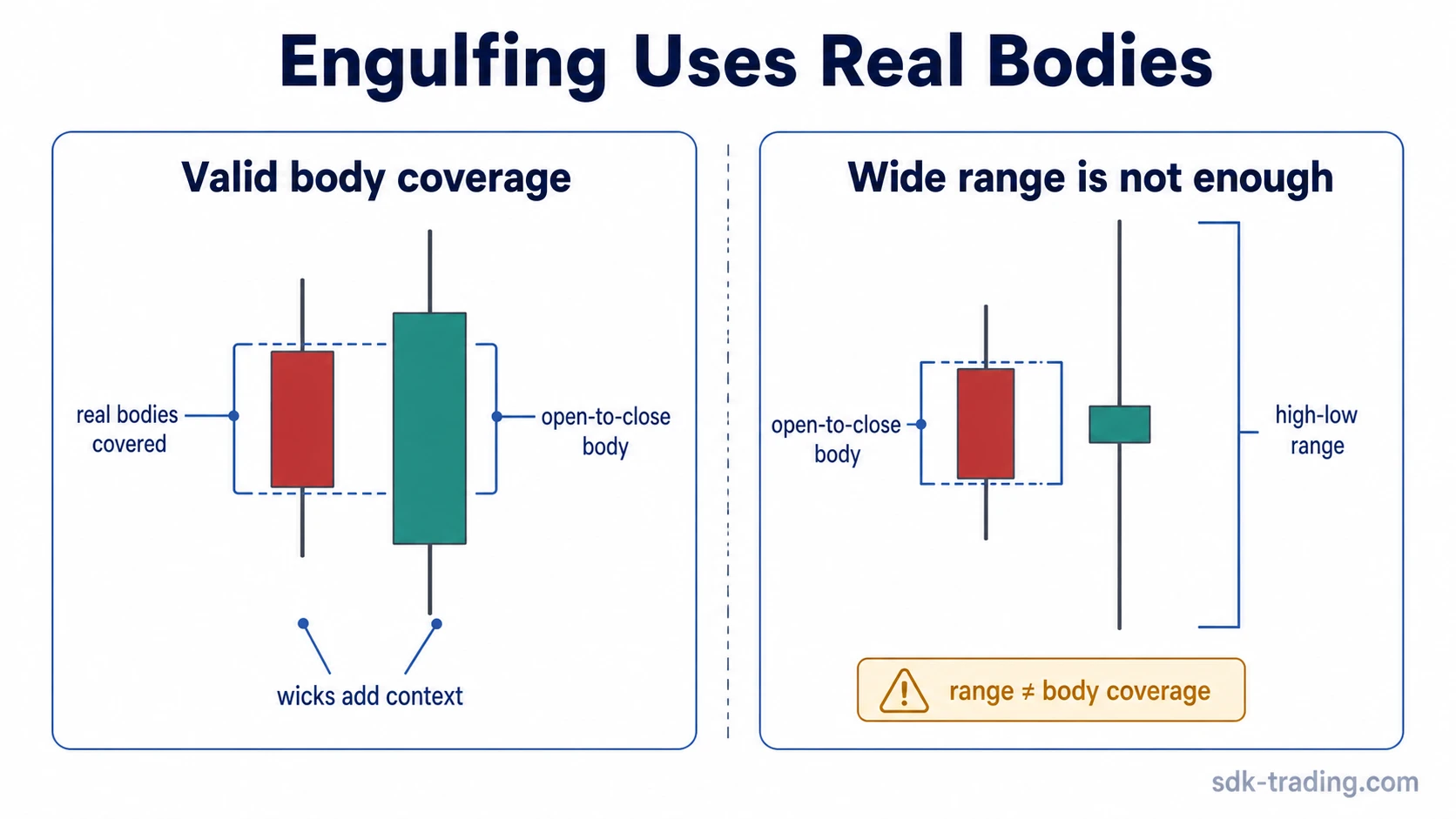
Definition: An engulfing candle pattern is a two-candle candlestick structure where the real body of the second candle covers the real body of the prior candle. The real body is the open-to-close portion of the candle, not the full high-low range.
The engulfing condition is only the starting point. The direction comes from the second candle’s close, the location of the pattern, and whether later candles hold or reject the newly engulfed body area.
Evidence Needed Before the Reading Carries Weight
The engulfing body relationship is not enough by itself. The stronger reading comes from a sequence of evidence: clean body coverage, useful location, close direction, and later candles holding on the pressure side of the engulfing range.
| Evidence to check | Why it matters | Not enough evidence |
|---|---|---|
| Real-body coverage | The second candle must cover the prior open-to-close body. | A large wick or wide range does not create an engulfing body pattern by itself. |
| Second candle close | The close direction separates bullish and bearish pressure. | A large candle with an unclear close gives a weaker reading. |
| Swing location | The pattern matters more near a tested area, prior reaction zone, or stretched swing. | Mid-range movement without structure can make the pattern noisy. |
| Later candle behavior | Follow-through, failure to reclaim the range, or rejection of the tested area can strengthen the reading. | Immediate reclaim of the engulfing range weakens the original pressure read. |
The Shared Real-Body Rule
Start with the prior candle’s real body. Then compare only the second candle’s real body against it. The second candle does not need to cover every wick, but its body must cover the prior open-to-close area.
- The first candle creates the body that will be tested.
- The second candle has a larger real body that covers the first candle’s real body.
- The second close defines whether the pressure is bullish or bearish.
- The surrounding swing context decides whether the pattern is meaningful or just noise.
Body rule: Wicks can add context, but the engulfing condition is based on real-body coverage. A candle can have a wider total range without creating a valid real-body engulfing pattern.
Bullish and Bearish Engulfing Variants
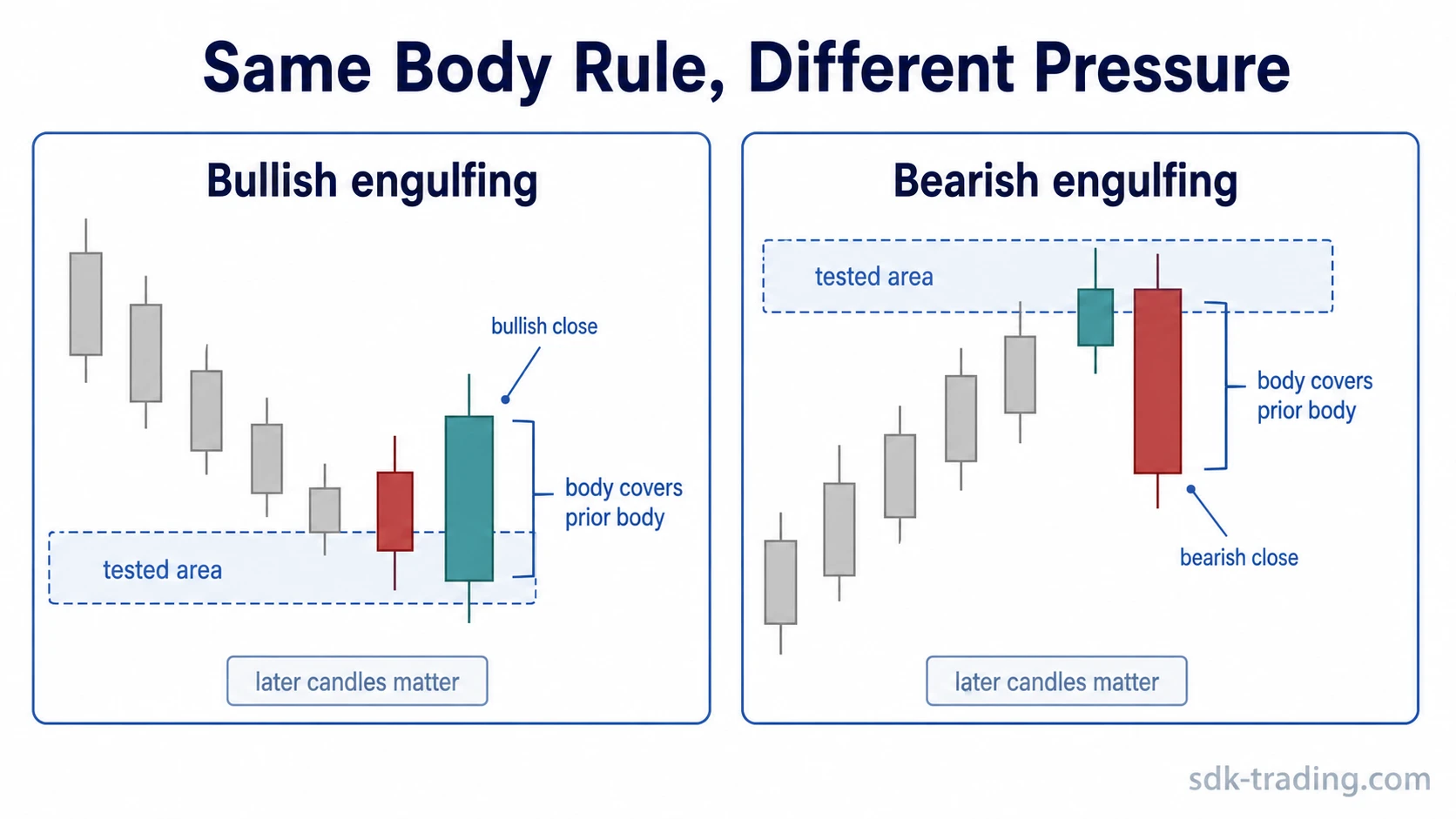
The shared engulfing rule is body coverage. The bullish or bearish variant comes from which body is covered, where the pattern appears, and where the second candle closes.
| Variant | Shared engulfing rule | Directional boundary |
|---|---|---|
| Bullish engulfing pattern | The second real body covers the prior real body. | The second candle closes as a bullish body after prior selling pressure. |
| Bearish engulfing pattern | The second real body covers the prior real body. | The second candle closes as a bearish body after prior buying pressure. |
This keeps the generic engulfing candle concept separate from the directional entity pages. The shared rule is real-body coverage; the variant pages handle bullish or bearish pressure, placement, and failed follow-through in more detail.
Engulfing Candle vs Outside Bar
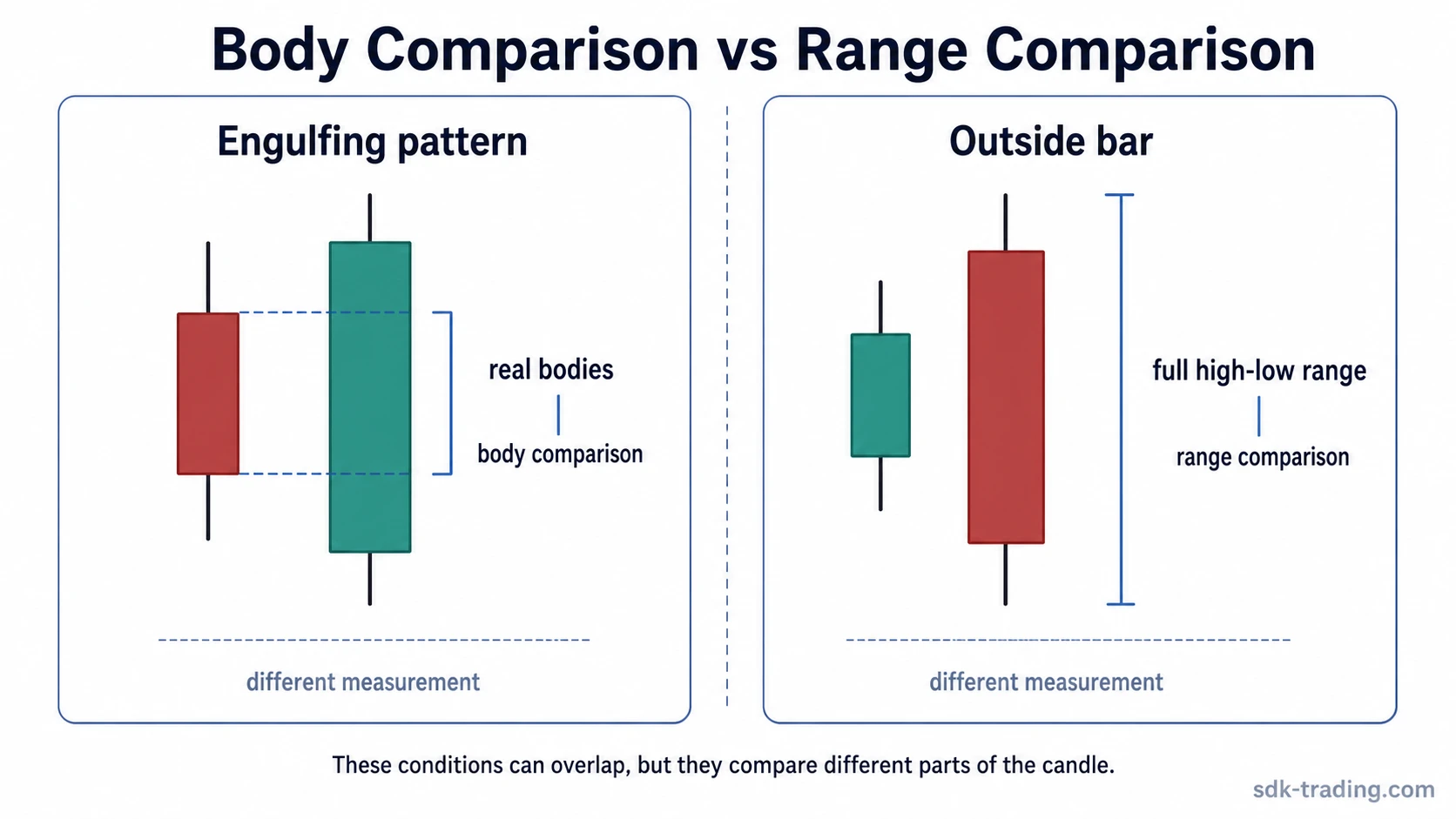
An engulfing candle pattern compares real bodies. An outside bar compares the full high-low range. The confusion happens because a large second candle can sometimes satisfy both conditions, but the two ideas measure different parts of the candle.
Engulfing pattern: The second real body covers the prior real body.
Outside bar: The second candle’s total high-low range exceeds the prior candle’s total high-low range.
A related bearish two-candle pattern, dark cloud cover, uses real-body penetration below the prior bullish body’s midpoint rather than full real-body engulfing.
Common Mistake: Treating Size as Proof
A large second candle can attract attention because it visually dominates the prior candle. The mistake is treating that size as complete evidence. If price quickly moves back through the engulfing range and later candles hold on the opposite side of the pressure move, the original reading weakens.
Safer reading: The engulfing body starts the question. Location, close quality, and later candles decide whether the pressure is accepted, rejected, or still unresolved.
When the Engulfed Body Area Is Lost
The reading weakens when the body relationship is present but price quickly trades back through the engulfed body area or the surrounding structure does not support a clean pressure shift.
- Later candles move back through the engulfing range instead of holding on the pressure side.
- The second candle is large but forms away from a meaningful swing area.
- The move appears inside choppy price action without clear context.
- The second body does not actually cover the prior real body.
Limitation: An engulfing candle pattern is a chart-reading clue, not a complete trading method. The reading is stronger when structure, pressure, and later acceptance point in the same direction.
FAQ
Does an engulfing candle pattern use the candle wicks?
The engulfing condition uses the real bodies. Wicks can add context, but they do not create the body-engulfing condition unless the second real body covers the prior real body.
How is an engulfing candle different from an outside bar?
An engulfing candle compares real bodies. An outside bar compares the full high-low range. A candle can sometimes meet both conditions, but they measure different parts of the candle.