A hammer candlestick is confirmed only when later candles support the lower-shadow rejection instead of immediately fading the recovery. The hammer itself shows a downside probe and recovery, but that shape alone does not confirm a reversal in trading.
- A hammer is not automatically confirmed by shape alone.
- Later candles must defend the rejected lower area.
- Weak follow-through keeps the signal unresolved.
- A retest that accepts below the lower shadow weakens or invalidates the reading.
What Hammer Confirmation Means
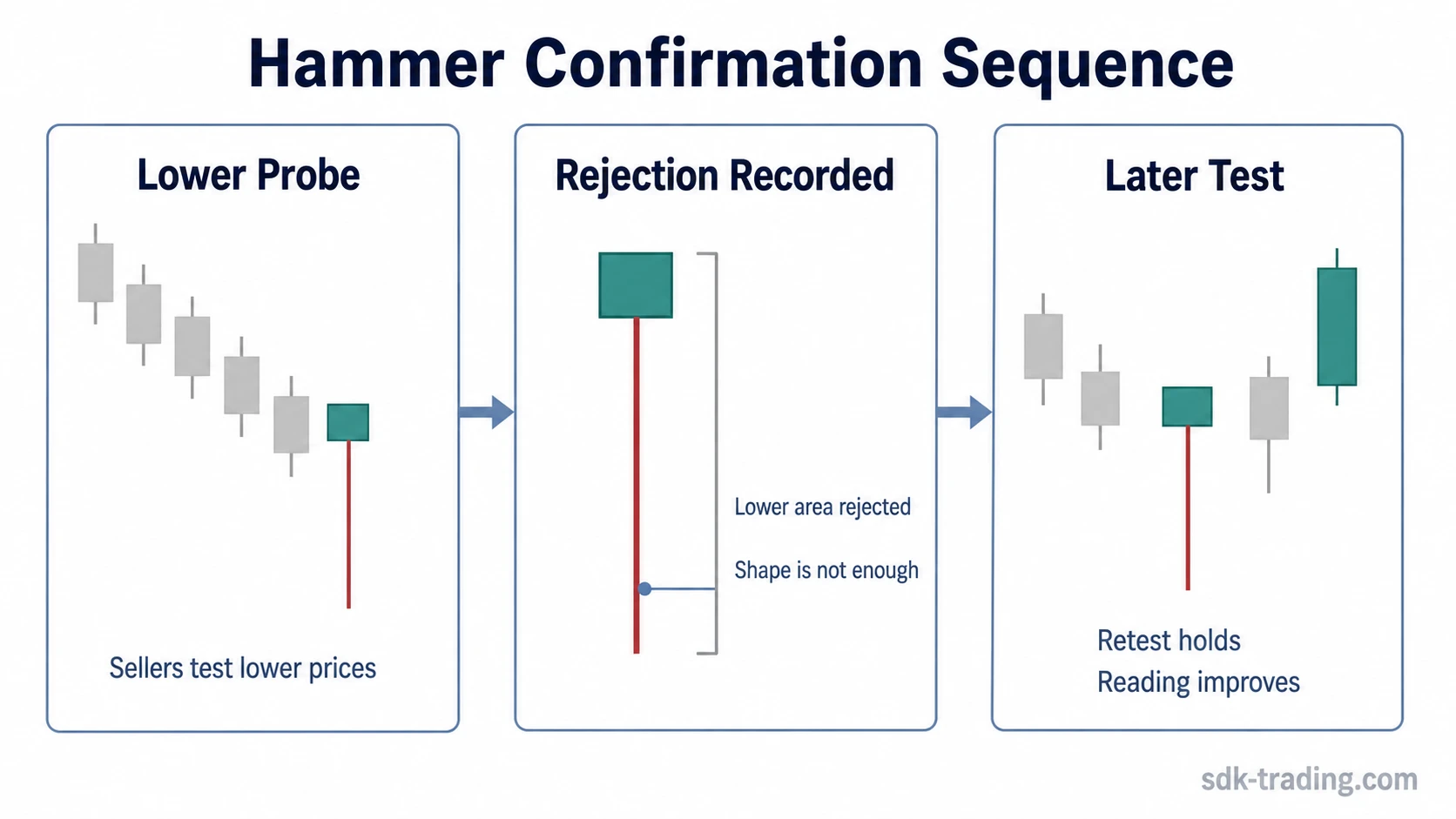
Hammer confirmation means later price behavior supports the lower-shadow rejection recorded by the candle. The hammer candlestick is the first sign that sellers tested lower prices and failed to hold the market there, but the next candles decide whether that rejection remains active.
The useful question is not only whether the hammer has the right shape. The stronger question is whether price can stay above the rejected area, attract follow-through, and avoid immediate acceptance below the lower shadow.
Why the Hammer Shape Alone Is Not Confirmation
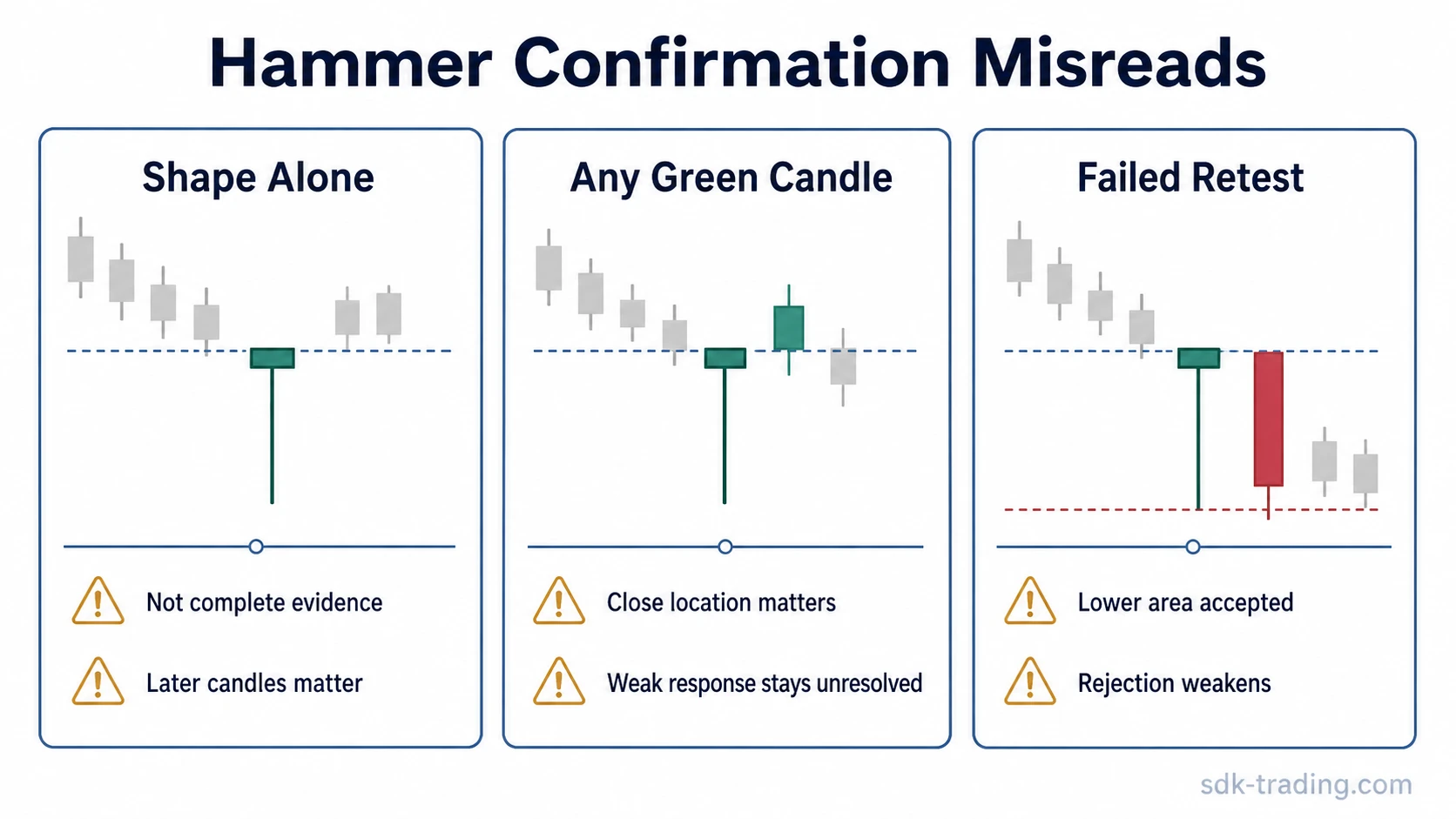
A hammer can look constructive because the candle closes well above its low. That recovery shows that lower prices were rejected during the session, but it does not prove that demand has taken control after the candle closes.
The common mistake is treating the hammer as complete evidence. A cleaner reading separates the candle’s message from later confirmation: the hammer records the rejection attempt; the next candles test whether that rejection still matters.
Hammer Confirmation Conditions, Misreads, and Limits
| Condition | Common misread | Safer interpretation | Limitation |
|---|---|---|---|
| Hammer appears after selling pressure | The pattern already proves a reversal | The candle shows that sellers failed to hold the lower probe | The prior pressure may still dominate if later candles do not improve |
| Next candle closes stronger | Any green candle confirms the hammer | A stronger close helps only if it holds above the hammer body or recovered range | A weak close near the lows can leave the signal unresolved |
| Price revisits the lower-shadow area | A retest is automatically constructive | A held retest supports the idea that lower prices were rejected again | Acceptance below the lower shadow weakens or invalidates the reading |
| Volume or broader context improves | Volume alone confirms the hammer | Context can support the reading when effort and price response align | High volume with poor follow-through can still show unresolved supply |
| Follow-through fails immediately | The hammer remains valid because the candle shape was correct | Failure after the hammer means the rejection did not attract enough support | The candle becomes a warning, not a completed reversal reading |
What Stronger Follow-Through Looks Like
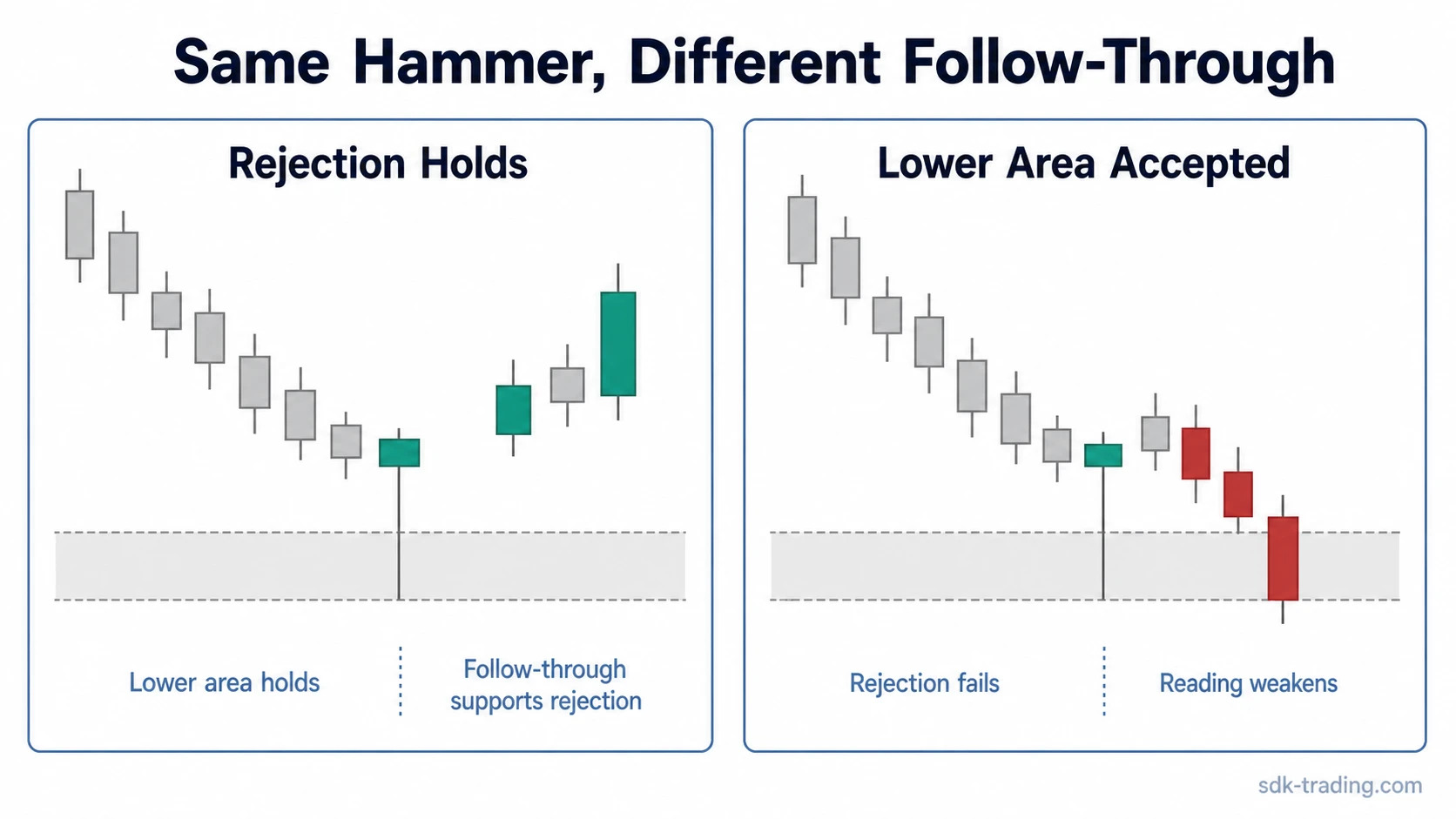
Stronger follow-through usually appears when later candles close above the hammer body, hold most of the recovered range, or reject a revisit toward the lower-shadow area. The stronger reading is not just a higher close; it is a sequence where sellers cannot easily reclaim the area that the hammer rejected.
A cleaner confirmation sequence often has three parts: the hammer rejects a lower probe, the next candle does not erase that recovery, and a later test of the lower area does not lead to sustained acceptance below it.
What Weakens or Invalidates the Reading
The hammer reading weakens when the next candle fades, closes back inside the lower part of the hammer range, or shows no meaningful response after the initial recovery. Weak follow-through means the market has not yet shown that demand can build on the rejection.
The reading becomes more fragile if price accepts below the lower shadow. That behavior changes the message because the area that was rejected during the hammer has now been revisited and absorbed.
Hammer Confirmation vs Nearby Patterns
Hammer confirmation is different from simply identifying the candle shape. The hammer has a long lower shadow and a small body near the upper part of the range, while confirmation asks whether later candles defend or lose the rejected lower area.
An inverted hammer uses a different structure because its key feature is an upper shadow rather than a lower-shadow rejection. Its confirmation logic still depends on later candles, but the tested area is different.
Hammer confirmation also differs from hanging man confirmation. A hanging man can have a similar lower-shadow shape, but it appears after upward movement, so the same candle structure can carry a different warning.
A belt-hold candlestick has a stronger real-body emphasis. That makes the comparison useful: a hammer depends heavily on rejection and later support, while a belt-hold structure places more weight on the body and directional close.
Hammer Confirmation Example in Context
Price has been moving lower, then a hammer forms after a sharp downside probe. The close near the upper part of the candle makes the reversal read tempting, but the evidence is still incomplete because only one candle has rejected the lower area.
The next candle gives the first follow-through test. If it holds above the hammer body and closes with a stronger response, the rejection reading improves. If it opens firm but fades back into the hammer range, the signal remains unresolved because buyers have not shown control after the first recovery.
A later revisit toward the lower-shadow area is the more useful test. If price probes that area and cannot hold below it, the hammer’s rejection remains active. If price moves below the lower shadow and stays there, the earlier rejection has failed to attract enough demand.
Hammer Confirmation FAQ
Does a hammer candlestick need confirmation?
Yes. A hammer shows a rejected downside probe, but confirmation depends on later candles supporting that rejection instead of immediately fading it.
What candle confirms a hammer?
A stronger later candle can support a hammer if it closes above the hammer body or range and does not give back the lower-shadow rejection.
Can a hammer fail after it forms?
Yes. A hammer can fail if price quickly accepts below the lower shadow or if later candles show weak demand after the initial recovery.
Is a green candle after a hammer enough confirmation?
Not always. A green candle helps only when it shows meaningful follow-through and does not leave the hammer’s rejection unresolved.