An ascending channel is a chart pattern formed by two upward-sloping, roughly parallel boundaries that contain a sequence of higher swing highs and higher swing lows. The channel reading is useful only when price reacts to both sides often enough for the boundaries to describe visible movement rather than forced lines around random swings.
Definition: An ascending channel is an upward-sloping price channel where both the upper boundary and lower boundary rise at a similar angle, creating a structured advance between two parallel lines.
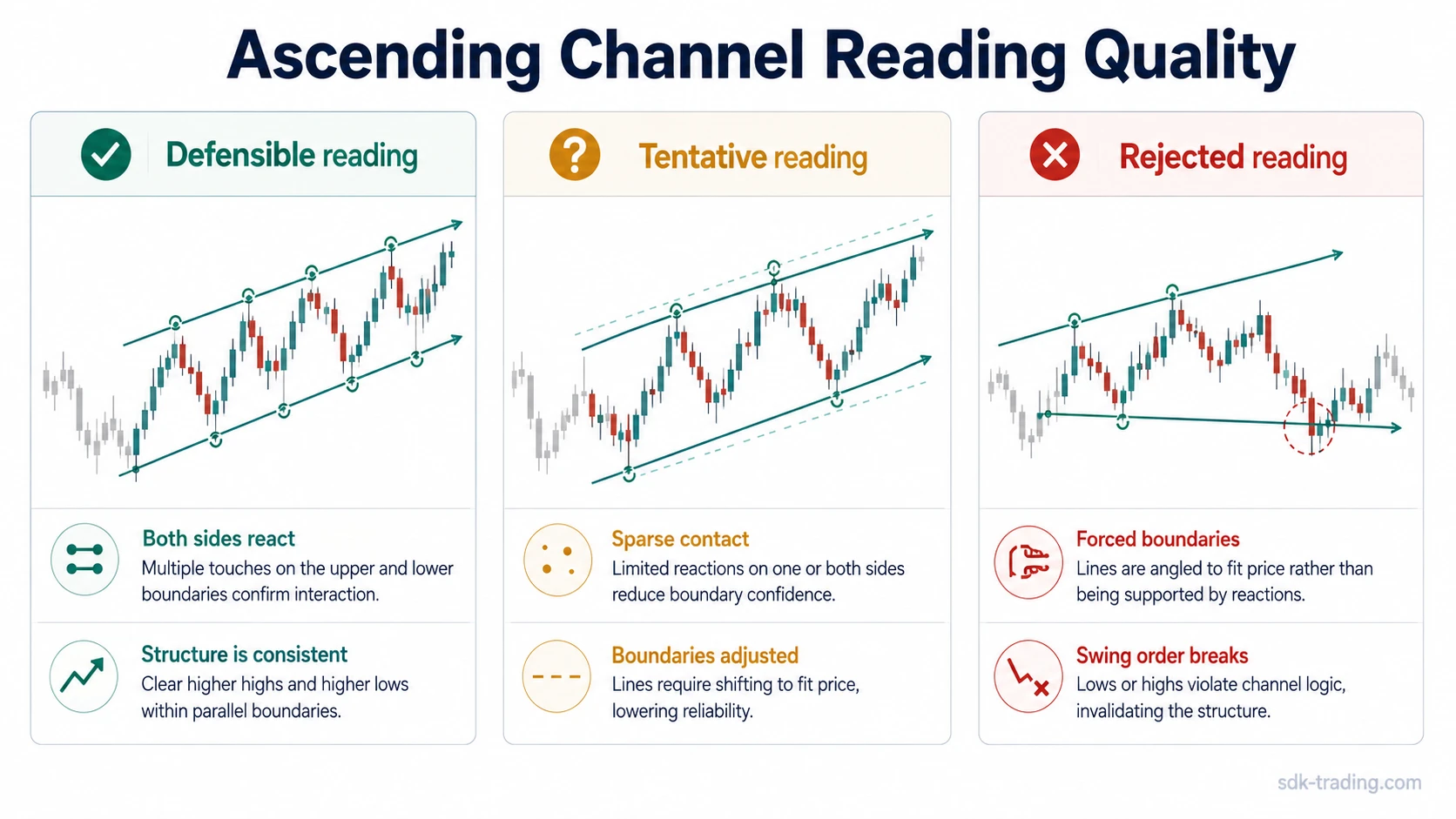
The pattern’s value comes from boundary quality, not from the label. A clean reading shows repeated reactions on both sides, a stable slope, and enough separation between swings to make the channel visible. A weak reading appears when one side has too few reactions, the lines need repeated adjustment, or one sharp candle is treated as decisive before later movement clarifies the boundary.
Key Points
- An ascending channel needs rising parallel boundaries, not just a general uptrend.
- Higher highs and higher lows should appear inside the structure, with reactions near both boundaries.
- Boundary quality is stronger when the same lines explain several swings without constant redrawing.
- A move outside the channel is only a change candidate until later candles show acceptance or rejection.
What Is an Ascending Channel?
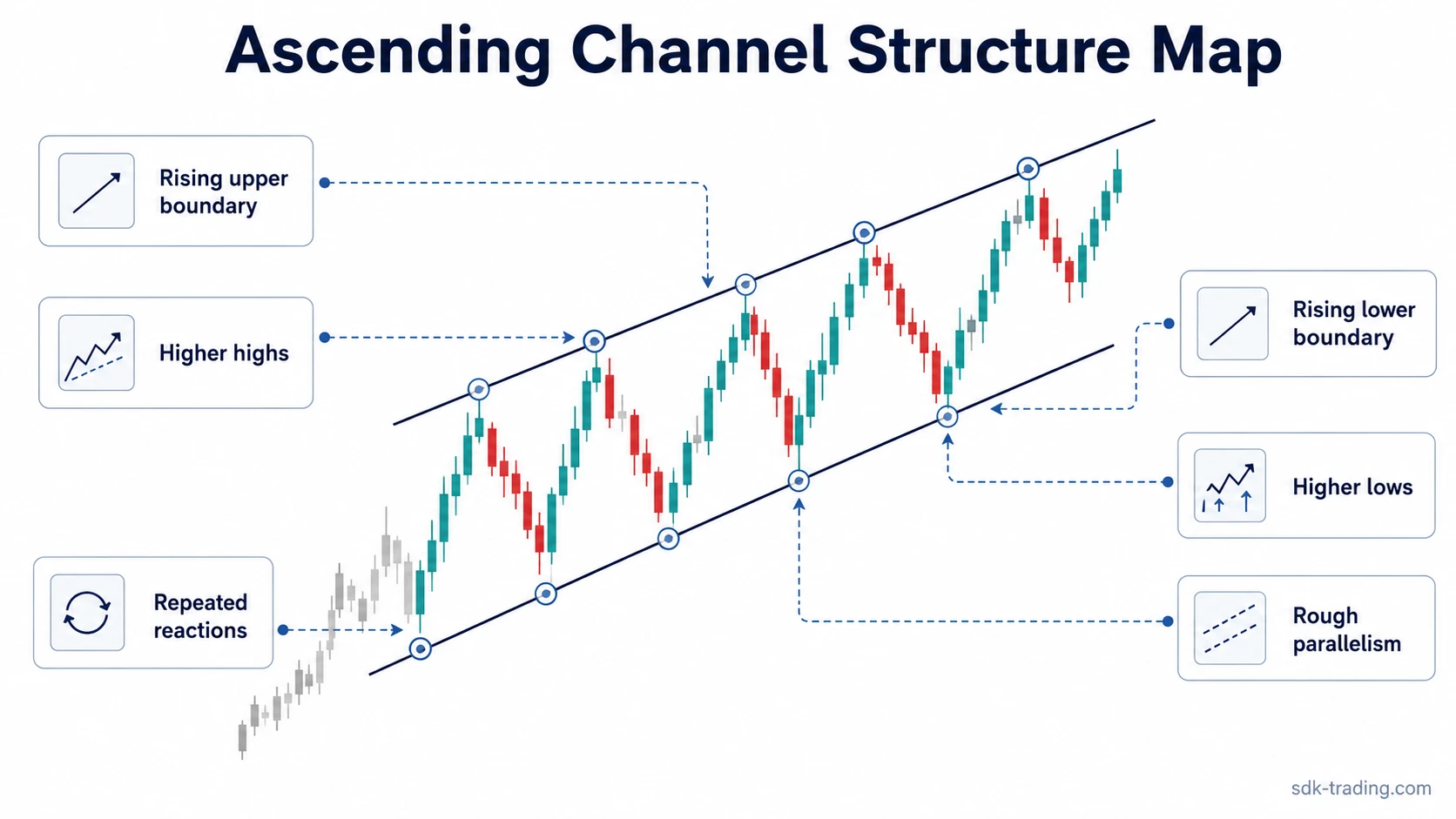
An ascending channel is a rising channel pattern in technical analysis. It connects a series of higher swing lows with a lower boundary and a series of higher swing highs with an upper boundary. The two boundaries should slope upward in a broadly parallel way.
The lower boundary marks where declines have repeatedly slowed or turned within the visible pattern. The upper boundary marks where advances have repeatedly stalled or paused. These boundaries do not predict the next movement by themselves. They describe the current price corridor that has been respected so far.
The word “ascending” describes slope direction. The word “channel” describes the relationship between two boundaries. Together, they separate the pattern from a simple trendline, where only one side of movement is usually defined.
How an Ascending Channel Forms
An ascending channel forms when both reaction lows and reaction highs shift upward over time. Each decline holds above the previous swing low, while each advance reaches a higher area before pausing. The result is a rising corridor rather than a vertical advance.
The structure usually develops in stages. First, price creates an upward swing and a reaction low. Later, a higher high and a higher low give the first outline of direction. Additional reactions near both sides of the movement make the channel easier to draw with less adjustment.
Parallelism matters. If the upper boundary rises sharply while the lower boundary barely rises, the structure may be a different pattern or a weak trendline reading. If the distance between boundaries expands quickly, the pattern may begin to resemble a broadening structure rather than a clean ascending channel.
How to Identify an Ascending Channel
A defensible ascending channel reading begins with observable swing structure. The pattern should not be drawn first and justified later. The visible movement should already suggest a rising corridor before the lines are added.
- Higher swing lows: each meaningful pullback holds above an earlier low inside the structure.
- Higher swing highs: each meaningful advance reaches a higher area before reacting.
- Two rising boundaries: both the upper and lower channel lines slope upward.
- Rough parallelism: the two boundaries rise at a similar angle without obvious convergence or expansion.
- Repeated reactions: price interacts with both sides more than once, rather than touching only one line clearly.
- Limited line adjustment: the same boundaries remain useful without constant redrawing after every new candle.
Volume can add background information, but it is not required to define the pattern. The structure itself comes from price movement, boundary slope, and repeated reactions.
Boundary Quality Checklist
Boundary quality determines whether the pattern is useful as a chart-reading structure. A channel with clean contact and stable slope gives a clearer description of movement than a channel created by forcing two lines around noisy price action.
| Boundary feature | Better reading | Weaker reading |
|---|---|---|
| Slope | Both boundaries rise at a similar angle. | One boundary rises while the other is flat, erratic, or too steep. |
| Contact | Several reactions appear near both sides. | Most reactions appear on one side, with the other line mostly guessed. |
| Spacing | Swings are separated enough to show a visible channel. | Lines are drawn across cramped or random movement. |
| Parallelism | The channel width stays reasonably stable. | The boundaries converge, diverge sharply, or require frequent adjustment. |
| Boundary breaks | A break is evaluated through later acceptance or rejection. | One wick outside the line is treated as final by itself. |
Clean, Weak, and Invalid Ascending Channel Readings
The same price movement can produce very different readings depending on boundary quality. The label is clean only when the structure can be seen without excessive adjustment.
| Reading type | What it looks like | How to treat the interpretation |
|---|---|---|
| Clean ascending channel | Higher highs, higher lows, two rising parallel boundaries, and repeated reactions near both sides. | The structure is a reasonable description of current movement, while later price behavior still decides whether it remains valid. |
| Weak ascending channel | The slope is visible, but one boundary has sparse contact or the channel needs several adjustments to fit new swings. | The reading should stay tentative because the pattern may be describing trend direction more than a true channel. |
| Invalid ascending channel | The lines converge, one boundary does not slope upward, swing order breaks down, or the boundaries are forced around unrelated movement. | The channel label should be dropped in favor of a clearer structure. |
Limitation: A neat pair of lines does not make the structure reliable. If the boundaries only work after several redraws, the chart may be showing a loose rising movement rather than an ascending channel.
Failure and False-Break Behavior
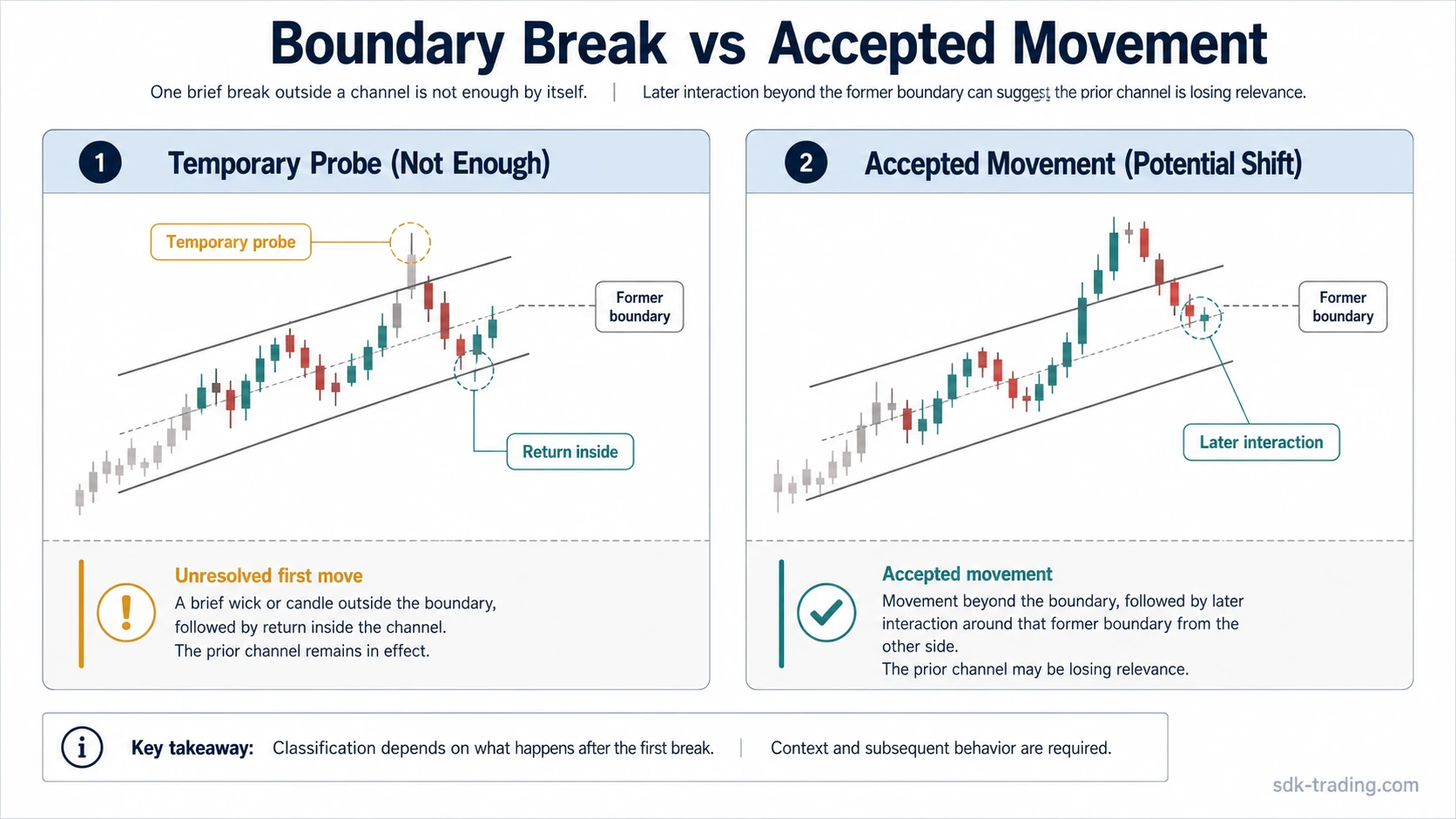
A break outside an ascending channel is not automatically decisive. The channel describes the current visible structure; movement beyond a boundary only raises the question of whether the structure is changing.
A brief move above the upper boundary can fail if price returns inside the channel and later cannot hold above the prior boundary area. A move below the lower boundary can also remain unresolved if price quickly reclaims the channel and later reactions continue to respect the old structure.
Breaks above and below the channel are classification events, not trade instructions. The important question is acceptance. If price remains outside the prior boundary and later interacts with that area from the other side, the old channel may be losing relevance. If price returns inside and the boundary continues to shape movement, the break may have been only a temporary probe.
Ascending channel example in context: Price advances inside a rising parallel channel and briefly pushes above the upper boundary. The next candles fail to hold above the boundary and return inside the channel. That behavior does not prove reversal or continuation. It means the first break did not establish accepted movement beyond the boundary.
Ascending Channel vs Related Channel Concepts
An ascending channel is one specific version of channel structure. It should stay separate from broader or opposite-slope concepts so the chart reading remains precise.
| Concept | Main distinction | Common confusion |
|---|---|---|
| Ascending channel | Two upward-sloping, roughly parallel boundaries contain higher highs and higher lows. | It can be confused with any rising trend if only one boundary is visible. |
| descending channel | Both boundaries slope downward, and the structure contains lower highs and lower lows. | The two patterns share channel logic but differ in slope direction and swing sequence. |
| price channel | The broader term covers rising, falling, and horizontal channel structures. | An ascending channel is one subtype inside the broader channel family. |
| Rising wedge | Boundaries often converge rather than remain parallel. | A steep rising channel can be mislabeled if the channel width narrows over time. |
| Rectangle | Boundaries are usually horizontal rather than rising. | A slow upward drift can be mistaken for a channel when swing slope is unclear. |
Common Mistakes When Reading an Ascending Channel
The most common mistake is drawing the label before the structure is visible. A rising market can have higher prices without forming a clean ascending channel. The second boundary must add real information, not decoration.
Common mistake: Treating one wick beyond a boundary as final can create a false sense of certainty. A boundary break becomes more meaningful only after later movement shows whether price accepted the new area or returned to the prior structure.
Another mistake is assuming that an ascending channel must have a bullish implication in every case. The pattern describes a rising structure, but its later meaning depends on boundary reactions, slope quality, failed attempts, and whether movement remains orderly or begins to break down.
Overly steep channels also need caution. A channel that rises too sharply may be less stable as a chart-reading structure, and frequent redraws can hide that instability. A slower, cleaner structure with repeated reactions often gives a more useful reading than a dramatic line fit around a short burst of movement.
FAQ
What does an ascending channel mean in trading?
An ascending channel means price is moving inside two upward-sloping, roughly parallel boundaries. It describes a rising structure with higher highs and higher lows, but it does not decide the next move by itself.
How do you identify an ascending channel?
Identify an ascending channel by looking for higher swing highs, higher swing lows, two rising parallel boundaries, and repeated reactions near both sides of the structure.
Can an ascending channel fail?
Yes. An ascending channel can fail when price no longer respects the prior boundaries, when swing order breaks down, or when movement outside the channel becomes accepted rather than quickly rejected.