Cup and handle pattern success rate is not one fixed percentage that applies to every chart. A reported rate belongs to the study that produced it, including the pattern definition, breakout rule, success condition, observation period, and sample that were used.
Safer interpretation: a success-rate statistic describes how a defined group of patterns performed under defined rules. It does not give every future Cup and Handle the same probability of success.
The first step is therefore to identify a valid cup and handle pattern. The second, separate question is how a particular study measured its outcome.
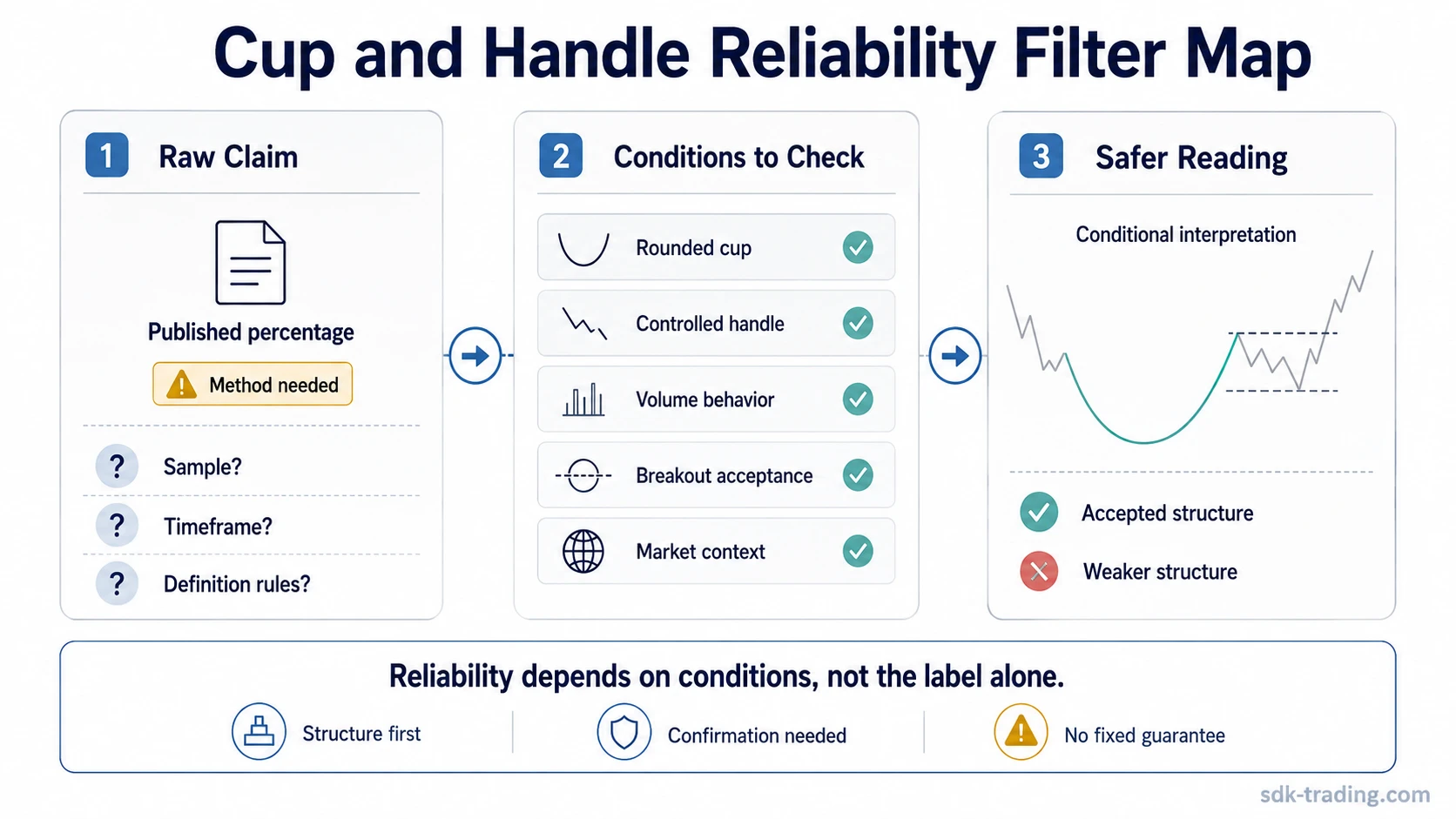
Why There Is No Single Cup and Handle Success Rate
Two studies can examine Cup and Handle patterns and report different results without either calculation being mathematically wrong. The difference can come from what each study counted as a pattern and what it counted as success.
| Study rule | Why it changes the reported rate |
|---|---|
| Pattern definition | A strict study may require a rounded cup and proportional handle, while a loose study may include more borderline formations. |
| Breakout definition | One study may count the first move above the rim, while another may require a close or sustained acceptance above it. |
| Success condition | Success could mean simply remaining above the breakout area, reaching a defined percentage move, or reaching a measured projection. |
| Observation horizon | A pattern can succeed over a longer window while failing a shorter test, or the reverse. |
| Market and timeframe | Stocks, indices, intraday charts, and higher timeframes can produce different samples and market behavior. |
| Sample period | A study dominated by strong trending markets can produce a different result from one containing more sideways or unstable periods. |
Core boundary: a percentage without its study rules cannot be treated as a context-free probability for the next Cup and Handle.
What a Success Rate Actually Measures
At its simplest, a success rate compares successful outcomes with the qualifying patterns included in the study.
Numerator: patterns that satisfied the study’s definition of success.
Denominator: all patterns that qualified under the study’s inclusion rules.
Both sides matter. If the qualification rules change, the denominator changes. If the definition of success changes, the numerator changes. The resulting percentage can therefore change even when researchers examine similar charts.
Example: a study that counts any move above the rim as success is measuring something different from a study that requires price to remain above the rim and reach a defined follow-through threshold.
Pattern Quality and Success Rate Are Different Questions
Study methodology explains what a percentage means. Pattern quality helps determine whether an individual chart resembles the formations that the statistic was intended to describe.
| Chart feature | Why it matters to the individual setup |
|---|---|
| Rounded cup | A developed rounded base fits the standard structure better than a sharp V-shaped reversal. |
| Controlled handle | A smaller handle near the upper part of the cup preserves the right-side recovery. |
| Rim behavior | Price needs to show whether the upper boundary can be accepted or rejected. |
| Volume behavior | Participation can support the structural reading, but it does not determine the outcome by itself. |
| Broader context | The same formation can develop under very different trend and volatility conditions. |
These factors do not create a new universal success rate. They help determine whether the individual chart resembles a cleaner or weaker version of the pattern being studied.
How to Read a Published Cup and Handle Statistic
Before using a published percentage as a reference, check what produced it.
- Check the pattern definition. Determine what cup shape, handle depth, and handle location were required for inclusion.
- Check when the pattern entered the sample. Find out whether qualification occurred before the breakout, on the first breakout, or only after confirmation.
- Check what counted as success. A breakout, a close above the rim, a percentage gain, and a measured move are different outcomes.
- Check the observation window. Results measured over several candles cannot be compared directly with results measured over several weeks or months.
- Check the market universe and period. Results from one asset class, market regime, or historical period may not transfer directly to another.
If those definitions are unavailable, the percentage can still provide background context, but its precision should not be overstated.
Why Strong-Looking Statistics Can Still Mislead
A percentage can look precise while hiding broad variation inside the sample.
| Misreading | Better interpretation |
|---|---|
| “The pattern has one known success rate.” | The reported rate belongs to a particular study method and sample. |
| “My chart looks similar, so the same percentage applies.” | The chart still needs to satisfy the structural and contextual assumptions used by the study. |
| “A breakout means the study would count it as successful.” | The study may require additional follow-through or another outcome threshold. |
| “A higher historical rate guarantees a stronger current setup.” | Historical frequency does not determine the outcome of an individual pattern. |
| “More decimal precision makes the statistic more reliable.” | Precision in the percentage does not replace transparent definitions, adequate sample size, or relevant context. |
Example: One Pattern, Different Success Definitions
Suppose price forms a rounded cup, a controlled handle, and then moves above the rim.
Under one study, the breakout itself may qualify as success. Under another, price may need to remain above the rim for a defined period. A third study may require a larger follow-through move within a defined observation window before the same pattern enters the successful group.
The underlying pattern can remain technically constructive while the measured outcome differs because the studies are asking different questions.
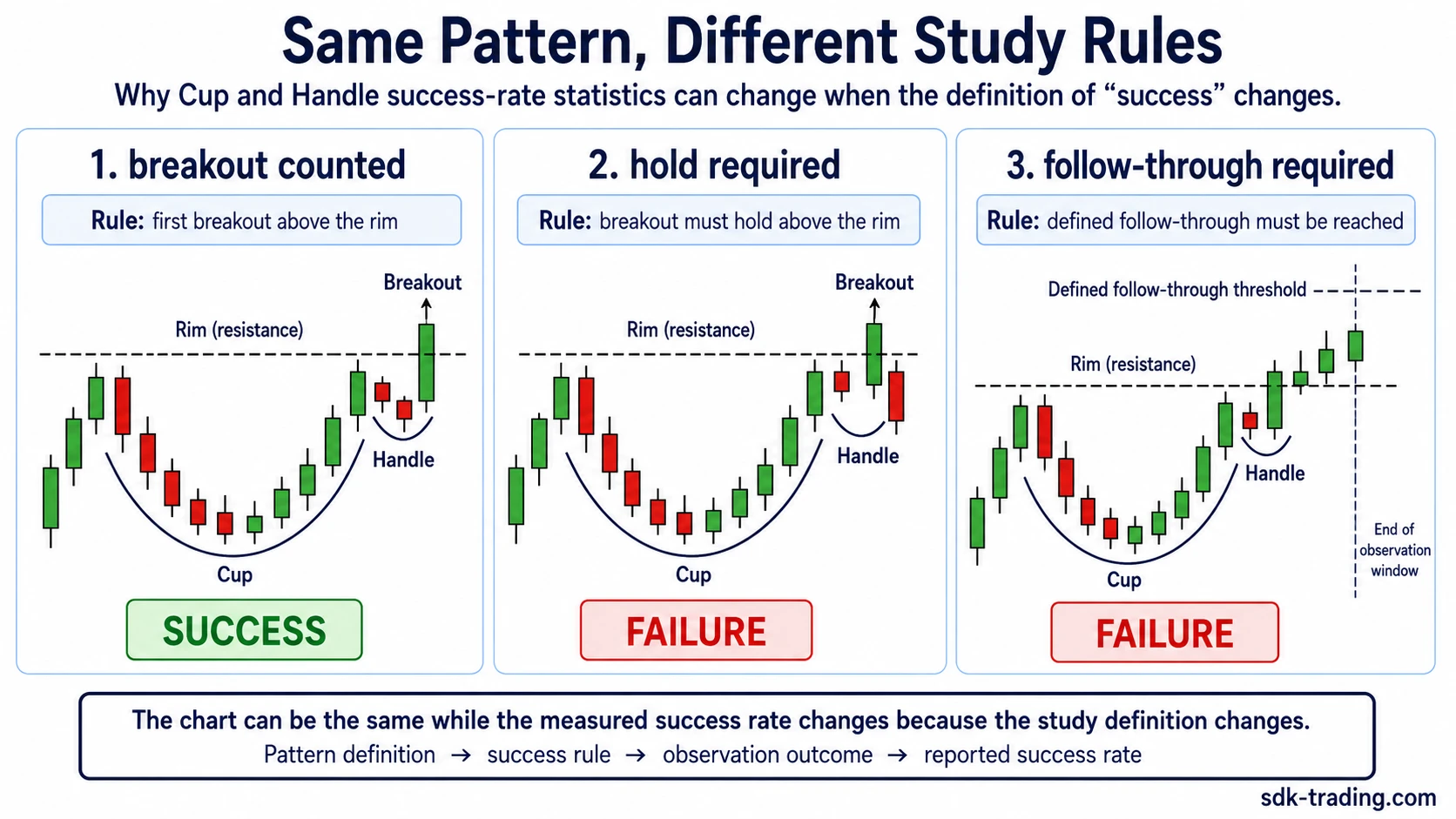
Reading rule: compare success-rate figures only after comparing what each study called a pattern and what each study called success.
How This Differs From an Inverted Cup and Handle
The inverted cup and handle pattern is a separate inverse structure. Its directional context, structural boundaries, and outcome definitions should not automatically share the same reliability assumptions as the standard pattern.
Combining both structures into one headline success rate can hide important differences in how the samples were defined.
Interpretation Limit
Cup and Handle success-rate statistics can describe historical samples. They cannot convert a current chart pattern into a known future probability without comparable definitions and conditions.
Core limit: a historical success rate is evidence about a defined sample, not a guarantee or fixed property of every future Cup and Handle pattern.