An inverted cup and handle is a trading chart pattern built from a rounded crest followed by a smaller rebound. The outline alone is not enough: the structure becomes more meaningful only when the handle, lower boundary, and later price behavior support the same reading.
Definition: An inverted cup and handle is a bearish-leaning chart pattern structure where price forms a rounded top, rebounds in a smaller handle, and then tests whether the lower boundary is accepted or rejected.
The pattern is a chart-reading structure, not a complete trading plan. Its quality depends on proportion, boundary behavior, and later acceptance or reclaim. A similar outline can remain incomplete, weaken, or fail if price quickly reclaims the lower area or if the handle becomes too large relative to the rounded crest.
Diagnostic Checkpoints
- The inverted cup is a rounded crest, not a single sharp reversal candle.
- The handle is usually a smaller rebound after the rounded crest, not a full recovery of the prior structure.
- The lower boundary matters because later acceptance or rejection changes the pattern reading.
- A complete reading needs structure, proportion, and follow-through to align.
- A weak or invalid reading often comes from a V-shape, oversized handle, or fast reclaim of the lower area.
What Is an Inverted Cup and Handle?
An inverted cup and handle is the upside-down version of the regular cup-and-handle structure. Instead of a rounded base followed by a smaller pullback, it has a rounded crest followed by a smaller rebound.
The trading interpretation is usually cautious because the structure can reflect fading upside control after price rounds over. That interpretation still needs qualification: a rounded top and handle shape can appear without producing a clean continuation of the lower-boundary reading.
The stronger test is whether price accepts the lower area after the handle or quickly moves back above it. That behavior separates a more complete structure from a weak or failed one.
How the Structure Forms
The structure usually develops in several parts. First, price advances or stabilizes enough to create a rounded crest. Then the market turns down from that crest and creates the left and right sides of the inverted cup. After that, a smaller rebound forms the handle.
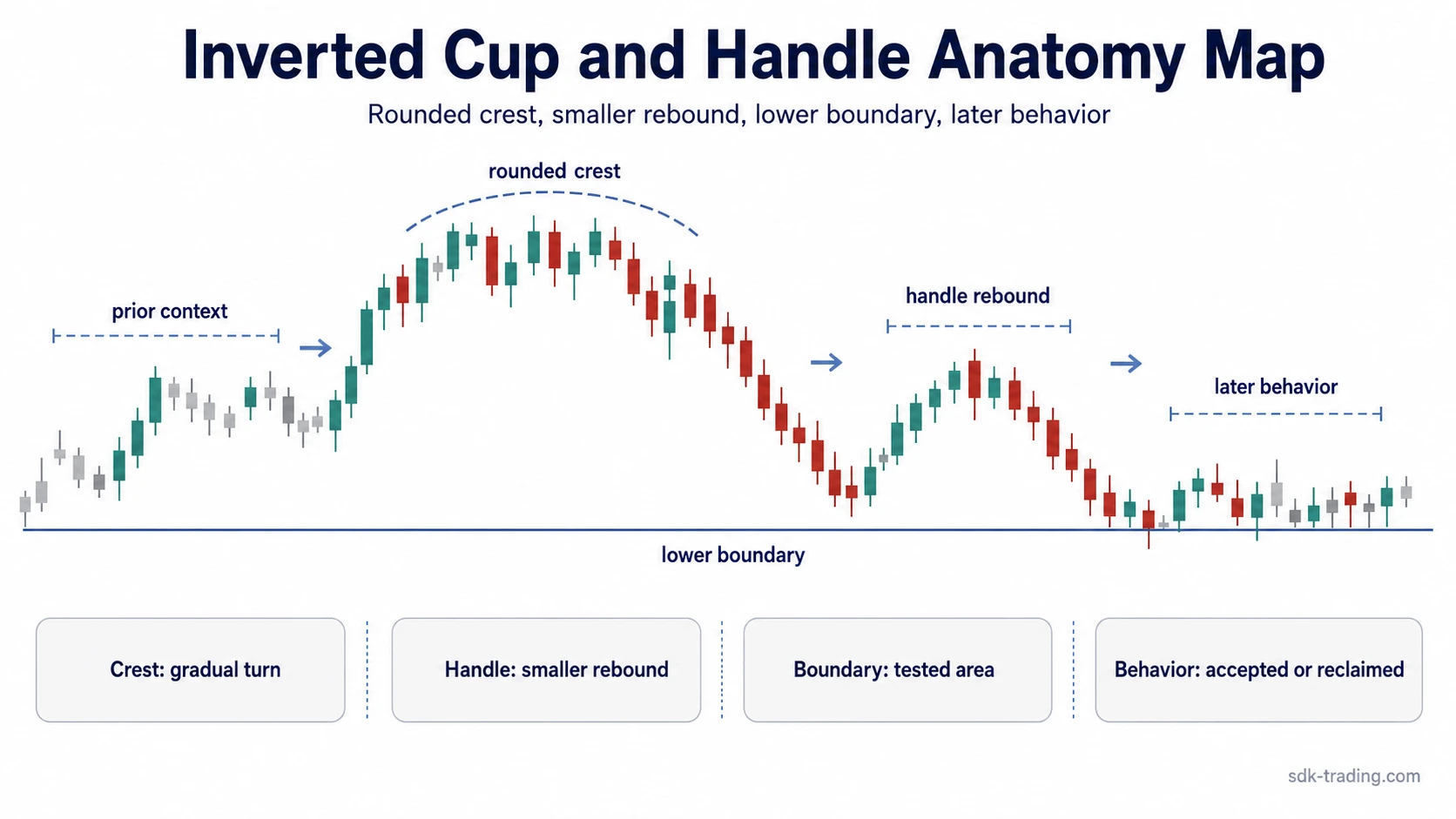
The lower boundary is the area where the base of the rounded crest and the handle structure are judged. Some traders call this a neckline, but the label matters less than the behavior around the area. A brief move through the boundary is not the full reading; acceptance, rejection, or reclaim changes the classification.
| Part of the structure | What to observe | Why it matters |
|---|---|---|
| Rounded crest | Price turns over gradually instead of making only one abrupt spike. | Creates the inverted cup shape and separates the pattern from a simple rejection candle. |
| Handle rebound | Price rebounds after the rounded crest but does not fully erase the structure. | Helps distinguish a handle from a full recovery attempt. |
| Lower boundary | Price tests the lower area created around the cup and handle structure. | Gives the structure a boundary that can be accepted, rejected, or reclaimed. |
| Later behavior | Price either stays below the boundary, hesitates around it, or moves back above it. | Changes the interpretation from complete to weak or invalid. |
How to Identify an Inverted Cup and Handle
Identification starts with structure before interpretation: a visible rounded crest, a smaller handle rebound after the crest, and a lower boundary clear enough to judge later acceptance or rejection.
A rough real-world shape can still qualify. Markets rarely draw perfectly smooth arcs. Uneven candles, small interruptions, and imperfect curvature are normal. The outline weakens when the shape turns into a sharp V, when the handle grows too large, or when price quickly reclaims the lower boundary.
Volume can add context, but it should not carry the whole interpretation. Higher activity near the lower boundary may show that the area is being contested, while quiet movement may show less conviction. Volume still needs price result, structure, and later behavior before it becomes useful.
Boundary note: The first break or test around the lower boundary is not enough by itself. Classification improves only after later candles show acceptance, rejection, or reclaim.
Complete, Weak, and Invalid Readings
The same general outline can lead to different classifications. The difference comes from proportion, boundary behavior, and whether the later candles support or reject the lower-boundary interpretation.
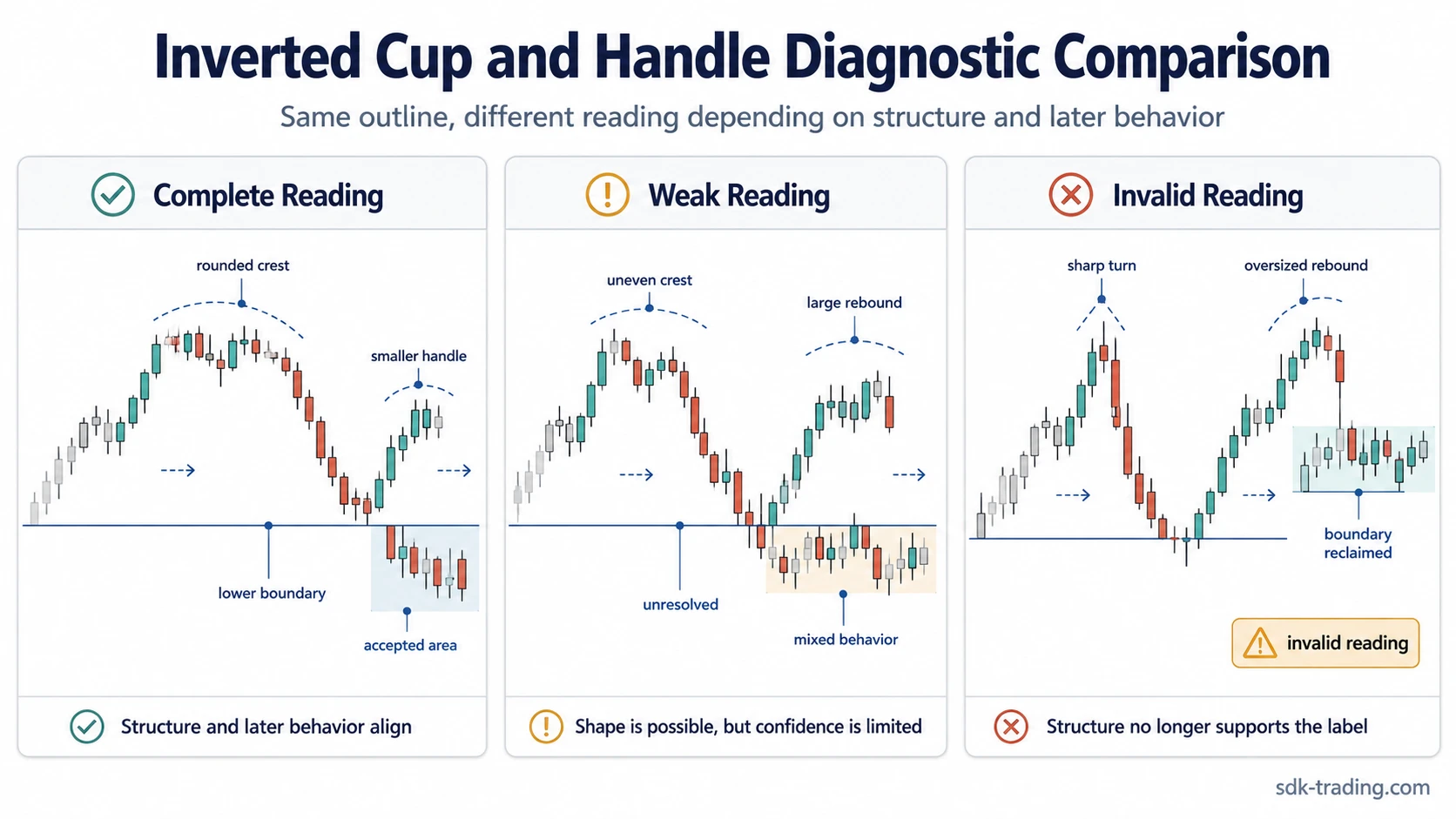
| Reading type | Structure | Boundary behavior | Diagnostic interpretation |
|---|---|---|---|
| Complete reading | Rounded crest, smaller handle rebound, and clear lower boundary. | Price accepts the lower area after the handle instead of immediately reclaiming it. | The components support the same structural reading. |
| Weak reading | Shape is visible but uneven, shallow, or poorly proportioned. | Price hesitates around the lower boundary or gives mixed follow-through. | The pattern remains possible, but confidence in the label is limited. |
| Invalid reading | The crest becomes a sharp V, the handle becomes oversized, or the structure is erased. | Price quickly reclaims the lower area and holds above it. | The chart no longer supports the inverted cup-and-handle interpretation. |
Inverted Cup and Handle Example in Context
Price advances into a prior resistance area, rounds over, and then forms a smaller rebound below the earlier high. The shape may resemble an inverted cup and handle, but the structure remains incomplete until price behavior around the lower boundary is visible.
The structure holds up better when the rebound stays proportionally smaller and later candles spend time below the lower boundary instead of immediately reversing through it. The outline weakens when the handle expands into a broad recovery, or when price reclaims the boundary and holds above it after the first test.
Inverted Cup and Handle vs Cup and Handle
The regular cup and handle uses a rounded base followed by a smaller pullback. The inverted version uses a rounded crest followed by a smaller rebound. The two patterns can look related because both use a cup shape and a handle, but the structural direction is opposite.
| Feature | Cup and handle | Inverted cup and handle |
|---|---|---|
| Main shape | Rounded base | Rounded crest |
| Handle behavior | Smaller pullback after recovery toward the rim. | Smaller rebound after decline from the crest. |
| Key boundary | Upper rim area. | Lower boundary area. |
| Main classification risk | Calling any rounded base a complete pattern too early. | Calling any rounded top a complete pattern too early. |
Common Misreads
- Rounded top only: a rounded top without a smaller handle is not a complete inverted cup and handle.
- Sharp V-shape: a fast spike and drop is a weak match because the inverted cup normally needs a rounded crest.
- Oversized handle: a rebound that recovers too much of the structure can turn the chart into a different reading.
- First boundary test only: the first move into the lower area is only a probe until later behavior shows acceptance, rejection, or reclaim.
Limitations of the Pattern Reading
The inverted cup and handle can be useful for chart classification, but it is not reliable enough as a standalone decision trigger. Structure, proportion, market context, and later behavior all affect the reading.
Reliability also depends on what is being measured. A clean-looking pattern, a rough pattern, and a failed reading should not be grouped together as if they are the same condition. Broader reliability questions belong with cup and handle pattern success rate analysis, where pattern quality, sample definitions, and confirmation criteria can be separated more carefully.
Limitation: The pattern can change classification as new candles form. A structure that looks complete at first can become weak or invalid if price action quickly rejects the lower-boundary reading.
FAQ
What does an inverted cup and handle mean in trading?
It means price has formed a rounded crest followed by a smaller rebound, creating a bearish-leaning chart structure. The meaning remains conditional because the handle, lower boundary, and later behavior must support the same reading.
How do you identify an inverted cup and handle?
Look for a rounded crest, a smaller handle rebound, and a lower boundary that can be tested after the handle. The reading is stronger when the structure is proportionate and later price behavior accepts the lower area.
Can an inverted cup and handle fail?
Yes. The reading can fail if the handle becomes too large, the structure turns into a sharp V-shape, or price quickly reclaims the lower boundary and holds above it.
Is an inverted cup and handle the same as a regular cup and handle?
No. A regular cup and handle has a rounded base and smaller pullback, while the inverted version has a rounded crest and smaller rebound.
Does volume matter in an inverted cup and handle?
Volume can add context, especially around the lower boundary, but it should not be used alone. Structure, price result, and later acceptance or rejection remain more important for classification.