A cup and handle is a bullish continuation chart pattern formed by a rounded cup followed by a smaller handle near the prior upper boundary. A rounded base alone is not enough. The handle is part of the structure, and later price behavior around the rim shows whether the pattern remains coherent.
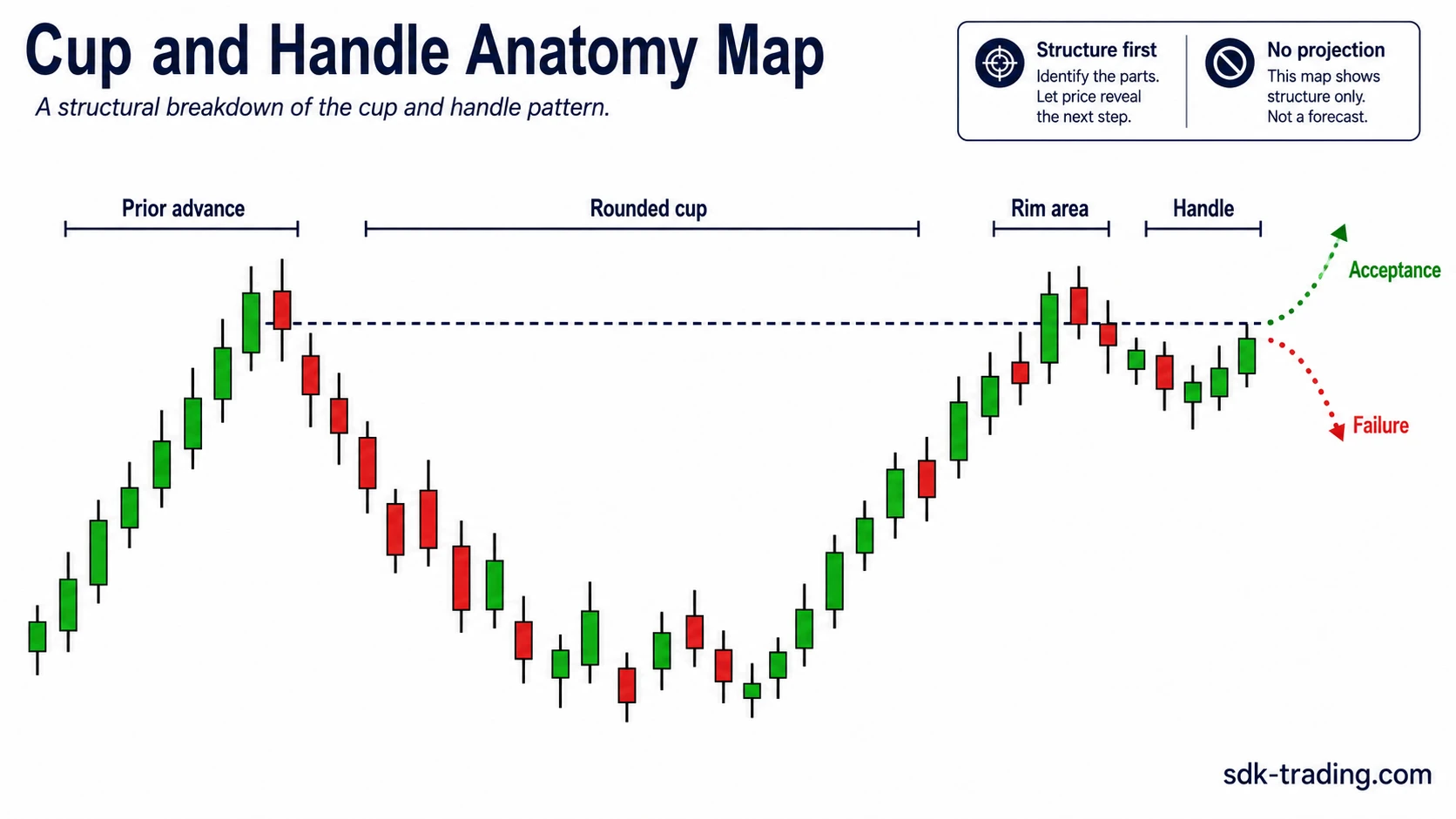
Definition: The pattern usually develops after an existing advance. Price forms a rounded consolidation, recovers toward the earlier high area, pauses in a smaller handle, and then tests whether the rim can be accepted or rejected.
Structural boundary: a rounded cup without a smaller handle near the rim is not a complete Cup and Handle pattern.
How the Cup and Handle Pattern Forms
The structure normally begins after price has already advanced. Price then pulls back, stabilizes, and gradually recovers toward the earlier high area. This decline, base, and recovery create the cup.
The handle develops near the rim when price pauses or pulls back instead of immediately extending higher. It should remain smaller than the cup and should not erase the right side of the recovery.
| Part | What to observe | Structural role |
|---|---|---|
| Prior advance | Price rises before the larger rounded consolidation develops. | Supports the usual continuation-pattern context. |
| Cup | Price declines, stabilizes, and gradually recovers. | Creates the main rounded base. |
| Rim | The right-side recovery approaches the earlier high area. | Creates the main upper structural reference. |
| Handle | A smaller pullback or consolidation forms near the rim. | Separates the complete pattern from a simple rounded recovery. |
| Rim test | Price attempts to move through or hold around the upper boundary. | Shows whether the structure is gaining acceptance or being rejected. |
Why the Cup Should Be Rounded
The cup is usually broader than a sharp V-shaped reversal. Price declines, spends time stabilizing, and then recovers toward the earlier upper area.
A very compressed drop-and-rebound can resemble the outline of a cup without developing the same rounded consolidation. The visual letter shape by itself is therefore not enough to define the pattern.
Volume can add context during this process. Participation may contract during parts of the cup or handle and increase as price tests the rim, but volume does not replace the structural requirements of the pattern.
Why the Handle Matters
The handle is a smaller pause near the upper part of the structure. It shows that price has recovered toward the rim without immediately breaking the larger pattern apart.
A cleaner handle remains proportionally smaller than the cup. If the pullback becomes deep enough to erase much of the right-side recovery, the structure becomes weaker and can stop fitting a Cup and Handle reading.
Proportion check: the handle should behave like a smaller consolidation attached to the upper part of the cup, not like a second large decline.
What the Rim Tells You
The rim is the main upper reference created by the earlier high and the later recovery. It separates the completed cup structure from the area price must test next.
Moving above the rim starts the breakout question, but the first cross does not guarantee continuation. Price can maintain the new area, retest it, fall back below it, or leave the structure unresolved.
| Rim behavior | Possible structural reading |
|---|---|
| Price moves above the rim and maintains the new area. | The continuation structure remains coherent. |
| Price breaks above the rim but quickly falls back below it. | The breakout attempt has weakened. |
| Price repeatedly overlaps the rim without establishing either side. | The pattern remains unresolved. |
| The handle breaks down and materially damages the right side of the cup. | The original Cup and Handle interpretation may no longer fit. |
See a Cup and Handle Pattern on a Real Chart
This short example shows the cup, handle, breakout area, and a common measured-move projection on a real chart.
The measured move shown in the video is a traditional projection method rather than a guaranteed price target. The more important structural question is whether price can maintain the pattern around the rim after the breakout attempt.
Clean, Weak, and Invalid Cup and Handle Structures
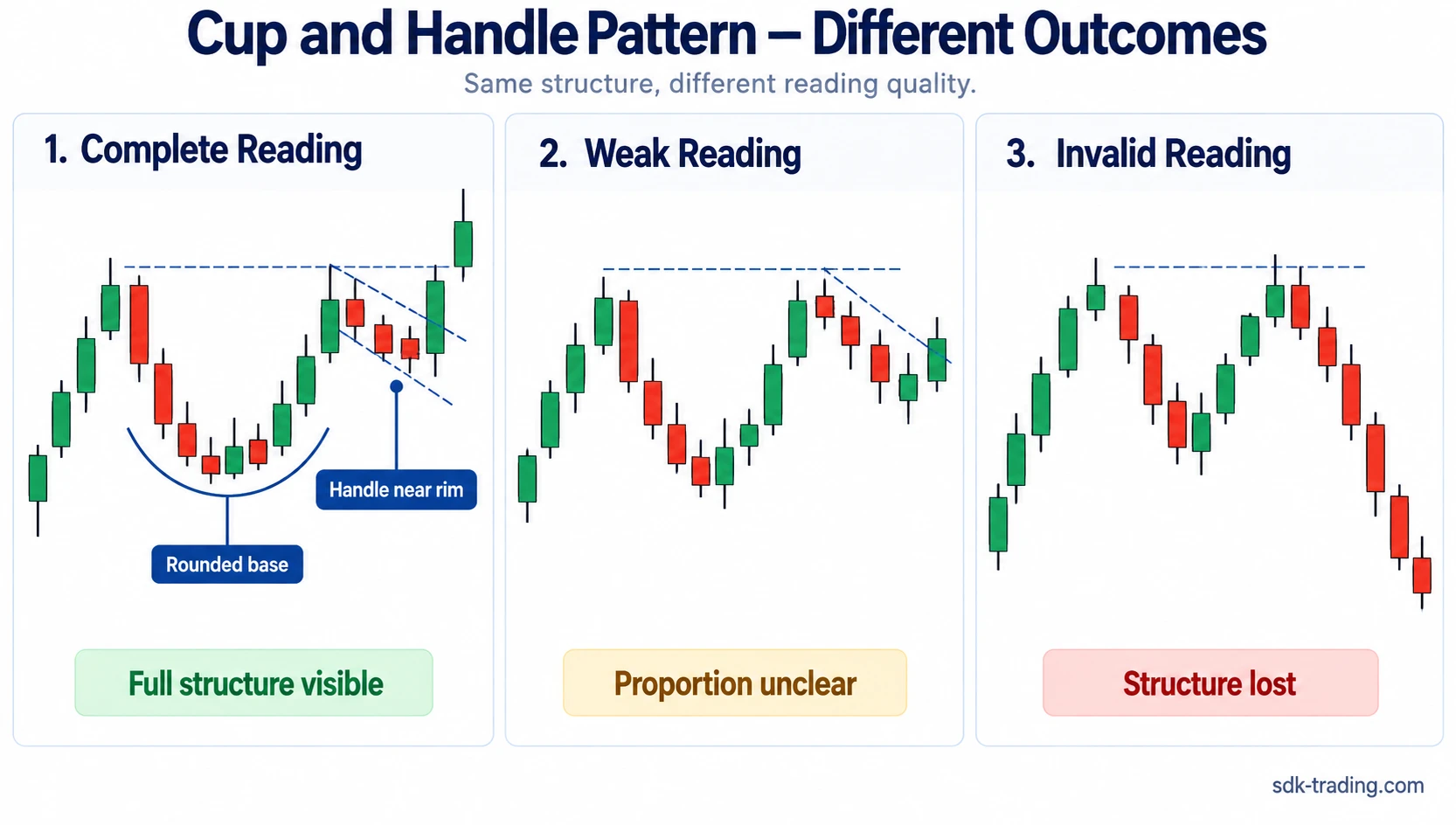
Similar rounded formations can have very different structural quality. The cup shape, handle proportion, and rim behavior provide the main distinctions.
| Reading | Typical structure | Diagnostic meaning |
|---|---|---|
| Clean | Prior advance, rounded cup, recovery toward the rim, and a smaller controlled handle near the upper area. | The main structural components remain visible and proportional. |
| Weak | The cup is uneven, the handle becomes relatively deep, or the right-side recovery loses coherence. | The pattern may still be developing, but the structural fit is weaker. |
| Invalid | No handle develops, the structure is mainly a sharp V-shaped rebound, or the handle destroys much of the right side of the cup. | The chart no longer fits the basic Cup and Handle definition. |
Cup and Handle vs Related Structures
An inverted cup and handle reverses the contour of the standard structure. Instead of a rounded base followed by a smaller upper pullback, it develops a rounded top followed by a smaller recovery near the lower boundary.
Pattern identification and pattern reliability are separate questions. A chart can match the required structure and still fail, so the cup and handle pattern success rate is better evaluated separately from the basic structural definition.
Interpretation Limit
A Cup and Handle identifies a recognizable chart structure. It does not guarantee that a breakout will hold or that a measured projection will be reached.
Core limit: the pattern remains a structural classification until later price behavior shows whether the rim can be accepted, rejected, or left unresolved.