An ascending triangle has a mostly flat upper boundary with rising lows, while a rising wedge has two rising boundaries that converge. Both can tighten while price moves upward, so the better label comes from boundary shape, swing progression, and follow-through rather than slope alone.
Definition: In chart-pattern analysis, the difference between an ascending triangle and a rising wedge is mainly geometric: the ascending triangle presses into a horizontal upper area, while the rising wedge narrows between two rising lines.
The first filter is the upper boundary. If the upper line behaves like a ceiling, the structure is closer to an ascending triangle. If the upper line rises with the lower line and both sides contract, the structure is closer to a rising wedge.
Key Points
- An ascending triangle usually has a flat upper boundary and rising lows.
- A rising wedge usually has two rising boundaries that converge.
- Both patterns can show upward compression, which creates the mislabel risk.
- The boundary structure matters more than the upward slope alone.
- Neither pattern label is a standalone trade signal.
Ascending Triangle vs Rising Wedge: The Fast Difference
In an ascending triangle, repeated highs tend to meet a similar upper area while pullbacks become shallower. In a rising wedge, highs also rise, but the upper and lower boundaries climb together and narrow into a converging structure.
That distinction changes the interpretation. The ascending triangle is commonly read as pressure building under a ceiling. The rising wedge is commonly read as upward progress becoming more compressed. Both readings can fail when price behavior does not support the boundary structure.
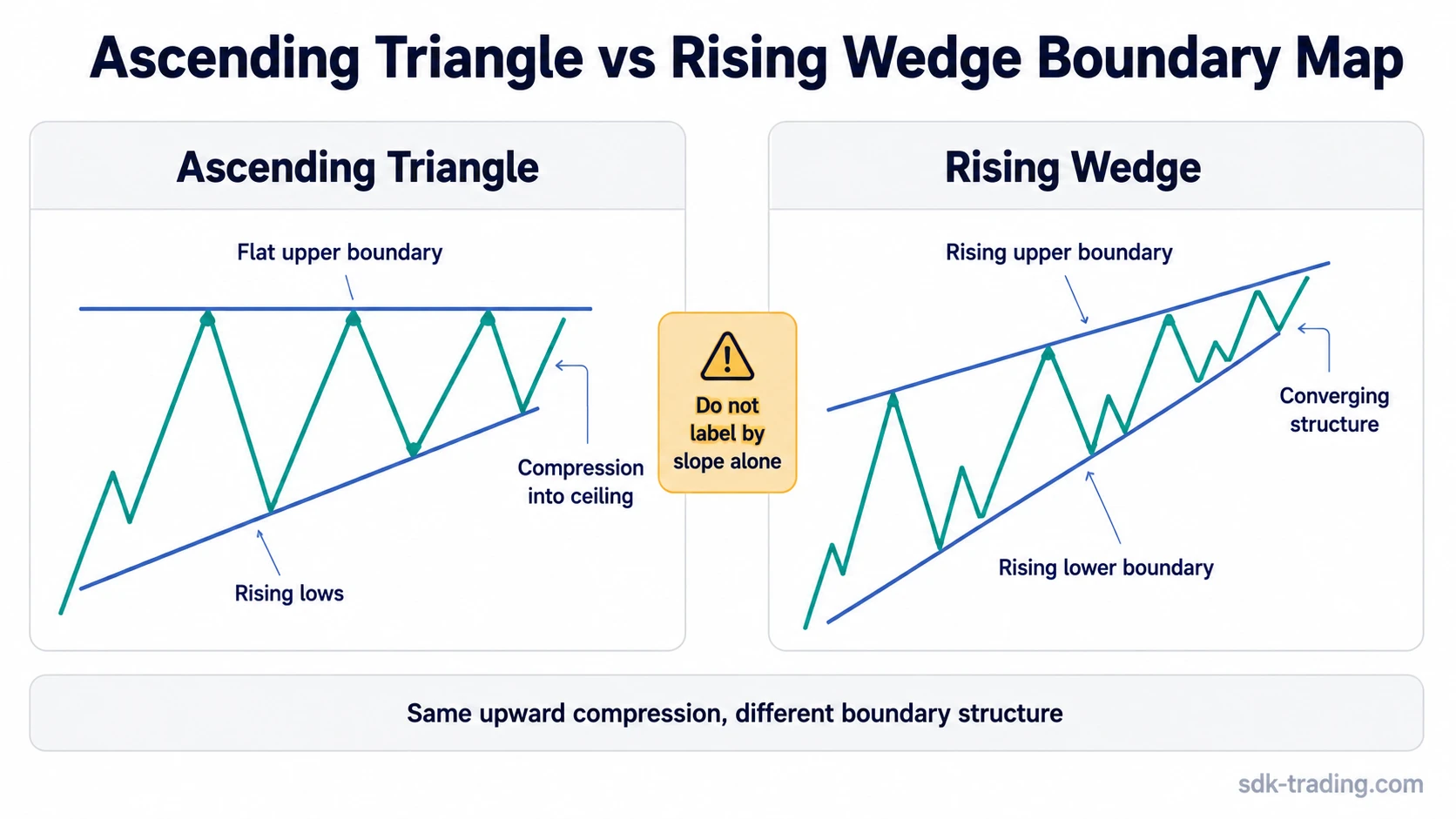
Comparison Table
| Criterion | Ascending triangle | Rising wedge |
|---|---|---|
| Upper boundary | Mostly flat or horizontal resistance area. | Rising upper boundary. |
| Lower boundary | Rising lows press toward the flat upper area. | Rising lows move inside a narrowing structure. |
| Swing progression | Highs cluster near the same area while lows step higher. | Both highs and lows rise, but the distance between them contracts. |
| Compression type | Compression into a ceiling. | Compression inside two rising converging lines. |
| Usual interpretation | Often associated with pressure building below resistance. | Often associated with a rising move losing range and momentum. |
| What weakens the reading | The upper boundary keeps rising, or the highs do not form a clear flat area. | The boundaries do not converge, or the structure behaves more like a rising channel. |
| Common misread | Calling any rising compression an ascending triangle. | Calling any rising compression a rising wedge without checking convergence. |
How to Identify the Better Label
Start with the upper boundary. If several swing highs stall near the same area while lows keep stepping upward, the structure leans closer to an ascending triangle reading. If each rally reaches a higher high while the upper and lower lines move closer together, the structure leans closer to a rising wedge reading.
The second check is compression quality. A clean ascending triangle compresses toward one obvious upper area. A rising wedge compresses because both sides of the structure slope upward and contract. If the upper line cannot be drawn as flat, do not force the ascending triangle label.
Reading note: Direction alone is not enough. A rising structure can still be mislabeled when the boundary test, swing sequence, and follow-through do not support the pattern name.
Ascending Triangle Reading
An ascending triangle reading depends on repeated pressure into a similar upper area. Rising lows suggest that each pullback is becoming shallower, but the flat upper boundary remains the main classification feature.
The reading becomes less convincing when the upper boundary is unstable. If highs keep rising with the lows, the structure no longer has the flat ceiling that separates the pattern from a wedge or a channel-like move.
Rising Wedge Reading
A rising wedge reading depends on two rising boundaries that move closer together. Price is still advancing, but the structure narrows as the swings compress.
The reading becomes weaker when the lines do not converge. If the upper and lower boundaries rise at a similar pace, the structure may resemble a rising channel more than a wedge. If the structure has a clear flat ceiling instead, the reading may shift back toward an ascending triangle.
Why the Two Patterns Get Confused
The confusion comes from shared upward compression. Both structures can show higher lows, reduced range, and pressure building inside a tightening area. A quick look can make them appear similar before the boundaries are drawn carefully.
The common mistake is naming the pattern from price slope alone. A better sequence is upper boundary first, swing progression second, follow-through third.
Common mistake: A rising structure is not automatically a rising wedge, and a pattern with higher lows is not automatically an ascending triangle. The upper boundary decides most of the first classification.
Same Upward Compression, Different Reading
Price rises toward a prior resistance area while each pullback becomes shallower. If the swing highs keep stalling around the same upper area, the structure fits an ascending triangle reading more closely.
Now change one feature: each new high also rises, but by less distance, while the lows rise faster from below. The two boundaries now narrow together. That same upward compression fits a rising wedge reading more closely because the whole structure is climbing and contracting at the same time.
Same Compression Example: A chart can begin as unresolved compression. A flatter upper boundary supports the ascending triangle label; two rising converging boundaries support the rising wedge label. If price later accepts outside the structure in a way that conflicts with the original boundary reading, the pattern name may need to be revised.
What Weakens Each Pattern Label
An ascending triangle label loses quality when the upper boundary is not actually flat, when highs continue stepping upward, or when the structure lacks repeated tests of a similar ceiling. Higher lows alone are not enough.
A rising wedge label loses quality when the boundaries do not converge, when price moves inside a clean rising channel, or when only one side of the structure is clearly defined. Convergence is not decoration; it is part of the pattern identity.
Limitation: Pattern names classify chart structure. They do not predict that price must continue, reverse, break out, or fail. Follow-through can improve a reading, but it cannot make a weak boundary structure clean after the fact.
Volume and Follow-Through
Volume can add context, but it should not override boundary geometry. Lower activity during compression may appear in several patterns, and a volume increase near a break can still fail if price does not hold outside the structure.
Follow-through is conditional. A break, rejection, or reclaim can change the quality of the reading, but it should not turn an unclear structure into a clean pattern label.
FAQ
What is the main difference between an ascending triangle and a rising wedge?
The main difference is the boundary structure. An ascending triangle has a mostly flat upper boundary with rising lows, while a rising wedge has two rising boundaries that converge.
Can a rising wedge look like an ascending triangle?
Yes. Both can rise and compress, especially when lows are stepping higher. The label depends on whether the upper boundary is flat or rising with the rest of the structure.
Is an ascending triangle always bullish?
No. An ascending triangle is a chart-structure label, not a guarantee. The reading can weaken if the upper boundary fails to hold as a clear reference area or if later behavior rejects the structure.
Is a rising wedge always bearish?
No. A rising wedge is commonly associated with compressed upward progress, but the label still needs boundary convergence and later behavior. It should not be treated as a standalone prediction.
Final Distinction
Use the upper boundary as the first filter. A flat ceiling with rising lows points toward an ascending triangle. Two rising converging boundaries point toward a rising wedge. When the boundary structure is unclear, unresolved compression is safer than a forced pattern name.