A triangle breakout begins when price moves out of a compressing triangle structure, but the boundary cross alone does not explain how much of the prior compression has actually been left behind. The quality of the breakout becomes clearer when the break is read relative to the local geometry of the triangle at that moment.
Definition: A triangle breakout is a move in which price exits the boundary of a triangle pattern and begins separating from the prior compression structure. The breakout is easier to evaluate when the location of the break, the remaining width of the triangle, the distance created outside the boundary, and any later re-entry are judged together.
How Triangle Breakouts Are Evaluated
- A close outside the boundary is only the first part of the breakout sequence.
- The same line break can look stronger or weaker depending on how much triangle width remained at the moment of the break.
- Price separation from the broken boundary matters because a minimal escape can be absorbed quickly.
- A later retest is not the same as a deep return into the old compression.
- Breakout quality should be judged through the triangle’s geometry, not only through the existence of a boundary cross.
What a Triangle Breakout Actually Changes
Inside a triangle, price keeps moving within a narrowing structure. A breakout matters because price is no longer confined to that same compression in the same way. The chart begins transitioning from contained movement to boundary escape.
That change is not captured by the line break alone. A breakout that occurs while meaningful compression still remains inside the structure is a different event from a tiny late break that happens when very little triangle width is left. Both may close outside the line, but the geometry behind them is not the same.
Triangle Boundary Escape Profile
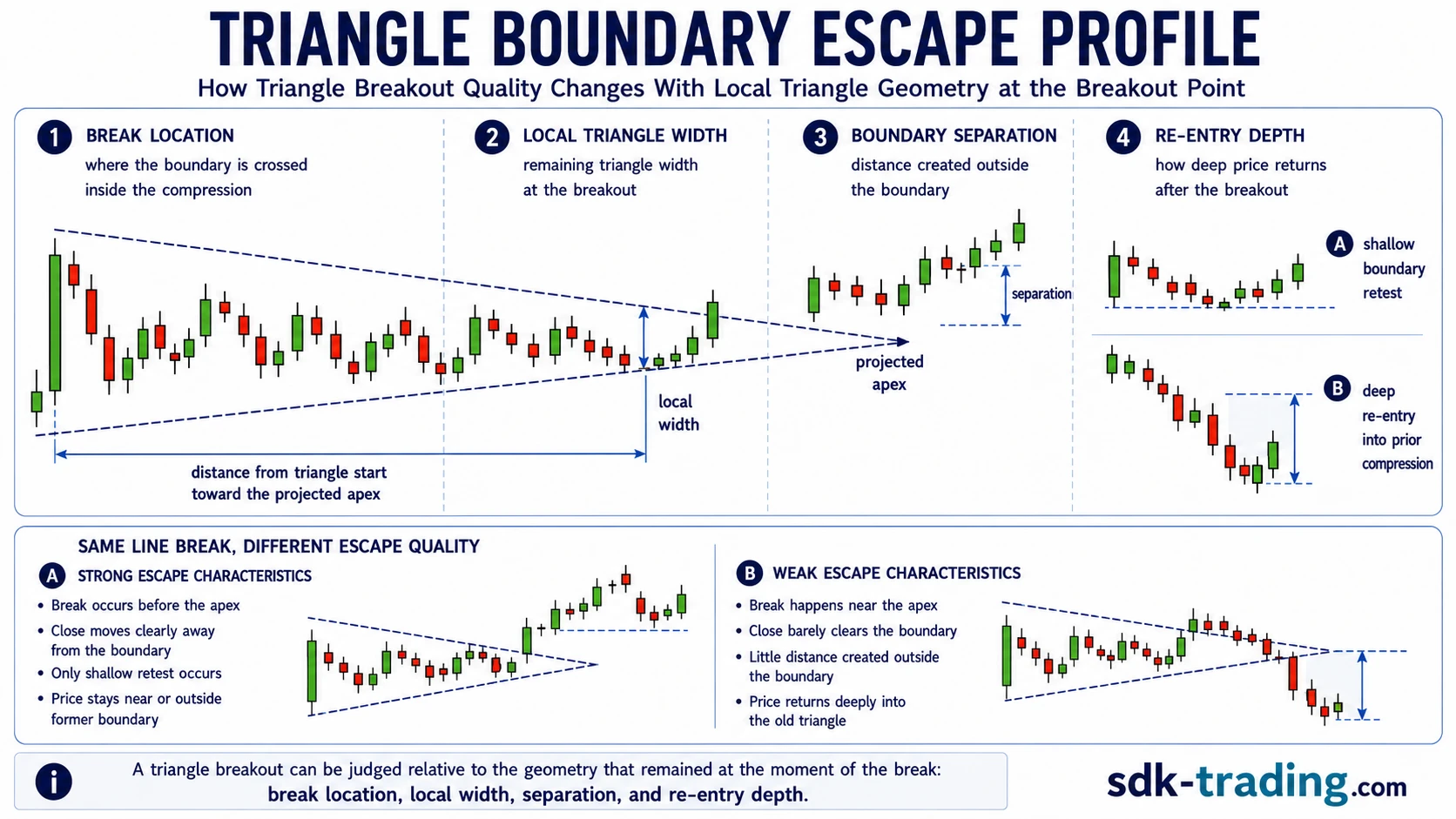
A practical way to judge a triangle breakout is to read four observable parts of the escape sequence. These do not create a new pattern type or a fixed formula. They simply describe how price is leaving the compression.
| Diagnostic | What to examine | Why it matters |
|---|---|---|
| Break location | Check where the breakout occurs inside the triangle structure. | The location shows how much of the compression had already developed before the break. |
| Local triangle width | Check the vertical distance between the upper and lower triangle boundaries in the area of the breakout bar. | The same absolute move outside the line means more when the remaining structure is still relatively wide than when very little width remains. |
| Boundary separation | Check how far price moves away from the broken boundary after the breakout. | Greater separation shows that price is creating distance from the old compression rather than only clipping the line. |
| Re-entry depth | Check how deeply price later returns toward or back into the former triangle area. | A shallow retest is different from a deeper move that travels materially back into the prior compression. |
Break Location and Remaining Triangle Width
A triangle narrows over time. Because of that, the width of the pattern near the breakout bar is part of the reading. When price breaks while the structure still has visible local width, the move is escaping a larger remaining compression. When price breaks very late, the same line cross may represent only a small departure from a nearly exhausted structure.
This does not create a rigid timing rule. It means the breakout should be read in context of the geometry that existed at the point of the break rather than as a detached candle event.
Boundary Separation After the Break
After price crosses the boundary, the next question is whether it creates visible distance from that boundary. Some breakouts move away cleanly and leave the broken line behind. Others barely separate before stalling.
The distinction matters because minimal separation leaves price close to the old compression. A chart can still be technically outside the triangle while remaining structurally vulnerable to quick re-absorption.
Retest and Re-entry Are Not the Same Thing
A later return toward the broken boundary does not automatically undo the breakout. Price can revisit the area, interact with the former boundary, and then move away again. That is different from a deeper return that travels materially back through the old local triangle width.
The retest question is therefore not simply whether price came back. The more useful distinction is how deeply it came back and whether the market still behaved as if it had left the prior compression behind.
Different Escape Sequences After the Break
| Observed sequence | What it shows | Structural implication |
|---|---|---|
| Break occurs with meaningful local width, separation follows, and any retest stays shallow. | Price is creating space outside the prior compression. | The triangle boundary has been left behind more clearly. |
| Break occurs, but separation remains small and price quickly stalls. | The escape from the triangle is limited. | The breakout exists, but the market has not created much distance from the old structure. |
| Break occurs, then price returns deeply into the old triangle area. | The prior compression is being re-entered rather than only retested. | The escape sequence is weaker because price has moved materially back into the former structure. |
| Break occurs and price keeps extending away without meaningful return. | The market is not revisiting the broken boundary in any important way. | The separation phase remains dominant. |
How Triangle Type Can Affect the Reading
The breakout logic stays similar across triangle types, but the geometry of the pattern changes how the structure is recognized before the break.
| Triangle type | Pre-break structure | Use when |
|---|---|---|
| ascending triangle | A relatively flat upper boundary with higher reaction lows pushing into it. | The breakout question follows a structure pressing into a similar overhead area from below. |
| descending triangle | A relatively flat lower boundary with lower reaction highs compressing downward. | The breakout question follows a structure leaning into a similar lower area from above. |
| symmetrical triangle | Both boundaries converge and neither side remains flat. | The breakout is judged from a structure in which both sides compress toward each other. |
Common Triangle Breakout Mistakes
| Mistake | Why it weakens the reading |
|---|---|
| Treating every boundary close as equally meaningful | The same line cross can happen with very different remaining triangle geometry. |
| Ignoring local triangle width | The breakout is then judged without reference to how much compression still existed at the moment of the break. |
| Calling every return to the boundary a failed breakout | A shallow retest and a deep re-entry describe different structural behavior. |
| Focusing only on the first breakout bar | Breakout quality also depends on the later separation and re-entry sequence. |
| Skipping the triangle-quality question | A weak triangle structure can produce a weak breakout reading because the underlying compression was not clear to begin with. |
How to Evaluate a Triangle Breakout
- Confirm that the prior structure was a defensible triangle.
- Identify where the breakout occurs inside the triangle.
- Check the local width of the pattern at the breakout point.
- Measure whether price creates meaningful separation from the broken boundary.
- If price returns, distinguish a shallow retest from a deeper re-entry into the old compression.
- Judge the breakout from the whole escape sequence rather than from the first close alone.
FAQ
What confirms a triangle breakout?
A triangle breakout becomes easier to defend when price not only crosses the boundary but also creates separation from the old compression and avoids a deep return into the former triangle area.
Why does local triangle width matter?
Local triangle width matters because the structure narrows over time. The meaning of a boundary cross changes depending on how much compression still remained at the point of the breakout.
Is a retest after a triangle breakout always bearish or bullishly invalidating?
No. A retest is not automatically the same as failure. A shallow return to the former boundary is different from a deeper re-entry that travels materially back into the prior compression.
Can a breakout happen late in the triangle and still count?
Yes, but a very late breakout should still be judged in relation to the small amount of triangle width remaining at that point. The line break alone does not describe the whole structural quality of the move.