Wedge patterns are trading chart structures formed by two same-direction sloped boundaries that converge while price swings become narrower. The classification is weak when diagonal price movement is named before boundary quality, compression, and repeated interaction are checked.
Definition: A wedge pattern is a narrowing chart formation where both boundaries slope upward or both boundaries slope downward, and the distance between the swings contracts as the formation develops.
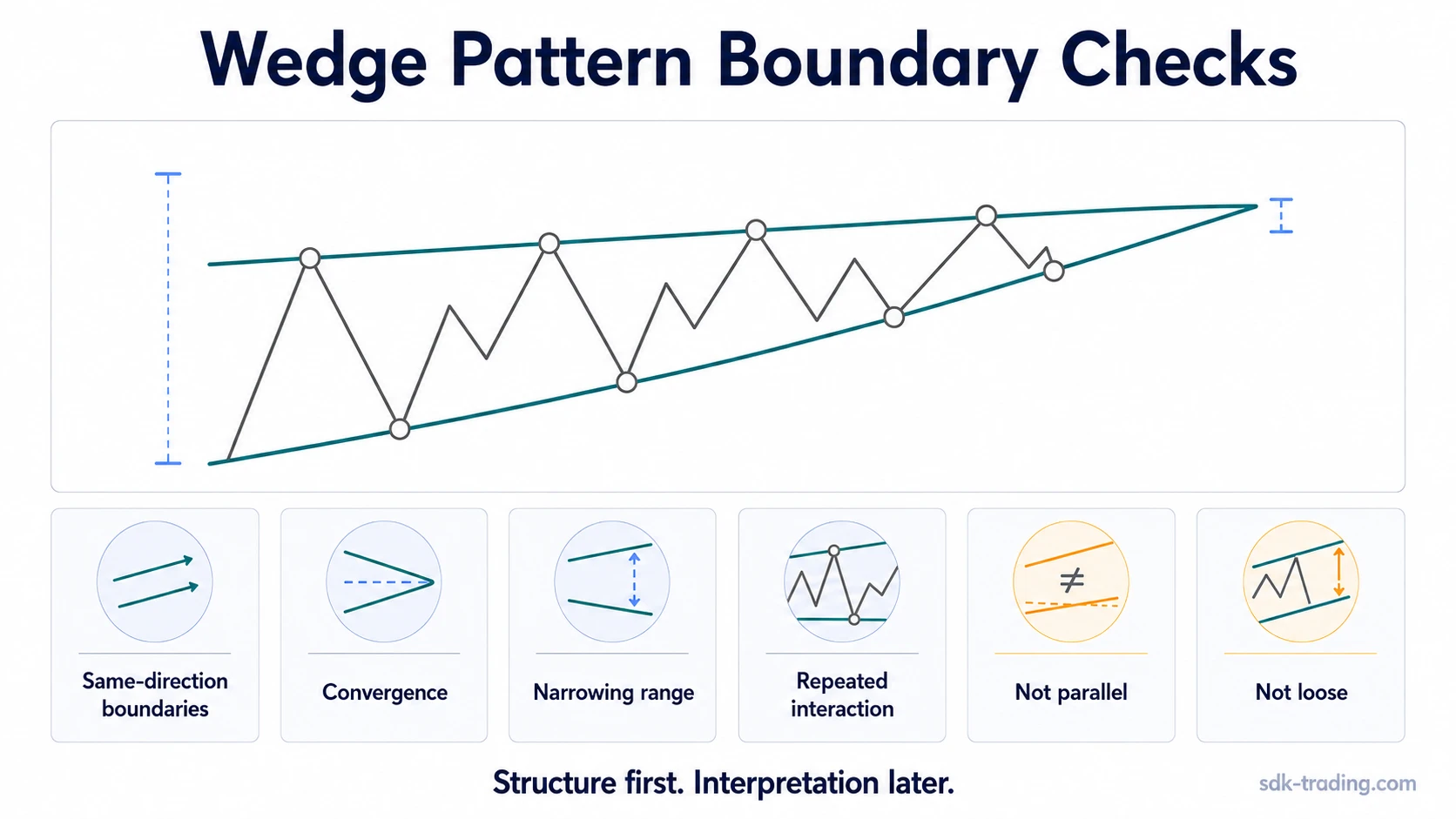
The visible outline is only the surface. A stronger wedge classification needs two meaningful boundaries, a narrowing range, and price behavior that respects the developing compression rather than drifting loosely through it.
Wedge Reading Checks
- A wedge needs two boundaries that slope in the same direction.
- The boundaries should converge rather than stay parallel.
- The swing range should compress as the formation develops.
- Repeated boundary interaction matters more than a single diagonal line.
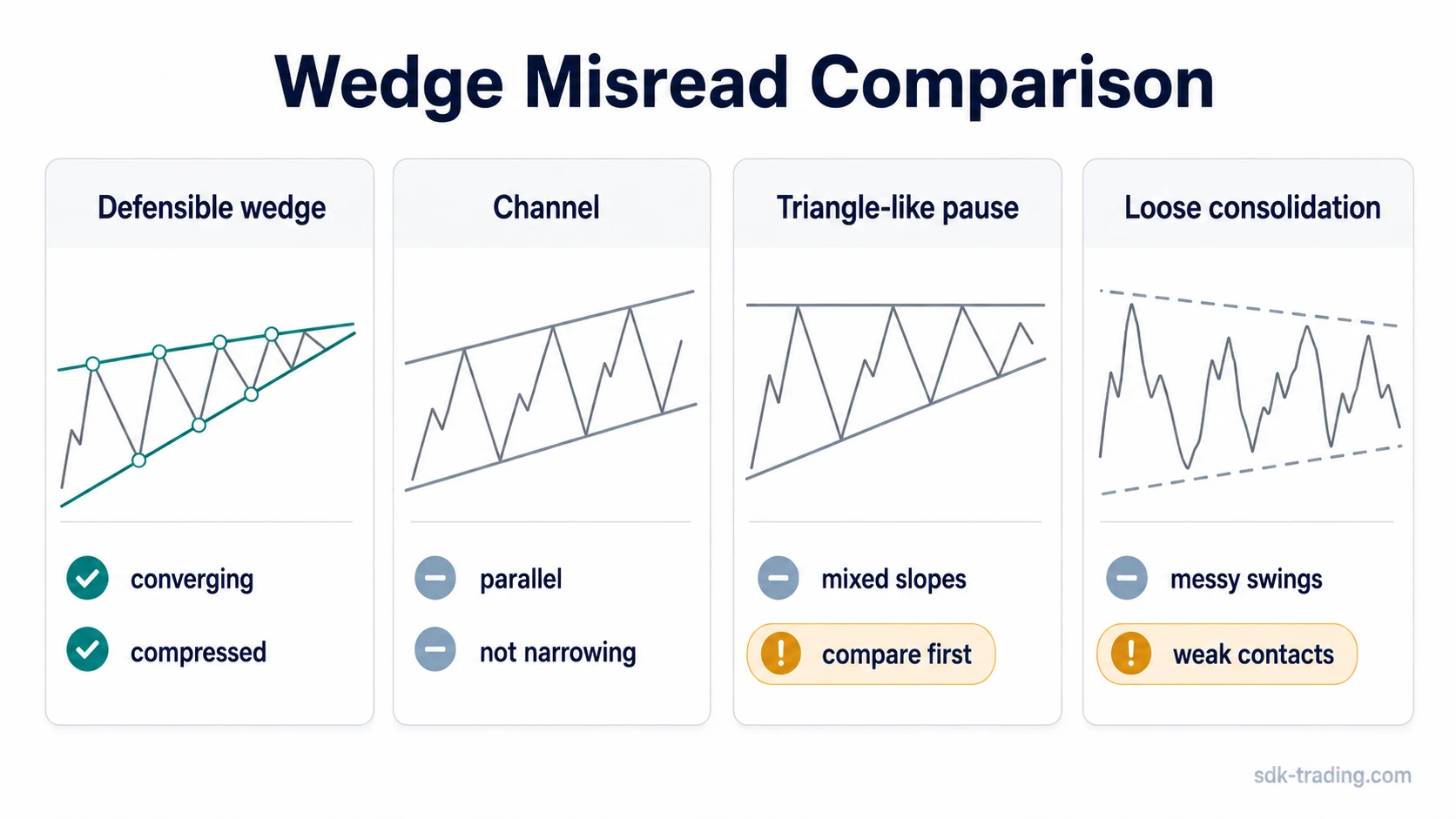
- The case is less convincing when the price path fits a channel, triangle-like pause, or loose consolidation more cleanly.
What Makes a Wedge Reading Defensible?
A wedge reading becomes more defensible when the formation has two sloped boundaries that point in the same general direction. In a rising version, both boundaries rise. In a falling version, both boundaries fall.
Convergence is the second requirement. The upper and lower boundaries should move closer together, creating a smaller swing range over time. Without that narrowing, the formation may be closer to a channel than a wedge.
The third requirement is repeated interaction. A single high and low can create a neat drawing, but the boundary behavior becomes more meaningful only when several swings interact with the lines closely enough to make them useful reference points.
Limitation: A clean-looking diagonal outline is not enough. If the boundaries are parallel, the swings are not compressing, or price keeps cutting through the lines, the wedge classification is fragile.
| Check | Stronger wedge reading | Weaker wedge reading |
|---|---|---|
| Boundary slope | Both boundaries slope upward or both slope downward. | One boundary is flat or the slopes conflict. |
| Convergence | The distance between swings narrows over time. | The boundaries stay roughly parallel. |
| Compression | Each swing covers less distance than earlier swings. | Price remains wide, loose, or irregular. |
| Boundary interaction | Several swing highs and lows respect the formation. | The classification depends on one or two convenient points. |
| Resolution behavior | Price later tests whether the boundary change is accepted or rejected. | The first break is treated as a complete conclusion. |
Rising and Falling Wedge Patterns in Brief
A falling wedge pattern forms when both boundaries slope downward while the swings compress. The main classification question is whether the decline is narrowing into a defensible formation rather than drifting lower in a loose channel.
A rising wedge pattern forms when both boundaries slope upward while the swings compress. The main classification question is whether the advance is losing range inside converging boundaries rather than simply rising inside a parallel channel.
Both variants can appear in different trend contexts. The wedge label identifies the formation; later price behavior, surrounding market structure, and acceptance or rejection around the boundary decide how the interpretation develops.
When Diagonal Narrowing Is Not Enough
Many weak wedge calls start with a correct observation: price is narrowing diagonally. The mistake is stopping there. Diagonal narrowing still needs to be separated from nearby formations that can look similar during early development.
| Formation | What it may look like | Why the wedge call may be weak |
|---|---|---|
| Wedge pattern | Two same-direction sloped boundaries converge while swings compress. | The classification is stronger only when both boundaries and compression are visible. |
| Price channel | Price moves diagonally between two roughly parallel boundaries. | Parallel movement lacks the narrowing range that defines a wedge. |
| Triangle-like pause | Price compresses, but one boundary may be flat or the slopes may differ. | The slope relationship does not cleanly match same-direction wedge behavior. |
| Loose consolidation | Price swings become messy, overlapping, and inconsistent. | The boundaries may be drawn after the fact rather than respected by price. |
Common mistake: Calling every diagonal squeeze a wedge creates false precision. Structure comes first, the classification comes second, and interpretation comes after the boundary behavior is tested.
How Wedge Readings Weaken
A wedge classification becomes less convincing when the boundaries do not carry enough information. If one side of the formation is based on a single touch, the line may be more decorative than diagnostic.
The case also weakens when price keeps expanding inside the outline. A wedge should show compression. If the swings remain wide or become wider, the formation is not behaving like a narrowing pattern.
Parallel boundaries are another warning. A clean rising or falling channel can be useful in its own way, but it is not the same as a converging wedge. The difference matters because channel behavior and wedge behavior describe different forms of price movement.
Safe interpretation note: A boundary break should be read as a test of structural resolution. A clean break, failed break, retest, or immediate return inside the formation can each change the interpretation, but none removes the need for broader chart context.
Simple Wedge Pattern Misread Example
Price advances through several swings and the highs and lows begin to narrow diagonally. The first impression is a rising wedge, especially if the upper line and lower line can be drawn neatly across recent candles.
The early call remains incomplete if the lower boundary is almost parallel to the upper boundary, the swing range has not clearly compressed, or the formation depends on only two convenient contact points. In that case, the chart may be showing a rising channel or a loose pause rather than a defensible wedge.
The interpretation becomes more useful after the formation is tested against objective checks: both boundaries slope the same way, the range narrows, several swings interact with the boundaries, and price behavior around any break shows whether the formation is being accepted or rejected.
Diagnostic conclusion: The outline is only useful after the boundaries, compression, and later price behavior support the classification.
Reading Rules for Wedge Patterns
A stronger wedge interpretation starts with boundary behavior, not with a directional assumption. The formation should show a clear relationship between slope, convergence, compression, and repeated interaction.
The weaker approach starts with a desired call and then draws lines to fit it. That approach can hide nearby alternatives such as channels, triangle-like pauses, and loose consolidations.
- If both boundaries do not slope the same way, the formation may not be a wedge.
- If the boundaries do not converge, a channel reading may fit better.
- If the swing range is not shrinking, compression is not yet clear.
- If contact points are thin or convenient, the boundary work is premature.
- If price breaks and immediately returns inside, the resolution remains unresolved.
FAQ
Are wedge patterns reversal or continuation patterns?
Wedge patterns can appear in different trend contexts, so the label alone does not decide reversal or continuation. The surrounding structure and later acceptance or rejection around the boundary are needed to qualify the interpretation.
What makes a wedge reading weak?
A wedge reading is weak when the boundaries are parallel, the range does not compress, there are too few meaningful touches, or the formation is better described as a channel, triangle-like pause, or loose consolidation.
Does a break from a wedge confirm the whole reading?
A break is only a structural resolution test. It can support, weaken, or invalidate the reading depending on whether price accepts the break, rejects it, or quickly moves back into the prior formation.