A point and figure chart is a price-movement chart, not a regular time-interval chart. It adds Xs or Os only when price moves far enough to satisfy the selected construction rules, so periods with little qualifying movement may add nothing to the chart.
Definition: A Point and Figure chart, often shortened to P&F, records qualifying upward movement in X columns and qualifying downward movement in O columns. Box size controls the movement needed to extend a column, while the reversal setting controls the opposite movement needed to start a new column.
| What it is | What it is not |
|---|---|
| A filtered representation of price movement. | A chart that creates one new bar or candle for every fixed time interval. |
| A sequence of X and O columns created by price thresholds. | A record of every smaller move between displayed boxes. |
| A chart whose visible structure depends on box size and reversal rules. | A settings-independent representation of raw price action. |
| A way to compress movements that do not satisfy the construction threshold. | A trading signal or forecast by itself. |
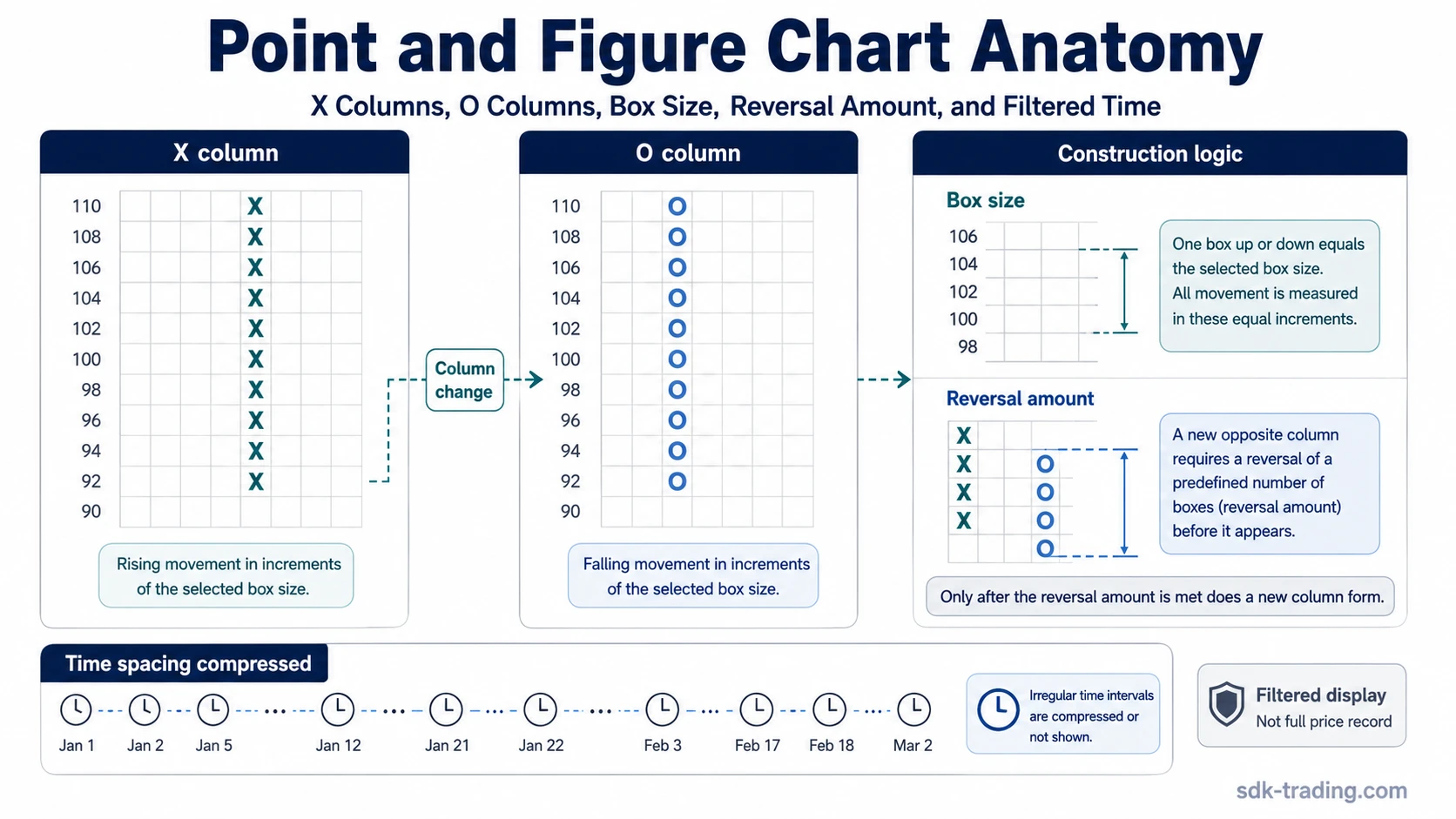
How a Point and Figure Chart Updates
The chart tests new price movement against the current column and the selected construction settings.
| Price behavior | Chart response |
|---|---|
| Price continues far enough in the direction of the current column. | Another X or O is added if the movement satisfies the box-size rule. |
| Price moves in the opposite direction but not far enough to satisfy the reversal rule. | No new opposite column is created. |
| Price reverses by the required amount. | A new column begins in the opposite direction. |
| Price moves without reaching a qualifying threshold. | The visible chart can remain unchanged. |
This is the central construction mechanism. The chart is not simply deleting time labels from a normal price chart. It is rebuilding the displayed sequence around price-movement thresholds.
Box Size Controls the Movement Filter
Box size defines the price increment represented by each X or O. A smaller box size allows smaller movements to appear. A larger box size requires more movement before the current column extends.
Changing box size can therefore change the visible swing structure even when the underlying market data is identical. More sensitivity can reveal smaller movements, while less sensitivity can compress them into a broader structure.
Interpretation boundary: box size changes what the chart displays. It does not make the underlying price movement stronger or weaker.
Reversal Amount Controls When a New Column Begins
The reversal setting defines how much opposite movement is required before an X column changes to an O column or an O column changes to an X column.
A larger reversal requirement filters more counter-movement before changing columns. A smaller requirement makes the chart respond to smaller reversals.
That means a column change establishes only that the selected reversal threshold was satisfied. It does not establish that the new direction will continue.
Horizontal Distance Does Not Represent Regular Time
This is one of the most important differences from candlestick and bar charts. On a regular time-based chart, consecutive bars usually represent equal time intervals. On a Point and Figure chart, consecutive columns represent qualifying changes in price direction.
One column can persist while substantial time passes if price does not create a qualifying reversal. During a more active period, several columns can form over a much shorter span.
Core boundary: equal horizontal distance on a P&F chart should not be interpreted as equal elapsed time.
Point and Figure vs a Time-Based Price Chart
| Feature | Point and Figure | Typical time-based chart |
|---|---|---|
| Primary update trigger | Qualifying price movement | Completion of a time interval |
| Horizontal progression | Successive qualifying columns | Successive time periods |
| Small movements | Can be filtered out by construction rules | Usually remain visible inside bars or candles |
| Displayed detail | Filtered directional structure | More direct time-sequenced price detail |
| Main interpretation risk | Reading filtered structure as if it preserved full timing and path information | Giving too much weight to short-term noise |
The Same Market Can Produce Different P&F Charts
Point and Figure structure depends on construction choices. Box size, reversal amount, and the selected price-input method can change which movements qualify for display.
For example, a close-based construction and a method that incorporates intraperiod highs and lows do not necessarily produce identical columns. Different scaling methods can also change sensitivity across price levels.
The practical implication is straightforward: the visible structure should always be interpreted together with the settings that created it.
What the Filter Leaves Out
P&F deliberately compresses information that does not satisfy its movement rules. Smaller counter-moves, regular time spacing, and parts of the exact path between displayed levels may therefore be absent from the visible structure.
This can make directional structure easier to inspect, but it can also make the move appear cleaner than the underlying time-based sequence.
Interpretation limit: Point and Figure is a filtered representation of price movement. It should not be treated as a complete record of timing, intraperiod path, execution conditions, or future direction.
Patterns and Nearby Non-Time-Based Charts
Once the construction rules are clear, detailed point and figure chart pattern interpretation can be treated as a separate question. Pattern analysis depends on the X/O structure already created by box size and reversal rules.
A line break chart also changes based on price behavior rather than adding a conventional candle at every fixed interval, but its construction rules are different. Similar visual goals do not make the two chart types interchangeable.