The bullish percent index (BPI) is a market breadth indicator that measures the percentage of components in a defined index, sector, or group whose Point & Figure charts are on buy signals. The reading shows how widely that technical state is distributed across the selected universe.
Each component contributes a binary standing state to the calculation. A component on a Point & Figure buy signal is included in the numerator; a component on a sell signal is not. The result therefore depends on both the component universe and the Point & Figure rules used to classify each component.
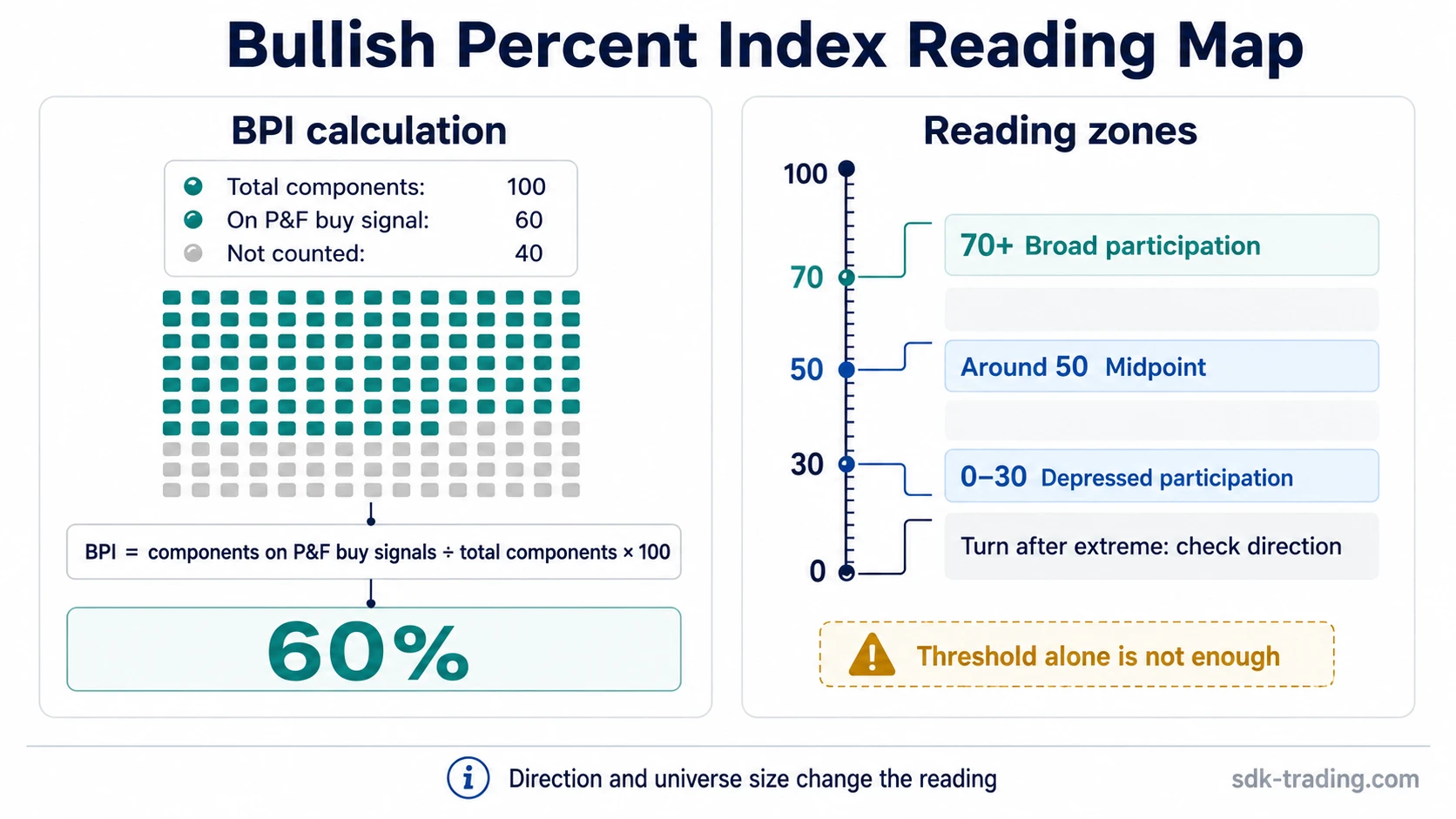
How the Bullish Percent Index Is Calculated
BPI divides the number of components on Point & Figure buy signals by the total number of components in the selected universe, then multiplies the result by 100.
| Calculation part | What it represents | Why it matters |
|---|---|---|
| Numerator | Components currently on Point & Figure buy signals | Determines how many components are counted as bullish participation. |
| Denominator | Total eligible components in the selected index, sector, or group | Defines the universe being measured. |
| BPI reading | Numerator ÷ denominator × 100 | Expresses participation as a percentage from 0 to 100. |
If 60 of 100 eligible components are on Point & Figure buy signals, BPI is 60. That reading describes participation across the group. It does not measure how far the index price has moved or how strong each individual component is.
How Point & Figure States Feed Into BPI
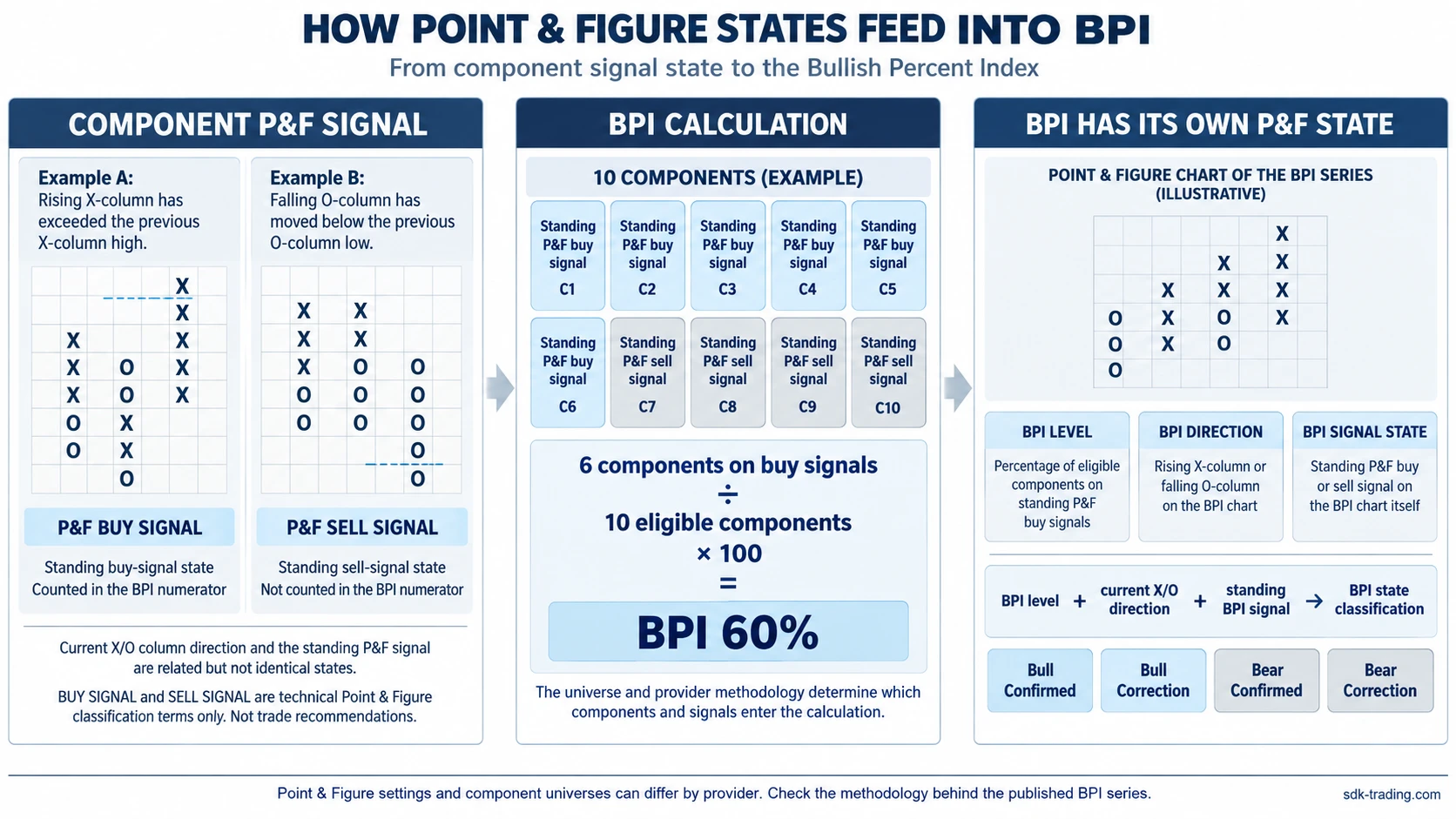
A basic Point & Figure buy signal occurs when a rising X-column exceeds the high of the previous X-column. A basic sell signal occurs when a falling O-column drops below the low of the previous O-column. The latest standing buy or sell signal determines whether a component is included in the BPI numerator.
That component-level state is separate from the direction of the BPI itself. When BPI is plotted as a Point & Figure series, the BPI can be rising in an X-column or falling in an O-column while its own standing Point & Figure signal remains either a buy or a sell signal. This distinction is what produces the classic BPI state framework.
| Layer | What it describes | What changes it |
|---|---|---|
| Component P&F signal | The standing buy or sell signal for an individual component | A qualifying Point & Figure breakout or breakdown under the provider’s construction rules |
| BPI level | The percentage of eligible components currently on buy signals | Changes in the number of components counted in the numerator |
| BPI column direction | Whether the BPI’s own Point & Figure chart is currently rising in Xs or falling in Os | A sufficient reversal in the BPI series under the provider’s P&F settings |
| BPI signal state | The BPI’s standing Point & Figure buy or sell signal | A breakout above a prior X-column high or breakdown below a prior O-column low on the BPI chart |
StockCharts ChartSchool and AAII both describe the component buy/sell logic and the classic BPI state framework. StockCharts also notes that published BPI values can differ across providers because component lists, price data, and construction conventions are not necessarily identical. Compare BPI series only after checking the provider’s universe and methodology.
Classic BPI State Framework
StockCharts describes six common BPI states by combining the BPI level, its current X/O column direction, and its own standing Point & Figure signal. These labels classify breadth condition. They are not automatic trade instructions.
| State | BPI condition | Interpretation |
|---|---|---|
| Bull Alert | BPI is below 30 and reverses into a rising X-column | Participation has started to improve from a depressed breadth area. |
| Bear Alert | BPI is above 70 and reverses into a falling O-column that moves back below 70 | Participation has started to deteriorate from an elevated breadth area. |
| Bull Confirmed | BPI is on a Point & Figure buy signal and in a rising X-column | The standing BPI buy signal and current direction agree. |
| Bear Confirmed | BPI is on a Point & Figure sell signal and in a falling O-column | The standing BPI sell signal and current direction agree. |
| Bull Correction | BPI remains on a Point & Figure buy signal but is in a falling O-column | Breadth is pulling back while the prior BPI buy signal remains active. |
| Bear Correction | BPI remains on a Point & Figure sell signal but is in a rising X-column | Breadth is improving while the prior BPI sell signal remains active. |
How to Read 30, 50, and 70
The 30, 50, and 70 areas are common BPI reference zones. A threshold describes breadth condition at that moment. The current direction and state show whether participation is expanding, contracting, or reversing.
| BPI area | What the level says | What to check next |
|---|---|---|
| Below 30 | Fewer than 30% of the selected components are on P&F buy signals. This area is commonly described as depressed or oversold breadth. | Check whether BPI remains in an O-column or has reversed into a new X-column. |
| Around 50 | About half of the selected components are on P&F buy signals. | Check whether participation is moving above or below the midpoint and whether the BPI state agrees with that direction. |
| Above 70 | More than 70% of the selected components are on P&F buy signals. This area is commonly described as elevated or overbought breadth. | Check whether participation continues to expand or reverses into a falling O-column. |
BPI Versus Other Breadth Indicators
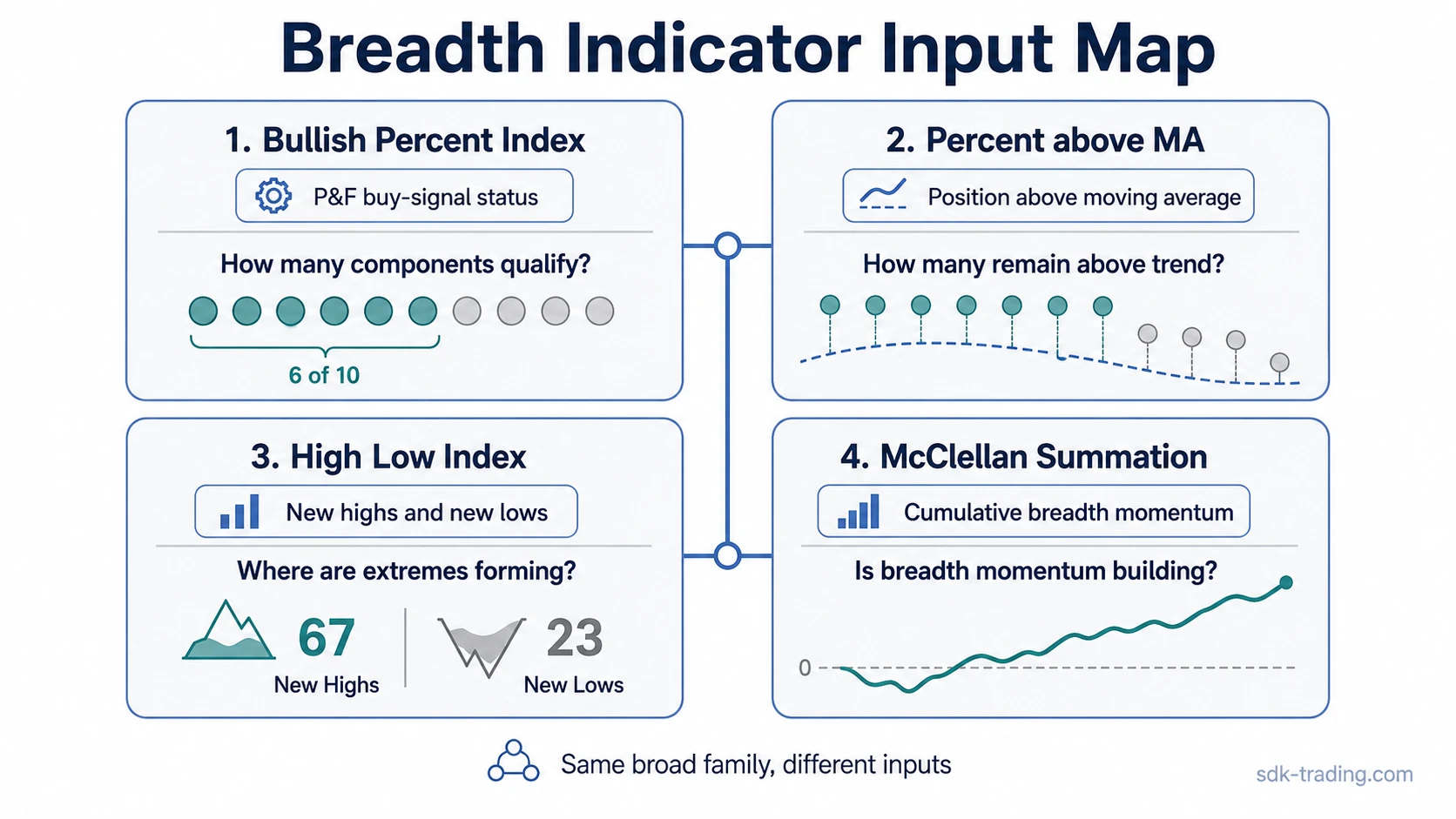
Breadth indicators can produce similar-looking percentages while measuring different inputs. BPI uses standing Point & Figure signal state, so it should be compared with other breadth tools by input rather than by output scale alone.
| Indicator | Main input | Core question |
|---|---|---|
| Bullish Percent Index | Components on Point & Figure buy signals | How widely is the P&F buy-signal state distributed across the selected universe? |
| Percent of Stocks Above 200 Day Moving Average | Components above a long moving average | How many stocks remain above a long-term trend reference? |
| Advance-decline ratio | Advancing issues versus declining issues | How broad is the current session or period movement? |
| High Low Index | New highs and new lows | Are more components making strength or weakness extremes? |
| McClellan Summation Index | Cumulative breadth momentum | Is breadth momentum accumulating or fading over a longer sequence? |
Limitations of the Bullish Percent Index
BPI can remain elevated or depressed for an extended period, and smaller universes can move more sharply when only a few components change state. Index membership, source data, and Point & Figure construction conventions can also affect comparisons across providers or long time spans. Price and breadth may diverge, so the BPI reading should be interpreted as participation evidence rather than a complete market-direction conclusion.