The Zweig Breadth Thrust is a stock market breadth indicator that tracks a rapid shift in advancing-stock participation. The commonly cited test looks for the 10-day moving average or exponential moving average of advancing issues divided by advancing plus declining issues to move from below 40% to above 61.5% within 10 trading days.
Definition: A Zweig Breadth Thrust is a completed breadth threshold event where participation expands quickly enough to move from a deeply weak reading to a broad participation reading within a short time window.
The reading belongs to the broader family of stock market participation indicators. Its value comes from the speed and breadth of the participation shift, not from a price forecast or trade instruction.
Key Points
- Zweig Breadth Thrust tracks how quickly advancing-stock participation improves.
- The common trigger requires a move from below 40% to above 61.5% within 10 trading days.
- A developing setup is not the same as a completed threshold event.
- The reading becomes less durable if participation narrows quickly after completion or if the measured universe does not match the market claim.
What Is the Zweig Breadth Thrust?
The Zweig Breadth Thrust measures whether a broad group of stocks has shifted from weak participation to strong participation quickly. It starts with the share of advancing issues compared with total advancing and declining issues, then smooths that participation reading over a short window.
The indicator is named after Martin Zweig and is usually discussed as a rare breadth event because both conditions must happen together: the reading must fall below the lower threshold, then recover above the upper threshold within the required time window. A market can show better breadth without completing a Zweig Breadth Thrust.
A completed threshold event is still a classification test, not a prediction. The interpretation becomes more useful when broad participation persists after the threshold is crossed and less durable when breadth narrows quickly afterward.
How the Zweig Breadth Thrust Is Calculated
The calculation begins with advancing issues as a share of advancing plus declining issues. That raw participation input is closely related to the advance-decline ratio, but the Zweig Breadth Thrust adds a smoothing rule, a lower threshold, an upper threshold, and a time limit.
In plain terms, the input is advancing issues divided by advancing plus declining issues, then smoothed and tested against the lower threshold, upper threshold, and time window.
| Calculation element | What it measures | Why it matters |
|---|---|---|
| Advancing issues | Stocks that closed higher during the measured period | Shows how many constituents are participating on the upside |
| Advancing plus declining issues | The active breadth universe used for the calculation | Keeps the reading tied to participation, not only price index movement |
| 10-day smoothing | A short moving average or exponential moving average of the participation ratio | Filters one-day noise while still preserving the speed of the shift |
| Lower threshold | Below 40% | Marks the weak participation starting condition |
| Upper threshold | Above 61.5% | Marks the broad participation completion condition |
| Time window | Within 10 trading days | Separates a fast breadth thrust from a slow breadth improvement |
The smoothing convention should be checked before comparing readings from different charting platforms or data vendors. Some references describe a 10-day moving average, while others use a 10-day exponential moving average. The interpretation should stay tied to the same formula, exchange universe, and threshold convention throughout the comparison.
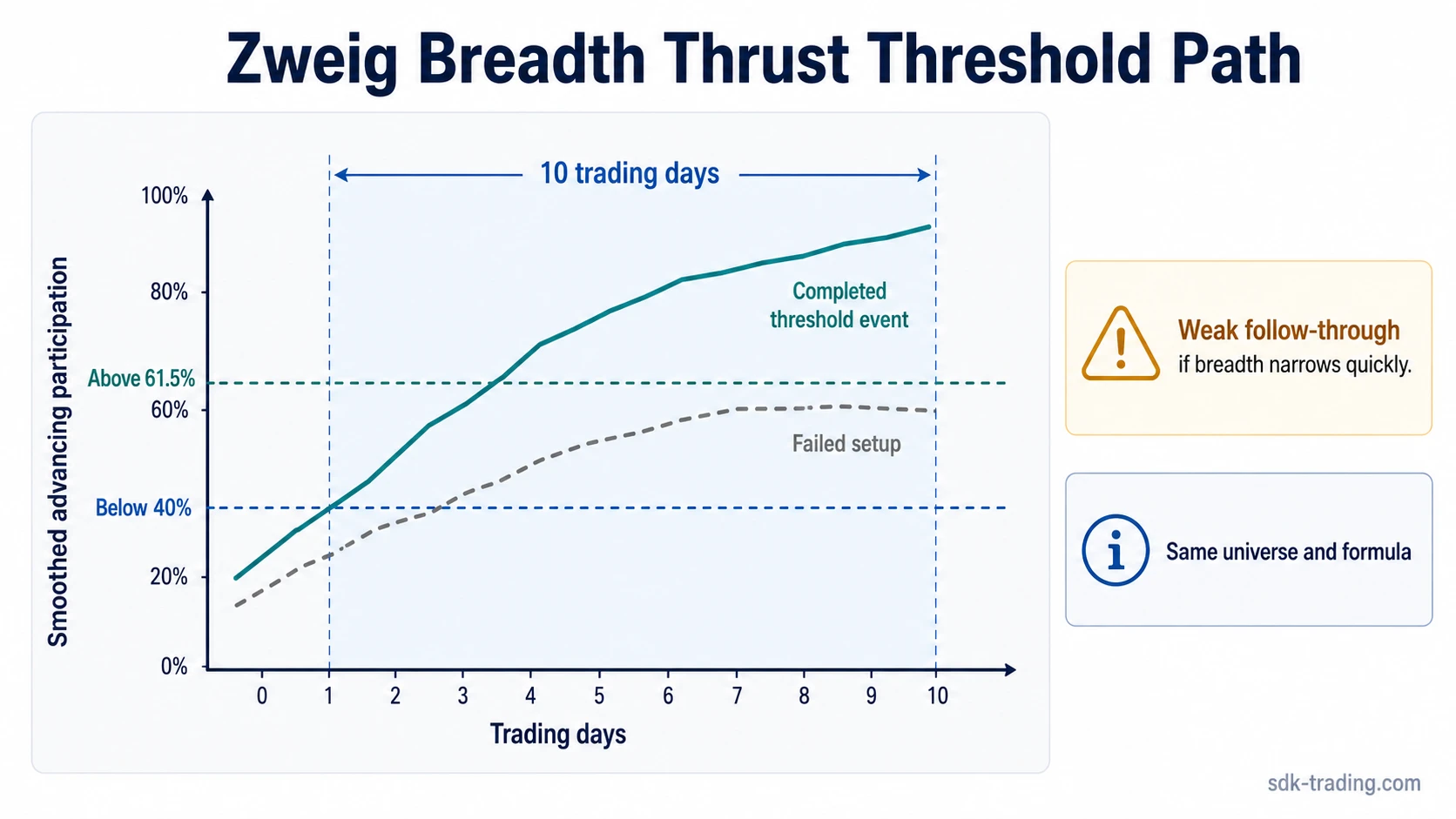
Completed Event vs Developing Setup
The most important boundary is whether the full threshold event has completed. A move below 40% creates only the starting condition. A later improvement above 61.5% matters only if it occurs inside the required 10-trading-day window.
| State | What happened | Safer interpretation |
|---|---|---|
| Developing setup | The smoothed participation reading has moved below 40% | Breadth is weak enough to create a possible starting condition, but no thrust has completed |
| Completed threshold event | The reading moves from below 40% to above 61.5% within 10 trading days | Participation has expanded quickly enough to meet the classic Zweig Breadth Thrust test |
| Failed setup | The reading improves but does not cross 61.5% in time | Breadth improved, but the completed ZBT classification is not supported |
| Questionable comparison | The thresholds are applied to a different universe or formula | The reading may not be comparable to the claimed market or historical reference |
The classification is incomplete if the lower threshold is reached but the upper threshold is not crossed within the required window. It also becomes less reliable when participation contracts soon after completion, because the initial burst did not translate into sustained breadth.
Clean, Weak, and Invalid Readings
A Zweig Breadth Thrust reading is not judged only by whether a number crossed a line. The cleaner reading is the one where the threshold event, the calculation universe, and the follow-through behavior all point in the same direction.
| Reading type | Diagnostic behavior | Interpretation boundary |
|---|---|---|
| Clean reading | The indicator moves from below 40% to above 61.5% within 10 trading days, and breadth remains broad afterward | The threshold event is complete and participation follow-through supports the reading |
| Weak completion | The threshold event completes, but participation narrows quickly after the move | The classification may still be valid, but the interpretation is less durable |
| Developing improvement | The reading rises sharply from weak levels but does not cross 61.5% in time | Breadth improved, but the classic ZBT condition is incomplete |
| Invalid reading | The lower threshold was not reached, the upper threshold was not crossed in time, or the data universe changed | The Zweig Breadth Thrust label is not supported by the full test |
The source universe matters. A reading based on one exchange, one stock universe, or one vendor’s constituent set should not be used as proof for a different market universe without checking whether the inputs match.
Common Misreadings of the Zweig Breadth Thrust
Common mistake: Treating a sharp improvement in breadth as a completed Zweig Breadth Thrust before the upper threshold is crossed inside the required window.
Another mistake is treating the indicator as a price trend trigger. The indicator measures participation, not entries, exits, targets, or stop placement. A price index can rise while participation remains narrow, and participation can improve before price structure has fully resolved.
A third mistake is treating rarity as a forecast. The event is rare because the threshold path is demanding. Rarity does not remove the need to check formula consistency, breadth follow-through, and whether the market being discussed matches the measured universe.
The strongest use is classification: weak participation, rapid participation recovery, completed threshold behavior, and later breadth follow-through. The weakest use is threshold-only interpretation with no check on participation quality after the event.
Zweig Breadth Thrust vs Related Breadth Indicators
Zweig Breadth Thrust overlaps with other breadth tools because they all study participation. The distinction is that ZBT is a specific two-threshold event, while related indicators usually measure broader participation, smoothing, new highs and lows, or pressure balance in different ways.
| Indicator or concept | Main focus | How it differs from Zweig Breadth Thrust |
|---|---|---|
| Advance-decline ratio | Raw advancing versus declining participation | ZBT uses the participation input but adds smoothing, thresholds, and a time-window condition |
| McClellan Summation Index | Smoothed breadth momentum over a broader sequence | McClellan Summation Index tracks smoothed breadth differently and does not use the same two-threshold ZBT event rule |
| Market breadth | General participation across a stock universe | ZBT is one named breadth event inside the wider participation toolkit |
| High-low index | New highs versus new lows | It focuses on leadership and deterioration through new extremes, not the ZBT 40% to 61.5% thrust path |
| Bullish percent index | Point-and-figure participation | It measures a different participation framework and does not classify the same rapid breadth thrust event |
| TRIN | Advancing and declining issues compared with volume pressure | It combines issue count and volume pressure, while ZBT focuses on advancing-stock participation through fixed thresholds |
Zweig Breadth Thrust Example in Context
Breadth falls sharply enough for the smoothed participation reading to move below 40%. Over the next several sessions, more stocks begin advancing and the reading climbs quickly. The improvement looks important because participation has shifted away from deeply weak conditions.
If the reading fails to move above 61.5% within 10 trading days, the move remains a breadth improvement rather than a completed Zweig Breadth Thrust. If it crosses the upper threshold in time but participation narrows again soon after, the event may still be classified as complete, but the interpretation becomes weaker.
The stronger classification is a completed threshold event followed by continued broad participation across the same measured universe.
FAQ
What does the Zweig Breadth Thrust measure?
The Zweig Breadth Thrust measures a rapid improvement in advancing-stock participation. The common test looks for the smoothed advancing-issues ratio to move from below 40% to above 61.5% within 10 trading days.
Is a developing setup the same as a completed Zweig Breadth Thrust?
No. A developing setup begins when the smoothed participation reading falls below 40%, but the completed event requires a move above 61.5% within the required 10-trading-day window.
Why can a completed Zweig Breadth Thrust reading weaken?
The reading can weaken if participation narrows quickly after the upper threshold is crossed, or if the calculation universe does not match the market being discussed.
Does the Zweig Breadth Thrust use price or breadth data?
It uses breadth data. The input is based on advancing issues as a share of advancing plus declining issues, then smoothed and tested against the 40% and 61.5% thresholds.