A key reversal is a price-action pattern where the market briefly extends beyond a prior high or low, fails to hold that extension, and closes back against the attempted continuation.
The common mistake is treating any large opposite candle as a key reversal. The reading depends on structure: a prior directional move, a visible reference extreme, failed acceptance beyond that extreme, and a close that rejects the attempt.
A key reversal can mark a pressure change, but it is not a standalone trading signal. Later behavior still matters because price can re-accept the broken extreme or remain trapped inside congestion.
What Is a Key Reversal?
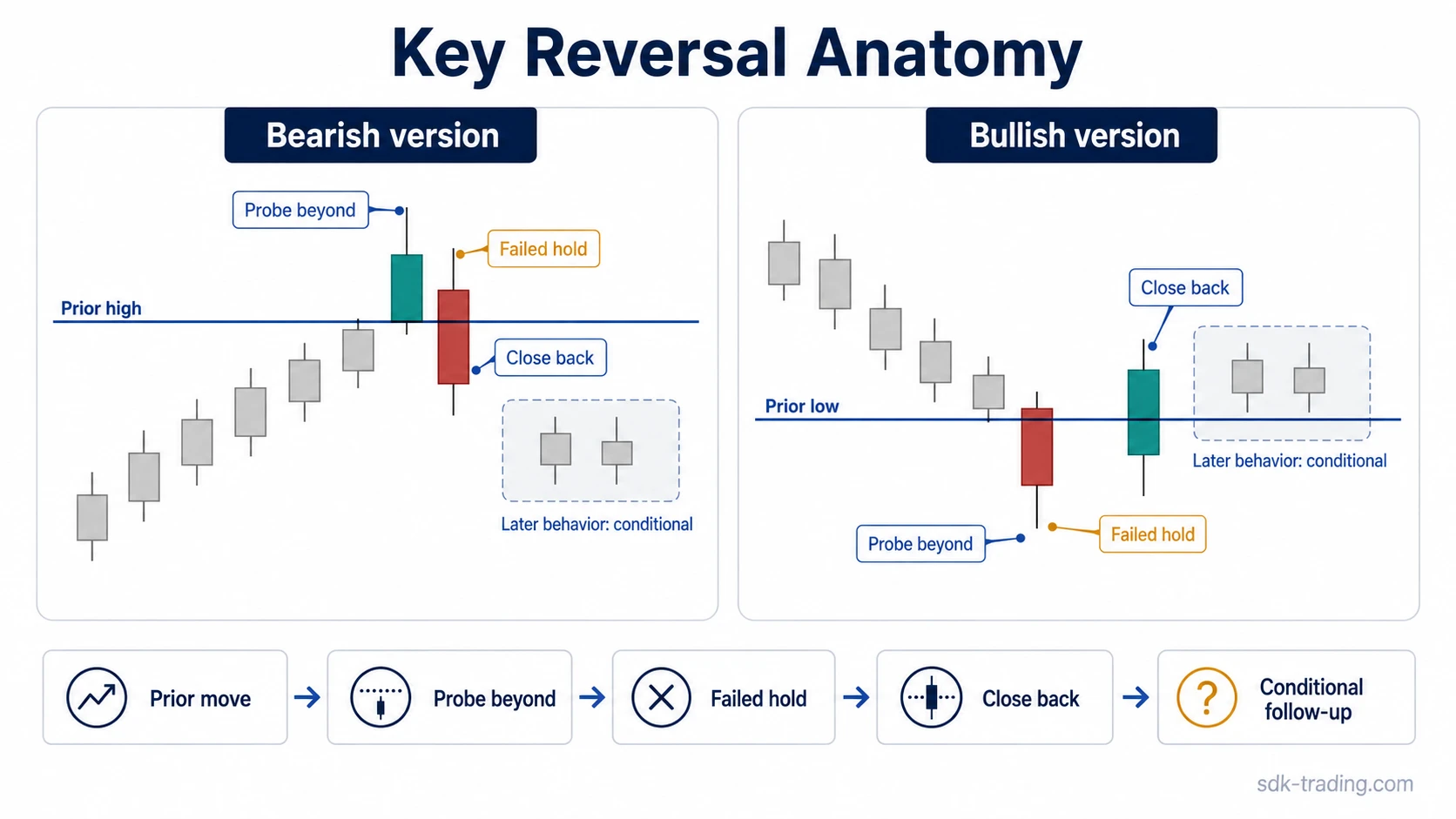
A key reversal is a chart-reading pattern built around failed continuation. Price first pushes beyond a prior extreme, creating the appearance of continuation, then closes back in the opposite direction before the candle or bar is complete.
In a bullish version, the market moves below a prior low and then closes back upward. In a bearish version, the market moves above a prior high and then closes back downward. The important feature is not the candle size alone, but the failed attempt to remain beyond the reference point.
Because it depends on a prior high or low, a key reversal belongs to price action and market structure analysis rather than to a mechanical indicator formula.
How a Key Reversal Forms
A key reversal usually starts after a directional move has made continuation look plausible. Price then pushes through a visible reference point, such as a prior swing high or prior swing low.
The extension becomes important only if acceptance fails. A bearish key reversal near a prior high often appears when price trades above the reference area, cannot remain there, and closes back below it. When that reference area is overhead, the surrounding resistance context can affect how meaningful the rejection is.
The same logic works in reverse for a bullish key reversal. Price probes below a prior low, fails to continue lower, and closes back above the reference area. The close changes the reading from simple extension to rejected continuation.
| Step | What happens | Why it matters |
|---|---|---|
| 1. Prior move | Price has already been moving in one direction. | The pattern needs a continuation attempt to fail. |
| 2. Break of prior extreme | Price moves beyond a prior high or prior low. | The market tests whether continuation can gain acceptance. |
| 3. Failed hold | Price cannot remain beyond the reference extreme. | The extension starts to look like a rejected probe. |
| 4. Opposite close | The candle or bar closes back against the attempted continuation. | The close creates the key reversal reading. |
| 5. Later behavior | Price either follows through, stalls, or re-accepts the extreme. | The reading remains conditional until structure confirms or weakens it. |
Key Reversal Criteria
The strongest key reversal readings combine required structure with supporting context. The required criteria define the pattern. Context-strengtheners help separate a cleaner reading from a weak or random candle.
A practical reading starts by separating what must happen from what only adds context. The pattern needs the failed break and opposite close; wider range, stronger location, volume, and follow-through only affect how clean the reading looks.
| Element | What to look for | Why it matters | Required or context-strengthener |
|---|---|---|---|
| Prior directional move | A visible push into a new high or new low area. | A key reversal needs a continuation attempt to reject. | Required |
| Prior high or prior low | A clear reference extreme that price can move beyond. | The reversal reading depends on failed acceptance past a known point. | Required |
| Break beyond the extreme | Price trades above the prior high or below the prior low. | The move tests continuation rather than only reacting inside range. | Required |
| Close back against the break | The candle closes back below the prior high or above the prior low. | The close shows that the extension did not hold into settlement of the bar. | Required |
| Readable candle structure | A range and close that clearly show rejection rather than noise. | The pattern is easier to interpret when the rejection is visible. | Required |
| Wide range | The candle is larger than nearby candles. | A wider range can show a stronger attempt and rejection. | Context-strengthener |
| Meaningful location | The pattern appears after extension, not in the middle of congestion. | Location helps prevent random candles from being overclassified. | Context-strengthener |
| Volume expansion | Participation increases during the failed extension. | Volume can add context, but it does not prove reversal by itself. | Context-strengthener |
| Follow-through | Later candles do not immediately re-accept the broken extreme. | The reading weakens if price quickly returns beyond the reversal bar extreme. | Context-strengthener |
Bullish vs Bearish Key Reversal
Bullish and bearish key reversals use the same failed-acceptance logic, but the prior context and close direction are opposite.
| Type | Prior context | Failed extension | Close behavior | Neutral interpretation |
|---|---|---|---|---|
| Bullish key reversal | Price has been moving lower or pressing into a downside extreme. | Price trades below a prior low but does not hold below it. | The candle closes back upward, often above the prior low or near the upper part of the range. | Downside continuation was attempted but rejected during the bar. |
| Bearish key reversal | Price has been moving higher or pressing into an upside extreme. | Price trades above a prior high but does not hold above it. | The candle closes back downward, often below the prior high or near the lower part of the range. | Upside continuation was attempted but rejected during the bar. |
A bullish key reversal does not prove that a down move has ended. A bearish key reversal does not prove that an up move has ended. Each reading only identifies a failed extension that needs context and later confirmation.
Clean, Weak, and Invalid Key Reversal Readings
The useful distinction is not “key reversal or no key reversal” in isolation. A cleaner reading has a visible structural reason, while a weak reading may be only a noisy candle inside unresolved movement.
| Reading | Typical features | Interpretation boundary |
|---|---|---|
| Clean reading | Meaningful prior extension, clear break of a known extreme, strong rejection close, and supportive context. | The failed extension is visible enough to treat as a meaningful change in pressure, while still remaining conditional. |
| Weak reading | Small marginal probe, congestion, unclear prior extreme, narrow range, or no later follow-through. | The candle may be a normal fluctuation rather than a meaningful failed continuation. |
| Invalid / false-positive reading | Immediate re-acceptance beyond the reversal bar extreme, no structure shift, or continuation resumes quickly. | The market did not reject the extension strongly enough for the reversal reading to hold. |
Key Reversal vs Nearby Concepts
A key reversal overlaps with nearby price-action ideas, but it is not identical to every rejection candle or failed breakout. The boundary is the combination of a prior extreme, a probe beyond it, and a close back against the attempted continuation.
| Concept | Main focus | How it differs from a key reversal |
|---|---|---|
| Rejection candle | Visible rejection within a candle. | A rejection candle can occur without breaking a prior high or low first. |
| Failed breakout | A breakout attempt that cannot hold outside a range or level. | A failed breakout can involve broader range structure, while a key reversal is tied to a failed extension beyond a prior high or low. |
| Exhaustion candle | A strong final-looking move after extended pressure. | Exhaustion emphasizes late-stage effort; a key reversal emphasizes failed acceptance beyond a reference extreme. |
| Reversal setup | A broader decision framework for changing directional bias. | A key reversal can be one input inside a reversal strategy framework, but it is not a complete framework by itself. |
Common Key Reversal Mistakes
The most common mistake is labeling a large opposite candle as a key reversal without checking whether it actually broke and rejected a prior extreme. Size alone does not define the pattern.
Another mistake is ignoring the next bars. If price immediately accepts back beyond the reversal bar extreme, the failed-continuation reading weakens. The pattern is a starting observation, not a final conclusion.
A third mistake is treating volume, location, or range size as proof. These details can strengthen the reading, but the core structure still depends on the break, failed hold, and close back through the reference area.
Key Reversal FAQ
What is a key reversal?
A key reversal is a price-action pattern where price briefly moves beyond a prior high or low, fails to hold that extension, and closes back against the attempted continuation.
Is a key reversal bullish or bearish?
A key reversal can be bullish or bearish. A bullish version rejects a move below a prior low and closes back upward. A bearish version rejects a move above a prior high and closes back downward.
Does volume have to increase for a key reversal?
No. Volume expansion can strengthen the context because it may show stronger participation during the failed extension, but the pattern is still defined by price structure and close behavior.
When does a key reversal fail?
A key reversal reading weakens when price quickly re-accepts the broken high or low, fails to shift structure, or remains trapped inside congestion without meaningful follow-through.
How is a key reversal different from a failed breakout?
A failed breakout usually describes a breakout attempt beyond a broader level or range. A key reversal is narrower: it focuses on a failed extension beyond a prior high or low and the close back against that extension.