A reversal trading strategy is a framework for judging whether a prior directional move is losing control and whether opposite-side acceptance is developing. The useful sequence is prior move, exhaustion or context test, failed continuation, opposite acceptance, and a failure path if the structure does not follow through.
Definition: A reversal trading strategy is a conditional price-action framework for reading a possible control shift after an existing move. It organizes evidence around exhaustion, failed continuation, acceptance in the opposite direction, and invalidation. It is not an automatic trade signal or a fixed entry plan.
The framework separates a real control shift from a pause, retracement, range, or failed counter-move. A reversal reading becomes more defensible only when later structure supports a change in control rather than a normal pullback inside the prior move.
Key Points
- A reversal reading starts with a prior directional move, not with a single candle or indicator reading.
- Exhaustion matters only if continuation begins to fail and opposite-side acceptance starts to appear.
- A pullback can move against the prior direction without becoming a full reversal.
- Confirmation should be read as a stack of evidence, not as proof that the next move is guaranteed.
- Invalidation is the point where the reversal interpretation no longer fits the observed structure.
What a Reversal Trading Strategy Means
A reversal trading strategy treats a possible reversal as a sequence problem. The prior side first needs to show weakening control, then the opposite side needs to show enough acceptance to make continuation less likely. Without both parts, the move may still be a pause, a retracement, or a failed counter-move.
The framework separates a reversal reading from a trade instruction. A reading asks whether the structure is changing. A trade instruction would specify entries, exits, stops, targets, or sizing. Those tactical details are outside the scope of a neutral reversal-reading framework because the same structure can appear across different markets, timeframes, and risk contexts.
Sequence principle: A weakening trend is not the same as a confirmed reversal. The opposing side needs to appear in price behavior before the reversal reading has enough structure to stand on.
The sequence also prevents premature top- or bottom-calling. A market can look extended and still continue. A market can reject a level and still return to the prior trend. The reversal question becomes cleaner only after failed continuation and opposite acceptance are visible together.
Reversal vs Pullback vs Retracement
A pullback or retracement is a counter-move inside an existing directional structure. A reversal is a broader change in control. The difference is not the size of one candle or the presence of a popular pattern. The difference is whether the prior direction loses acceptance and whether the opposite direction begins to hold structure.
| Situation | Structural meaning | What weakens the reversal reading |
|---|---|---|
| Pullback | Price moves against the prior direction but remains inside the broader trend structure. | The prior trend resumes with acceptance and the counter-move fails to change swing behavior. |
| Retracement | Price gives back part of the prior move without proving that control has changed. | The move only corrects distance or volatility and does not create opposite-side acceptance. |
| Possible reversal | Continuation weakens, a reference area fails, and the opposite side begins to hold acceptance. | The move cannot hold beyond the reference area or quickly returns to the prior direction. |
| False reversal | Early evidence looks like a control shift, but later behavior does not support the change. | Follow-through fails, acceptance disappears, or the prior trend absorbs the counter-move. |
The distinction matters because a normal pullback can look dramatic while still respecting the prior structure. A reversal reading requires more than a counter-move. It needs evidence that the old directional logic is losing acceptance and that new behavior is being accepted by the market.
The Reversal Sequence
A reversal sequence is easier to read as a scenario tree than as a list of signals. Each stage either adds evidence to the reversal reading or redirects the interpretation toward pullback, range, fakeout, or noise.
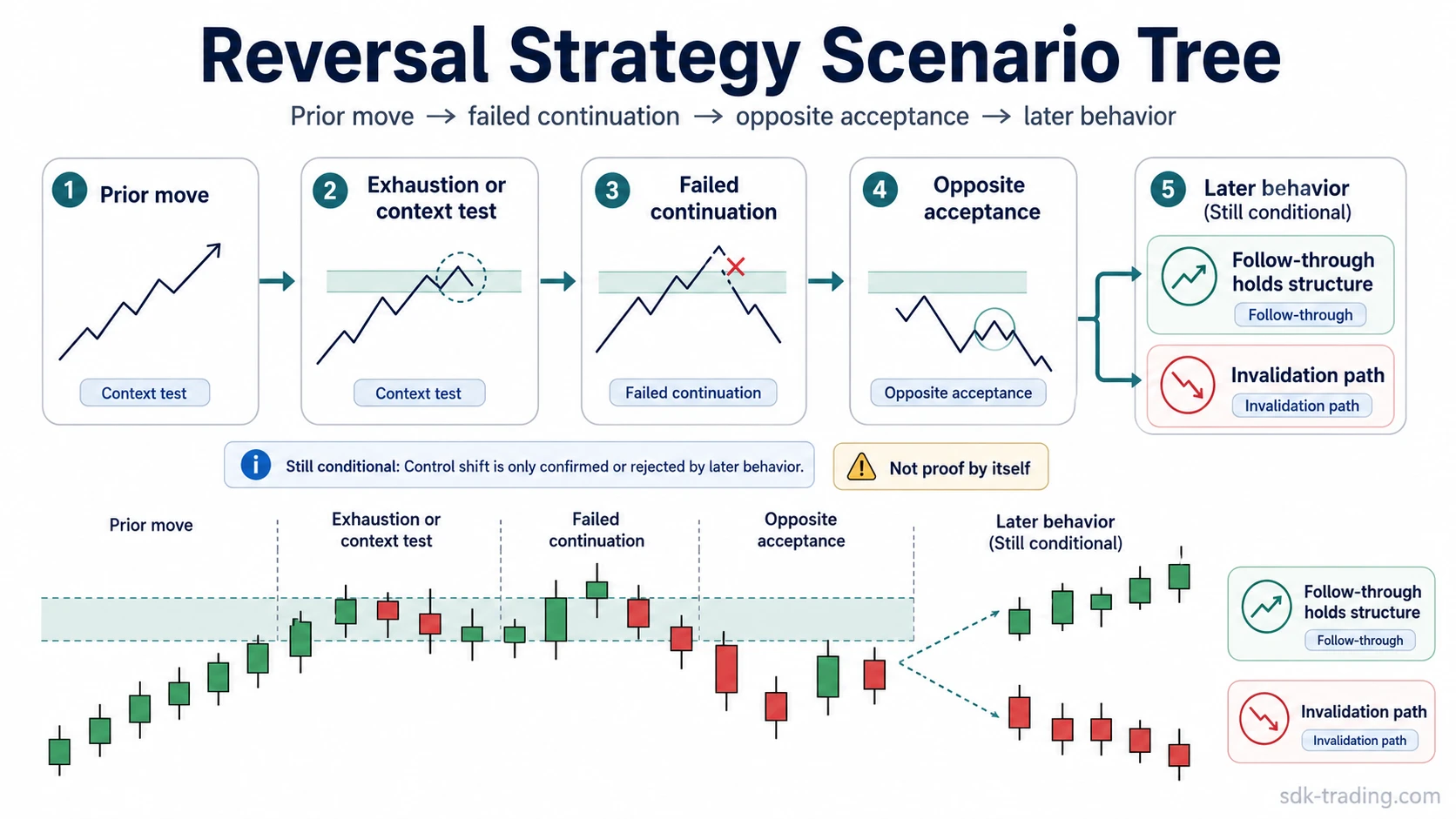
- Prior directional move: A visible trend, impulse, or directional leg creates the context. Without a prior move, there is little to reverse.
- Exhaustion or context test: Price reaches a reference area, stretches away from value, slows, compresses, rejects, or begins to lose clean continuation behavior.
- Failed continuation attempt: The prior side tries to extend the move but cannot hold acceptance beyond the relevant swing, zone, or boundary.
- Opposite acceptance: Price begins to hold on the other side of the failed continuation area, or starts building structure in the opposite direction.
- Follow-through or invalidation: The reading strengthens if the new structure holds. It weakens if price quickly returns to the prior directional logic.
Failure path: If the market only rejects once and then resumes the prior direction, the sequence is not complete. A single rejection can begin the question, but later acceptance decides whether the reversal reading is still valid.
Evidence Categories Used in Reversal Reading
Reversal evidence is strongest when several categories point toward the same structural change. No single category should be treated as proof. The role of each category is to test whether continuation is weakening and whether opposite acceptance is becoming more credible.
| Evidence category | How it supports a reversal reading | Common limitation |
|---|---|---|
| Structure and swing behavior | Higher lows, lower highs, failed swing extensions, or changed reaction behavior can suggest a shift in control. | One broken swing can be a temporary disturbance rather than a durable change. |
| Support, resistance, or reference zones | A visible level gives the market a place to test acceptance, rejection, or failed continuation. | A level alone does not create a reversal; later behavior around it matters more. |
| Failed breakout or false breakout behavior | A break that cannot hold beyond a boundary can reveal failed acceptance in the prior direction. | Some failed-looking breaks later turn into real continuation if acceptance returns. |
| Inside-range failure | A failed break from a compact range can show that the first directional attempt did not gain acceptance. | The range must be clear enough for the failure to mean something structurally. |
| Break and return behavior | A breached boundary followed by a controlled return can show whether the old area has changed function. | The return can become noise if the original boundary was weak or poorly defined. |
| Volume or momentum divergence | Weakening participation or momentum can support the idea that the prior move is losing force. | Divergence, oscillator readings, or volume changes can support the reversal reading, but they do not define it by themselves without structure, acceptance, and follow-through. |
| Higher-timeframe context | Broader structure can show whether the reversal attempt is aligned with a larger boundary or only a small interruption. | A lower-timeframe reversal can fail if it fights a stronger higher-timeframe structure. |
A breakout should be treated as a question until structure and follow-through answer it. In reversal analysis, that means a break beyond a level is not enough. The market still needs to show whether the new area is accepted, rejected, or absorbed back into the prior structure.
What Makes a Reversal Reading Stronger
A stronger reversal reading usually has a visible prior move, a clear reference area, a failed continuation attempt, and opposite acceptance that does not immediately collapse. The structure does not need to be perfect, but it needs to show more than one piece of evidence.
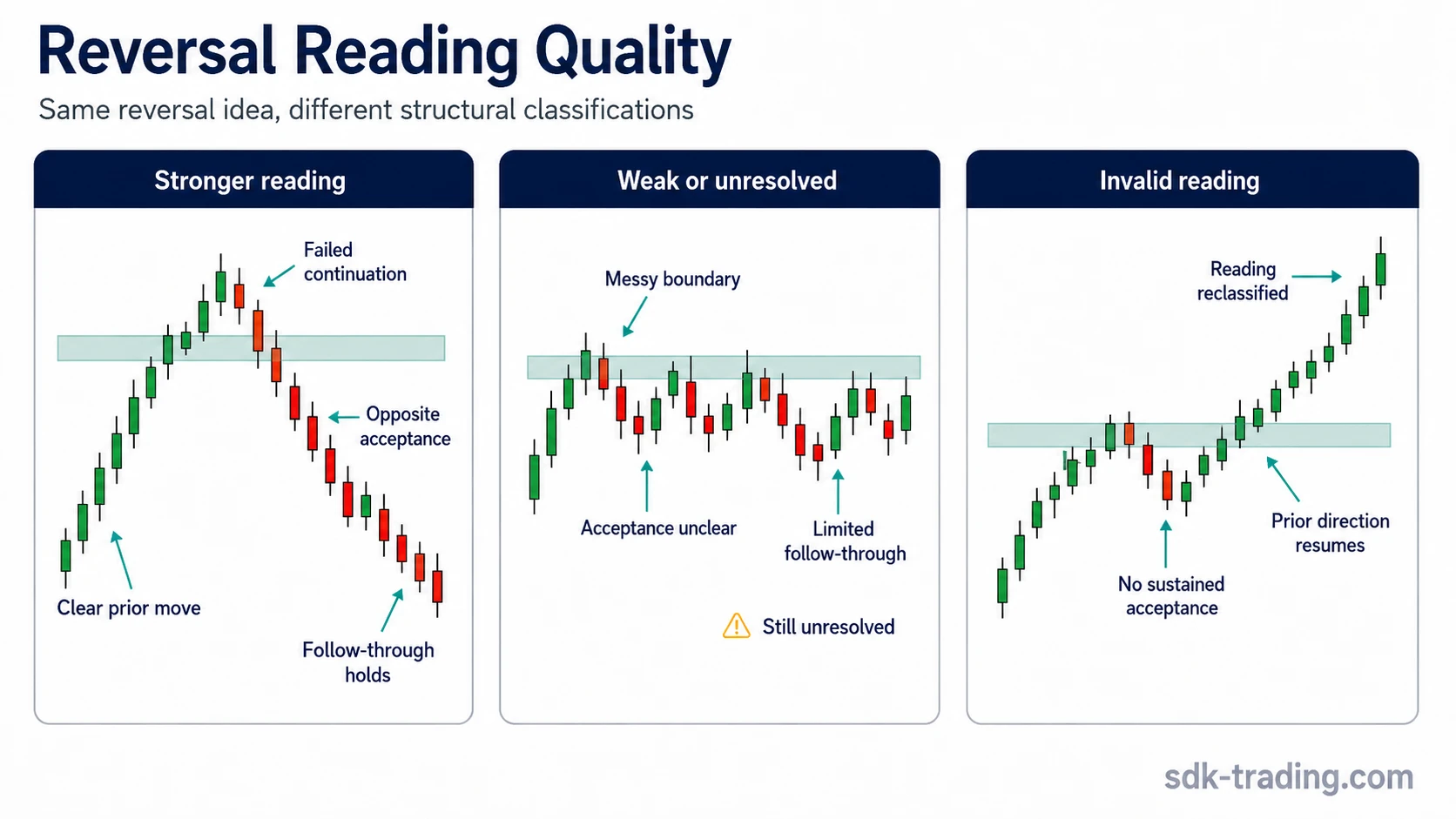
| Reading quality | Typical structure | Interpretation |
|---|---|---|
| Stronger | Clear prior move, failed extension, visible boundary interaction, opposite acceptance, and follow-through. | The reversal scenario becomes more defensible because the market has shown both prior-side weakness and opposite-side participation. |
| Weak or unresolved | Prior move is visible, but acceptance is unclear, the boundary is messy, or follow-through is limited. | The market may be pausing, ranging, or forming an early reversal attempt that still needs more structure. |
| Invalid | Price returns quickly to the prior direction, failed continuation is not visible, or the whole reading depends on one indicator. | The reversal interpretation no longer fits the observed behavior and should be reclassified. |
A common mistake is treating exhaustion as enough. Exhaustion can explain why the prior move is vulnerable, but it does not show that the other side has taken control. Opposite acceptance and later behavior carry the stronger evidence.
What Makes a Reversal Reading Weak or Invalid
A reversal reading weakens when the market has not shown a clear prior move, when the supposed reversal is only a normal pullback, or when the evidence depends on one isolated candle, wick, divergence, or indicator reading.
Invalidation boundary: Invalidation is the point where the reversal interpretation no longer matches the structure. If the prior direction regains acceptance, if the opposite move cannot hold structure, or if follow-through disappears, the reading should be treated as weakened or failed.
| Weakness | Why it matters | Safer classification |
|---|---|---|
| No clear prior move | Without a meaningful prior leg, the market may simply be rotating inside noise. | Range or low-quality structure |
| Only a normal pullback | The counter-move does not change the broader swing behavior. | Pullback or retracement |
| Break without acceptance | Price touches or exceeds a boundary but does not hold beyond it. | Probe, failed break, or unresolved test |
| Immediate return to prior direction | The prior side absorbs the reversal attempt quickly. | Failed reversal reading |
| Conflicting higher-timeframe structure | The smaller reversal attempt may be fighting a stronger broader structure. | Lower-timeframe counter-move |
| One-indicator dependence | Divergence, oscillator readings, or volume changes can support the reversal reading, but they do not define it by themselves without structure, acceptance, and follow-through. | Insufficient evidence |
Risk and Invalidation Boundaries
Risk in reversal analysis begins with classification risk. The market may not be reversing at all. It may be pulling back, ranging, trapping early participants, or preparing another continuation attempt. A clean framework keeps that uncertainty visible instead of converting early evidence into certainty.
A useful invalidation boundary is structural, not emotional. It asks what would make the reversal reading stop fitting the chart. That may be regained acceptance in the prior direction, failure to hold the new reference area, or a lack of follow-through after the supposed control shift.
Framework boundary: The reversal scenario remains conditional until price behavior supports it. If later behavior contradicts the sequence, the classification should change before the interpretation becomes forced.
This is different from a tactical stop or target. Invalidation defines when the idea no longer fits. It does not specify where to enter, exit, size, or manage a trade.
A Practical Reversal Scenario
Example scenario: Price has been moving upward in a clean sequence of higher highs and higher lows. Near a visible resistance area, the next extension pushes above the prior high but cannot hold there. Price returns below the breakout area, builds acceptance underneath it, and later attempts to reclaim the level fail. The reversal reading becomes more defensible because the prior continuation attempt failed and the opposite side began to hold structure.
If price instead breaks above the same area, returns briefly, holds the level, and continues upward, the reversal reading weakens. In that path, the move against the trend was closer to a retest or pause than a confirmed control shift.
The same logic applies in bearish-to-bullish reversals. Direction changes, but the sequence remains the same: prior move, failed continuation, opposite acceptance, and a failure path if the market cannot sustain the new structure.
Related Reversal Structures
Several price-action structures can appear inside a reversal framework. They should be treated as components of the reading rather than automatic reversal labels.
- A break and retest can help judge whether a breached area is being accepted or rejected after the first break.
- A fakey pattern can appear when an inside-range break fails and price returns back into the prior range.
- A failed breakout can support a reversal reading when the failed break occurs at a meaningful boundary and later acceptance confirms the failure.
- A prior zone changes function reading can help test whether earlier support or resistance behaves differently after a structural break.
- A hikkake pattern can reflect an inside-bar failure sequence when the first break does not hold acceptance.
The shared principle is acceptance. A setup name is less important than whether the market accepts the new structure, rejects the attempted continuation, or invalidates the reversal scenario.
FAQ
What is a reversal trading strategy?
A reversal trading strategy is a framework for evaluating whether a prior directional move is losing control and whether opposite-side acceptance is developing. It is not a guaranteed signal or fixed trade plan.
How is a reversal different from a pullback?
A pullback moves against the prior direction while the broader structure can remain intact. A reversal needs stronger evidence that prior control is weakening and the opposite direction is gaining acceptance.
What makes a reversal reading stronger?
A reversal reading becomes stronger when a clear prior move fails to continue, a meaningful boundary is rejected or reclaimed, opposite-side acceptance develops, and follow-through does not immediately collapse.
When does a reversal reading fail?
A reversal reading fails when price behavior no longer supports the control-shift idea. Common failure paths include immediate return to the prior direction, weak follow-through, unclear acceptance, or evidence that depends on one isolated signal.
Can indicators confirm a reversal?
Indicators can support a reversal reading, especially when they show weakening momentum or participation. They should be read as supporting evidence, not as standalone confirmation.