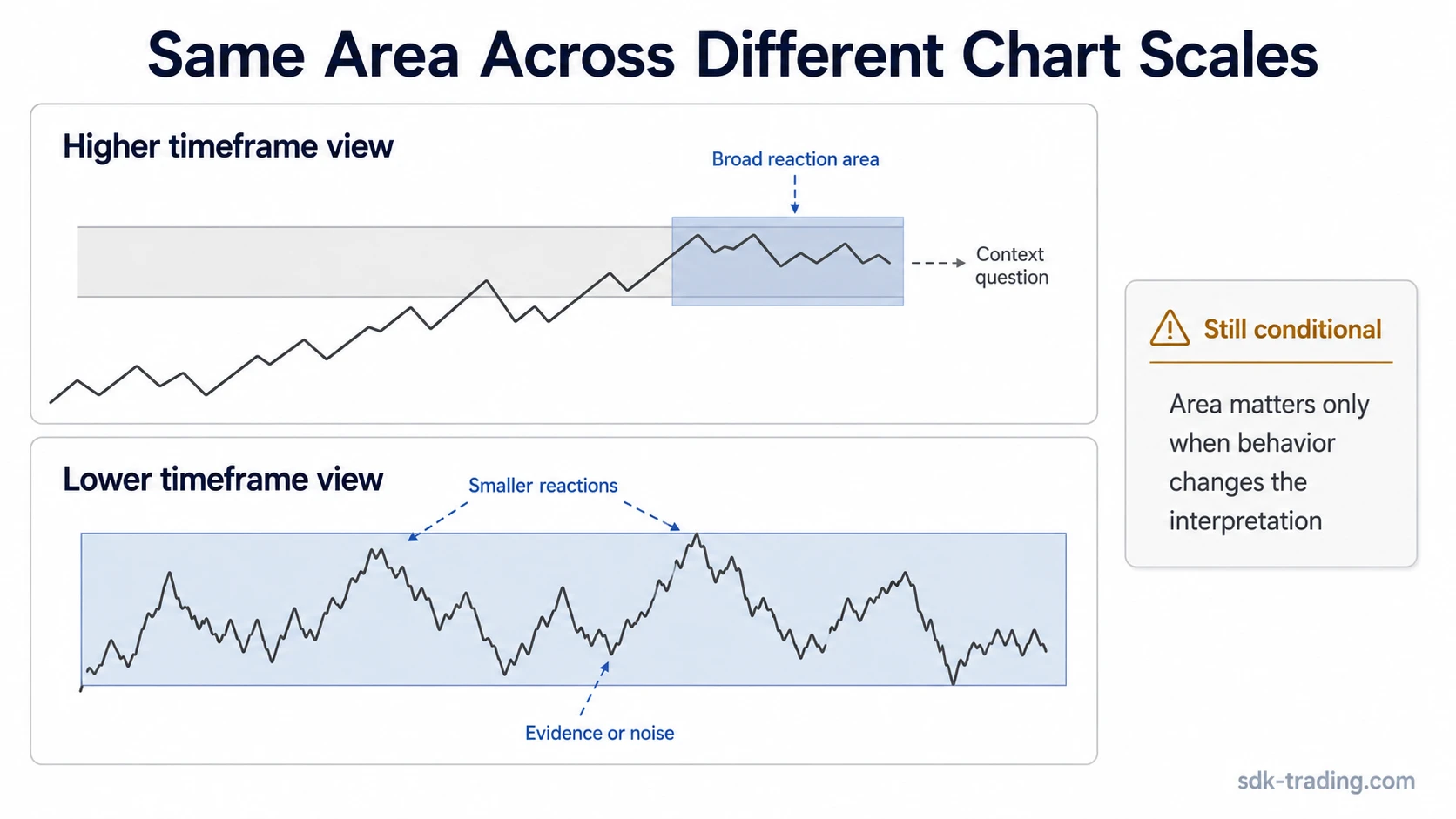
Multi timeframe analysis compares the same market across different chart scales so broader structure can be separated from shorter-term price behavior. A higher timeframe usually frames the structural question, while a lower timeframe adds detail about what price is doing inside that context.
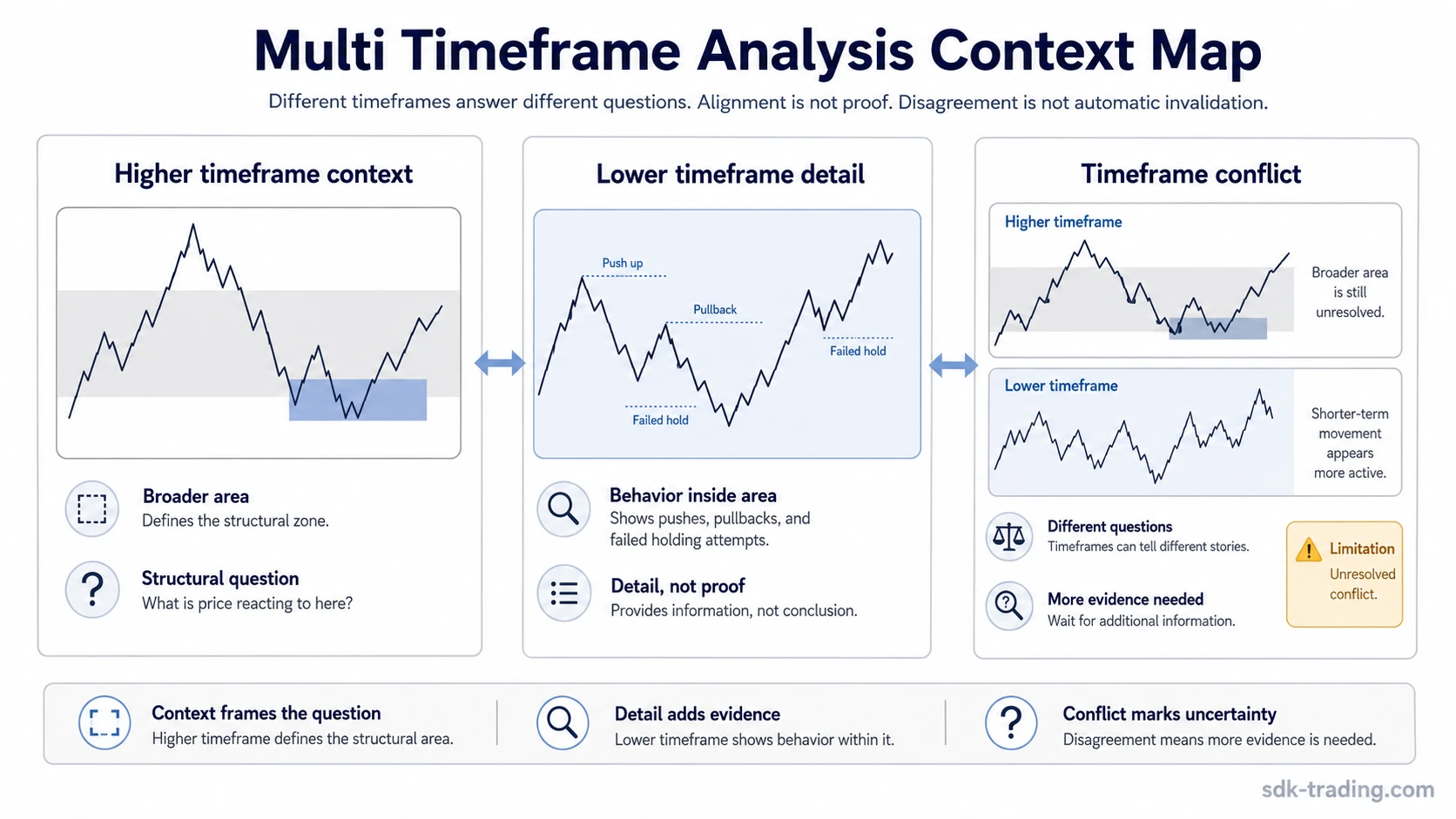
The method is useful only when each timeframe has a defined job. A larger chart is not automatically more reliable, and a smaller chart is not automatically more precise. The purpose is to organize evidence, not to keep adding charts until one supports a preferred conclusion.
Key Points
- Higher timeframes usually provide broader structural context.
- Lower timeframes can show more detailed behavior inside that context.
- A move can look important on one timeframe while remaining minor on another.
- Timeframe disagreement is normal and does not automatically invalidate either chart.
- Adding another timeframe is useful only when it changes or clarifies the structural question.
See Multi-Timeframe Analysis on a Real Stock Chart
This ServiceNow example shows why a large decline on the daily chart does not automatically mean that the larger weekly structure has broken. The higher timeframe provides the broader reference, while the daily chart shows the movement developing inside it.
The point of the example is not that the higher timeframe must always win. It is that the daily decline and the weekly structure answer different questions. The interpretation changes when price behavior materially changes the broader structural reference.
Higher Timeframe Context vs Lower Timeframe Detail
The cleanest multi-timeframe process gives each chart scale a distinct role instead of treating all timeframes as interchangeable sources of confirmation.
| Chart Scale | Useful Role | Common Misuse | Better Question |
|---|---|---|---|
| Higher timeframe | Defines the wider trend, range, reaction area, or structural boundary. | Assuming the larger chart must always be more correct. | What broader structure is price currently moving inside? |
| Lower timeframe | Shows smaller swings, acceptance, rejection, compression, or failed follow-through. | Confusing additional candles with additional reliability. | What observable behavior is developing inside the broader context? |
| Multiple timeframes | Separate context, detail, and structural conflict. | Adding charts until enough of them support the preferred view. | Does another timeframe materially change the interpretation? |
Why Different Timeframes Can Disagree
Different chart scales can tell different stories because they describe different layers of the same price movement. A weekly chart may still show an intact broad advance while the daily chart contains a significant decline. An intraday chart can contain several apparent reversals while the daily structure remains inside one larger range.
The useful question is not which timeframe is right. It is whether the smaller movement has become important enough to change the larger structural interpretation.
| Timeframe Relationship | Possible Meaning | What to Check |
|---|---|---|
| Higher and lower timeframes align | Different scales are showing compatible directional or structural behavior. | Confirm that each timeframe contributes separate evidence rather than simply repeating the same observation. |
| Higher timeframe intact, lower timeframe weak | The smaller chart may be showing a pullback or local deterioration inside a larger structure. | Identify the higher-timeframe level whose loss would materially change the broader reading. |
| Higher timeframe unclear, lower timeframe active | Shorter-term movement may appear precise while the broader context remains unresolved. | Avoid giving lower-timeframe movement more importance than the larger chart supports. |
| Lower timeframe begins changing the larger structure | The smaller movement may be developing into a broader structural shift. | Look for meaningful breaks, failed reclaims, and later swing development rather than one isolated move. |
What Makes a Timeframe Relevant?
A timeframe is relevant when it adds evidence to a specific question. It is not relevant simply because it is larger, smaller, cleaner, or more familiar.
| Structural Question | Useful Evidence | Not Enough by Itself |
|---|---|---|
| Does the higher timeframe matter here? | It defines a visible range, trend boundary, prior reaction area, or meaningful swing structure. | It is simply a weekly or monthly chart. |
| Does the lower timeframe add useful information? | It shows acceptance, rejection, compression, failed continuation, or inability to reclaim an area. | It contains more candles and therefore looks more detailed. |
| Do the timeframes really align? | Each scale contributes compatible structural evidence. | Both charts moved in the same direction for several candles. |
| Does timeframe conflict matter? | The disagreement identifies a clear uncertainty between local behavior and broader structure. | One chart simply looks more convincing than another. |
A possible key reversal area becomes more meaningful when the higher timeframe defines why the area matters and the lower timeframe shows how price is behaving there. The label remains conditional if the lower chart only shows noise, isolated candles, or one brief reaction.
How to Perform Multi-Timeframe Analysis
- Start with the structural question. Decide what you are trying to understand before changing chart scales: trend condition, range location, reaction around an important area, or a possible structural change.
- Choose a higher timeframe that frames the question. Identify the wider swing structure, range, or relevant resistance or support area.
- Define what would materially change that broader reading. The larger chart should provide a structural reference rather than only a directional opinion.
- Move to a lower timeframe only when additional detail is useful. Look for observable behavior such as acceptance, rejection, failed continuation, compression, or reclaim attempts.
- Separate local movement from broader structural change. A sharp lower-timeframe move can remain only one component of the larger chart.
- Stop adding timeframes when another chart no longer changes the interpretation. More charts do not automatically create better analysis.
Common Multi-Timeframe Analysis Mistakes
| Common Mistake | Why It Weakens the Analysis | Better Check |
|---|---|---|
| Starting with the smallest timeframe | Short-term movement can appear more important before the wider context is understood. | Define the broader structural question first. |
| Searching for a timeframe that agrees | The process becomes confirmation seeking rather than evidence gathering. | Assign a clear job to every timeframe before using it. |
| Forcing all timeframes to align | Normal local movement can look like a contradiction when different scales are answering different questions. | Identify what each disagreement actually means structurally. |
| Assuming lower timeframe means greater precision | More candles create more detail but also more noise. | Use lower-timeframe information only when it changes the wider interpretation. |
| Using too many timeframes | Additional charts create more opportunities for contradictory labels and selective interpretation. | Stop when every selected timeframe already has a distinct function. |
| Ignoring the larger structural boundary | A dramatic local move can be mistaken for a complete reversal while the broader structure remains intact. | Define in advance what would materially change the higher-timeframe reading. |
Limitations of Multi-Timeframe Analysis
Multi-timeframe analysis does not remove interpretation risk. Swing points, reaction areas, and relevant chart scales still require judgment, especially when the market is moving sideways or transitioning between structures.
The method also cannot create useful evidence where none exists. If the broader chart does not define a meaningful structural question and the lower chart only adds scattered movement, another timeframe usually adds complexity rather than clarity.
Multi-timeframe analysis is therefore best used as a context framework. It helps separate larger structure from local behavior and makes disagreement explicit, but it does not predict an outcome or confirm a trade by itself.