Liquidity grab vs liquidity sweep is a distinction between a quick local probe beyond a visible price boundary and a broader move through a liquidity area. Both readings can begin around the same high, low, or range edge, but they differ by scope, duration, and what price does after the boundary is tested.
A grab is usually read as a shorter move beyond a level that quickly returns back inside the prior area. A sweep is usually read as a wider or more sustained move through a zone, where price may linger, test acceptance, reject the area, or leave the structure unresolved.
Liquidity Grab vs Liquidity Sweep: The Core Difference
The main difference is scale and duration. A liquidity grab describes a localized probe beyond a visible high or low, often shown as a wick or brief break that does not spend much time beyond the boundary.
A liquidity sweep describes a broader move through a liquidity area, where the market interacts with more than a single point and later behavior matters more than the first touch.
Core reading: a grab is usually a quick boundary probe; a sweep is usually a broader interaction with the area beyond the boundary. Neither label is complete until later price behavior shows rejection, acceptance, or unresolved structure.
Quick Comparison Table
The table below separates the two terms by observable price-action criteria. These criteria are more useful than treating every wick as a grab or every move beyond a level as a sweep.
| Criteria | Liquidity Grab | Liquidity Sweep |
|---|---|---|
| Basic idea | A quick probe beyond a visible high, low, or boundary. | A broader move through a liquidity area or zone. |
| Typical scope | Localized around one level or one nearby boundary. | Wider interaction with an area beyond the level. |
| Typical duration | Often brief, sometimes only one candle or a short sequence. | Can involve several candles, a deeper penetration, or a longer test. |
| Candle behavior | Often appears as a wick, quick break, or fast return. | May show bodies beyond the level, repeated testing, or a broader push. |
| Relationship to level or zone | Usually centered on a specific visible high or low. | Usually concerns the area around and beyond that boundary. |
| Later behavior | The reading is stronger if price rejects the probe quickly. | The reading depends on whether price rejects, accepts, or remains unresolved beyond the area. |
| Structural meaning | Suggests a brief test of orders around the boundary, not a full structural shift by itself. | Suggests a broader boundary interaction that may need more follow-through to interpret. |
| Main mistake | Calling every wick a grab without checking context. | Calling every break a sweep without checking duration, acceptance, and later behavior. |
Same Boundary, Different Reading
Imagine price moving toward a visible prior high. Traders may watch that high because resting orders can cluster around obvious boundaries. The same boundary can produce two different readings depending on how price behaves after crossing it.
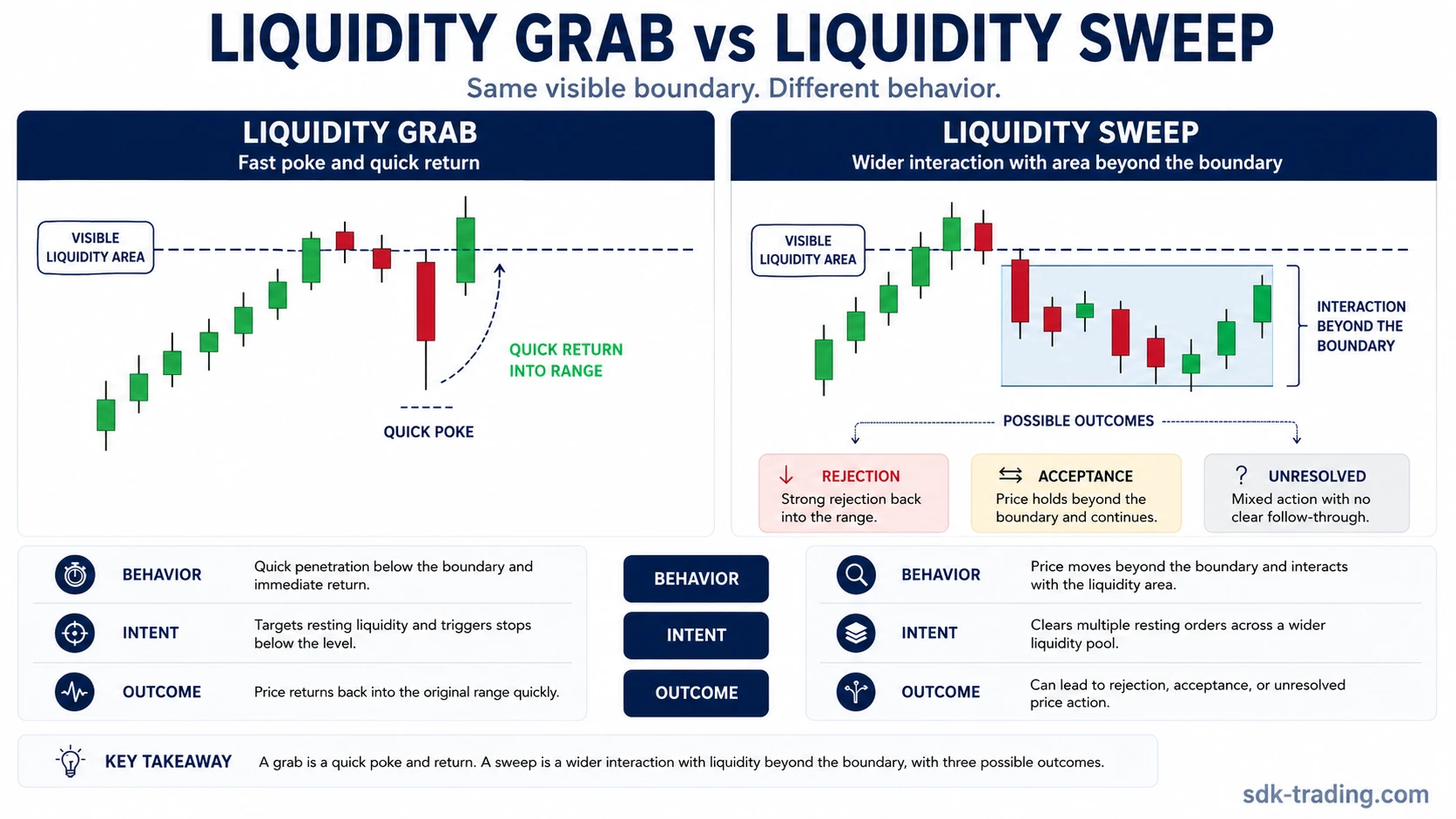
Scenario A: quick probe and return: Price briefly moves above the prior high, forms a visible wick, and quickly returns below the boundary. If the move stays localized and later behavior rejects the area, the event is more likely to be described as a liquidity grab.
Scenario B: broader move through the area: Price moves above the prior high, spends more time beyond it, and tests whether the area can hold. If the movement interacts with a wider zone and later behavior tests acceptance or rejection, the event is more likely to be described as a liquidity sweep.
This distinction also overlaps with stop hunting language, but the safer reading comes from what can be seen: boundary, depth, duration, and the behavior that follows.
Reading limit: if price action after the probe is still unresolved, the label remains weaker. A boundary break by itself does not prove rejection, acceptance, or directional intent.
When the Difference Becomes Ambiguous
The difference between a liquidity grab and a liquidity sweep can become unclear when price only moves slightly beyond a level, pauses, and then returns without a clean rejection or acceptance sequence. In that case, the label may describe the same event differently depending on the framework being used.
Terminology also varies across SMC, ICT, and general price-action discussions. Some traders use “grab” for nearly any quick stop run. Others use “sweep” for the same idea unless the move is clearly larger. That variation is why visible criteria matter more than the label alone.
- Not every wick is meaningful. A wick beyond a high or low matters more when the boundary was visible and the later reaction is clear.
- Not every break is a sweep. A small move beyond a level may still be a minor probe if it never interacts with a broader area.
- Acceptance changes the reading. If price holds beyond the boundary, the event may stop looking like a failed probe and start looking like accepted structure.
- Unresolved behavior weakens both labels. If price remains messy around the boundary, the safest reading is that the structure is not yet clear.
Common Mistakes When Comparing Grabs and Sweeps
| Mistake | Why it weakens the reading | Cleaner check |
|---|---|---|
| Treating every wick as a grab | A wick can be ordinary volatility if the level was not meaningful or later behavior gives no confirmation. | Check whether the boundary was visible and whether price rejected it quickly. |
| Treating every sweep as an automatic reversal | A sweep can reject, accept, or remain unresolved. The label does not decide direction by itself. | Check what happens after price moves through the area. |
| Ignoring duration | A one-candle probe and a multi-candle interaction with a zone do not carry the same reading quality. | Compare how long price stayed beyond the boundary. |
| Ignoring acceptance | If price holds beyond the level, the move may no longer behave like a simple failed probe. | Check whether price returns inside the prior area or builds structure beyond it. |
| Assuming hidden intent as fact | The chart can show price behavior, but it cannot prove the motive of every participant behind the move. | Describe the observable structure instead of claiming certainty about intent. |
FAQs
Are liquidity grabs and liquidity sweeps the same?
They are related, but not always the same. A liquidity grab usually describes a shorter probe beyond a visible high or low, while a liquidity sweep usually describes a broader move through a liquidity area. The distinction depends on scope, duration, and later behavior.
Can a liquidity grab become a liquidity sweep?
Yes, the reading can change if the move expands beyond a quick probe. A brief boundary test may start as a grab reading, but if price continues through the area, lingers, or tests acceptance, traders may describe the event as a sweep instead.
Does a liquidity sweep always mean price will reverse?
No. A sweep can be followed by rejection, acceptance, or unresolved price action. The label does not guarantee a reversal, continuation, or trade outcome. Later behavior is what makes the reading stronger or weaker.
How do you tell the difference between a grab and a sweep?
Start with the boundary, then compare the depth, duration, candle behavior, and reaction after the move. A quick probe and fast return supports a grab reading. A broader move through a zone with acceptance or rejection testing supports a sweep reading.
Why do traders disagree about the labels?
The terms are used differently across trading communities. Some traders use them almost interchangeably, while others separate them by scale and later price behavior. Using clear criteria reduces the confusion.