Loss aversion in trading is the tendency to give realized or potential losses more emotional weight than comparable gains, especially when that pressure starts overriding updated evidence, invalidation, or clean risk-control decisions.
Definition: Loss aversion is a decision bias where the discomfort of loss becomes stronger than the balanced assessment of new information. In trading, the issue is not simply that a position is losing. The issue is whether the loss state begins to dominate judgment more than the evidence does.
The bias can appear before a loss is realized, while a position is still open, or after a previous loss changes how the next decision feels. A trader may become more focused on avoiding the emotional event of being wrong than on checking whether the original reason for the position still exists.
Key Points
- Loss aversion is about asymmetric decision pressure: losses often feel more urgent than comparable gains.
- In trading, it can appear as holding losing positions too long, exiting winners too early, or resisting valid invalidation.
- Not every defensive decision is biased. Reducing risk can be clean risk control when it follows evidence or predefined rules.
- The useful test is whether the decision reflects current evidence or emotional attachment to avoiding a realized loss.
What Loss Aversion Means in Trading
Loss aversion in trading means that the pain of losing can become a stronger decision input than the possibility of an equivalent gain. A profitable position may feel fragile, while a losing position may feel difficult to close because closing it makes the loss final.
This is why the bias is closely connected to reference points. A trader may compare the current position to the entry price, the recent high, a previous unrealized profit, or the price where the position “should” have worked. Once that reference point becomes emotionally dominant, new evidence can be filtered through the desire to avoid loss rather than through the original trade logic.
Loss aversion is often discussed in behavioral finance and prospect theory because people can react differently to gains and losses of similar size. In trading, the narrower question is whether the loss state distorts reassessment or whether the trader is making a disciplined risk decision.
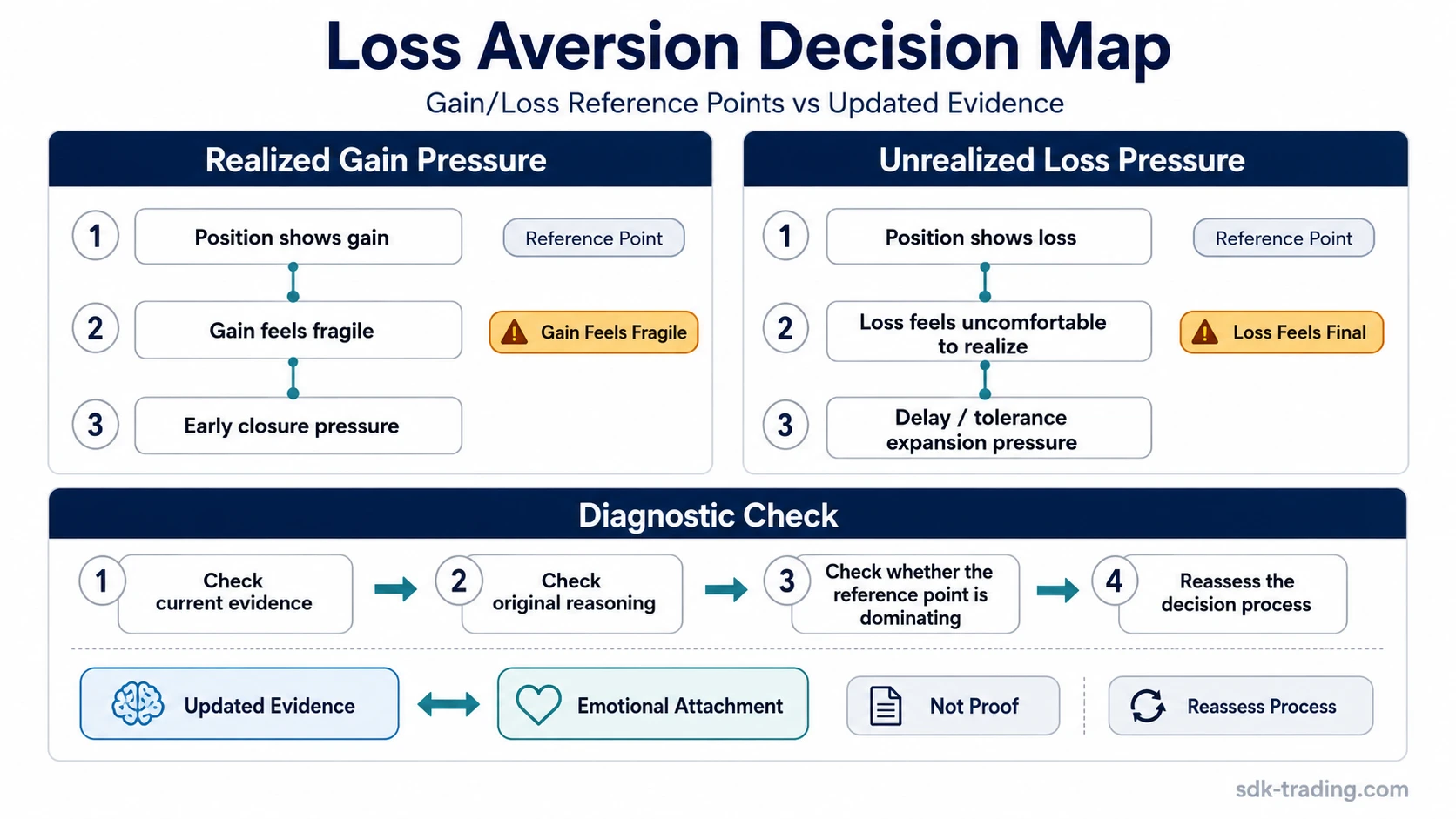
Why Losses Can Dominate Decision-Making
A loss can feel different from an ordinary information update because it challenges both the position and the trader’s prior judgment. The trader is not only evaluating price movement. The trader is also dealing with the discomfort of admitting that the original idea may no longer be supported.
The bias is not the loss itself. It is the decision pressure created by the loss. A loss may be fully compatible with a normal plan. It becomes more problematic when the trader starts changing the interpretation only to avoid recognizing that the setup has weakened.
Trading-context boundary: A market view and a trade expression are separate decisions. Accepting that a position is invalid does not require predicting the opposite direction. It only means the current evidence no longer supports the same exposure or interpretation.
How Loss Aversion Shows Up in Trading Decisions
Loss aversion is easiest to observe through changes in behavior around losing positions, unrealized gains, and invalidation. These signs are not proof by themselves, but they can show where emotional pressure may be replacing evidence-based reassessment.
| Trading behavior | What it may indicate | Safer interpretation |
|---|---|---|
| Holding a losing position after the original reason has weakened | The trader may be avoiding the discomfort of realizing the loss. | Check whether the original evidence still exists, not whether the loss feels recoverable. |
| Closing a winning position too quickly only because the gain feels fragile | The trader may be protecting the feeling of being right rather than reassessing structure. | Separate normal profit protection from fear-driven exit behavior. |
| Changing the allowed loss after new evidence appears | The trader may be adjusting the decision boundary to avoid realization. | Ask whether the change came from evidence or from discomfort with the current loss. |
| Avoiding a valid future setup after a previous loss | A prior loss may be distorting the next decision. | Review whether the new setup has its own evidence, rather than treating the prior outcome as controlling. |
These behaviors can overlap with the disposition effect, where traders tend to sell winners too early and hold losers too long. Loss aversion is broader because it describes the underlying pressure around losses, while the disposition effect describes a more specific realized-position pattern.
Clean Risk Control vs Loss-Aversion Bias
The most important boundary is that risk reduction is not automatically loss aversion. A trader can reduce exposure, close a position, or avoid a new trade for valid reasons. The bias appears when the loss state starts overriding evidence, invalidation, or a defined decision process.
| Decision type | What it looks like | Loss-aversion reading |
|---|---|---|
| Clean risk containment | The trader follows a predefined invalidation rule or responds to new evidence that weakens the setup. | Not loss aversion. The decision is evidence-based or process-based. |
| Weak or emotionally distorted decision | The trader changes the interpretation mainly because realizing the loss feels uncomfortable. | Possible loss aversion. The loss state is pressuring the decision. |
| Invalid loss-aversion accusation | The trader cuts risk because volatility, structure, liquidity, or confirmation has clearly changed. | Do not label it as bias without checking the evidence behind the decision. |
Limitation: Loss aversion should not be used to criticize every cautious decision. Defensive action can be rational when evidence changes. Risk control becomes loss aversion only when the loss state starts overriding evidence.
Loss Aversion vs Risk Aversion
Loss aversion and risk aversion are related, but they are not the same. Risk aversion describes a general preference for reducing uncertainty or avoiding risk. Loss aversion describes a stronger sensitivity to losses relative to comparable gains.
| Concept | Main focus | Trading example |
|---|---|---|
| Loss aversion | The emotional weight of loss compared with gain. | A trader resists accepting invalidation because realizing the loss feels worse than reassessing the evidence. |
| Risk aversion | A preference for lower uncertainty or smaller exposure. | A trader chooses a smaller position size because the setup has wider uncertainty or weaker confirmation. |
A risk-averse decision can still be disciplined. A loss-averse decision becomes more questionable when it is driven by the emotional cost of loss rather than by the actual risk profile.
Related Biases and Where the Boundary Sits
Loss aversion often appears near other trading psychology biases, but it should not replace them. Each bias describes a different distortion in the decision process.
| Related concept | Boundary |
|---|---|
| Disposition effect | More specific behavior involving selling winners too early and holding losers too long. |
| Sunk cost bias | Focuses on prior time, money, or effort already committed, rather than current evidence. |
| Overconfidence bias | Centers on excessive certainty in one’s judgment or forecast. |
| Confirmation bias | Centers on favoring evidence that supports the existing view while ignoring contrary information. |
| Hindsight bias | Centers on judging past decisions after the outcome is already known. |
| Recency bias | Centers on overweighting recent outcomes or recent price behavior. |
The cleaner distinction is this: loss aversion asks whether the emotional weight of loss is dominating the decision. Other biases may explain how the trader interprets evidence, remembers outcomes, or becomes too certain.
Example of Loss Aversion in a Trading Decision
Example: A trader may first treat a small unrealized loss as ordinary noise. That is not automatically a problem. The decision becomes more suspect if new evidence weakens the original reason for the position, but the trader keeps expanding the tolerance for loss only because closing the position feels uncomfortable.
In that scenario, the useful question is not whether the position is currently losing. The useful question is whether the trader is still responding to evidence. If the decision boundary keeps moving only to avoid realizing the loss, loss aversion may be influencing the process.
Common Misreadings and Limits
A common mistake is treating loss aversion as a label for every losing position. A losing position can exist inside a valid plan, and a trader can reduce risk without being biased. The label only becomes useful when it identifies a specific decision distortion.
Another mistake is assuming that overcoming loss aversion means forcing action. That turns the concept into a trading instruction, which is not the purpose here. The safer approach is diagnostic: compare the decision against evidence, invalidation, and the original reasoning process.
- Not enough: The position is losing.
- More relevant: The trader ignores new evidence because realizing the loss feels unacceptable.
- Cleaner boundary: The trader separates normal risk control from emotional attachment to the loss state.
FAQ
Is holding a losing position always loss aversion?
No. Holding a losing position is not enough by itself. The decision becomes more suspect when the original evidence has weakened and the trader continues mainly to avoid realizing the loss.
How is loss aversion different from risk aversion?
Risk aversion is a general preference for reducing uncertainty or exposure. Loss aversion is specifically about losses feeling more intense than comparable gains and distorting the decision process.
Can loss aversion affect winning trades?
Yes. A trader may close a winning position too early because the unrealized gain feels fragile. That can reflect the same pressure to avoid the emotional pain of seeing a gain disappear.