Overconfidence bias distorts judgment when a trader’s certainty becomes stronger than the evidence supporting the decision. In trading, the problem is not confidence itself. The problem is miscalibration: the trader treats an uncertain decision as more reliable than the available information can justify.
Overconfidence bias is the tendency to overestimate the accuracy of one’s judgment, the strength of one’s skill, or the precision of one’s forecast. In a trading process, it can make a thesis feel more dependable than the evidence, alternatives, and risk conditions actually support.
- Overconfidence bias is a calibration problem between confidence, evidence quality, and risk exposure.
- It can appear after recent success, repeated correct calls, or a strong attachment to a market view.
- The bias often affects position size, trade frequency, evidence review, and post-trade evaluation.
- A confident decision is not automatically biased; the warning sign is certainty that no longer matches the decision record.
- Process review, defined invalidation, evidence logging, and outcome-separated review can make overconfidence easier to detect.
What Is Overconfidence Bias?
Overconfidence bias means confidence exceeds the quality of the information behind the decision. A trader may believe a setup is clearer, a forecast is more precise, or a personal read is more reliable than the available evidence can justify.
In trading psychology, this matters because decisions are made under uncertainty. Price can move for reasons that are not visible at the time of the decision. A trade plan may be reasonable without being certain, and a trader can be skilled without being immune to miscalibration.
Core boundary: confidence becomes overconfidence when the trader stops treating the decision as uncertain. The issue is not having a view; the issue is assigning more reliability to that view than the evidence, risk, and alternatives support.
How Overconfidence Bias Changes Trading Decisions
Overconfidence bias usually affects the decision process before it becomes visible in the outcome. It can reduce doubt, narrow the review process, and make exposure feel more justified than the decision record supports.
- Perceived skill or recent success increases confidence. A trader may read a recent correct call as stronger proof of ability than it really is.
- Doubt becomes less active. Alternative scenarios and invalidation conditions receive less attention.
- Evidence review becomes thinner. The trader feels less need to test the view against alternatives.
- Risk exposure can expand. Position size, number of trades, or concentration may increase without a matching improvement in evidence quality.
- Review becomes defensive. After the result is known, the trader may defend the original decision instead of testing whether the process was well calibrated.
This sequence does not mean every confident trade is biased. It means the decision deserves closer review when confidence rises while the evidence base stays the same or weakens.
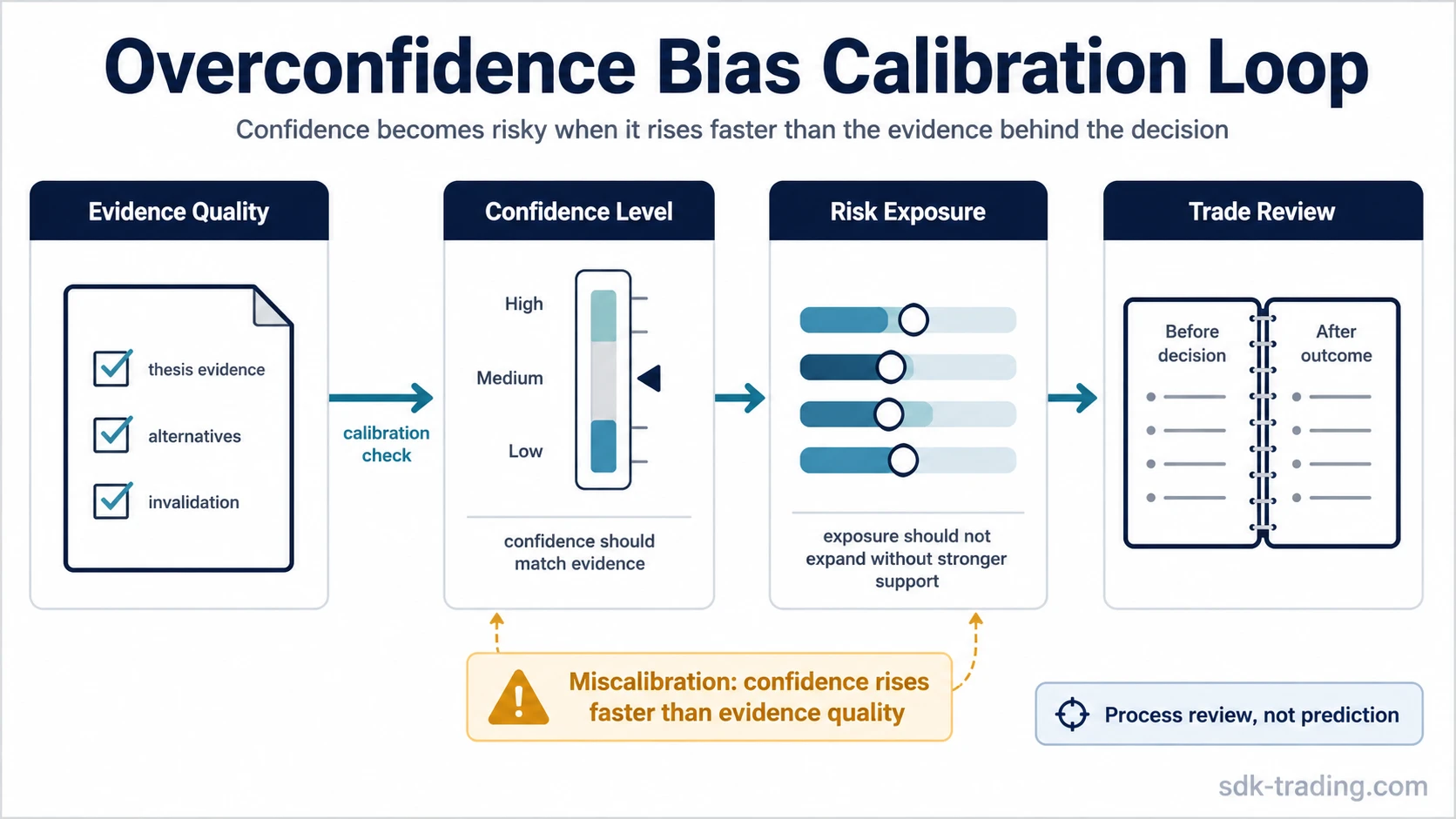
The Diagnostic Boundary: Confidence vs Overconfidence
Confidence can be useful when it is tied to preparation, evidence quality, risk limits, and a willingness to change the view when conditions change. Overconfidence appears when the trader treats uncertainty as if it has already been resolved.
| Decision state | What it looks like | Safer interpretation |
|---|---|---|
| Calibrated confidence | The trader has a defined thesis, knows what would weaken it, and keeps risk aligned with uncertainty. | Confidence is linked to process quality rather than certainty about the outcome. |
| Overconfidence bias | The trader feels unusually certain, treats the view as obvious, and sees less need to test alternatives. | Confidence may be running ahead of evidence, especially if size or trade frequency also increases. |
| Low confidence | The trader hesitates even when the plan is clear and risk is defined. | The issue may be execution anxiety rather than overconfidence. |
Important limitation: skill does not remove overconfidence risk. A skilled trader can still become miscalibrated after a strong run, a familiar setup, or a market view that has worked several times before.
Common Trading Signs of Overconfidence Bias
Overconfidence bias cannot be proven from one trade result. A profitable trade can still have been poorly reasoned, and a losing trade can still have followed a disciplined process. The more useful signs appear in behavior before and after the trade.
| Observable sign | What may be distorted | Review question |
|---|---|---|
| Position size increases without stronger evidence | Exposure may be expanding because confidence feels higher, not because setup quality improved. | What changed in the evidence base that justified more exposure? |
| Trade frequency rises after a series of wins | Recent success may be interpreted as proof that more opportunities are valid. | Are the new decisions meeting the same standard as the earlier ones? |
| Conflicting evidence is dismissed quickly | The trader may be treating uncertainty as resolved before it is actually resolved. | What evidence would make the original view weaker? |
| Invalidation becomes flexible | The plan may be adjusted to protect the thesis rather than to reflect changing conditions. | Was invalidation defined before the trade, or only after pressure appeared? |
| Review focuses only on outcome | The trader may judge the decision by whether it worked instead of whether it was well supported. | Would the decision still look reasonable if the result were hidden? |
Practical Forms of Overconfidence in Trading
For trading review, overconfidence is easier to detect when it is separated into practical forms. These are not separate trade signals. They are lenses for checking whether confidence has become stronger than the decision record.
| Review lens | How it can appear | Process risk |
|---|---|---|
| Overestimating skill | The trader treats a recent correct read as proof that future reads deserve more trust. | The plan may rely more on self-belief than on current evidence. |
| Overestimating precision | The trader acts as if the forecast is more exact than the market conditions allow. | Alternative paths may be ignored too early. |
| Overestimating control | The trader feels able to manage uncertainty after the fact, even when the plan was not defined clearly beforehand. | Risk limits and invalidation may become less stable. |
Example of Overconfidence Bias in Trade Review
A trader has several recent trades work in the expected direction. On the next setup, the evidence is weaker, but the trader feels unusually certain because the previous decisions were correct. Position size increases, the invalidation point becomes less precise, and alternative scenarios receive less attention.
The issue is not that the trader has confidence. The issue is that confidence has increased faster than the quality of the new decision record. A cleaner review would separate the current setup from the emotional weight of recent success.
How Traders Can Check for Overconfidence Bias
Overconfidence cannot be removed by simply telling a trader to be less confident. The practical goal is to make miscalibration easier to notice before it changes risk, frequency, or review quality.
- Write the evidence before the outcome is known: Record what supports the thesis, what conflicts with it, and what would weaken it.
- Define invalidation before pressure appears: A plan is easier to review when the boundary was written before the trade became emotional.
- Separate outcome from decision quality: A good result does not prove the decision process was sound, and a bad result does not automatically prove it was biased.
- Compare size with evidence quality: If exposure increased, the review should identify what evidence improved enough to justify it.
- Check whether alternatives were considered: Confidence is more defensible when the trader can explain what would make the view wrong.
Review boundary: these habits do not guarantee better outcomes. They help reveal whether certainty, exposure, and review discipline stayed aligned with the actual evidence available at the time.
Overconfidence Bias vs Related Trading Biases
Overconfidence bias can overlap with other trading biases, but the main distortion is different. The useful question is which part of the decision process became less objective.
| Bias | Main distortion | How it differs from overconfidence bias |
|---|---|---|
| Confirmation bias | Evidence is filtered around an existing thesis. | Overconfidence inflates certainty; confirmation bias filters what evidence receives attention. |
| Hindsight bias | The outcome makes the past decision feel more obvious than it was. | Overconfidence affects certainty before or during the decision; hindsight bias distorts the review after the result is known. |
| Anchoring bias | The trader stays attached to an initial reference point. | Overconfidence is about excess certainty; anchoring is about over-reliance on a starting value or first impression. |
FAQ
Is confidence always bad for traders?
No. Confidence can be useful when it is tied to preparation, evidence quality, defined risk, and willingness to update the view. It becomes risky when the trader treats uncertainty as already resolved.
How can overconfidence bias lead to overtrading?
Overconfidence can make more situations feel valid than the evidence supports. After recent success, a trader may lower the decision threshold and take more trades without the same level of review.
Can skilled traders still have overconfidence bias?
Yes. Skill can improve process quality, but it does not remove miscalibration risk. A skilled trader can still overestimate precision, give too much weight to recent success, or expand exposure without stronger evidence.
What are useful signs of overconfidence bias?
Useful signs are process-based: rising size without stronger evidence, flexible invalidation, thinner review of alternatives, and trade reviews that defend the decision instead of testing it.