Anchoring bias in trading begins when a trader treats one price, target, forecast, or prior market level as the main reference point after conditions have changed.
The issue is not the use of reference levels. Traders often need prior highs, prior lows, entry prices, volatility ranges, and planned invalidation areas to organize market information. The bias appears when that reference point keeps controlling judgment even after price structure, volume behavior, trend context, volatility, or market participation no longer supports the original view.
In trading psychology, this can distort how a trader reads current evidence. An old entry price can make a losing position feel closer to “normal” than it really is. A prior high can keep looking important after the market has already rejected that area. A forecast can keep shaping interpretation even when the chart has stopped supporting the original scenario.
Key Points
- Anchoring bias is a reference-point problem: one old price, forecast, level, or scenario keeps too much influence.
- A level is not biased by itself. The bias begins when new evidence is ignored or underweighted.
- Common anchors include entry price, prior highs or lows, price targets, old volatility conditions, and invalidated trade ideas.
- The practical review question is whether the reference point still has current structural relevance.
What Anchoring Bias Means in Trading
Anchoring bias in trading is the tendency to rely too heavily on an initial or familiar reference point when judging current market information. The anchor may be an entry price, a previous high or low, a forecast, a target, a news reaction, or an old regime condition.
The bias usually works through slow adjustment. A trader forms a view around a first reference point, then new information arrives. Instead of fully reassessing the position or market read, the trader adjusts only slightly and keeps the old reference point in charge.
For example, a trader may focus on a previous breakout level because it mattered earlier in the move. If price later loses that level, fails to reclaim it, and volume confirms weaker participation, the old breakout level may no longer carry the same meaning. Anchoring bias appears when the trader keeps treating that level as decisive without reassessing the changed evidence.
When a Reference Point Becomes an Anchor
A reference point becomes an anchor when it stops being a tool for orientation and starts becoming a fixed lens. The trader no longer asks whether the level, forecast, or scenario is still supported. Instead, later information is interpreted around the old point.
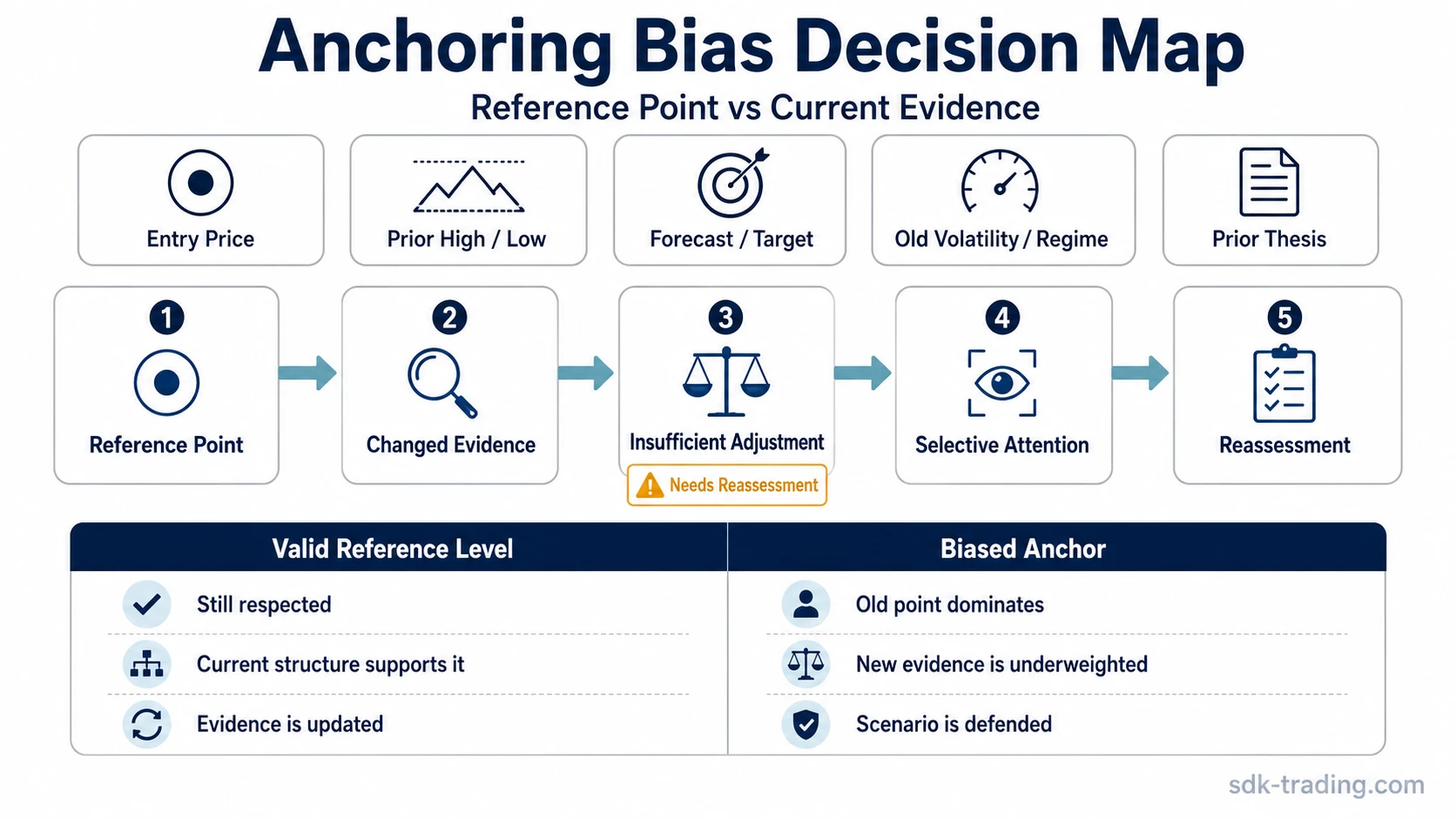
Important boundary: using a prior level is not automatically anchoring bias. A prior high, prior low, support area, resistance area, or entry price can remain useful if current structure still respects it. The problem is the refusal to reassess that reference point when market evidence changes.
This distinction matters because trading uses reference points constantly. A valid level can help organize risk, context, and interpretation. A biased anchor does the opposite: it narrows attention and makes the trader defend an outdated read.
Common Anchor Sources in Trading Decisions
Anchoring bias can start from different types of reference points. The useful question is not only “what is the anchor?” but also “how is it changing judgment?”
| Anchor source | How it distorts judgment | Trading-specific example | Review question |
|---|---|---|---|
| Entry price anchor | The entry price becomes the emotional center of the decision. | A trader keeps judging the position by whether price returns to the entry rather than by the current structure. | Would the same position still make sense if the entry price were unknown? |
| Prior high or prior low anchor | An old level receives more weight than current acceptance or rejection behavior. | A previous high remains the focus even after repeated failure and weaker participation near that area. | Is the level still being respected by current price behavior? |
| Target or forecast anchor | The trader keeps interpreting evidence in favor of the earlier projection. | A price target continues to shape expectations after the trend has flattened and volatility has changed. | What evidence would make the original target less relevant? |
| Old volatility or regime anchor | Current movement is judged by conditions that no longer describe the market. | A range that worked in quiet conditions is still used after volatility expands and intraday swings widen. | Has the volatility or participation environment changed enough to reset the reference frame? |
| Prior thesis or invalidated scenario anchor | The original idea keeps shaping interpretation after the scenario weakens. | A trader keeps explaining new weakness as temporary because the first thesis was built around continuation. | Which part of the original scenario is still supported, and which part has failed? |
How Anchoring Bias Distorts Market Interpretation
Anchoring bias usually follows a simple sequence. First, a reference point becomes psychologically important. Then new evidence appears, but the trader adjusts too little. After that, attention often shifts toward information that makes the anchor feel valid.
The process can be subtle. The trader may not openly ignore contrary evidence. Instead, the old reference point changes the weighting of the evidence. Price behavior that supports the original view feels meaningful. Price behavior that weakens it feels temporary, noisy, or incomplete.
This can delay reassessment. A trader may keep waiting for price to return to an entry, reclaim a prior level, or validate a forecast. The longer the anchor remains central, the harder it becomes to separate current evidence from the old expectation.
Practical distinction: anchoring bias is not the same as having a plan. A plan defines conditions. An anchor survives after those conditions are no longer present.
Examples of Anchoring Bias in Trading
Entry price example: A trader enters a position and then treats the entry price as the main measure of whether the decision is working. Price moves away from the entry, structure weakens, and the original setup no longer looks the same. Anchoring bias appears if the trader keeps focusing on a return to entry instead of reassessing the current evidence.
Prior high example: A previous high acted as resistance earlier, so it remains visually important. Later, price tests that area several times, fails to hold above it, and begins forming lower reactions. The old high may still matter, but it should not automatically dominate the read if the current behavior shows rejection rather than acceptance.
Forecast example: A trader forms a scenario around a target. The market then loses momentum, volume participation changes, and the original structure becomes less coherent. Anchoring bias appears when the target keeps shaping interpretation more than the updated chart behavior.
Old regime example: A trader becomes used to a market that respects narrow pullbacks and quick rebounds. If volatility expands and pullbacks become wider, the old regime can become an anchor. The same small-reference framework may no longer describe the current market.
How Anchoring Bias Differs From Related Biases
Anchoring bias often overlaps with other trading psychology problems, but it has a specific center: the old reference point keeps too much authority.
| Bias | Main distortion | How it differs from anchoring bias |
|---|---|---|
| confirmation bias | Selecting evidence that supports an existing view. | Confirmation bias can defend the anchor, but anchoring bias is the initial overreliance on the reference point itself. |
| hindsight bias | Rewriting the past after the outcome is known. | Hindsight bias changes how the trader remembers the decision. Anchoring bias changes how the trader weighs current evidence. |
| overconfidence bias | Overestimating the reliability of one’s view or forecast. | Overconfidence can make the original forecast feel more reliable, while anchoring explains why the forecast remains central after evidence changes. |
| Disposition effect | Holding losing positions too long or realizing gains too quickly. | An entry price anchor can contribute to this behavior, but the disposition effect describes the outcome pattern more broadly. |
| Loss aversion | Feeling losses more strongly than comparable gains. | Loss aversion explains the emotional pressure around loss. Anchoring explains why a specific reference price may dominate the decision. |
When a Level Is Not Anchoring Bias
A trader can use a prior level without being anchored to it. The level remains valid when current price behavior still gives it structural relevance. For example, a prior high may still matter if price repeatedly reacts there, volume changes near that area, and acceptance or rejection remains visible.
The same level becomes a biased anchor when the trader treats it as important only because it was important before. If the market has stopped respecting the area, or if the broader structure has changed, the old level should lose authority.
Illustrative scenario: A prior low once marked a strong reaction area. Later, price breaks below it, retests from underneath, and fails to reclaim it. The level still has information value, but its role may have changed. Treating it as unchanged support would be anchoring; reassessing it as a changed reference point would be structural review.
Review Questions for Anchoring Bias
Anchoring bias is easier to see when the reference point is made explicit. These questions help separate a valid level from a fixed mental anchor.
| Review question | What it checks |
|---|---|
| What is the reference point controlling the decision? | Identifies whether the trader is focused on entry price, target, prior level, forecast, or old regime conditions. |
| What evidence has changed since that reference point became important? | Checks whether structure, volatility, participation, or trend context has shifted. |
| Would the same interpretation make sense without knowing the original level? | Tests whether the read depends too heavily on the anchor. |
| What would reduce the importance of this reference point? | Forces a reassessment condition instead of open-ended attachment. |
| Is the level still active in current market behavior? | Separates structural relevance from psychological fixation. |
FAQ
What is anchoring bias in trading?
Anchoring bias in trading is the tendency to give too much weight to one old price, level, target, forecast, or scenario after new market evidence has changed the context.
Is using support and resistance anchoring bias?
No. Support and resistance levels can be valid reference points when current market behavior still respects them. Anchoring bias begins when the trader refuses to reassess the level after evidence changes.
Can an entry price become an anchor?
Yes. An entry price can become an anchor if the trader judges the position mainly by distance from entry instead of by current structure, volatility, participation, and invalidation conditions.
Can price targets create anchoring bias?
Yes. A price target can become an anchor if it continues to shape expectations after the original trend, structure, or participation evidence has weakened.
How is anchoring bias different from confirmation bias?
Anchoring bias starts with overreliance on a reference point. Confirmation bias then may support that anchor by giving more attention to evidence that agrees with it.