Key Points
- Confirmation bias in trading is the tendency to search for, interpret, and remember market evidence in a way that protects an existing trade thesis.
- The bias is not the same as strong conviction. It appears when evidence is weighted asymmetrically because the trader wants the original view to survive.
- The most useful diagnostic question is not whether the trade idea feels logical, but what evidence would force reassessment.
- A cleaner review separates supportive evidence, conflicting evidence, invalidation conditions, and alternate scenarios before confidence is upgraded.
Confirmation bias in trading is a decision bias where a trader gives more weight to evidence that supports an existing market view and less weight to evidence that challenges it.
The bias usually starts after a trade thesis already exists. A trader may notice the chart patterns, commentary, indicators, or news that support the thesis, while treating conflicting information as temporary noise, irrelevant context, or something that can be explained away.
Definition: Confirmation bias in trading is selective evidence handling around a trade thesis. It affects what evidence is searched for, how mixed evidence is interpreted, and which details are remembered during later review.
The practical problem is not that a trader has a view. Trading decisions often require a working thesis. The problem begins when the review process protects that thesis instead of testing it.
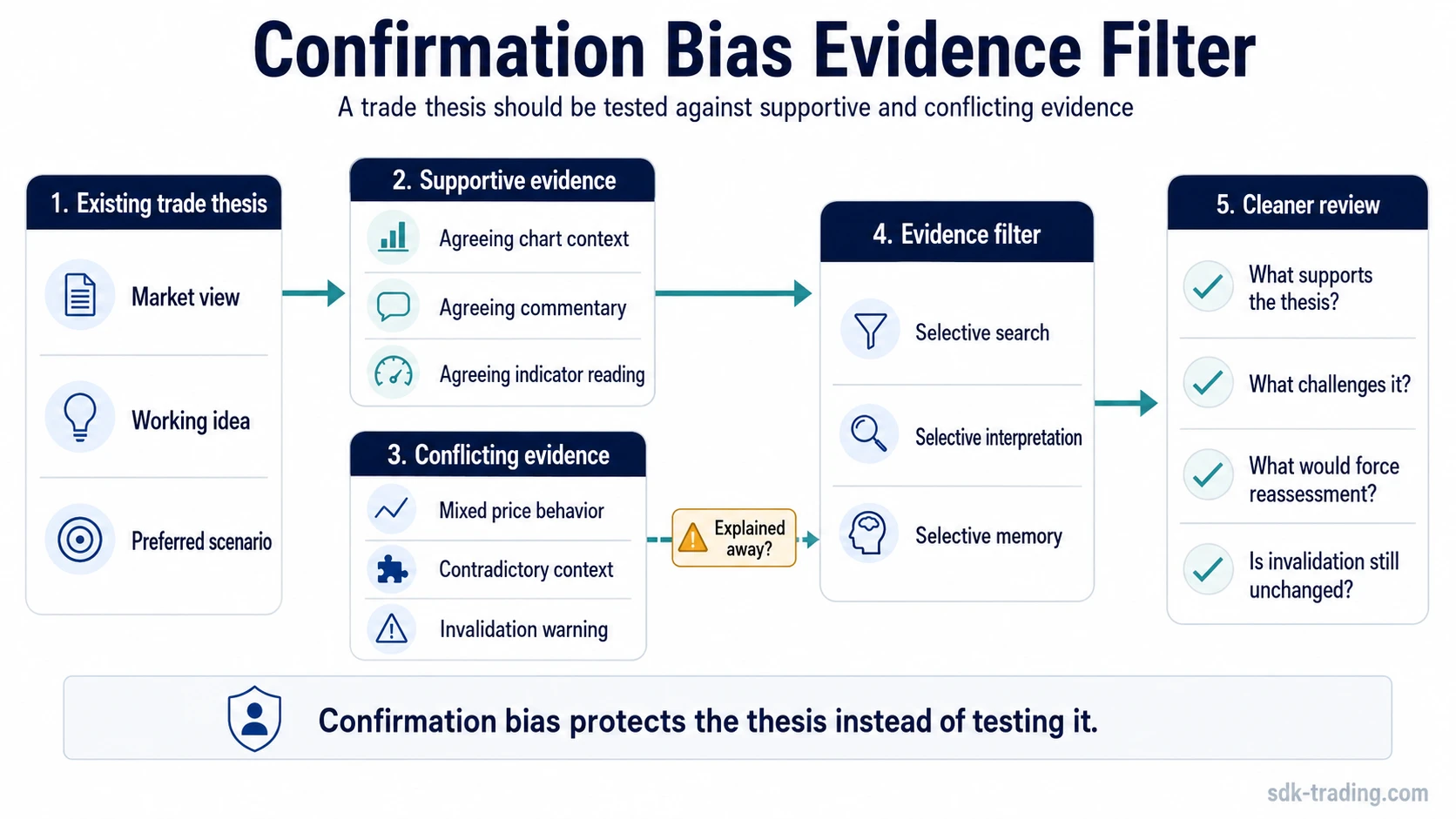
Selective Search, Interpretation, and Memory in Trading
In trading, confirmation bias distorts the evidence layer of the decision process. The trader may begin with a bullish or bearish idea, then unconsciously build a case around the preferred outcome instead of testing whether the evidence is still balanced.
That distortion can appear in three connected ways: selective search, selective interpretation, and selective memory. Each one changes the quality of the review before any trade outcome is known.
| Bias channel | Clean review behavior | Confirmation-biased behavior |
|---|---|---|
| Selective search | Looks for evidence that supports and challenges the thesis. | Searches mainly for charts, commentary, or signals that agree with the thesis. |
| Selective interpretation | Adjusts confidence when evidence becomes mixed. | Treats supportive evidence as meaningful and conflicting evidence as an exception. |
| Selective memory | Reviews what was known at the time, including warnings and uncertainty. | Remembers the original idea as more supported than it actually was. |
The bias becomes stronger when the trader moves from analysis to defense. At that point, new evidence is no longer being used to improve judgment. It is being used to preserve the original conclusion.
How Confirmation Bias Enters Trade Decisions
Confirmation bias can enter several parts of the trading process. It does not need to appear as a single obvious mistake. More often, it shows up as small evidence-handling choices that all lean in the same direction.
| Decision layer | How the bias can appear | Cleaner control question |
|---|---|---|
| Thesis formation | The trader forms a view first, then gathers only the strongest supporting reasons. | What evidence would make this thesis less convincing? |
| Chart interpretation | Ambiguous price action is read in the direction of the preferred scenario. | Could the same structure support an alternate reading? |
| News selection | Agreeable commentary is treated as confirmation, while conflicting commentary is dismissed quickly. | Is the source being used for evidence or reassurance? |
| Invalidation review | The original invalidation condition is softened after the thesis comes under pressure. | Was invalidation defined before the evidence became uncomfortable? |
| Post-trade review | The trader remembers the supportive evidence more clearly than the warnings that were present. | What did the review log show before the outcome was known? |
Process note: Confirmation matters more than conviction when the evidence is mixed. A thesis can remain useful while alternate paths are still possible, but it becomes weaker when its invalidation conditions are quietly rewritten.
Confirmation Bias vs Disciplined Conviction
Strong conviction is not automatically confirmation bias. A trader can have a high-conviction thesis if the reasoning is documented, the risk conditions are clear, and disconfirming evidence is reviewed honestly.
The boundary is evidence treatment. Disciplined conviction can reduce confidence when the facts change. Confirmation bias protects confidence by changing how the facts are interpreted.
| Question | Disciplined conviction | Confirmation bias |
|---|---|---|
| How is supportive evidence handled? | Used as one part of the thesis. | Treated as the main evidence while other information is minimized. |
| How is conflicting evidence handled? | Logged, reviewed, and allowed to reduce confidence. | Explained away because it threatens the preferred view. |
| How is invalidation handled? | Defined before the review becomes emotionally difficult. | Moved, softened, or rationalized after the thesis is challenged. |
| How are alternate scenarios handled? | Considered before confidence is upgraded. | Treated as distractions unless the original thesis fails completely. |
Important boundary: The presence of a preferred market view does not prove confirmation bias. The bias appears when the trader stops testing the view and starts filtering evidence to defend it.
Clean Review vs Confirmation-Biased Review
A practical way to see the bias is to compare two reviews of the same trade thesis. The market view can be identical at the start, but the evidence process changes the quality of the decision.
Illustrative scenario: A trader begins with a bullish thesis after a market has held a key area and started to recover. A clean review notes the supportive structure, but also records weaker follow-through, mixed volume behavior, and the condition that would make the recovery less convincing. A confirmation-biased review highlights only the recovery attempt, searches for commentary that agrees with it, and treats the weak follow-through as irrelevant because the bullish thesis already feels correct.
| Review step | Clean review | Confirmation-biased review |
|---|---|---|
| Starting thesis | Uses the thesis as a scenario to test. | Uses the thesis as a conclusion to defend. |
| Supporting evidence | Records what supports the scenario and how strong it is. | Collects supportive details until the thesis feels confirmed. |
| Conflicting evidence | Identifies what would reduce confidence or require reassessment. | Downgrades conflicting details because they do not fit the preferred view. |
| Decision quality | Confidence changes as evidence changes. | Confidence remains protected even when the evidence becomes mixed. |
The useful distinction is not whether the trader was eventually right or wrong. A biased process can sometimes be followed by a favorable outcome, and a clean process can still face uncertainty. The process matters because it determines whether future decisions are being reviewed honestly.
How to Identify Confirmation Bias in a Trade Review
Confirmation bias is easier to identify after the evidence trail is written down. Without a written review, the trader may remember the original thesis as more balanced than it really was.
A simple review should separate supportive evidence from disconfirming evidence before confidence is raised. The review should also identify what would force reassessment, because vague invalidation gives the bias more room to protect the thesis.
| Diagnostic question | Why it matters |
|---|---|
| What evidence was actively searched for? | A one-sided search can create the feeling of confirmation without balanced evidence. |
| What evidence was ignored or minimized? | Conflicting evidence often exposes the difference between analysis and thesis defense. |
| What would weaken the thesis? | A thesis that cannot be weakened by new evidence is no longer being tested. |
| Was invalidation defined before or after pressure appeared? | Late invalidation changes can reveal rationalization rather than fresh analysis. |
| Was an alternate scenario reviewed? | Alternate scenarios reduce the chance that all evidence is forced into one preferred interpretation. |
Practical control: A review log does not eliminate bias, but it makes selective evidence handling more visible. The key is to record the evidence before the outcome changes the memory of the decision.
How Confirmation Bias Affects Technical Analysis
Technical analysis becomes weaker when a trader uses it to confirm a preferred thesis rather than to test price behavior. The same chart can often support more than one scenario, especially when structure is incomplete or evidence is mixed.
A confirmation-biased chart review may overemphasize the pattern, indicator, or level that supports the trader’s view. It may also ignore acceptance, failed follow-through, weaker participation, or a structure that no longer fits the original thesis.
The cleaner approach is to treat technical evidence as conditional. A structure may support a thesis under one set of conditions and weaken it under another. The review becomes more balanced when the trader defines what would confirm the scenario, what would challenge it, and what would make an alternate scenario more defensible.
Limitation: Confirmation bias does not mean every supportive signal is false. It means the trader may be giving supportive evidence a higher standard of importance than conflicting evidence receives.
Process Controls That Reduce Confirmation Bias
Confirmation bias cannot be removed by simply deciding to be objective. A better control is to build a review process that makes one-sided evidence handling harder.
- Write the thesis before reviewing new evidence: A written thesis makes it easier to see whether later interpretation is changing or merely defending the original view.
- Separate confirming and disconfirming evidence: Supportive and conflicting observations should not be mixed into one vague confidence judgment.
- Define invalidation before pressure appears: Invalidation is more useful when it is defined before the trader has a reason to rationalize it.
- Review at least one alternate thesis: An alternate scenario prevents every new detail from being forced into the preferred interpretation.
- Record what changed confidence: Confidence should rise or fall because evidence changed, not because the trader spent more time defending the same idea.
Evidence-routing model: A cleaner process asks four questions: what belief already exists, what evidence supports it, what evidence challenges it, and what would force reassessment.
Confirmation Bias vs Related Trading Biases
Confirmation bias is often confused with nearby trading psychology concepts. The distinctions matter because each bias distorts a different part of the decision process.
| Bias | Main distortion | How it differs from confirmation bias |
|---|---|---|
| Anchoring bias | Overweights an initial reference point. | Confirmation bias protects an existing thesis by filtering evidence, while anchoring bias keeps judgment tied to an earlier level, price, forecast, or idea. |
| Hindsight bias | Reconstructs past outcomes as more predictable after they happen. | Confirmation bias affects evidence handling before or during the decision, while hindsight bias changes how the decision is remembered after the outcome. |
| Overconfidence bias | Overstates skill, certainty, or judgment quality. | Confirmation bias filters evidence to defend a view, while overconfidence bias can make the trader trust that view too strongly. |
Other biases, including the disposition effect and loss aversion, can interact with confirmation bias when a trader wants to keep an existing view alive. They are not the same bias, but they can reinforce the same defensive review behavior.
FAQ
What is confirmation bias in trading?
Confirmation bias in trading is the tendency to favor evidence that supports an existing trade thesis while discounting evidence that challenges it. It affects the search for information, the interpretation of mixed signals, and the later memory of the decision.
Is strong conviction the same as confirmation bias?
No. Strong conviction can be disciplined when the thesis is tested against conflicting evidence and clear invalidation conditions. Confirmation bias appears when the trader protects the thesis by filtering or downgrading evidence that does not fit.
Can a trade thesis be valid even if the review process is biased?
Yes. A thesis can still be valid even when the review process is biased, because outcome and process are separate. The issue is that a biased review makes future decisions harder to evaluate honestly.
How can confirmation bias affect technical analysis?
It can make a trader read ambiguous chart evidence in the direction of a preferred scenario. The risk is not the use of technical analysis itself, but using patterns, indicators, or levels mainly to defend a view that should still be tested.
How can a trader identify confirmation bias during review?
A trader can look for one-sided evidence search, ignored conflicting signals, late changes to invalidation, and a lack of alternate scenarios. A written evidence log makes these patterns easier to see before the outcome changes the memory of the decision.