Hindsight bias in trading is the tendency to treat a market outcome as more obvious or predictable after it happens than it was before the trade. It can distort review because the trader remembers the prior setup through the known result instead of through the uncertainty, alternatives, and invalidation points that existed at the time.
Definition: Hindsight bias is a post-outcome review distortion. In trading, it appears when a trader looks back at a completed move and feels the result was clear all along, even though the pre-trade evidence was incomplete, mixed, or uncertain.
The problem is not trade review itself. The distortion begins when the known result rewrites what the trader believes was knowable at the decision point.
Key Points
- Hindsight bias appears after the trade outcome is known, not before the decision is made.
- It can make a prior market move feel more predictable than it really was at the decision point.
- The bias often rewrites uncertainty into a cleaner post-outcome story.
- A trading journal helps by preserving the original thesis, alternatives, and invalidation conditions before the result is known.
What Hindsight Bias Means in Trading
Hindsight bias in trading means judging a past market decision with information that was not fully available when the decision was made. After price moves, the final result can make the earlier setup look cleaner, stronger, or more obvious than it actually was.
A trader may look at a finished move and think, “I knew that would happen,” even if the original notes showed hesitation, conflicting evidence, or no clear plan. The mind compresses the messy pre-trade situation into a simpler story because the outcome is now visible.
Trading-specific boundary: Hindsight bias is not the same as learning from a trade. Learning compares the original decision record with the later result. Hindsight bias replaces the original uncertainty with a post-outcome narrative.
This distinction matters because trade review should improve decision quality, not create false certainty about what was predictable. A move can be obvious after it happens and still have been uncertain before it happened.
Why Outcomes Feel Obvious After the Move
Once the market result is visible, the review starts with information the original decision did not have. Price reached one path and not the alternatives. That final path can make the earlier evidence feel more decisive than it was.
Several review distortions can appear together:
- Memory reconstruction: the trader remembers the original view as cleaner than the actual decision record.
- Narrative fitting: scattered clues are rearranged into a smooth explanation after the result.
- Foreseeability feeling: the outcome feels like it should have been easy to anticipate.
- Overconfidence spillover: a winning result may inflate confidence in future judgment, while a missed move may create exaggerated self-blame.
The “knew it all along” feeling is especially risky when the trader reviews charts without checking the original notes. The chart now contains the answer. The decision point did not.
Pre-Trade Evidence vs Post-Trade Story
The clearest way to spot hindsight bias is to compare the decision record made before the outcome with the explanation created after the outcome. The gap between those two records is often where the bias appears.
| Pre-trade record | Post-outcome narrative | Bias risk |
|---|---|---|
| The setup had mixed evidence, with both continuation and failure scenarios still possible. | The move looks like it was clearly going to continue. | Uncertainty gets replaced by a single clean story. |
| The thesis depended on confirmation that had not yet appeared. | The trader remembers the confirmation as already obvious. | Later price action is treated as if it was available earlier. |
| The original plan listed invalidation conditions and alternative paths. | The review focuses only on the path that actually happened. | Alternatives disappear from memory, making the result feel inevitable. |
| The trader was uncertain and sized or acted cautiously. | The trader feels they should have acted with more confidence. | Outcome knowledge creates unfair self-criticism or inflated skill assessment. |
A strong review process does not ask only whether the outcome was good or bad. It asks whether the original decision was reasonable based on the information available at the time.
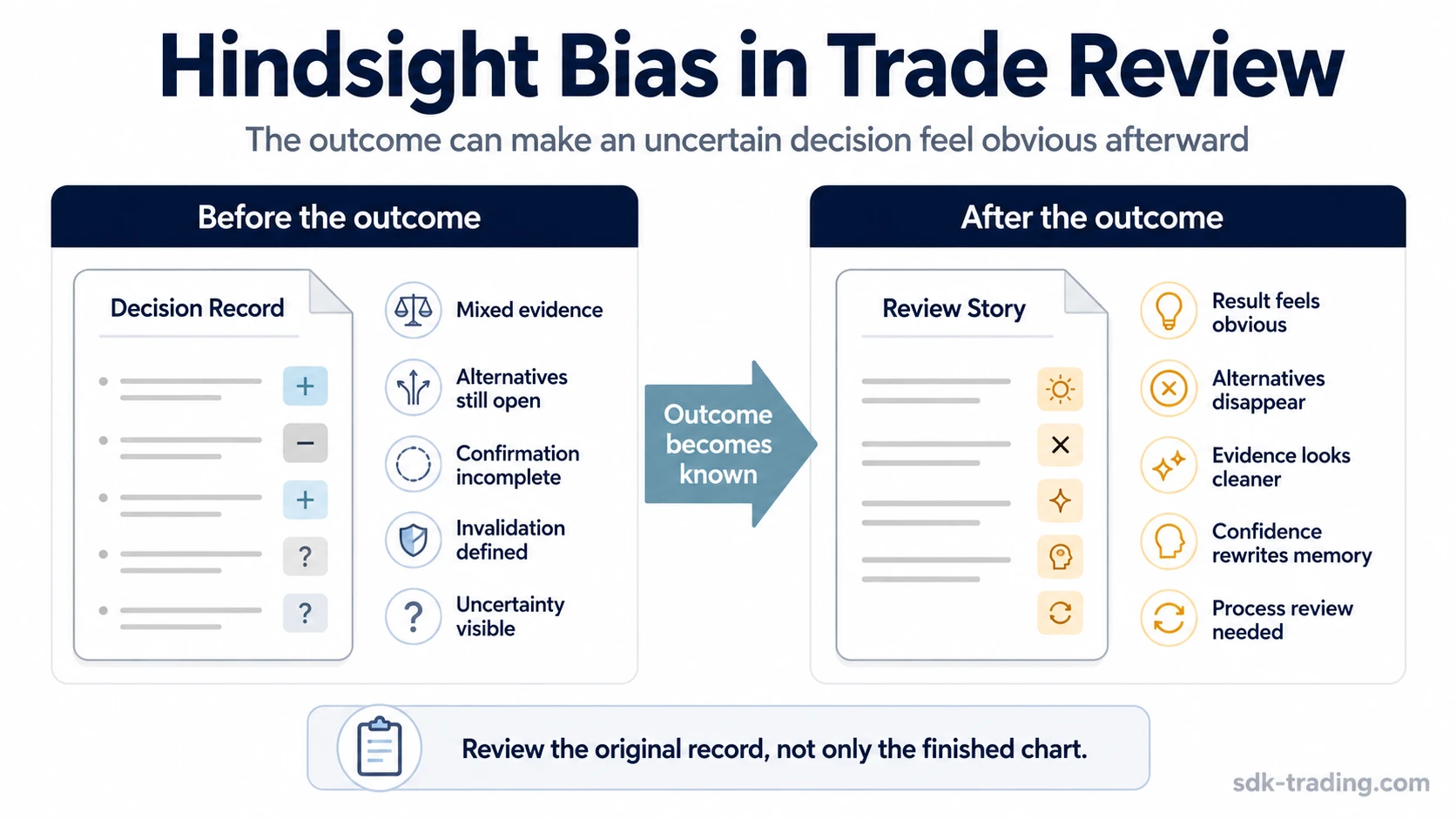
Hindsight Bias Example in Trade Review
Example: A trader reviews a chart after a strong breakout has already unfolded. After the move, the breakout candle, prior consolidation, and follow-through seem to form an obvious sequence. The trader says, “I should have known this would run.”
The original notes tell a different story. Before the move, the trader had listed two possible scenarios: continuation if acceptance held, and failure if price returned into the prior range. Confirmation was still incomplete. The post-outcome chart makes the continuation path look obvious, but the pre-trade record shows that the decision was still conditional.
That is hindsight bias. The finished move makes the trader judge the earlier decision as if the later evidence had already existed. A better review would ask whether the trader followed the plan, respected uncertainty, and updated only when new information appeared.
Hindsight Bias vs Related Trading Biases
Hindsight bias overlaps with other trading biases, but its timing and mechanism are distinct. It is mainly a post-outcome review problem: the result changes how the trader remembers the decision environment.
| Bias | Main distortion | Difference from hindsight bias |
|---|---|---|
| Confirmation bias | Selecting evidence that supports an existing thesis while discounting conflicting evidence. | Confirmation bias affects evidence handling before or during the thesis. Hindsight bias rewrites perceived predictability after the outcome. |
| Overconfidence bias | Overestimating forecasting skill, judgment quality, or control over outcomes. | Hindsight bias can feed overconfidence when past outcomes feel more predictable than they were. |
| Anchoring bias | Over-weighting an initial price, level, thesis, or reference point. | Anchoring fixes attention on an earlier reference point. Hindsight bias reshapes the memory of a decision after the result. |
| Loss aversion | Feeling losses more strongly than comparable gains. | Loss aversion affects emotional response to gains and losses. Hindsight bias affects how obvious the outcome feels afterward. |
| Disposition effect | Holding losing positions too long or taking gains too quickly because realized outcomes feel emotionally different. | The disposition effect affects position handling. Hindsight bias affects the later review of what the trader believes they should have known. |
The practical boundary is simple: if the distortion happens while selecting evidence for a live thesis, confirmation bias is more likely. If the distortion happens after the result and changes how predictable the trader believes the move was, hindsight bias is more likely.
How a Trading Journal Can Reduce Hindsight Bias
A trading journal can reduce hindsight bias by preserving the decision environment before the outcome is known. The journal does not remove bias completely, but it gives the trader a record that can be compared against the later story.
A useful decision record should capture:
- Original thesis: what the trader believed before the outcome.
- Supporting evidence: what made the idea reasonable at the time.
- Conflicting evidence: what weakened or complicated the idea.
- Alternative scenarios: what other paths were possible.
- Invalidation conditions: what would make the thesis less defensible.
- Uncertainty level: whether the setup was clear, mixed, early, or conditional.
- Review comparison: how the later result differed from the original decision record.
| Journal question | Why it helps |
|---|---|
| What did I know before the result? | Separates available evidence from later information. |
| What was uncertain at the time? | Prevents the review from turning uncertainty into false obviousness. |
| What alternatives were still valid? | Keeps the review from focusing only on the path that happened. |
| What would have invalidated the idea? | Preserves process discipline instead of judging only the final result. |
| Did the outcome match the plan or only the later story? | Exposes the gap between decision quality and post-outcome narrative. |
The most useful journal habit is writing before the outcome and reviewing after the outcome. Without the first part, the review can become a polished explanation of what already happened.
Limits of Hindsight Bias Control
Limitation: Awareness does not fully remove hindsight bias. A trader can understand the bias and still feel that an outcome was obvious after seeing the final chart. The control mechanism is not perfect memory; it is a written decision record that keeps the review anchored to what was actually known at the time.
Hindsight bias can also appear after both wins and losses. After a win, the trader may overestimate skill because the result feels predictable. After a loss or missed move, the trader may judge the earlier decision too harshly because the final path is now visible.
The useful review question is not “Why didn’t I know?” A better question is: “What evidence was available, what evidence was missing, and did the decision process handle that uncertainty properly?”