Fear and greed in trading matter when emotional pressure changes the decision process before the evidence changes. Fear can push a trader to avoid, reduce, or exit a decision too early. Greed can push a trader to chase, enlarge, or defend a decision too aggressively. The useful question is not whether the emotion feels strong, but whether it changed the evidence review, risk behavior, or invalidation discipline.
Definition: Fear and greed in trading are internal decision-process pressures. Fear is pressure to avoid discomfort, uncertainty, or further loss. Greed is pressure to capture more, act faster, or ignore limits. Neither emotion is a trade signal by itself.
Key Points
- Fear and greed become decision risks when they change the process before the evidence changes.
- Fear often appears as hesitation, premature exits, avoidance, or freezing after losses.
- Greed often appears as chasing, over-sizing, overtrading, or ignoring invalidation.
- The Fear & Greed Index is an external sentiment gauge, not the same thing as a trader’s internal discipline.
- Emotional pressure is not enough evidence to enter, exit, avoid, enlarge, or reverse a trade idea.
What Fear and Greed Change in the Trading Decision Process
Fear and greed usually do not begin as fully formed decisions. They begin as pressure. The decision becomes distorted when that pressure changes how evidence is weighed, how risk is sized, or how invalidation is treated.
Fear can make a valid setup feel too uncomfortable even when the planned conditions are still present. Greed can make an incomplete setup feel urgent even when the evidence is still weak. In both cases, the emotion becomes a process problem when it replaces review with impulse.
Process check: A decision is more defensible when the evidence, risk, and invalidation logic still make sense without the emotional pressure attached to the moment.
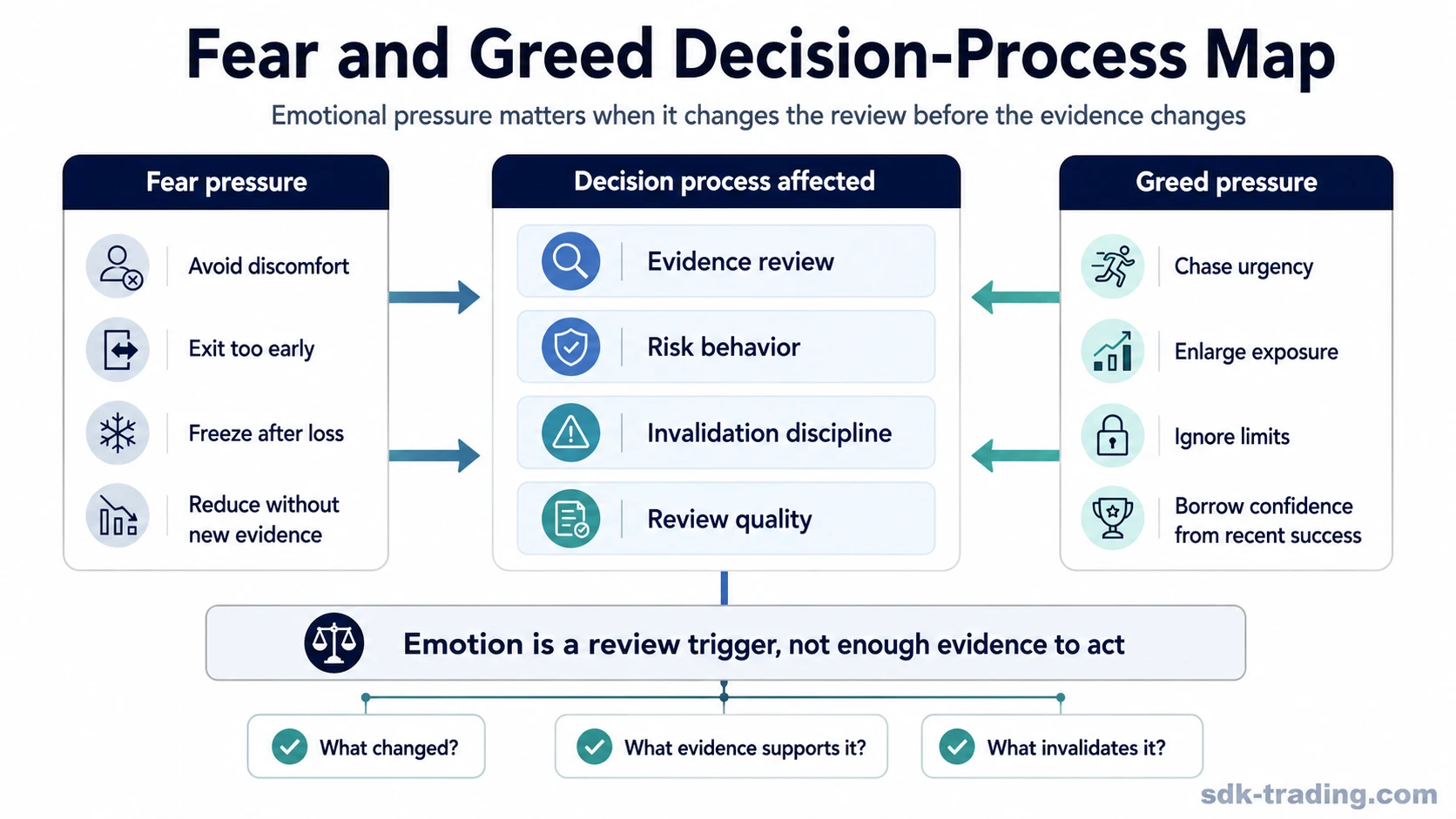
Fear Pressure vs Greed Pressure
Fear and greed often create opposite behaviors, but both can weaken objectivity. Fear tends to reduce participation or force exits. Greed tends to expand exposure or weaken limits. The safer review starts with the behavior that changed.
| Emotional pressure | How it changes behavior | Common misread | Safer process check |
|---|---|---|---|
| Fear after a loss | Freezing, avoiding a planned setup, or refusing to review new evidence | The discomfort means the next idea is automatically unsafe | Check whether the setup conditions changed, or only the emotional state changed |
| Fear before a valid setup | Hesitation, late reaction, or reducing the plan without a new reason | Waiting longer always means being more disciplined | Compare the original criteria with the current evidence before changing the decision |
| Fear during a fast adverse move | Forced exits, rushed decisions, or panic-driven exits | Immediate relief is the same as better judgment | Separate planned invalidation from discomfort caused by speed or volatility |
| Greed after a win | Over-sizing, relaxing filters, or assuming the next idea deserves less scrutiny | Recent success proves the process is stronger | Review whether the next decision has its own evidence, not borrowed confidence |
| Greed during a fast move | Chasing, entering late, or accepting poor structure because the move feels urgent | Speed confirms quality | Check whether the decision is based on evidence or on fear of missing out |
| Greed after a missed opportunity | Forcing a new decision to recover the missed move | Acting now fixes the earlier hesitation | Reset the decision around current evidence instead of the missed opportunity |
When Emotion Is Not Enough Evidence
Emotional pressure can reveal that a decision needs review, but it does not prove that action is required. A trader still needs to check whether the market evidence, risk conditions, and invalidation logic changed.
| Review step | Question to ask | Why it matters |
|---|---|---|
| Trigger condition | What created the emotional pressure? | The pressure may come from speed, prior loss, missed opportunity, or uncertainty rather than new evidence. |
| Common misread | Is the emotion being treated as proof? | Fear can feel like danger, and greed can feel like conviction, even when the evidence is incomplete. |
| Safer interpretation | What changed in the decision process? | The key distortion is often a change in patience, risk size, evidence standards, or respect for invalidation. |
| Evidence to check | Did structure, confirmation, risk, or invalidation actually change? | A process-based decision should be tied to observable conditions, not only to emotional intensity. |
| Action if evidence is still missing | Would the same decision still make sense without the emotional pressure? | If the answer is no, the decision may be driven by fear or greed rather than review. |
Boundary: Feeling afraid is not automatically a reason to exit or avoid a setup. Feeling confident is not automatically a reason to increase risk or chase. The decision needs evidence beyond the emotion itself.
Fear & Greed Index vs Trader Emotional Discipline
The Fear & Greed Index and trader fear or greed are different concepts. The index is an external sentiment gauge. Trader fear and greed are internal pressures that can distort evidence review, risk behavior, and execution discipline.
| Concept | What it describes | What it should not become |
|---|---|---|
| Fear & Greed Index | A broad sentiment reading about market conditions | A direct instruction to buy, sell, enter, exit, enlarge, or reverse a trade idea |
| Trader fear and greed | Internal pressure affecting decision quality | A replacement for evidence, risk review, or invalidation discipline |
Useful distinction: External sentiment can describe the environment, while internal fear and greed describe how a trader responds to that environment.
Fear and Greed Example in Context
Illustrative scenario: A trader has a plan that requires a specific confirmation before acting. Price moves quickly toward the area being watched, but the confirmation has not appeared yet. Greed makes the move feel urgent, and the trader wants to act before the plan is complete.
The same situation can create fear after entry. If price pulls back quickly but the planned invalidation has not been reached, fear can make the position feel wrong simply because the movement is uncomfortable.
The safer review is to compare the decision against the original evidence: what confirmation was required, what risk was accepted, and what condition would actually invalidate the idea. The emotion identifies pressure. It does not complete the evidence.
How to Identify Fear and Greed While Trading
Fear and greed are easier to identify through process changes than through feelings alone. The emotion matters when it changes what would normally be checked before a decision.
- Evidence standard changed: weaker evidence suddenly feels acceptable, or normal evidence suddenly feels impossible to trust.
- Risk size changed: exposure is increased or reduced because of pressure, not because the setup changed.
- Invalidation changed: the original condition for being wrong is ignored, moved, or softened without new evidence.
- Timing changed: the decision is rushed to avoid missing a move or delayed to avoid discomfort.
- Review changed: conflicting information is dismissed because it interferes with the desired action.
Common mistake: Judging the process only by the outcome can hide emotional distortion. A rushed decision can still look good afterward, and a disciplined decision can still have an unfavorable result.
How to Control Fear and Greed Without Turning Emotion Into a Signal
Controlling fear and greed does not mean removing emotion. It means preventing emotion from replacing the decision process. The practical control is a short review that separates pressure from evidence.
- Name the pressure: identify whether the decision is being pulled by fear, greed, missed opportunity, recent loss, or recent success.
- Check what changed: compare current evidence with the evidence required by the plan.
- Review risk behavior: look for sudden changes in size, tolerance, or urgency.
- Respect invalidation: do not soften or move the reason for being wrong without new evidence.
- Delay unsupported action: if the only new input is emotion, the decision needs more review.
Process anchor: A decision becomes more reviewable when the reason for action can be explained without relying on relief, urgency, recent success, or fear of regret.
Common Mistakes With Fear and Greed in Trading
The largest mistake is treating emotion as proof. Fear can warn that risk feels uncomfortable, but it does not prove the decision is wrong. Greed can create conviction, but it does not prove the evidence is strong.
| Mistake | Why it weakens the process | Better review question |
|---|---|---|
| Treating fear as always wrong | Fear may contain useful caution, but it can also exaggerate discomfort. | Is the concern based on new evidence or on the feeling of uncertainty? |
| Treating greed as conviction | Greed can make incomplete evidence feel stronger than it is. | Would the idea still qualify if the move were slower and less exciting? |
| Judging the process only by outcome | A good result can hide a poor process, and a poor result can hide a disciplined process. | Was the decision consistent with the evidence available at the time? |
| Using index readings as trade signals | External sentiment does not automatically resolve individual evidence, risk, or invalidation. | What does the actual setup show beyond the sentiment reading? |
| Changing risk or invalidation after emotional pressure | The decision becomes anchored to relief, urgency, or regret instead of the original review. | What new evidence justifies the change? |
Related Emotional Discipline Concepts
Greed pressure often becomes more specific when it turns into FOMO trading, where urgency comes from fear of missing a move rather than from completed evidence.
Fear pressure can become more specific when it turns into panic selling, where the desire for immediate relief can overtake the planned review of risk and invalidation.
FAQ
What is fear and greed in trading?
Fear and greed in trading are internal emotional pressures that can change the decision process. Fear often pushes avoidance or premature exits, while greed often pushes chasing, over-sizing, or ignoring limits.
How do you control fear and greed in trading?
Control starts by separating emotional pressure from evidence. Check what changed, whether risk size changed, whether invalidation is still respected, and whether the same decision would make sense without the emotion.
How do you overcome fear and greed in trading?
Fear and greed are managed by using a repeatable review process, not by pretending emotion will disappear. The goal is to prevent emotion from replacing evidence, risk review, and invalidation discipline.
How do you identify fear and greed while trading?
Look for changes in behavior: hesitation, rushing, chasing, over-sizing, freezing, dismissing conflicting evidence, or changing invalidation without a new reason.
Is the Fear & Greed Index the same as trader fear and greed?
No. The Fear & Greed Index is an external sentiment gauge. Trader fear and greed are internal pressures that affect how a trader reviews evidence and risk.