A trading journal is used by recording the decision context behind each trade, reviewing the behavior behind those decisions, and finding repeated execution problems before changing the process.
The journal is most useful when it separates three things: what the trader planned, what the trader actually did, and what later comparison can reasonably learn from the difference. A single trade outcome is not enough. The useful information comes from entry clusters that show whether criteria were followed, skipped, changed, or reviewed honestly.
Definition: A trading journal is a decision log and review loop for trading behavior. It records the setup context, planned criteria, decision rationale, result, and trader state so that execution patterns can be reviewed without turning one outcome into proof.
Boundary: A journal records behavior and context. It does not predict market direction, validate a setup by itself, or prove that future trades will improve.
Key Points
- A trading journal becomes useful through review, not through record keeping alone.
- Each entry should capture the decision reason, planned criteria, context, outcome, and state of mind.
- Journal checks should focus on behavior clusters rather than judging one trade in isolation.
- Journal findings are process feedback, not market prediction or performance proof.
What a Trading Journal Should Record
A useful journal entry should capture enough information to reconstruct the decision without relying on memory. The goal is not to collect every possible detail. The goal is to preserve the factors that shaped the trade and the points where execution can be compared later.
| Journal field | What to record | Why it matters in review |
|---|---|---|
| Market context | Trend, range, volatility, key area, or broader condition at the time of the decision. | Helps separate a valid plan from a decision made in unclear or changing conditions. |
| Planned criteria | The conditions that were supposed to be present before acting. | Allows the entry to be compared with a written trading plan instead of hindsight. |
| Decision rationale | The reason the trade was taken, skipped, reduced, or changed. | Shows whether the decision came from criteria, pressure, boredom, urgency, or reaction to a recent outcome. |
| Execution behavior | Whether the trader followed the planned process, changed size, added trades, moved criteria, or shortened the journal check. | Makes rule breaks visible without turning them into moral judgments. |
| Outcome and follow-up | The result and any later information that changed the interpretation. | Prevents the review from treating profit or loss as the only measure of execution quality. |
| Trader state | Pressure, fatigue, frustration, confidence, fear of missing out, or hesitation. | Helps identify whether emotional context affected the execution standard. |
The entry should be short enough to complete consistently and detailed enough to make later comparison possible. A journal that is too complex often becomes abandoned. A journal that is too vague usually cannot explain why the same problem keeps repeating.
How to Review Journal Entries
Journal review should look for repeated decision behavior, not isolated embarrassment or isolated success. One loss after a clean decision does not prove the method is broken. One profit after a poor decision does not prove the execution standard was sound.
A practical review can move through three layers:
- Post-trade check: Confirm whether the recorded decision matched the planned criteria and whether the notes are honest enough to be useful later.
- Session or weekly comparison: Look for recurring behaviors, such as trades with incomplete criteria, clustered decisions after losses, or plan changes after a missed move.
- Process review: Decide whether the issue belongs to planning, execution, emotional pressure, fatigue, or review discipline before changing the system.
Review filter: Before changing the process, check four things: whether the original criteria were complete, whether the decision changed under pressure, whether the same behavior appears across several entries, and whether the problem belongs to planning, execution, fatigue, or review discipline.
Review focus: The strongest journal insight usually comes from recorded behavior clusters. A single entry may raise a question, but several comparable entries can show whether the same pressure state keeps changing the decision standard.
Condition, Implication, and Limitation Table
The same journal observation can mean different things depending on context. The table keeps the review process narrow: observe the condition, consider the implication, and keep the limitation visible before making process changes.
| Journal condition | Possible implication | Limitation before changing the process |
|---|---|---|
| Several trades were taken with incomplete criteria. | The trader may be acting before the planned decision standard is complete. | The journal should distinguish unclear criteria from ignored criteria before the plan is changed. |
| Trade frequency rises after a loss or missed move. | The journal may be revealing an overtrading pattern driven by recovery pressure or urgency. | Higher frequency alone is not enough. Review whether criteria quality also changed. |
| Notes become shorter late in the session. | Attention, patience, or cognitive energy may be weakening. | Short notes can also reflect a simpler market condition, so compare them with actual rule adherence. |
| Winning trades repeatedly include rule exceptions. | Outcome may be masking execution drift. | A favorable result does not automatically make the decision process repeatable. |
| Losing trades repeatedly match the written criteria. | The process may be followed correctly even when outcomes are unfavorable. | The sample may still be too small to justify changing the method. |
| Emotional notes appear before weaker decisions. | Pressure may be influencing execution quality. | Emotion is context, not market evidence. It should trigger review, not automatic rejection of every trade. |
Common Mistakes When Using a Trading Journal
Most journal problems are not caused by the format. They are caused by inconsistent entries, hindsight-only review, and treating the journal as a record of outcomes rather than a record of decisions.
| Mistake | Why it weakens the journal | Safer review habit |
|---|---|---|
| Recording only wins and losses | The journal becomes an outcome diary instead of a decision review tool. | Record the decision reason and criteria quality before judging the result. |
| Writing detailed notes only after painful trades | The sample becomes biased toward emotional moments. | Use a simple baseline entry for every decision, then add extra notes only when needed. |
| Changing the process after one trade | One outcome can create false urgency. | Review clusters of similar entries before treating the pattern as structural. |
| Using software features as a substitute for review | Charts, tags, and statistics can look useful while the decision logic remains unclear. | Use tools to organize evidence, not to avoid judgment. |
| Ignoring trader state | Rule breaks may look random when pressure, fatigue, or frustration is not recorded. | Add a short state-of-mind note when the decision feels rushed, reactive, or unusually hesitant. |
Limitation: A journal can reveal patterns only if the records are consistent enough to compare. Missing entries, selective notes, and hindsight explanations reduce the value of the review.
Manual Journal vs Trading Journal Software
The journal format matters less than whether the trader can record decisions consistently and review them honestly. A notebook can support short reflective notes. A spreadsheet can support consistent fields and filtering. Journal software can support tagging, screenshots, imports, and faster comparison.
Each format also has a weakness. A notebook can make long-term comparison harder. A spreadsheet can become a mechanical scorecard that overweights numbers and underweights decision logic. Software can create feature distraction if tags, charts, and statistics replace the actual review question.
A useful format is one the trader can maintain consistently and review honestly. If the format causes skipped entries, vague notes, or tool distraction, it is not supporting the process.
Trading Journal Example in Context
Example: A trader records several sessions and notices a repeated pattern: after a missed move or a frustrating loss, the next trades have thinner criteria, shorter notes, and more exceptions to the usual decision process. Some of those trades may still produce favorable outcomes, but the journal points to a different issue. The decision standard changed after pressure appeared.
The journal does not prove that the next trade will fail. It shows that execution quality may have changed under pressure. The next review question is not “Was the trade profitable?” but “Did the decision still match the process that was supposed to govern it?”
If similar notes appear late in sessions or after several difficult decisions, the pattern may also relate to decision fatigue. In that case, the journal helps separate market evidence from declining review quality, shorter reassessment, or reduced patience.
How Journal Review Connects to Execution Discipline
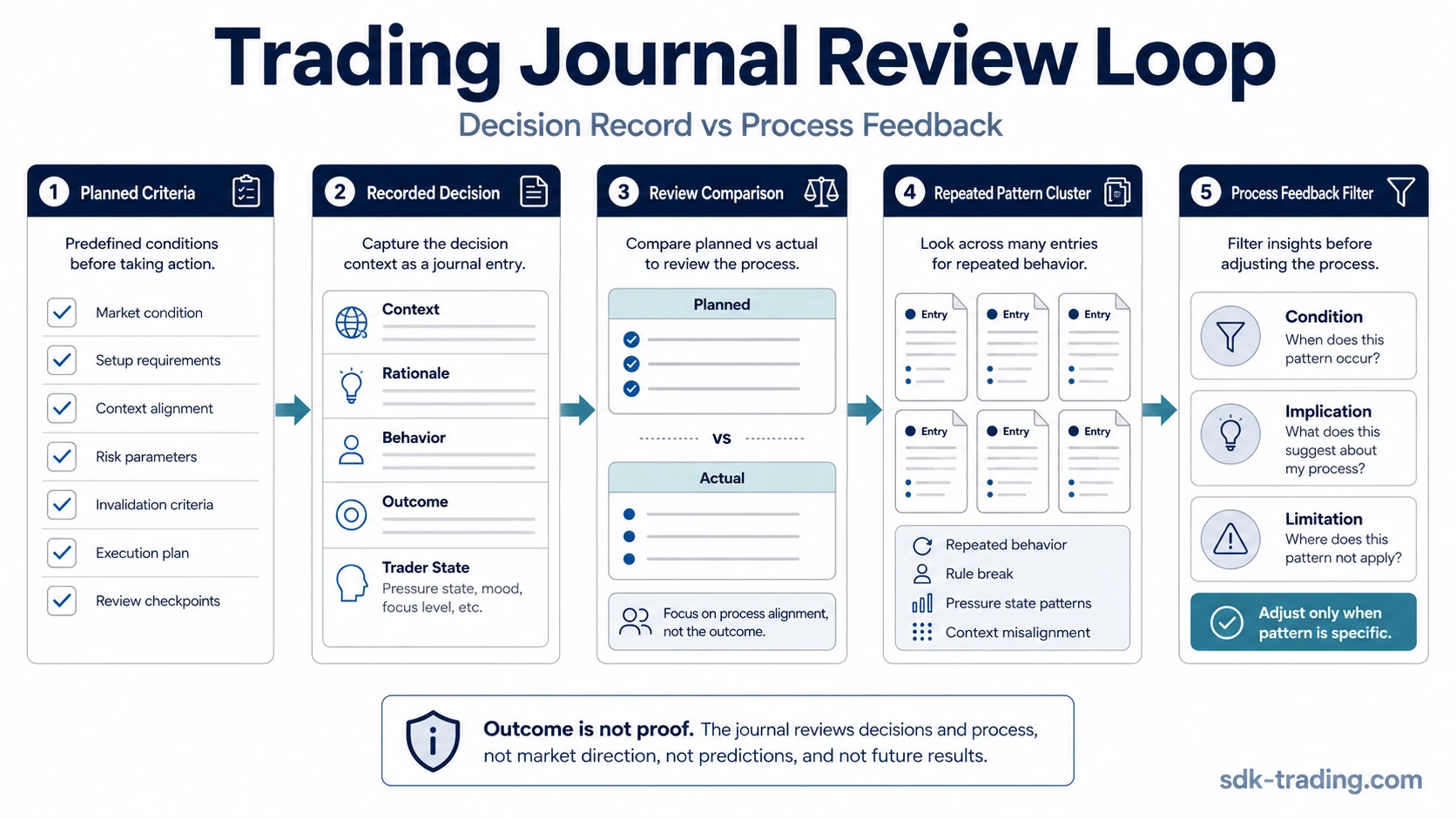
A trading journal sits between the plan and the adjustment. The plan defines the decision standard before execution. The journal records whether that standard was followed. Later comparison decides whether the evidence is specific enough to justify a process change.
This order matters because a trader can damage a workable method by reacting to one outcome too quickly. The opposite problem is also common: a trader can keep repeating the same rule break because the journal never turns scattered mistakes into a visible pattern.
Process sequence: Plan the criteria before the trade, record the decision after the trade, compare repeated behavior across entries, then adjust only when the pattern is specific enough to act on.
Used this way, a trading journal supports execution discipline without becoming a trading signal. It helps identify where behavior diverges from the process, where emotional pressure changes the standard, and where review should slow down before the next adjustment.
FAQ
What should be included in a trading journal?
A trading journal should include market context, planned criteria, decision rationale, execution behavior, outcome, follow-up notes, and trader state. The exact format can vary, but the entry should make later decision review possible.
How often should a trading journal be reviewed?
A journal can be checked after each trade for basic accuracy and reviewed periodically for repeated patterns. The useful cadence depends on trading frequency, but the review should be consistent enough to detect recurring behavior.
Is trading journal software required?
No. Software can help organize entries, screenshots, and tags, but a notebook or spreadsheet can also work if the trader records decisions consistently and reviews them honestly.