Crowd psychology in trading belongs to the broader study of market behavior. It focuses specifically on how visible group behavior, social proof, and shared emotional pressure can influence an individual trader’s judgment. Herd behavior, FOMO, panic, and euphoria can appear inside that environment, but they are not identical concepts.
Definition: Crowd psychology in trading is the effect that perceived group beliefs and behavior can have on individual decision standards. The practical issue begins when what other participants appear to believe starts receiving more weight than the trader’s own evidence, rules, or uncertainty assessment.
Crowd Psychology vs Related Concepts
| Concept | What it describes | Key distinction |
|---|---|---|
| Crowd psychology | The pressure environment created by visible group beliefs, emotion, participation, and social proof. | It describes how the presence or apparent agreement of others can influence judgment. |
| Herd behavior | Following or imitating the behavior of other participants. | It is one possible behavioral response to crowd pressure, not the whole concept. |
| Market sentiment | The prevailing positive, negative, or uncertain attitude expressed across market participants. | It describes the state of collective attitude rather than the mechanism through which that attitude changes one trader’s criteria. |
| Market psychology | The broader emotional and behavioral forces present across market participation. | Crowd psychology is a narrower part of that broader behavioral field. |
| Individual trading psychology | The trader’s own emotions, biases, discipline, and decision process. | Crowd pressure is one external influence that can affect this internal process. |
This separation prevents a common analytical error. A fast rally, sell-off, or crowded position does not prove that participants are blindly following one another. Similar behavior can also come from independent reactions to the same information, liquidity conditions, or constraints.
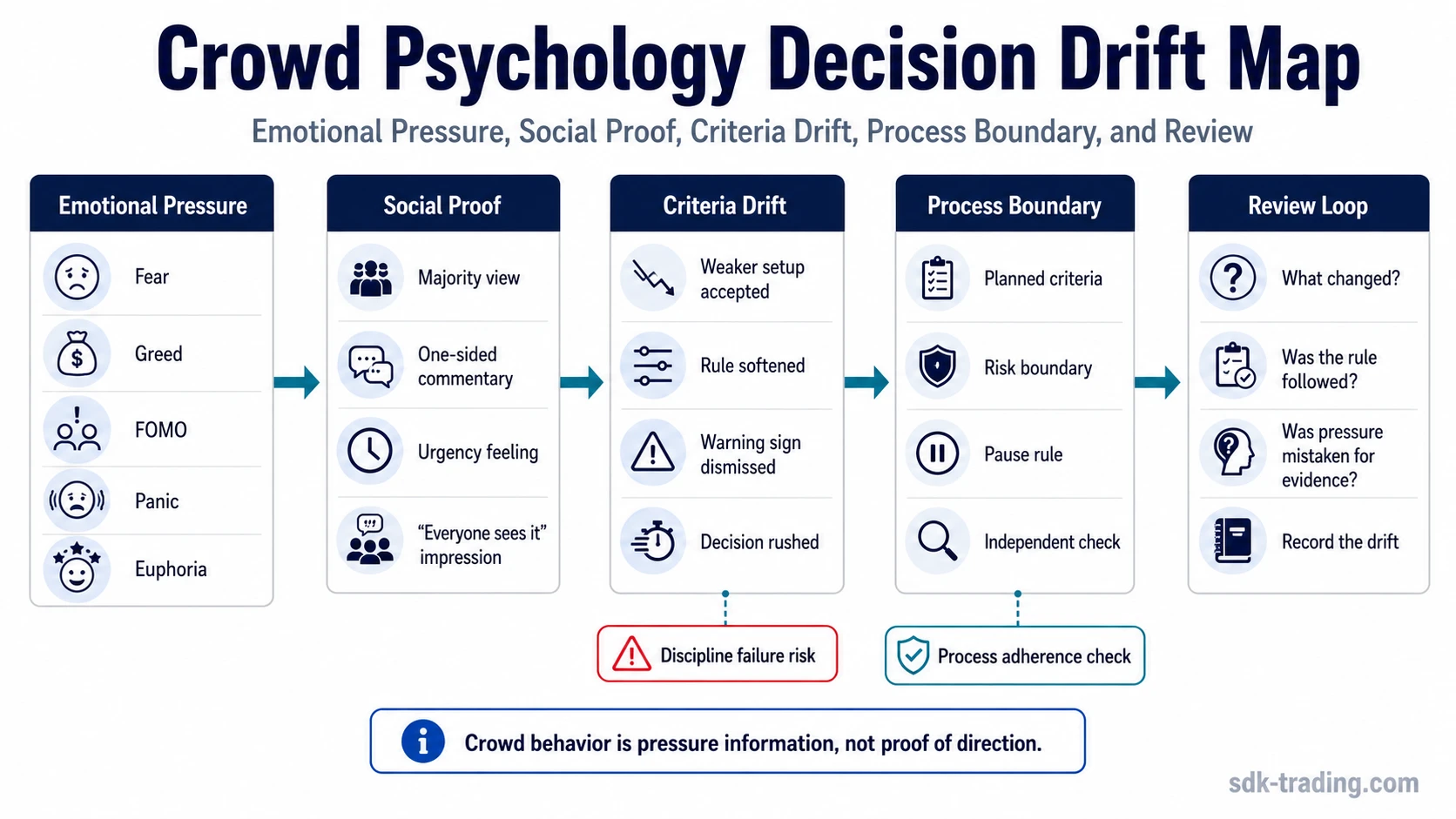
How Crowd Pressure Changes a Trading Decision
The mechanism does not require a trader to consciously decide to copy the crowd. Decision drift can happen in smaller steps.
| Stage | What changes | Decision effect |
|---|---|---|
| 1. Visible group behavior | Price movement, commentary, positioning, or social activity creates the impression of broad agreement. | The crowd becomes part of the information environment. |
| 2. Social proof | Agreement by others starts to feel like additional evidence. | The trader gains confidence without necessarily gaining new independent information. |
| 3. Borrowed confidence or urgency | Being outside the move becomes uncomfortable, or acting with the majority feels safer. | Waiting for normal criteria becomes psychologically harder. |
| 4. Criteria drift | A weaker setup, incomplete confirmation, or poorer price becomes acceptable. | The original decision standard changes. |
| 5. Process consequence | Rules, risk boundaries, patience, or review receive less weight. | The decision is increasingly driven by crowd pressure rather than the original process. |
Core boundary: observing what the crowd is doing is not the problem. The problem begins when perceived agreement changes the criteria required for the trader’s own decision.
Herd Behavior Is One Possible Outcome
Herd behavior occurs when the trader begins following observed majority behavior rather than relying fully on independent criteria. Crowd psychology is broader because the pressure can affect judgment even when the trader never directly copies another participant.
For example, the crowd may change how much evidence feels necessary, how much uncertainty feels tolerable, or how urgent participation appears. A trader can therefore experience crowd influence before clear imitation occurs.
| Observation | What can reasonably be inferred | What cannot be inferred yet |
|---|---|---|
| Many traders appear positioned in the same direction. | Participation may be concentrated. | That all participants copied one another. |
| Commentary becomes strongly one-sided. | Social reinforcement may be increasing. | That the prevailing view is necessarily wrong. |
| A trader weakens normal entry criteria because everyone appears involved. | Crowd pressure is affecting the decision standard. | That price must reverse because the behavior is crowded. |
Practical Scenario: From Social Proof to Criteria Drift
A stock accelerates after several strong sessions. Financial commentary becomes increasingly confident, social feeds focus on traders already benefiting from the move, and waiting begins to feel like a mistake.
The trader originally required a pullback into a defined area before considering participation. After watching the crowd, the trader becomes willing to accept a much weaker setup simply because the move appears widely accepted.
The crowd psychology issue is not whether the rally continues. It is that social proof changed the trader’s evidence threshold. The original market observation and the final decision are now being judged by different standards.
When a Crowd Reading Is Weak
Visible agreement should not automatically be interpreted as shared psychology. Participants can make similar decisions for different reasons.
| Condition | Why the crowd interpretation weakens |
|---|---|
| Common public information | Many independent participants can react similarly to the same earnings report, policy decision, or other new information. |
| Forced activity | Liquidations, hedging, rebalancing, or other constraints can produce clustered behavior without shared emotional conviction. |
| Dominant participants | Price movement can reflect a limited number of large actors rather than broad independent crowd behavior. |
| Intervention-heavy conditions | Policy or structural forces can dominate price formation and make a crowd-based explanation less useful. |
Interpretation limit: crowd psychology describes behavioral pressure and decision drift. It does not establish that the crowd is wrong, identify market direction, or provide a timing signal.
Crowd Psychology Across Market Phases
The expression of crowd pressure can change as the market environment changes. Early participation can be cautious, a mature advance can produce confidence and social reinforcement, and a sharp decline can replace borrowed confidence with urgency to exit.
Market cycle psychology focuses on those changing emotional conditions across market phases. Crowd psychology focuses more narrowly on how perceived group behavior influences the decision standard at any one of those stages.
A Simple Independence Check
A useful diagnostic question is: would the decision still meet the same criteria if the crowd reaction were hidden?
If the answer is yes, crowd behavior may be additional context without controlling the decision. If the answer is no, social proof or emotional urgency may already be changing the process.